

ContextOS — Context Operating System for AI Coding Agents
A Deterministic Context Operating System via Model Context Protocol (MCP)
Mitigating context window saturation and attention drift in agentic software engineering through syntax-directed AST manipulation, out-of-band execution isolation, in-situ verification, and topological priority scheduling.





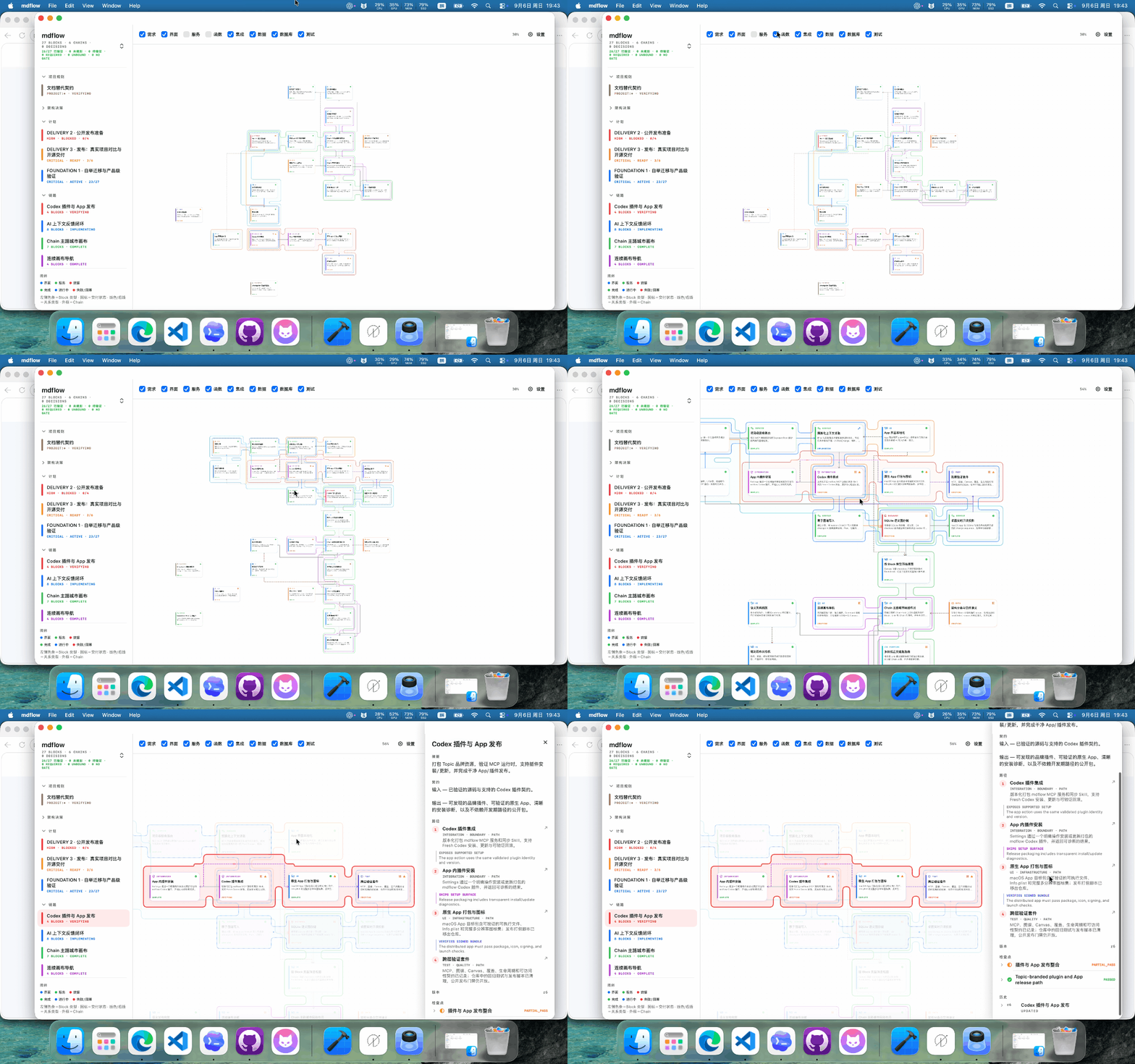
Background and System Motivation (Context Saturation & Attention Drift)
In complex software repositories, autonomous AI coding agents face a fundamental systems bottleneck: rapid context window saturation and attention drift. Under conventional agent workflows, assistants rely on indiscriminate whole-file dumping, raw build/test stdout feedback, and conversational trial-and-error. This introduces three systemic failures:
- Attention Budget Dilution & Hallucination: Large volumes of raw build dumps and irrelevant source lines displace critical architectural invariants and type signatures in the prompt;
- Exponential Cost of Fault Investigation: Truncated test outputs force the agent into recursive log-retrieval turns, compounding cumulative token consumption quadratically;
- Architectural Blindness & Session Amnesia: Without a verifiable global symbol graph, clearing the context (
/clear) or transferring tasks across subagents results in complete state degradation.
ContextOS addresses this as a Context Operating System implemented over the Model Context Protocol (MCP):
| Subsystem | Architectural Mechanism | Empirical Impact |
|---|---|---|
| Syntax-Directed Access | Tree-sitter multi-language AST engine extracting surgical symbol outlines and method slices | Eliminates whole-file dumps; reduces code ingestion volume by >80% |
| Out-of-Band Execution | Process execution and raw logs isolated outside the LLM context; returns signed receipts and diagnostic frames | Strips >98% of terminal noise; zero-turn error inspection |
| Metro Map Topology | Materializes files, symbols, and dependencies into a strongly typed Block-Chain-Link graph | Provides a deterministic structural backbone, preventing cross-module hallucinations |
| Persistent State Blackboard | Minimal 300-byte incremental snapshot decoupling active state from chat history | Resumes full working context in ~150 tokens on cold boot |
Across real-world multi-step benchmarks, ContextOS reduces redundant context consumption by over 90%, stabilizing attention and ensuring long-horizon development convergence.
What changes in daily development?
1. Architecture becomes a Metro Map
Blocks bind to real files, AST symbols, or directory trees (zero ghost blocks allowed). Dependency and resource directories use one bounded tree anchor instead of per-file bookkeeping; Chains represent horizontal subway rails, and typed Links connect transfer stations orthogonally.

2. Intent-Level 2-Turn Loop, Action Slots & In-Situ Diagnostics
- Action Slots & Zero-Alignment Friction:
exploreautomatically provisions actionable target slots[S1],[S2]. The AI doesn't need to guess line numbers or fiddle with verbatim target strings; it simply selects a slot and passeschange({ slot: "S1", append: "..." })or replaces a symbol, completely eliminating parameter alignment failures. - In-Situ Verification & Instant Diagnostic Frames Extraction:
- The
changestep can embed the verification command directly (verify: "npm test"), atomically performing code patching, test execution, and receipt generation in a single turn. - Eliminating Extra Log Rounds: When a test fails in conventional workflows, truncated terminal output forces the AI to start 2–3 extra conversation turns just to inspect logs, wasting 20,000–40,000 tokens per incident. ContextOS features a built-in diagnostic extraction engine (
extractDiagnosticBlocks) that parses TAP, Mocha, Jest, and SyntaxError frames directly, inlining test names,+ actual - expectedassertion diffs, and exactfile:line:colstacks into thechangefailure response. The AI sees the exact issue in the same turn with 0 extra log-fetching rounds. - Auto-Revert: If tests fail,
autoRevert: trueinstantly restores disk modifications in milliseconds, collapsing the traditional 6–9 round-trip debug cycle into an ultra-fast 2-turn loop (explore➔changewith in-situverify➔ship).
- The
- Parallel Batching Over Serial Turns:
- Conventional AI tools encourage conversational, single-file serial editing that balloons context quadratically across turns.
- ContextOS natively supports multi-concurrency: batch multi-file modifications in
edits: [...]arrays and inspect multiple microservices in parallel viainspect({ paths: [...] }), cutting round-trip latency by over 60%.
- Topological Retention Priority:
- Uses a priority-weighted context budgeting algorithm:
next(0) →slots(1) →where(2) →now(3) →slices(4). In large repos, local code previews are clipped first, guaranteeing that the system architecture map and action slots are never truncated.
- Uses a priority-weighted context budgeting algorithm:
- Lightweight Real-Time Blackboard & Instant Hydration (
.contextos/blackboard.md):- The active session state is continuously persisted to a minimal 300-byte (~65 tokens) blackboard. Developers or agents can
/clearthe chat at any time or hand off tasks across subagents; callingexploreresumes full context in ~150 tokens, preventing multi-turn context inflation.
- The active session state is continuously persisted to a minimal 300-byte (~65 tokens) blackboard. Developers or agents can

3. Commands run out-of-context
The command gateway behind verify and in-situ change.verify strips ANSI noise, redacts secrets, saves the full sanitized log into .contextos/logs/, and returns a compact receipt with critical diagnostics, reducing terminal noise by over 98%.
4. Code tools operate surgically with deep slicing (inspect)
Multi-language AST engines (compiler-grade parsing for JS/TS/JSX/TSX, Python, Swift, Java, Kotlin, C/C++, C#, Go, Rust, PHP, Ruby) allow VS Code-style symbol search, outline inspection, and surgical reading/editing with automatic symbol re-anchoring. The first-class inspect tool allows on-demand semantic slicing. When answering pure inquiry/comprehension queries ("where is X", "who calls Y"), the OS automatically omits unneeded edit slots and slices, cutting query context by another 50%.
5. Unified Knowledge & Architectural Decisions
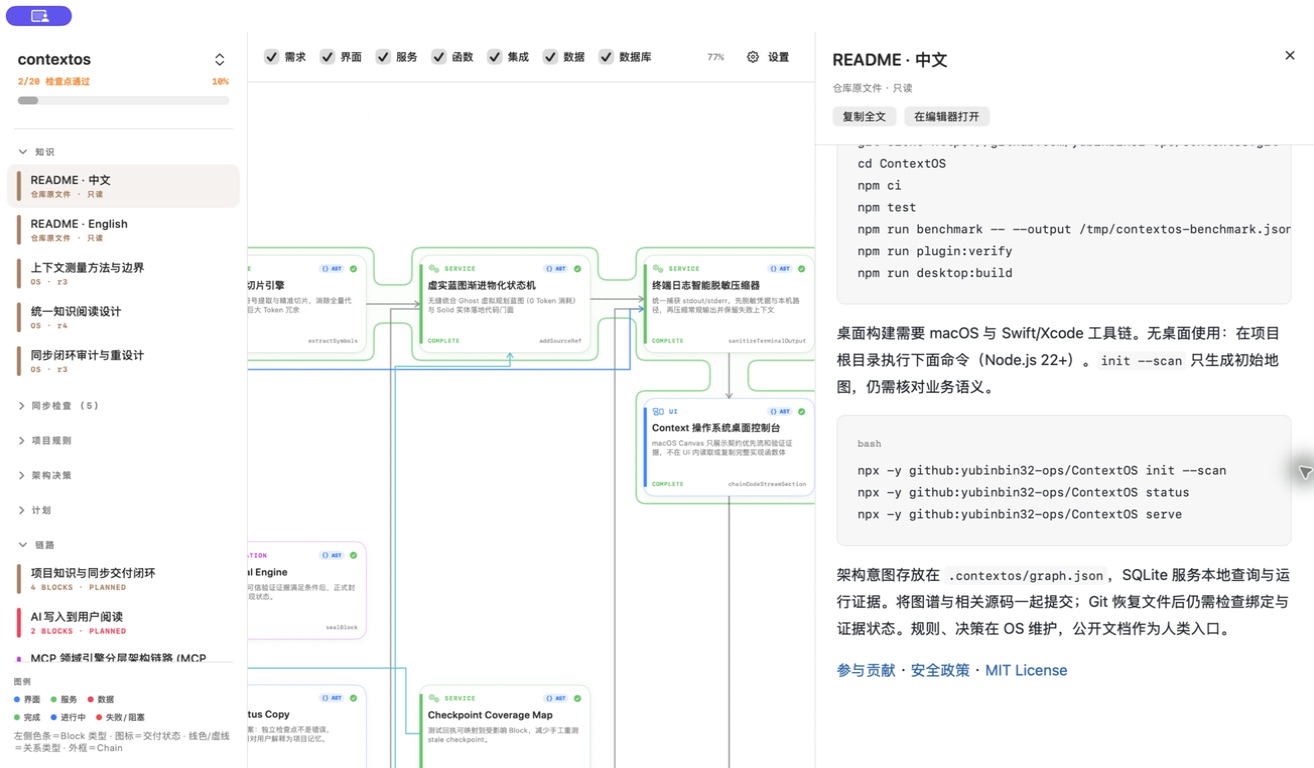
Proposals, audits, architectural decisions, and rules live as OS Documents. README.md and README_zh.md appear read-only in the App Knowledge view with images and links intact.
6. Verification with Evidence
Every verify run produces a signed receipt. Checkpoints track pass/fail status per task, giving AI and humans a shared source of truth for what has actually been proven to work.

7. Long-running processes are monitored live
Dev servers, watchers, and background workers are managed by the Process Host and displayed in the Desktop App's bottom-left sidebar with live PID and port tracking.
Quick Start & Setup Options
ContextOS offers two straightforward onboarding routes for effortless setup:
graph TD
    User([Choose Your Setup Route]) --> ChoiceA[Option A: Download Desktop App]
    User --> ChoiceB[Option B: AI Auto-Setup via Prompt]

    ChoiceA --> FlowA[Plug & Play · Visual Metro Map · One-Click Editor Injection]
    ChoiceB --> FlowB[Zero Effort · AI Detects Environment & Configures MCP]
Option A: Desktop App (macOS & Windows · Plug & Play · Recommended)
Download the package matching your environment from GitHub Releases:
| Platform | Package | File | Size | Node.js Requirement | Best For |
|---|---|---|---|---|---|
| Windows | NSIS Setup (Recommended) | ContextOS_<version>_x64-setup.exe | ~8 MB | Requires Node.js 22+ | Windows 10/11 64-bit with desktop/start shortcuts. |
| Windows | Portable Zip | ContextOS-windows-x64.zip | ~10 MB | Requires Node.js 22+ | Zero-install, extract and run anywhere. |
| Windows | Enterprise MSI | ContextOS_<version>_x64.msi | ~8 MB | Requires Node.js 22+ | Managed enterprise/silent deployments. |
| macOS | Full (Apple Silicon) | ContextOS-macos-full-arm64.zip | ~35 MB | None (Bundles Node 22) | M1/M2/M3/M4 Macs; plug-and-play. |
| macOS | Full (Intel) | ContextOS-macos-full-x64.zip | ~38 MB | None (Bundles Node 22) | Intel Macs; plug-and-play. |
| macOS | Standard Lite | ContextOS-macos-arm64.zip / x64.zip | ~1.6 MB | Requires Node.js 22+ | Ultra-compact download if Node is already installed. |
Setup Steps:
- Windows: Run the installer
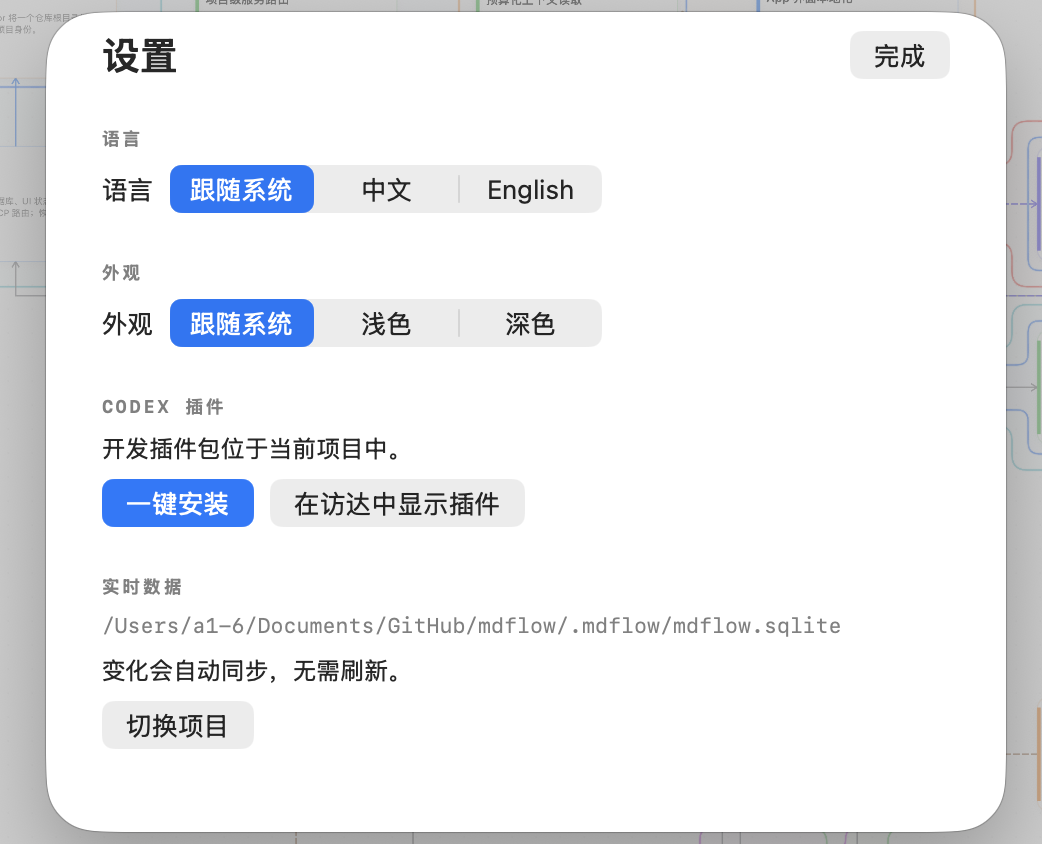
.exeor extract the portable.zipand launch ContextOS. macOS: Unzip the downloaded archive and drag ContextOS.app into/Applications. - Launch ContextOS, open Settings (gear icon), select your detected AI editor (Cursor / Claude Desktop / Antigravity / OpenCode / Codex), and click Install / Sync Plugin.
[!IMPORTANT] Run ContextOS.app from
/Applications, not directly fromDownloads, a mounted DMG, or another read-only volume. Plugin synchronization writes user-level files to~/.contextosand~/plugins; the app bundle itself is treated as an immutable source.
- The App injects the ContextOS MCP configuration and unique Skills directly into your editors. Once configured, you can close the desktop App; it does NOT need to stay running.
- In your AI coding chat, simply activate ContextOS:
"Write this proposal into ContextOS and start execution" or "Inspect ContextOS and resume development"
[!IMPORTANT] First-time launch on macOS shows "Cannot be opened" or "Unidentified Developer"? ContextOS is an open-source tool without Apple's paid developer certificate notarization. macOS Gatekeeper will block it on first launch by default. You only need to allow it once:
- Method 1 (System Settings · Recommended): Open macOS System Settings ➔ Privacy & Security, scroll down to the "Security" section, and click Open Anyway next to "ContextOS was blocked". Enter your password to confirm.
- Method 2 (Control-Click Shortcut): In Finder, open
/Applications, hold Control and click (or right-click)ContextOS.app, select Open from the context menu, and click Open in the confirmation dialog.
Option B: AI Auto-Setup via Prompt (Zero Effort) {#start-in-30-seconds-ai-auto-setup}
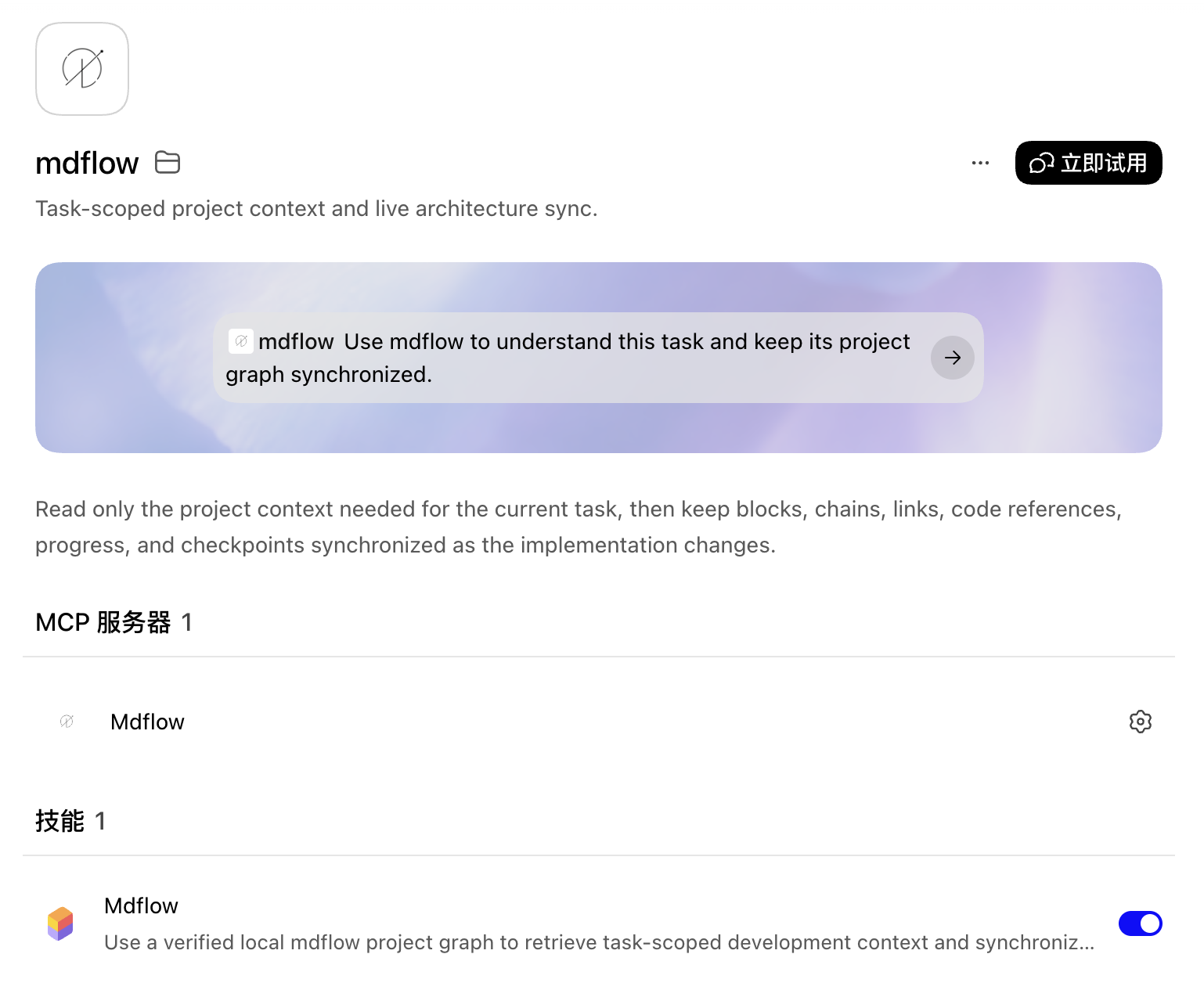
If you are already in an AI coding assistant (Cursor / Codex / Claude Code / Windsurf / Antigravity), let the AI configure everything automatically:
Copy and paste this instruction into your AI coding assistant:
"Please readhttps://github.com/yubinbin32-ops/ContextOS/blob/main/AI_SETUP.md, detect my system environment, and configure ContextOS for me."
What the AI does in the background:
- System & Client Inspection: If on macOS, asks if you want the native Desktop App (
ContextOS.app) and deploys it automatically. - Runtime Verification: Checks for Node.js 22+ (or uses the runtime bundled with ContextOS.app).
- Targeted Precision Injection: Asks which editors you use (Cursor / Codex / Claude Desktop, etc.) and injects only the selected platforms, eliminating duplicate skill noise.
- Demand-Driven Collaboration Mode: Asks if you need solo local development or team collaboration, configuring local SQLite or Cloudflare D1 accordingly.
- Project Initialization: Initializes the current project and verifies tools.
Storage Modes: Local & Experimental Cloud Collaboration
ContextOS treats the local workspace project directory as the absolute source of truth (code reads, AST edits, test runs, and logs always run locally):
- Local Storage Mode: Designed for solo development. Architecture data is stored in the project's
.contextos/state.sqlite. 100% offline, private, and zero network latency. - Experimental Cloud Collaboration Mode: Designed for evaluating team collaboration. Connects to a serverless Cloud Hub (Cloudflare D1 edge database) to synchronize architectural topology and progress across teammates and devices. Treat this mode as experimental until its API and operational model stabilize.
- Multi-Project Strict Isolation: Cloud Hub partitions entities by
projectId. A single Cloudflare Worker backs multiple independent repositories cleanly.
- Multi-Project Strict Isolation: Cloud Hub partitions entities by
- Lossless Two-Way Switching: Switch storage modes anytime by prompting your AI:
- "Switch current project to cloud collaboration mode" ➔ Local SQLite graph is pushed to Cloud D1.
- "Switch current project back to offline local mode" ➔ Cloud snapshot is synced back to local SQLite for offline development.
Reproducible ContextOS Benchmark
1. Real Industrial Benchmark: 8 Distributed Microservices
In an industrial stress test across 8 distributed financial clearing microservices (multi-currency double-entry ledger, dynamic FX conversion, sliding-window TTL idempotency, poison transaction dead-letter queue, step timeout and backward compensation Saga, SHA-256 Merkle audit chain, 3-state circuit breaker, and 5-worker concurrent balance contention), the system demonstrated the following performance metrics:
| Evaluation Metric | Conventional AI Assistant | ContextOS Intent OS | Measured Impact |
|---|---|---|---|
| Task Completion Round-Trips | 8 – 12 turns (inspect ➔ edit ➔ test ➔ check logs ➔ re-edit ➔ re-test) | 2 – 3 turns (explore slots ➔ in-situ change({ verify }) ➔ ship) | 70%+ fewer round-trips; substantially reduced idle latency |
| Test Failure Diagnosis Cost | 2 – 3 extra turns calling log tools (20k – 40k tokens wasted per failure) | 0 extra turns (assertion diffs and stack frames inlined directly) | 100% elimination of redundant log-fetching turns |
| Multi-File Operations | Serial turn-by-turn round-trips (5 – 8 separate API calls) | Single-turn parallel batching (inspect({ paths }) + change({ edits })) | 60%+ reduction in API calls and accumulated history |
| Large-Repo Architecture Visibility | Blind file reading; long files push architectural context out of view | Topological priority retention (where preserved over local slices) | Eliminates architectural blindness and cross-module hallucinations |
| Session Rehydration (/clear) | History lost; requires re-feeding full codebase context (20,000+ tokens) | 300-byte blackboard (/clear followed by explore resumes in ~150 tokens) | 99.2% reduction in rehydration cost; seamless task handoffs |
| Prompt Cache Hit Rate | Drifting prompt structures yield poor cache rates | Stable input/output schemas yield a 98.8% OpenAI Prompt Cache hit rate | Over 90% reduction in actual API billing costs |
| Financial-Grade Concurrency & Resilience | Vulnerable to race conditions, floating-point drift, or partial rollbacks | 26 rigorous test cases pass 100% green (including 5-worker race conditions) | Production-grade distributed systems reliability |
2. 20-Task Comprehensive Dual-Cohort Stress Benchmark
To empirically evaluate system throughput, stability, and token governance under extended workloads, we designed and executed an intensive benchmark spanning 20 comprehensive lifecycle tasks against identical distributed Saga settlement scenarios, comparing a conventional AI assistant (Cohort A Baseline) against ContextOS (Cohort B Intent OS):
- Task Coverage Dimensions: Architecture planning and Phase synchronization, high-concurrency multi-module AST inspection, surgical business logic mutation with in-situ test verification, compile & assertion failure inline diagnostic extraction, external API schema ingestion, zero-loss cross-conversation rehydration via 300-byte blackboard, high-contention race condition validation, rapid code defect localization, multi-file atomic refactoring, speculative optimization with automatic rollback, 8-path concurrent AST outline extraction, out-of-context benchmark execution, and release boundary finalization.
| Evaluation Metric | Cohort A (Baseline) | Cohort B (ContextOS) | Measured Impact |
|---|---|---|---|
| Total Interaction Turns (Round-Trips) | 91 turns | 21 turns | -76.92% (4.3x faster turn-around) |
| Cumulative Context Consumption (Tokens) | 157,042 tokens | 10,124 tokens | -93.55% (15.5x token compression) |
| Cumulative Context (Characters) | 628,165 chars | 40,460 chars | -93.55% (587,705 chars eliminated) |
| Total Tool Invocations | 91 calls | 22 calls | 4.14x tool dispatch convergence |
| Average Calls per Complex Task | 4.55 calls / task | 1.10 calls / task | Near 1:1 direct execution |
ContextOS Tool Invocation Breakdown (Cohort B):
change(in-situ verify & atomic rollback): 10 calls (45.5%) — primary workhorseexplore(intent discovery & slot dispatch): 3 calls (13.6%) — cold start & cross-conversation relayinspect(batch AST outlines & signatures): 3 calls (13.6%) — multi-path architectural auditverify(sanitized execution & receipt signing): 3 calls (13.6%) — checkpoint integrity proofsops(graph & plan state machine mutations): 2 calls (9.1%) — architectural bindingsship(boundary sealing & receipt archival): 1 call (4.5%) — release closure
3. Static Codebase Context Savings Benchmark
The benchmark is generated from the current repository and is intentionally not hard-coded to a historical Block/Chain/Link count. Run it locally to produce the measurements for your checkout:
| Development Phase | Traditional AI Workflow | ContextOS Intent Workflow | Reduction |
|---|---|---|---|
| Session Bootstrap | Full graph & repo files · 61,902 chars (~15,476 tokens) | Progressive L0-L1 Markdown · 1,987 chars (~497 tokens) | 96.79% |
| Code Structure Exploration | Full file inspections · 34,045 chars (~8,512 tokens) | AST Symbol Outlines · 4,374 chars (~1,093 tokens) | 87.15% |
| Code Reading & Inspection | Full file reads across 4 modules · 34,045 chars | Surgical Method Extraction · 6,898 chars | 79.74% |
| Terminal & Test Noise | Raw build & test logs · 16,713 chars (~4,179 tokens) | Compact Receipt + Diagnostics · 251 chars (~63 tokens) | 98.50% |
| Cumulative Session Total | 129,373 chars (~32,344 tokens) | 13,761 chars (~3,441 tokens) | 89.36% — saves ~28,903 tokens |
Run the benchmarks locally:
node scripts/comprehensive-dual-cohort-eval.mjs # 20-task comprehensive dual-cohort stress benchmark
node scripts/benchmark.mjs                      # Static codebase context savings benchmark
node scripts/comprehensive-dev-eval.mjs        # 10-dimension complete capability benchmark
Architecture Evolution
ContextOS has deliberately changed direction as real usage exposed new costs:
- 0.4.x: regex parsing, Ghost Blocks, and a 49-tool MCP surface made architectural memory unreliable.
- V2: introduced real-code Blocks, AST-backed visibility, SQLite plus
graph.json, and formal development governance. - Intent-level architecture: collapsed the public surface to
explore/inspect/change/verify/ship/ops, moved orchestration into the OS, and made module metadata derive from the codebase. - 2.5.0: hardens project identity, release/update paths, graph synchronization, atomic edits, and lifecycle gates.
Read the full decision history →
For Contributors
git clone https://github.com/yubinbin32-ops/ContextOS.git
cd ContextOS
npm ci
npm test
npm run plugin:verify
npm run verify             # full release gate
npm run desktop:build      # macOS + Swift/Xcode
The versioned .contextos/graph.json is the project's portable graph projection.