Listed from the MCP registry; nobody on Odel publishes it.
Refract
git log for Wikipedia: typed events for changed sentences, citations, and structure on any page.
Runs on your machine from its package; the steps are below.
What it does
- Reads
- Writes
- High impact
Not assessed yet.
What it costs
FreeOdel charges nothing per call. The publisher may charge for its own service.
Runs locally over stdio
This server isn't hosted — your MCP client launches it from a package registry. Use one of the commands below, or drop the config into your client (e.g. Claude Desktop).
Run
npx -y @refract-org/cli
MCP client config
{
  "mcpServers": {
    "refract": {
      "command": "npx",
      "args": [
        "-y",
        "@refract-org/cli"
      ]
    }
  }
}
Refract
git log for Wikipedia.
See how a page's sentences, citations, and structure changed, revision by revision, as data you can check. Runs locally, with no API key or model.
Documentation · CLI reference · Compared to XTools and WikiBlame



Watch Pluto stop being a planet
On 24 August 2006, the International Astronomical Union reclassified Pluto as a dwarf planet. Wikipedia's Pluto article went through 43 revisions in under an hour that afternoon. Here is what Refract reports for its first sentence:
| UTC | First sentence | Source |
|---|---|---|
| 13:39 | Pluto is the ninth and smallest of the traditional planets of the Solar system, though its status as a planet has been disputed… | revision |
| 13:40 | Pluto is the ninth and smallest of the traditional planets of the Solar system, but on August 24, 2006 it was 'demoted'… | diff |
| 13:41 | Pluto was until recently considered the ninth… | diff |
| 13:59 | Pluto is considered the ninth and smallest of the traditional planets of the Solar system, except by the IAU… | diff |
| 14:09 | Pluto is widely considered the ninth… | diff |
| 14:10 | Pluto was considered the ninth… | diff |
| 14:20 | Pluto at one time was considered the ninth… | diff |
| 14:37 | Pluto was considered the ninth and smallest of the planets of the Solar system… | diff |
Rows are excerpts and skip the edits between them. Captured events · Walkthrough. Article text by Wikipedia contributors, CC BY-SA.
Follow that sentence yourself (Node.js 20+ and network access). This prints it from each of the 43 revisions:
npx @refract-org/cli claim Pluto --text "ninth and smallest" --from 71593043 --to 71601937
Browse every change from that hour as a timeline. Fetching takes about a minute, then your browser opens:
npx @refract-org/cli explore Pluto --from 71593043 --to 71601937
Refract reports what changed. Why it changed, and whether that matters, is for you to judge.
Who it's for
- Researchers and journalists who need to show when a statement appeared, changed, or lost its citation.
- Developers feeding wiki content to RAG pipelines or agents who need change events alongside the current text.
- Anyone who relies on a set of wiki pages and wants to see what changed since they last checked.
Refract reads Wikipedia and any other MediaWiki wiki. It does not fetch arbitrary web pages; the libraries accept versioned text you supply. Events carry no editor identity, and the misuse policy rules out editor targeting.
Questions it answers
| Your question | Command | What you receive | Start here |
|---|---|---|---|
| “What changed in my pages since my last review?” | refract review | Pending changes with full text, source links, coverage, and explicit acknowledgment | Review a watchlist |
| “When did this text appear, change, or disappear?” | refract claim | Candidate text, match kind, latest revision, and status within the fetched revisions | Inspect changes to a passage |
| “What did the page say at an earlier date?” | refract snapshot | A text preview and revision ID at or before the requested date | Inspect an earlier record |
| “My application needs changes as data.” | refract export | NDJSON events to filter, store, or pass to your review process | Build a review feed |
Install
npm install -g @refract-org/cli
refract analyze "Bitcoin" --depth detailed --json
This reads the page's latest 20 revisions. Use a page title, not a URL. For another wiki, pass its api.php endpoint with --api.
Choose a history range and output mode · Install compatibility
Try it offline
init runs the analyzers on a bundled fictional library history and makes no wiki requests:
npx @refract-org/cli init
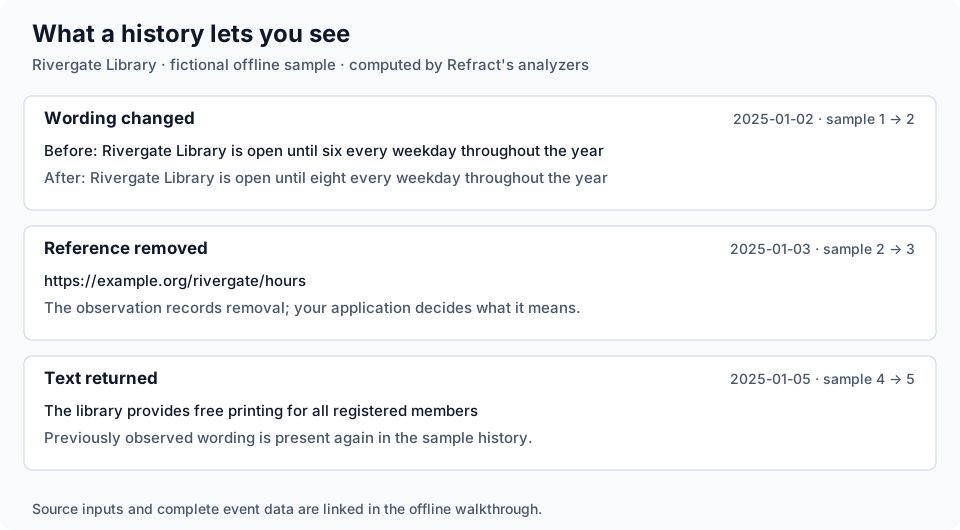
review keeps changes pending until you acknowledge an inspected report, then compares later runs against that point:
npx @refract-org/cli review --sample --from 1 --state-dir ./review-state
Complete review workflow · Captured review · Offline recipe
What Refract captures
| Part of the record | Examples |
|---|---|
| Sentences | First observed, modified, removed, reintroduced |
| Citations | Added, removed, replaced |
| Document structure | Section changes, lead/body changes, page moves |
| Links, categories, templates | Added, removed, template parameters changed |
| Revision activity | Revert patterns and edit clusters |
| Talk pages and access controls | Nearby talk-page activity and protection changes |
Events can carry deterministic enrichment fields such as change magnitude, extracted terms, and certainty-marker counts. Event reference
How it works
Refract compares revisions under deterministic rules and makes no model calls. The same captured inputs, analyzer versions, and configuration produce the same events; export timestamps can differ. Coverage is limited to the analyzed revisions and the matching rules.
A citation does not establish that a statement is supported, and changed wording does not establish that editors disputed it. Your application decides what the events mean.
Architecture · Claim-state timelines · Repository boundary · Share or check a result
Use it in your application
| Interface | Use it when | Example |
|---|---|---|
| CLI | You want to inspect or export a page's history | refract export "Bitcoin" --from 369361755 --to 369393212 --format ndjson |
| Libraries | You already fetch revisions or own versioned text inputs | buildRevisionEvents(revisions, { depth: "detailed" }) |
| MCP | An agent needs to request histories and receive structured observations | refract mcp |
| Python | You work in Python and want events as dataclasses, DataFrames, or LangChain documents | pip install "git+https://github.com/refract-org/refract.git#subdirectory=clients/python" |
| Agent skill | Your coding agent should know which command answers which question | cp -R skills/refract ~/.claude/skills/ |
| Viewer | You want to browse an exported file in a browser | apps/ui |
Library adapter and data integrations · MCP setup · Agent skill · Private wiki access
Development and testing
git clone https://github.com/refract-org/refract.git
cd refract
bun install
bun run build
bun run test
bun run lint
The apps are workspaces with their own checks, run from their directories: bun run lint, bun run test and bun run build in apps/docs or apps/ui. The Python adapter uses Hatch and pytest in clients/python. CI runs them in docs-site.yml, viewer.yml and python.yml, separately from the engine gate.
| Package | Role |
|---|---|
@refract-org/evidence-graph | Types, schemas, identity and verification primitives |
@refract-org/ingestion | MediaWiki access, pagination, retries, and authentication |
@refract-org/analyzers | Deterministic revision comparisons and enrichment |
@refract-org/cli | Commands and the local browser explorer |
@refract-org/mcp | MCP library; the executable is refract mcp from the CLI |
@refract-org/persistence | Local SQLite persistence; not published |
@refract-org/eval | Evaluation harness and independently sourced labels |
Runnable examples · Benchmark corpus · Repository map and related projects
License
AGPL-3.0. See LICENSE.
If you modify this software and deploy it as a network service, you must release your modifications.
Commercial use: NextConsensus offers commercial licenses for proprietary integration without AGPL obligations. See nextconsensus.com.
Community
- Contributing — how to get started
- Roadmap — what is being worked on
- Discussions — questions, ideas
- Code of Conduct
- Security
- Changelog
- Cite this software