Listed from the MCP registry; nobody on Odel publishes it.

Clickcast
Drive a real Playwright browser: annotated screenshot + structured page state after every action.
Runs on your machine from its package; the steps are below.
What it does
- Reads
- Writes
- High impact
At most: moves money, runs code or commands, deletes data, or sends messages for you.
What it costs
FreeOdel charges nothing per call. The publisher may charge for its own service.
Runs locally over stdio
This server isn't hosted — your MCP client launches it from a package registry. Use one of the commands below, or drop the config into your client (e.g. Claude Desktop).
Run
uvx clickcast
MCP client config
{
  "mcpServers": {
    "clickcast": {
      "command": "uvx",
      "args": [
        "clickcast"
      ]
    }
  }
}Run
npx -y clickcast-mcp
MCP client config
{
  "mcpServers": {
    "clickcast": {
      "command": "npx",
      "args": [
        "-y",
        "clickcast-mcp"
      ]
    }
  }
}🎞️ clickcast — Playwright browser automation, screenshots, and GIF/MP4/WebP recording for AI agents
Give AI agents visual + structured feedback about live web UIs — and give humans deterministic demo reels while you're at it.




What's new (v0.5.0) —
clickcast exploremaps an app's shape (pages, link targets, clickable elements) without paying for a reel, and the MCP registry now advertises the npm install path (npx -y clickcast-mcp) alongside PyPI — on top of the v0.4.4npxwrappers (clickcast+clickcast-mcp) and the v0.3.0 highlights: live agent control via an MCP server, pixel-levelclickcast diff, accessibility semantics fused with the pixel-grid overlay, an official CI GitHub Action, Homebrew/apt packaging, and a self-healing first run. SeeCHANGELOG.mdfor the full notes.
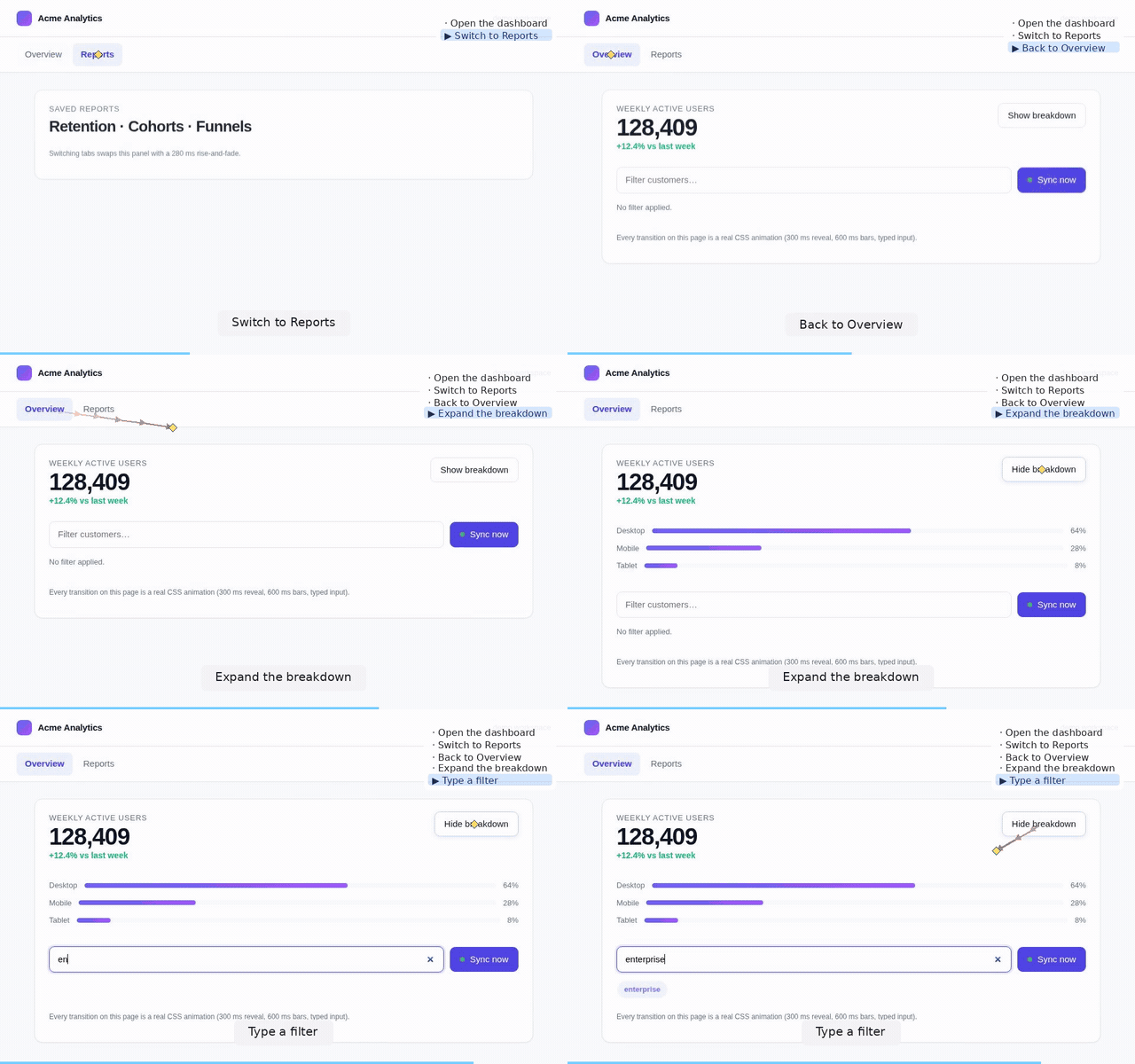
▶ Watch the full 30 fps MP4 (8.7 s, 275 KB) — recorded with
--capture screencast --smooth: continuous page motion plus reel grammar (speed-capped cursor glides, click ripples, per-step captions, a timeline). 55.8% unique frames vs 22.9% for the same scenario on the stills backend. Reproduce it fromdemo/screencast-reel/— its own page, no network. How it works:docs/smooth-video.md.An auto-discovered tour of react.dev is in
docs/demo.gif.
See
docs/ONE_PAGE_NAVIGATION_ORDER_TIPS.mdfor the nine principles behind why this reel reads as legibly as it does — and the scenario template you can copy for your own reels.
clickcast drives a real browser through a website and hands back two things:
- A watchable reel — GIF / MP4 / WebP / raw frames.
- A machine-readable JSON sidecar — every step's selector, timings, per-step frame paths, discovered elements, and post-action page state (title, URL, console errors, failed requests). Versioned. See
docs/feedback-schema.md.
Point it at a URL and it will auto-discover the interactive elements and build a tour for you, or hand it a small YAML scenario for a scripted, repeatable walkthrough.
Install
One line, ready to run immediately after:
pip install clickcast && clickcast install --with-deps chromium && clickcast doctor
Broken down — pip install clickcast (requires Python ≥ 3.10) gets you the
CLI; clickcast install downloads Chromium (~one-time, ~180MB — kept out of
the pip package itself since it's versioned independently and every project
doesn't need every engine); --with-deps also pulls the system libraries
Chromium needs (Linux only, may prompt for sudo); clickcast doctor
confirms everything above actually worked.
Forgot the second step? Any command that needs a browser (auto, run,
shot, elements, mcp) detects a missing engine itself and offers to
install it right then instead of failing — say yes once and it retries
automatically. That prompt only fires in an interactive terminal; CI/scripted
runs fail fast with the exact fix command instead of hanging on stdin.
Homebrew (macOS/Linux)
brew install --build-from-source ./Formula/clickcast.rb   # works today, clone this repo first
brew install AlexKay28/clickcast/clickcast                # tap not bootstrapped yet -- see docs/packaging/homebrew.md
apt (Debian/Ubuntu, .deb)
bash scripts/build_deb.sh 0.2.9 && sudo dpkg -i dist-deb/clickcast_0.2.9_amd64.deb   # works today, clone this repo first
sudo apt install clickcast                                                           # hosted repo not bootstrapped yet -- see docs/packaging/apt.md
Both native packages skip the Chromium download (~180MB, versioned
independently of clickcast) and never install a second ffmpeg (clickcast
already bundles one via imageio[ffmpeg]) -- run clickcast install --with-deps chromium once after either install path. Full design rationale,
what's live today vs. what needs one-time bootstrapping, and the exact
bootstrap steps: docs/packaging/homebrew.md,
docs/packaging/apt.md.
npm (clickcast + clickcast-mcp)
Two npm packages -- thin Node wrappers whose postinstall provisions an
isolated Python venv and pip-installs the pinned PyPI clickcast, since
there's no way to ship clickcast's Playwright/Pillow/ffmpeg runtime as pure
JS. Built specifically because the MCP ecosystem's install pattern is
npx <package>, not pip install:
npx -y clickcast-mcp                 # MCP entry point -- execs `clickcast mcp`
npx clickcast --version              # general CLI wrapper
Both are published on the npm registry. To run against your working copy instead of the published version:
cd npm/clickcast-mcp && npm pack && npm install -g ./clickcast-mcp-*.tgz && clickcast-mcp --help
cd npm/clickcast      && npm pack && npm install -g ./clickcast-*.tgz      && clickcast --version
Full design rationale
(including why the shared provisioning code is a vendored copy rather than
a file: dependency), what's live today vs. what needs bootstrapping, and
the exact bootstrap steps: docs/packaging/npm.md.
For AI agents — copy this prompt into your chat
Paste the block below into your coding agent (Claude Code, Cursor, Copilot Chat, Codex, etc.) to teach it clickcast in one message. The agent will install the tool, verify the environment, generate a visual + machine-readable report for your project, and know how to gate CI on the results. If your harness supports the Agent Skills format, install this repository as a skill; the root-level SKILL.md is the manifest and references/REFERENCE.md holds the deeper runbook.
You are going to use `clickcast` (https://pypi.org/project/clickcast/) to visually verify
this project's frontend. It produces a watchable GIF reel + a JSON sidecar with
per-step selectors, timings, page state, error codes, and a graph of the app's
pages. Follow this exact sequence:

1. INSTALL
   pip install clickcast
   clickcast install --with-deps chromium   # first time only, ~180 MB
   clickcast doctor                          # bail out if this fails

2. LOAD FULL CAPABILITIES
   Run `clickcast skill --json` and read the output. It lists every subcommand,
   flag, docs URL, and sidecar schema pointer. Prefer this over guessing.

3. RUN A QUICK TOUR OF THE APP
   If we have a running URL (dev server / staging / production):
     clickcast auto <URL> --for-humans --emit-events --out tour.gif
   If we have a specific flow to verify, write a YAML scenario and run:
     clickcast run tour.yml --emit-events --out tour.gif
   `--for-humans` gives a legible reel for the user to watch;
   `--emit-events` prints a machine-readable JSONL line you can parse.

4. READ THE SIDECAR (JSON at `<gif>.json`, schema v5)
   For each step, gate on the structured fields — NOT regex over prose:
     - `status`      : "ok" | "failed" | "skipped"
     - `error_code`  : "timeout" | "locator_missing" | "cross_origin" |
                       "navigation_error" | "selector_ambiguous" | "other"
     - `skip_reason` : "optional_no_reaction" | "pre_action_failed" |
                       "element_vanished" | "cross_origin_bounce"
     - `page_state`  : title, url_after, console_errors, page_errors,
                       network_failed
   The top-level `graph` block gives page nodes + navigation edges you can
   use to reason about the app's shape, not just the sequence you ran.

5. WATCH STDERR FOR ADVISORIES
   clickcast prints `⚠ <message> — see <docs-url>` lines for known anti-
   patterns (nav-heavy tour, click without DOM reaction, very short reel,
   cross-origin bounce, incoherent cursor styling). Each has a stable
   kebab-case id you can dedupe or gate on.

6. FOR CI REGRESSION GATES
   `clickcast assertions <sidecar>.json --baseline golden.json` diffs the
   run against a committed baseline; nonzero exit on drift. Byte-identical
   across runs (timestamps, frame paths, and URL query strings excluded).

Reference docs (all in-repo, load lazily as needed):
  - Sidecar shape:   https://github.com/AlexKay28/clickcast/blob/main/docs/feedback-schema.md
  - Human-legible reel authoring: https://github.com/AlexKay28/clickcast/blob/main/docs/ONE_PAGE_NAVIGATION_ORDER_TIPS.md
  - Agent integration:  https://github.com/AlexKay28/clickcast/blob/main/docs/ai-integration.md

If something is unclear, run `clickcast <subcommand> --help` before asking me.
Once the agent has this, ask it something concrete like "run clickcast auto against http://localhost:3000 and tell me which clicks had DOM reactions" — it now has everything it needs.
Live agent control (MCP)
Everything above is batch mode: record a whole tour, then read back a GIF + sidecar. clickcast mcp is the live counterpart — an MCP server that drives one action at a time (goto/click/type/scroll/...) and hands back clickcast's richer per-call payload (annotated frame, page_state, grid coordinates, an enumerated error_code) instead of a bare screenshot, so an agent can react before deciding the next step.
pip install 'clickcast[mcp]'
{
  "mcpServers": {
    "clickcast": { "command": "clickcast", "args": ["mcp"] }
  }
}
Reach for mcp when an agent needs to explore and react live; reach for auto/run for a repeatable, one-shot artifact (CI, docs, release notes). Full tool reference, client config for Claude Code / Claude Desktop, and the schema doc: docs/mcp.md · docs/mcp-tool-schema.md.
The agent loop: observe → act → settle → receipt
Live driving is token-bounded end to end, so an agent can iterate dozens of times without its context filling with DOM dumps and screenshots:
| Call | What you get |
|---|---|
observe | a ranked snapshot of what you can act on, addressed by stable ref=eN handles — ≤800 estimated tokens, ≤20 nodes, truthful truncation counts |
click(ref=…) / type(ref=…) / … | one action, plus a delta telling you what actually changed (added/removed nodes, text changes, errors, layout shift, settled) |
settle | "has the page stopped changing?" across network, DOM mutations and compositor activity — timeouts reported, never hangs |
receipt | one artifact directory (reel, v5 sidecar, assertions, visual diff) and a ≤200-token summary with the first failed step's error_code |
Every primitive is also on the Python SDK (Reel.observe(), Reel.receipt()). Loop doc and artifact layout: docs/perception.md.
If you are an agent or a crawler, llms.txt is a single-file index of the install path, CLI, SDK, MCP tools, the loop and the schema — and the docs also build as a static site at alexkay28.github.io/clickcast.
First run — 30 seconds
clickcast auto https://example.com --out tour.gif
Produces two files:
tour.gif— the reeltour.gif.json— the AI-consumable sidecar (schema_version: 5, spec atdocs/feedback-schema.md)
For a walkthrough of how an LLM agent consumes both, see docs/ai-integration.md.
Modes
| Mode | Command | When |
|---|---|---|
| Auto | clickcast auto <url> | Quick tour of a site; you don't care about the exact script. |
| Scenario | clickcast run tour.yml | Precise, repeatable walkthrough. Docs, release notes, CI. |
| Shot | clickcast shot <url> | One screenshot, viewport or full-page. |
| Explore | clickcast explore <url> | The app's shape only — nodes, edges, per-page discoveries — no reel. |
Every mode is deterministic, headless-by-default, and CI-friendly.
Commands
auto <url>
Discover interactive elements and record a click-tour.
| Flag | Default | Notes |
|---|---|---|
--out PATH | reel.gif | Extension picks the format. |
--max-steps N / -N | 15 | Total click budget across every visited page. |
--max-pages N | 5 | Cap on pages visited; 1 disables multi-page exploration. |
--max-duration SEC | 120 | Hard wall-time cap; on hit the tour stops and frames are encoded. |
--click-timeout SEC | 5 | Per-click timeout so one stuck click can't stall the tour. |
--traversal dfs|bfs | dfs | dfs = narrative reels; bfs = site-map style coverage. |
--seed-url URL | – | Repeatable; tour visits exactly the start URL + seeds, no auto-enqueue. |
--pace fast|natural|slow|onboarding | natural | Sets --fps + --dwell together. Explicit flags win. |
--zoom-on-click F | 0 (off) | Post-click crop-and-scale around the click point (e.g. 2.5 = 2.5×). |
--for-humans | off | Composite: flips --pace onboarding, --zoom-on-click 2.5, --highlight-target, --title-card, --summary-card. |
--highlight-target | off | Pulsing ring around each click target before the ripple. |
--title-card | off | Prepend a title card; masks the pre-first-paint flash. |
--summary-card | off | Append a pages · clicks · duration stats card. |
--dwell SEC | 1.0 | Hold time after each action. |
--initial-wait SEC | 2.0 | Post-networkidle hold to let SPAs hydrate. |
--viewport WxH | 1280x800 | |
--device NAME | – | Playwright preset (e.g. "iPhone 15", "Pixel 8"). |
--engine E | chromium | chromium / firefox / webkit. |
--headful | off | Show a real browser window. |
--lang LOCALE | – | e.g. en-US. |
--dark | off | Emulate prefers-color-scheme: dark. |
--fps N | 12 | |
--format F | gif | Override extension-derived format. |
--quality 1..30 | 8 | Lower = better (higher fidelity, bigger file). |
--loop N | 0 | 0 = infinite. |
--no-sidecar | off | Skip the JSON. |
--with-feedback | off | Attach a feedback block (repo URL + prefilled issue URL) to the sidecar. |
--redact-pattern RE | – | Repeatable regex; matches in the sidecar become «redacted». |
--strip-query-strings | off | Drop query strings from every recorded sidecar URL. |
--emit-events | off | Print a JSONL tour_complete event on stdout. |
--dump-elements | off | On step failure, dump the full discover() list to stderr. |
--insecure | off | Ignore TLS cert errors (self-signed / private CA). |
--header "Name: value" / -H | – | Repeatable extra header; scope auth tokens with --header-host. |
--header-host HOST | – | Restrict --header to this host (+ subdomains) — prevents token leaks to third-party origins. |
--grid | off | Pixel-grid overlay on every frame with readable coordinate labels. |
--grid-pitch N | 100 | Major-line spacing in px; minor lines at pitch/10. |
--grid-color HEX | #FFFFFF33 | RGBA hex. |
--grid-style full|ruler | full | ruler = edge labels only. |
-v / --verbose | – | Repeatable. |
run <scenario.yml>
Execute a YAML scenario. See Scenario format.
clickcast run docs/scenarios/spa.yml \
    --out release-notes.mp4 --format mp4 \
    --var base_url=https://staging.example.com
Flags: --out, --format, --headful, --slowmo MS, --url URL (retarget the first goto step — see below), --var key=value (repeatable — substitute {{ key }} inside the scenario), --no-sidecar.
CLI flags override the scenario's meta: block.
Point an existing scenario at a different environment with --url — no YAML edits, no {{ URL }} templating:
clickcast run tour.yml --url https://staging.example.com/app
--url rewrites the first goto step's URL and wins over --var URL=.... Only the first goto is touched — later goto steps are usually intra-app navigation from the entry point, so they stay put.
shot <url>
Single screenshot.
clickcast shot https://example.com --full-page --out home.png
Flags: --out, --full-page, --wait (load / domcontentloaded / networkidle / a selector / a number of seconds), --viewport, --device, --engine, --dark.
init [path]
Scaffold a starter YAML scenario. --from-auto runs discovery once and seeds the file with the top-scoring click steps.
clickcast init tour.yml --url https://example.com --from-auto
Flags: --url, --name, --out, --from-auto, --force.
elements <url>
Dump the discovered interactive elements — useful for authoring selectors.
Each entry additionally carries an accessibility block (Playwright's own
role / accessible name / interactive state, fused with the pixel-grid
overlay's grid_cell when --grid is on) — see
docs/feedback-schema.md.
clickcast elements https://example.com --json > elements.json
clickcast elements https://example.com --grid --grid-pitch 50 --json
| Flag | Default | Notes |
|---|---|---|
--limit N | 20 | Cap on returned elements. |
--json | off | Emit machine-readable JSON on stdout. |
--viewport WxH | 1280x800 | |
--device NAME | – | Playwright preset (e.g. "iPhone 15", "Pixel 8"). |
--engine E | chromium | chromium / firefox / webkit. |
--headful | off | Show a real browser window. |
--lang LOCALE | – | e.g. en-US. |
--dark | off | Emulate prefers-color-scheme: dark. |
--slowmo MS | 0 | Delay each Playwright op by N ms. |
-v / --verbose | – | Repeatable. |
--grid | off | Populate each element's accessibility.grid_cell (#196). |
--grid-pitch N | 100 | Major-line spacing in px, used for grid_cell. |
--grid-color HEX | #FFFFFF33 | Unused by elements beyond validation — kept symmetric with auto/run/shot. |
--grid-style full|ruler | full | Unused by elements beyond validation — kept symmetric with auto/run/shot. |
explore <url>
Map the site's state graph and emit explore.json — auto --traversal bfs minus everything that records (no frames, no annotator, no encoder), so mapping an app costs seconds instead of a reel shoot. Output shape: docs/explore-schema.md.
clickcast explore https://example.com --out map.json
| Flag | Default | Notes |
|---|---|---|
--out PATH | explore.json | The exploration map. |
--max-pages N | 10 | Cap on pages visited. |
--max-steps N | 15 | Total click budget across every visited page. |
--max-duration SEC | 120 | Hard wall-time cap. |
--click-timeout SEC | 5 | Per-click timeout. |
--initial-wait SEC | 1.0 | Post-networkidle hold for SPA hydration. |
--traversal dfs|bfs | bfs | BFS = site-map coverage (exploration default); DFS = narrative order. |
--per-page N | 10 | Top-N discovered elements pinned per page in the output. |
--viewport WxH / --device / --engine / --headful / --lang / --dark / --insecure / --header / --header-host | as auto | Same session flags as the other browser commands. |
report-bug <sidecar.json>
Turn a sidecar into an actionable bug report — redacted by default, shareable as-is, or --open to launch a prefilled GitHub issue.
clickcast report-bug tour.gif.json
clickcast report-bug tour.gif.json --json    # machine-readable Track-C payload
clickcast report-bug tour.gif.json --open --note "behind corporate proxy; TLS interception on"
Flags: --json, --open, --redact/--no-redact (default on — sanitizes URLs, selectors, and visible text), --note.
feedback
Long-form usage feedback: record a session, then summarize it.
clickcast feedback start
clickcast feedback status
clickcast feedback summary --json
clickcast feedback stop
Subcommands: start, stop, status, list, summary.
doctor
Check Python version, playwright, engine binaries, ffmpeg, config path.
clickcast doctor           # human-readable
clickcast doctor --json    # machine-readable, non-zero exit on failure
config
Read / write persistent defaults.
clickcast config path                    # print the user config file path
clickcast config list                    # every effective value + source
clickcast config get engine
clickcast config set engine firefox
Set values land in the user TOML at clickcast config path. See Configuration for precedence.
install [engines…]
Wrapper over playwright install. Default engine: chromium.
clickcast install                        # chromium only
clickcast install firefox webkit         # add more
clickcast install --with-deps chromium   # Linux: pull system libs (needs sudo)
mcp
Start a stdio MCP server for live agent control — see Live agent control (MCP) above and docs/mcp.md. Requires pip install 'clickcast[mcp]'.
clickcast mcp --grid # every action tool's returned frame carries the coordinate overlay
Flags: --engine, --viewport, --device, --headful, --lang, --dark, --grid/--grid-pitch/--grid-color/--grid-style — all defaults for start_session when the connecting agent doesn't override them.
Scenario format
A scenario is plain YAML: a meta: block and a list of steps:. Full worked examples: docs/scenarios/.
meta:
  name: WorldSight broad tour
  engine: chromium              # chromium | firefox | webkit
  viewport: 1280x800
  device: null                  # or "iPhone 15", "Pixel 8", "iPad Pro"
  fps: 12
  dwell: 1.0                    # default seconds after each step
  format: gif                   # gif | mp4 | webp | frames
  out: worldsight.gif

steps:
  - goto: https://worldsight-weld.vercel.app
    wait: networkidle
    label: Open WorldSight

  - click: "text=3D"
    label: Switch to 3D globe
    dwell: 2.0

  - hover: "[aria-label='Rankings']"
  - click: "[aria-label='Rankings']"
    label: Open Rankings

  - type:
      into: "#search"
      text: "Japan"
    label: Search Japan

  - select:
      in: "#metric"
      value: "GDP"

  - scroll:
      to: footer
Supported actions
| Action | Example | Notes |
|---|---|---|
goto | goto: https://… | Navigate. Pair with wait. |
click | click: "text=Compare" | CSS, text=…, or role=… selectors — Playwright syntax. Also accepts click: { selector: ..., wait: networkidle } — wait (same shape as goto's) blocks after the click; pair it with a target that triggers client-side/SPA navigation. |
dblclick | dblclick: ".cell" | Also accepts wait, same as click. |
hover | hover: ".menu" | Reveals CSS :hover state. |
type | type: { into: "#q", text: "Japan", delay: 40 } | delay is per-char ms. |
press | press: "Enter" | Or press: { key: "Ctrl+A", selector: "#in" }. |
select | select: { in: "#m", value: "GDP" } | in: in YAML → into internally. |
scroll | scroll: { to: "footer" } or scroll: { by: 600 } | Element or pixel scroll. |
wait | wait: 1.5 or wait: networkidle or wait: ".map-loaded" | Number = seconds, string = load-state or selector. |
screenshot | screenshot: { full_page: true } | Force a frame capture. |
Every step also accepts label, dwell, optional: true (don't fail the run if the selector is missing — sidecar records status: "skipped"), and repeat: N.
Variable substitution: {{ key }} inside any string, injected via --var key=value.
Python API
Fluent, chainable — every builder returns self:
from clickcast import Reel

reel_path = (
    Reel("https://worldsight-weld.vercel.app", viewport=(1280, 800), fps=12)
    .goto(wait="networkidle")
    .click("text=3D", label="Switch to 3D globe", dwell=2.0)
    .click("[aria-label='Rankings']", label="Open Rankings")
    .scroll(to="footer")
    .save("worldsight.gif")  # or .save("tour.mp4", quality=8)
)
Async variant for callers already inside a running event loop:
from clickcast import AsyncReel

reel = AsyncReel("https://example.com").goto(wait="networkidle").click("#cta")
path = await reel.save("tour.gif")
Discovery only, no reel:
from clickcast import discover

elements = discover("https://example.com", limit=10)
Skip the sidecar with save(..., no_sidecar=True).
Pre-push iteration on a local static build
Building a static site and reeling it locally before pushing? Use Reel.serve_dir (or the standalone serve_directory helper) as a context manager — it starts a threaded HTTP server on a free port, yields the base URL, and tears the server down on exit. No more python3 -m http.server 8091 & invocations that leak past your shell session and collide with the next iteration.
from clickcast import Reel

with Reel.serve_dir("./public") as url:
    Reel(url).goto().click(".chip").save("out.gif")
# Server is gone; the port is free.
Defaults are safe for dev iteration: loopback-only bind (127.0.0.1), OS-picked free port, ThreadingHTTPServer so parallel browser requests don't queue. Override any of them explicitly:
from clickcast.serving import serve_directory  # importable without going through Reel

with serve_directory("./dist", port=8091, bind="0.0.0.0", threading=False) as url:
    ...
bind="0.0.0.0" exposes the server to your LAN — opt-in, not the default.
Reading the sidecar
Every recording run writes <out>.json alongside the media file.
from clickcast.feedback import load

report = load("tour.gif.json")

for step in report.steps:
    if step.status == "failed":
        print(f"step {step.index} ({step.action}) failed: {step.error}")
        print("  frames:", step.frames)
        if step.page_state:
            print("  console errors:", step.page_state.console_errors)
Consumers that don't want to import clickcast can parse the JSON directly against the schema at src/clickcast/feedback/schema/v5.json. A standalone reference implementation lives at tests/consumer/read_sidecar.py.
See docs/ai-integration.md for the two-line agent-integration example and docs/feedback-schema.md for the full field-by-field walkthrough.
Measured cost, not claimed cost
Two numbers matter and both are reproducible with one command:
- M1 —
pip install→ verified report: 31.4 s measured (fresh venv → schema-validated sidecar, cold pip, browser already present; the ~180 MB browser download is timed separately). - M2 — context per step: 1,530 B of sidecar per step (≈382 estimated tokens at 4 chars/token); the live-loop calls are capped separately (observe ≤800, delta ≤300, receipt ≤200).
python scripts/bench_metrics.py re-measures both, validates the sidecar through the shipped schema, and fails on a 2× regression. Methodology, exclusions and ceilings: docs/benchmarks.md.
CI: 2-line regression gate
On GitHub Actions? .github/actions/clickcast
packages this recipe (plus the visual diff gate below, browser caching,
and a PR comment with the reel + a summary table) as a reusable Action —
see docs/ci/README.md. This section stays the
canonical recipe for every other CI platform, and for anyone who'd rather
not depend on a third-party Action for two lines of shell.
Every reel writes a JSON sidecar, but raw sidecars carry timestamps, frame
filenames, and query-string tokens — none of which are stable across runs.
For a proper CI regression gate, use clickcast assertions (or
Reel.assertions()) to distill the sidecar down to the shape that
actually matters: step count, per-step action / label / status, and the
per-step error counters.
The distilled shape is byte-identical across runs of the same scenario
against the same URL (schema: docs/assertions-schema/v1.json).
Diff it against a committed baseline; non-zero exit on drift.
Bootstrap the baseline once:
clickcast run tour.yml --out reel.gif
clickcast assertions reel.gif.json > tests/golden-tour.json  # commit this
Then in CI (2 lines):
clickcast run tour.yml --out reel.gif
clickcast assertions reel.gif.json --baseline tests/golden-tour.json
Exit 0 means the target UI produced the same step ordering, statuses, and
error-signal counts as when the baseline was captured; anything else is
real drift and the command prints per-line descriptions like
step 2: status changed 'ok' -> 'failed'.
Same signal from Python:
from clickcast import Reel

reel = Reel(url).goto().click(".cta").save("reel.gif")
drift, is_clean = reel.assertions_diff("tests/golden-tour.json")
if not is_clean:
    raise SystemExit("\n".join(drift))
Excluded from the distilled shape on purpose: wall-clock timestamps,
per-step duration_ms, frames filenames, resolved URLs (including
query-string tokens), cursor_xy. If you need those in your gate too,
diff the raw sidecar with your own tooling — the assertion set is the
narrow "did the UI still behave" contract, not the wire-level snapshot.
Its visual companion: clickcast diff
assertions is structural — it never looks at a pixel. clickcast diff
(and Reel.visual_diff()) is the pixel-level companion: it pairs up two
sidecars' steps and pixel-diffs their frames, reporting a percent-changed
and a list of changed bounding regions per step, plus region-highlighted
diff images. Reach for assertions to catch "the flow broke" (wrong step
count, a step that started failing); reach for diff to catch "the flow
ran fine but the button moved / the color changed / the layout shifted."
The two compose — run both in CI for full coverage, or diff alone if
pixel drift is your only concern.
clickcast diff reel.gif.json tests/golden-tour.gif.json \
  --out diff-report --fail-above 5
Exits non-zero when any step's changed pixel percentage exceeds
--fail-above, or when a step couldn't be paired with its baseline
counterpart at all (mismatched step counts fall back to label matching;
anything still unmatched is flagged rather than silently skipped).
--out collects the region-highlighted diff images plus a summary.json
for CI artifacts; --threshold tunes the per-pixel noise floor. Clickcast's
own overlays (progress bar, action label, actions panel, cursor + ripple)
are excluded from the diff by default — otherwise every run would flag its
own chrome as a regression — pass --no-exclude-overlays for a strict
raw-pixel diff. Same signal from Python via reel.visual_diff(run_path, baseline_path).
Configuration
Precedence (highest → lowest):
- CLI flags
- Scenario
meta:block CLICKCAST_*environment variables- Project
./clickcast.toml - User TOML (path via
clickcast config path) - Built-in defaults
Every Config field can be set at any of these layers: engine, viewport, device, headful, slowmo, lang, dark, proxy, fps, dwell, format, quality, loop.
Project TOML — flat or [defaults]-wrapped both work:
# clickcast.toml
engine   = "chromium"
viewport = "1280x800"
fps      = 12
dwell    = 1.0
format   = "gif"
Env vars:
CLICKCAST_ENGINE=firefox
CLICKCAST_VIEWPORT=1440x900
CLICKCAST_HEADFUL=true
CLICKCAST_PROXY=http://proxy.internal:8080
Output formats
| Format | Best for | Notes |
|---|---|---|
gif | READMEs, chat, quick shares | Widest compatibility; larger files. |
mp4 | Docs sites, social, long tours | Smallest for length; uses imageio-ffmpeg's bundled binary. |
webp | Web embedding | Great size/quality; animated. |
frames | Custom pipelines | Numbered PNGs + a frames.json manifest. |
--quality 1..30 trades size for fidelity (lower = better). --loop 0 loops forever; --loop 1 plays once.
For a smooth 30/60-fps MP4 without capturing 30/60 browser screenshots per
second, add --smooth --video-fps 30. Smooth mode eases cursor movement and
crossfades page transitions while preserving reel duration. On screencast
capture the cursor is additionally speed-capped (1600 px/s by default) so it
glides across the page instead of teleporting between clicks. Declarative
rectangles, arrows, callouts, circles, and spotlights can be added with
--annotations annotations.yml; see Smooth MP4 reels and region
annotations and the annotated scenario
example.
How it works
   URL ─▶ Session ─▶ Actions ─▶ Recorder ─▶ Encoder ─▶ .gif/.mp4/.webp
        (chromium)  (auto or   (per-step   (Pillow /
                     YAML)      PNGs +      imageio-
                                manifest)   ffmpeg)
                        │           │
                        ▼           ▼
              PageStateCollector    ─▶ ReportBuilder ─▶ <out>.json
                (console errors,
                 page errors,
                 failed requests)
- Session launches a Playwright browser at the requested viewport/device.
- Actions run one step at a time (
click,type,scroll, …) with normalised timings and cursor tracking. - Recorder captures a pre-frame + N padding frames per step (deterministic filenames, byte-identical copies for padding).
- PageStateCollector subscribes to page events for the sidecar.
- Encoder produces the final artifact; ReportBuilder finalises the JSON.
The annotator (clickcast.annotate.Annotator — click ripples, cursor trail, caption bar, progress bar) ships as a library API in v0.1. Automatic wiring into auto / run outputs is planned for v0.2 (see Roadmap).
Troubleshooting
- Blank frames — the site is a SPA; increase
--initial-wait, or addwait: networkidle(or a specific selector) to the first step. ffmpeg not found—imageio-ffmpegbundles a static binary; falls back if missing. Choosegif/webpif you'd rather skip MP4 entirely.- Selector not found —
clickcast elements <url>shows what's actually clickable. Or mark the stepoptional: true. - Can't reach an internal site — set
CLICKCAST_PROXY, orproxyin the scenariometa:block. - Chromium missing —
clickcast install. On Linux CI add--with-deps. - Sidecar shape changed — the current schema is versioned at
src/clickcast/feedback/schema/v5.json; every bump from v1 has been strictly additive (thegraphblock landed in v2,steps[].deltain v5), so older sidecars keep parsing. Seedocs/feedback-schema.mdfor each version's additive contract.
Contributing
See CONTRIBUTING.md for dev setup, the lint/format/mypy/pytest loop, test markers, and the label taxonomy. In short:
git clone https://github.com/AlexKay28/clickcast
cd clickcast
pip install -e ".[dev]"
clickcast install

ruff check .
ruff format --check .
mypy
pytest -m "not integration"      # fast; no browser needed
pytest                            # full; needs chromium
Security issues go through .github/SECURITY.md — privately, never a public issue.
Cutting a release is documented in RELEASING.md.
Roadmap
v0.1 — Session · Actions · Recorder · Encoder · Discovery · YAML scenarios · CLI · Python API · Sidecar (schema v1) · Config precedence · Fixture test site · Docs.
v0.2 — everything on the original v0.2 list shipped during the v0.2–v0.4 line:
- On-frame HUD — shipped as the
--for-humanscomposite (--highlight-target,--title-card,--summary-card,--zoom-on-click, onboarding pace) with the annotation pipeline wired intoauto/run. - BFS UI exploration — shipped as
auto --traversal bfs(plus--seed-urlfor deterministic paths,visited-dedup, and the top-levelgraphsidecar block). No separateexplorecommand yet — see below. - Sidecar schema v2 with the
graphblock — shipped (schema is now at v5; every bump strictly additive). - Automatic annotation of
auto/runoutputs — shipped (annotate.pipeline+AnnotateConfig).
v0.5 (in development on the v0.5 line):
- Flagship: first-class
clickcast explore <url>— implemented (see Unreleased in the CHANGELOG): the state-graph command the v0.2 plan only gestured at. Same traversal/dedup internals asauto --traversal bfs, minus recording + encoding — returns a fastexplore.json(nodes = distinct page states, edges =(from, to, action, transition_kind), plus top discoveries per state). Structured-only, agent-first — the reel is opt-in. Contract:docs/explore-schema.md. Pillow 14 deprecation cleanup— done: the 28Image.getdatadeprecation warnings in pixel-assertion tests migrated to aflattened_pixelshelper (tests/_stubs.py) that prefersget_flattened_dataand falls back across the supportedPillow>=10.0range.- Sidecar schema maturity — the v0.1-era plan for a graph block (originally tracked in #29) landed at schema v2 and the schema has since matured to v5 with strictly additive bumps; any future v6 keeps that contract.
Related projects
vercel-labs/webreel — a TypeScript tool for authoring polished demo videos. Easy to confuse with this project given the similar name and overlapping output, so: clickcast is a Python tool aimed primarily at AI agents that need a visual modality onto a live web UI, and secondarily at humans who want reproducible demo reels. If you want hand-authored marketing videos, webreel is the better fit.
License
MIT © 2026 Alex Kay. See LICENSE.