Stellar Agent Search
Discover and rank Stellar 8004 agents with a read-only MCP server and fail-closed contract probes.
Runs on your machine from its package; the steps are below.
What it does
- Reads
- Writes
- High impact
At most: only reads or looks up information.
What it costs
FreeOdel charges nothing per call. The publisher may charge for its own service.
Runs locally over stdio
This server isn't hosted — your MCP client launches it from a package registry. Use one of the commands below, or drop the config into your client (e.g. Claude Desktop).
Run
npx -y stellar-agent-search
MCP client config
{
  "mcpServers": {
    "stellar-agent-search": {
      "command": "npx",
      "args": [
        "-y",
        "stellar-agent-search"
      ]
    }
  }
}


A read-only discovery layer on top of the stellar-8004 registry — the ERC-8004-style Identity/Reputation/Validation contracts on Stellar mainnet. It adds no contracts and forks nothing: it exposes the existing on-chain registry to MCP clients, keeps indexed reputation explicitly declared-vs-verified, and proves the full agent-finds-agent loop with recorded mainnet transactions.
npm · GitHub · Docs · Evidence package
| npm | MCP Registry | Remote endpoint | Mainnet proof |
|---|---|---|---|
✅ 0.1.0 | ✅ published & verified | ⏳ not deployed yet | ✅ x402 payment · feedback |
There are two official interfaces, not two copies of the stack. TypeScript applications, registration, and
signed writes use the canonical @trionlabs/stellar8004
SDK from trionlabs/stellar-8004; MCP clients and terminal discovery use this package, which exact-pins that
SDK internally. The upstream repo's restricted Supabase Studio /mcp is database-operator tooling behind
SSH/IP controls, not an agent-registry MCP and must never be exposed as this runtime. See
the integration boundary.
A read-only, keyless MCP server (and human CLI) that lets an AI agent — or you — discover, rank, and vet on-chain stellar-8004 agents on Stellar mainnet, then prepare an x402 (USDC pay-per-call) payment. One binary speaks the Model Context Protocol over stdio to Claude Code / Cursor / Windsurf / Cline / VS Code, and doubles as a plain-terminal tool. A separate Cloudflare Worker implementation exposes the same surface over stateless Streamable HTTP, but that remote endpoint is not live yet; use the local stdio transport until its deployment canary passes.
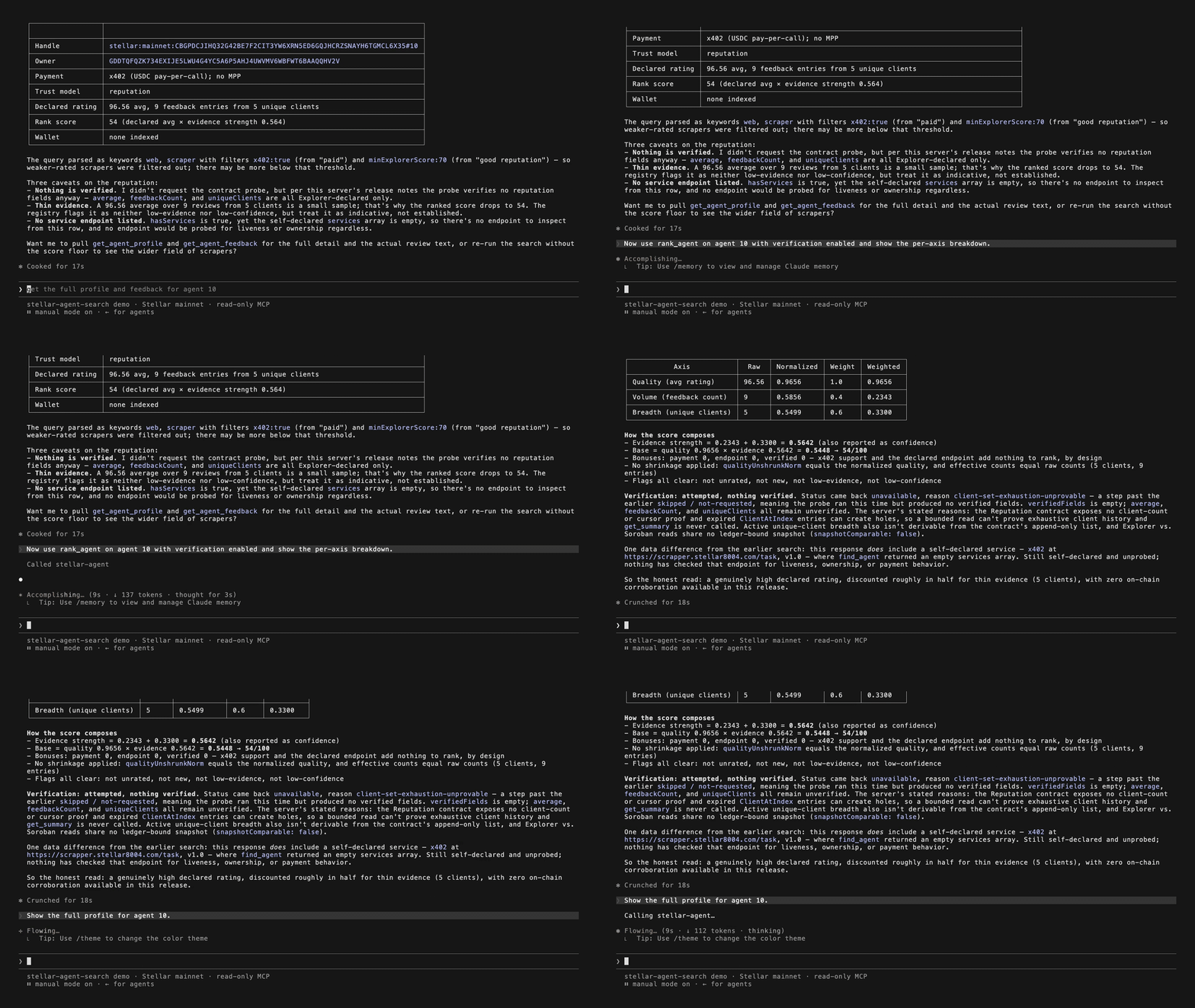
npx -y stellar-agent-search@0.1.0 find "a paid web scraper with a good reputation"
Why this exists: declared data vs. what the chain read can prove
Off-chain agent directories (A2A cards, the MCP Registry, OASF, NANDA) list self-declared agents. That is exactly where the trust gap lives. A 2026 study of the ERC-8004 ecosystem (arXiv 2606.26028) found that only 3–15% of registrations have a live endpoint, and 59–91% of "reviewers" are Sybils.
stellar-8004 is the only non-EVM ERC-8004 implementation we are aware of running on mainnet (66 agents on
Stellar mainnet as of July 2026; get_registry_stats returns the current count). No published survey
enumerates non-EVM deployments — the study above restricts itself to Ethereum, BSC and Base, "the three chains
with the highest registration and feedback volume" — so read that as unrefuted, not as proven. This server
adds something a directory listing cannot give you: a bounded Reputation-contract reachability probe.
The current path calls get_clients_paginated once with a six-slot observation window. The contract exposes
no authoritative client count/cursor, and expired client-index entries create holes, so even an empty or short
page cannot prove that no later live client exists. Calling get_summary over that set would manufacture a
false match or mismatch; this release therefore does not call it and verifies no reputation fields. An
attempted, reachable probe returns unavailable with reason client-set-exhaustion-unprovable;
verifiedFields is empty and average, feedback count, and unique clients all remain unverified.
verified/partial/mismatch are reserved for a future authoritative aggregate. The full status set remains
verified | partial | mismatch | unavailable | skipped. Self-declared marketing text (name, description,
service labels, feedback tags) remains untrusted data, never instructions (see Security).
That fail-closed boundary — plus a versioned declared-evidence heuristic — is the product. Normalized
Explorer quality is multiplied by fixed evidence strength (0.4 × capped volume + 0.6 × effective breadth).
Effective unique clients cannot exceed feedback rows, and repeated rows per declared client are capped. These
are cost-of-manipulation proxies, not chain verification, proof of personhood, or Sybil resistance.
What it exposes
All three MCP primitives, all read-only:
Tools
| Tier | Tool | What it does |
|---|---|---|
| 0 · SOW | find_agent | Natural-language discovery → ranked candidates |
rank_agent | Rank an explicit id set or a query, full 3-axis declared-reputation breakdown + bounded chain reachability | |
get_agent_profile | Deep profile: identity, capabilities, declared reputation + contract-probe limits, recent feedback, unverified A2A projection | |
list_services | Self-declared x402/MPP endpoint candidates; liveness, ownership, conformance, and payment stay unverified | |
| 1 · complete-core | list_agents | Paginated, filterable listing, ranked |
leaderboard | Top agents in a bounded scan (client-side 3-axis rank + coverage) | |
resolve_agent | Any handle (id / stellar:…#id / owner G-address) → canonical identifiers | |
get_agents_by_owner | Current owner API page (up to 20 agents) with explicit continuation coverage | |
get_agent_feedback | Recent on-chain reviews (sanitized, labeled) | |
verify_reputation | Fail-closed Reputation-contract reachability probe; no current fields are verified | |
get_agent_card | Derived, unverified A2A-shaped projection + x402 hint; not protocol-conformance proof | |
get_registry_stats | Exact-count queries + capped sampled metrics, with definitions and coverage | |
get_registry_health | Per-registry indexer staleness |
Full per-tool reference (inputs, outputs, defaults): docs/tools.md.
Resources — stellar8004:// (pinnable context)
registry · leaderboard · health · agent/{id} · agent/{id}/card · agent/{id}/feedback ·
agent/{id}/reputation · owner/{address}. Each returns a dual JSON + rendered-markdown payload.
Prompts — slash workflows
/find-and-vet-agent (flagship) · /vet-agent · /compare-agents · /prepare-x402-call ·
/explore-registry. prepare-x402-call lays out the exact x402 flow and stops before signing — this
server holds no keys.
Quickstart
One-command MCP setup (Claude Code):
npx -y stellar-agent-search@0.1.0 setup --client claude --scope user --handshake
This downloads the package, registers a version-pinned npx -y stellar-agent-search@0.1.0 mcp stdio launch through
Claude Code's own CLI, then performs a real MCP initialize + tools/list handshake. It is idempotent: rerun
with --check --handshake to verify without changing config, or use --dry-run to preview the registration.
Cursor and Codex examples, config paths, and scope limitations are in
docs/getting-started.md. Manual configs for other clients remain in
docs/integration.md.
Optionally install the skill first — the usage guide your agent reads before it calls anything:
npx skills add berkingurcan/stellar-agent-search --skill mcp
Terminal (human CLI):
npx -y stellar-agent-search@0.1.0 find "web scraper" --x402       # discover
npx -y stellar-agent-search@0.1.0 profile 10                       # full profile for agent 10
npx -y stellar-agent-search@0.1.0 rank "scraping agents" --json    # rank + fail-closed contract-probe status, machine-readable
npx -y stellar-agent-search@0.1.0 services --x402                  # declared paid-endpoint candidates
npx -y stellar-agent-search@0.1.0 doctor                           # self-check: env, explorer, RPC, bounded read path
npx -y stellar-agent-search@0.1.0 setup --client cursor --scope project --dry-run  # preview client config
New here? Start with docs/getting-started.md.
Remote endpoint status
The intended hosted URL is https://mcp.stellar8004.com/mcp. The Worker, transport tests, routing, and
hardening are implemented, but the route has not been deployed: /mcp currently falls through to the
landing site and returns 404. Deployment remains deliberately blocked until the Cloudflare rate-limit
namespace is replaced from its sentinel value and a live canary proves that the original caller identity is
preserved through the Service Binding. Do not configure a remote MCP client against that URL yet.
The landing page and MCP runtime are separate Workers. The assets-only landing Worker owns the
mcp.stellar8004.com custom domain; exact /mcp and /healthz zone routes will send only those two paths to
the runtime Worker. The runtime reads the existing stellar8004-web API through a Cloudflare Service Binding.
It does not connect to Supabase, hold a service-role key, or create a second indexer. See
docs/architecture.md and
docs/stellar8004-integration.md.
Configuration
All configuration is via environment variables (canonical for MCP mode); CLI flags override them (precedence: flag → env → default).
| Env var | Default | Purpose |
|---|---|---|
STELLAR_NETWORK | mainnet | mainnet or testnet — testnet also requires EXPLORER_BASE_URL, see below |
EXPLORER_BASE_URL | https://stellar8004.com | Explorer HTTP API base. Indexes mainnet only |
STELLAR_RPC_URL | https://mainnet.sorobanrpc.com | Soroban RPC for the bounded Reputation-contract reachability probe |
VERIFY_ONCHAIN | true | Set false to skip the probe; reputation remains declared-only either way |
RANK_SCORE_MAX | 100 | Fixed v1 compatibility assertion; any value other than 100 is rejected |
Ranking uses the fixed, versioned stellar-agent-search-declared-evidence-v1 policy: indexed average normalized
against exactly 100, multiplied by 0.4 × capped volume + 0.6 × effective breadth. Both a changed
RANK_SCORE_MAX and legacy RANK_W_* variables are rejected so a deployment cannot silently redefine
published score semantics.
STELLAR_PRIVATE_KEY is intentionally ignored if present (and warned about on stderr) — this server is
keyless by construction.
testnetneeds its own explorer, and refuses to start without one. The default explorer indexes mainnet only, whileSTELLAR_NETWORKalso selects the Soroban contracts and RPC. That pairing would give you mainnet registry rows alongside testnet on-chain reads — two chains described as one — soSTELLAR_NETWORK=testnetfails at startup unlessEXPLORER_BASE_URLis set explicitly. No public testnet indexer exists today, so in practice testnet is for someone running their own; the dry-run gate for the x402 demo isDRY_RUN=1on mainnet, which spends nothing.
Security
- Read-only and keyless. No signer, no write clients, no private keys anywhere under
src/. The only keyed actor in the repo is the standaloneexamples/x402-demo.ts, run under explicit human control. - stdout is JSON-RPC only. Every log/diagnostic goes to stderr, so the protocol stream is never corrupted.
- Trust boundary. Server-authored summary text (
content[].text) interpolates only typed/enum/numeric values. All agent-authored free text (names, descriptions, service labels, feedback tags) lives only in labeledselfDeclaredslots of the structured output, sanitized (control/zero-width/bidi stripped) and length-bounded — never treated as instructions.
Full threat model + disclosure policy: SECURITY.md and docs/architecture.md.
How it works
flowchart LR
    A["MCP client<br/>Claude Code · Cursor · Windsurf …"] -- "stdio JSON-RPC" --> B["stellar-agent-search<br/>one Node binary · read-only · keyless"]
    T["Terminal (human CLI)"] --> B
    B -- "HTTP" --> C["ExplorerService<br/>stellar8004.com API · primary data"]
    B -- "Soroban RPC" --> D["ReputationVerifier<br/>bounded reachability probe"]
    C -.indexes.-> E[("stellar-8004 contracts<br/>Stellar mainnet")]
    D --> E
Local MCP client (or terminal) → one Node binary → ExplorerService (stellar8004 HTTP API, primary
data) + ReputationVerifier (Soroban RPC, bounded reachability probe) → canonical stellar-8004 contracts on
mainnet. Indexed reputation remains explicitly Explorer-declared; the contract probe either reports its
limited reachability observation or degrades closed without manufacturing a comparison.
The not-yet-live hosted path adds only an edge adapter: remote client → stateless Cloudflare Worker →
existing stellar8004-web service → its canonical Supabase-backed index. The Worker never reads Supabase
directly and never owns indexer credentials. It still uses Soroban RPC for the same bounded reachability probe.
Architecture, ranking formula, cache boundaries, and the upstream discovery contract are documented in
docs/architecture.md.
Built on the split MCP v2 packages (@modelcontextprotocol/server and @modelcontextprotocol/client
2.0.0), Zod 4, @trionlabs/stellar8004, TypeScript ESM, Node ≥ 22. The local stdio handshake currently
negotiates protocol 2025-11-25; the remote handler targets the modern stateless 2026-07-28 protocol while
retaining a stateless legacy compatibility lane. That is an implementation target, not a live conformance
claim until the remote canary is recorded.
Contributing
Reviewing this against a grant or SOW? Start at docs/evidence.md — a deliverable-to-evidence map with verification steps, written to be checked without a technical background.
The proposed continuation is Stellar Agent Search Phase 2. The first phase helps users find agents. Phase 2 will give independent developers a standard way to offer paid services, while wallets and private keys remain outside this read-only search server.
Known open work and release blockers are tracked in issues/, one file per issue.
Bug reports and PRs welcome. Read CONTRIBUTING.md first — it covers the project layout and the four invariants CI enforces (read-only/keyless, stdout-is-JSON-RPC-only, the trust boundary, and degrade-closed verification). Release history lives in CHANGELOG.md.
License
MIT — see LICENSE.