Listed from the MCP registry; nobody on Odel publishes it.
SAP ABAP MCP
Develop, test, analyze, and operate SAP ABAP systems through ADT from AI coding agents.
Runs on your machine from its package; the steps are below.
What it does
- Reads
- Writes
- High impact
At most: moves money, runs code or commands, deletes data, or sends messages for you.
What it costs
FreeOdel charges nothing per call. The publisher may charge for its own service.
Runs locally over stdio
This server isn't hosted — your MCP client launches it from a package registry. Use one of the commands below, or drop the config into your client (e.g. Claude Desktop).
Run
npx -y @coaspe/sap-abap-mcp
MCP client config
{
  "mcpServers": {
    "sap-abap-mcp": {
      "command": "npx",
      "args": [
        "-y",
        "@coaspe/sap-abap-mcp"
      ]
    }
  }
}

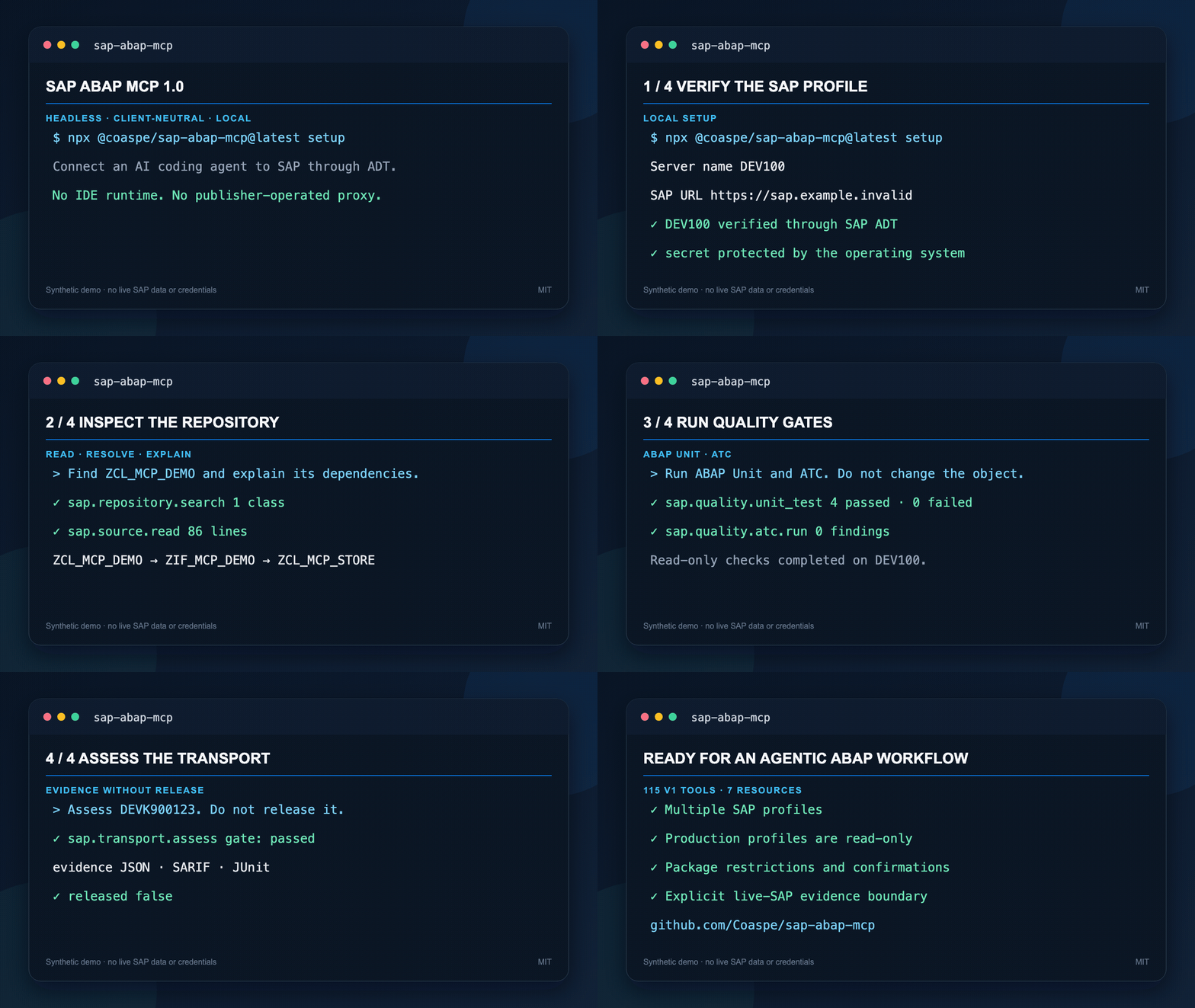
Connect your AI assistant to an ADT-enabled SAP system to read ABAP, make scoped changes and inspect actual check results.
- Small gateway: the current checkout's five-tool minimal mode measured 1,024 estimated initial tokens in an offline fixture; an earlier measurement was 961.
- Six hosts: start onboarding with one command for Claude Code, Codex, VS Code, Cursor, Gemini CLI or Claude Desktop.
- Headless transport assurance: run
assurein CI to evaluate configured checks without releasing the transport.
SAP's official ADT MCP is IDE-integrated and overlaps with development and ATC workflows. See the side-by-side and SAP API Policy review; no live-SAP or policy approval is implied.
Quick start: launch in 30 seconds
Launching the command is quick; connection setup, VPN and SAP authorization can take longer.
- Install Node.js 22/24 and connect to your company VPN.
- Run
npx -y @coaspe/sap-abap-mcp@2.3.0 onboard(npx.cmdon Windows). - Verify and save your SAP connection, register your host, then restart the app and verify an actual SAP system read.
| Host | Setup command |
|---|---|
| Claude Code | npx -y @coaspe/sap-abap-mcp@2.3.0 onboard |
| Codex | npx -y @coaspe/sap-abap-mcp@2.3.0 onboard |
| VS Code | npx -y @coaspe/sap-abap-mcp@2.3.0 register DEV100 --client vscode --apply |
| Cursor | npx -y @coaspe/sap-abap-mcp@2.3.0 register DEV100 --client cursor --apply |
| Gemini CLI | npx -y @coaspe/sap-abap-mcp@2.3.0 register DEV100 --client gemini --apply |
| Claude Desktop | npx -y @coaspe/sap-abap-mcp@2.3.0 register DEV100 --client claude-desktop --apply |
Try a practical prompt
- "In DEV100, find class ZCL_EXAMPLE and explain the public methods; do not change anything."
- "Compare the implementation of ZCL_EXAMPLE in DEV100 and QAS200 and report differences."
- "Inspect transport DEVK900123, run the approved checks, and report failures without releasing it."
Version 2.2.0 includes company CA files, six-host registration and Windows SAP
Logon import. Omit --apply to preview a registration; existing entries are
preserved and existing settings files are backed up. Claude Desktop MCPB users
should avoid a duplicate registration. On Windows replace npx with npx.cmd.
CA profiles use file format version 3 and need 2.2.0 or later. Existing npm registrations pin their package version: restart alone does not update a 2.1.0 registration. Use registration doctor and reviewed repair to update a pinned registration to the version you intend to run.
See setup details, including Linux environment-only credentials and registration recovery.
2.1.0 fixes noninteractive startup, native macOS credential storage and registration recovery. Windows DPAPI explicitly loads its native security module even when Node inherits a PowerShell 7 module path. Bundled npm/npx Windows launchers are resolved without a shell while preserving custom wrappers. This release also reduces the runtime package. Patched vendor bytes are preserved across Windows and Unix checkouts. Existing five gateways still reach 120 capabilities.
What's new in 2.3.0
- Transport release and inspection. Discover the SAP ADT background endpoint before release, verify the exact Request or Task, and keep Task-before-Request ordering. CTS object addition confirms the exact key on read-back and avoids duplicate writes.
- ATC results. Isolate worklists, keep findings that match the target, and count each resolved transport object once. Incomplete evidence stays visible in the gate.
- Source and data controls. Open ADT links from supported results, read active source explicitly, and scope class changes to a method. The ADT client sends the reconstructed source. The data policy can block configured table and view names before a query reaches SAP.
See the 2.3.0 changelog and verification limits.
One existing-object change
Select the existing sap-change-object prompt, with the configured systemId,
exact Z program/class as target, and desired behavior in goal. It reuses
source, semantic/public API, dependency, quality and transport features.
Production/read-only policy, package restrictions, transport requirements and exact-source checks remain enforced. Source writes recheck the same current-source view under lock, without an explicit inactive probe. A changed current version stops the write. Requested activation follows successful unlock and is skipped on syntax errors. Uncertain multi-object writes stop with saved/uncertain/unattempted identities; there is no automatic rollback or atomic-transaction claim. Inspect state before retrying. Zero tests, unsupported checks and partial findings cannot establish completion.
For a read-only evaluation, keep readOnly: true and expose only search,
describe and invoke_read gateways in the host. Do not execute write, activation,
Unit, ATC, debugger or profiling operations during that evaluation.
See workflow prompts and T1–T5 criteria.
Verified environments and limits
| Scope | Evidence and limit |
|---|---|
| Clean npm tarball, macOS arm64, Node 24 | Eight launch/profile combinations, Unicode/spaces, help, invalid commands and shutdown passed on the reliability candidate |
| macOS Keychain | Actual throwaway legacy-item/UTF-8/9,000-byte storage, renewal and deletion passed |
| Windows read-only field procedure | Owner reports all supplied steps passed without candidate source changes; sanitized operation records were not supplied |
| Windows DPAPI / npx.cmd automation | Windows CI passed: native storage/module-shadow regression, bundled launchers and eight installed-tarball protocol cases |
| Native Desktop MCPB / host restart | Standalone bundle checks and an owner's overall field report remain distinct from retained app-level evidence |
| Current 2.x live-SAP acceptance | not verified across the complete feature set on the published artifact. Field evidence for specific pre-release cases is listed below. |
| SAP transport acceptance | A pre-release build passed Request and Task release, exact Request/Task lookup, CTS add verification and duplicate prevention in a development SAP system. This covers those cases in that build and environment. |
| V4 service unpublish | Live verification remains open. The development client blocked publication of the test service. |
| Multi-page transport search and customer CI | Live multi-page search lacked a fixture with multiple result pages. No accessible customer CI pipeline was available for integration verification. |
| Historical live SAP / model comparison | 2026-08-05 results are historical; no identical-model T1–T5 completion rate or product ranking is established |
Known SAP limitations from earlier field runs: older requests may be missing when the SAP system does not advertise all-date search. Top-level package creation was rejected by the tested backend. Separate LIMU DOMD registration was not observed in a task already containing the parent R3TR DOMA; the tool verifies the requested key before reporting success. The acceptance kit skips lookup of previous ABAP Unit runs.
Candidate measurements reduced compressed npm size from 26.29 to 13.33 MB and installed dependency bytes from 118.89 to 91.81 MB. Three warm protocol sessions measured 346–351 to 223–239 ms. Cold install was 12.92 to 16.06 seconds; no cold speed improvement is claimed. See exact snapshots and limits.
If setup fails
| Symptom | Next action |
|---|---|
| MCP closes immediately | Keep serve explicit, especially on 2.0.1; verify Node on the host PATH |
SETUP_REQUIRED | Complete local setup and reconnect; this state is not an accepted SAP installation |
| Removed Node/cache or old registered version | Run registration doctor and reviewed repair/update |
| Certificate untrusted / expired / hostname mismatch | Keep verification enabled; use the company CA PEM file or ask the administrator to fix the certificate/URL. See TLS trust |
| SAP URL unknown | On Windows use SAP Logon import to find candidate URLs, then check ADT and confirm the endpoint with your administrator |
| SAP authentication/authorization failure | Renew locally or ask the administrator for ADT permission; avoid blind repeated logins |
| Inactive conflict / uncertain write | Read current active/inactive state and reconcile with its owner before resuming |
Reference and release status
- Transport
assureand CI, full reference, CLI, profiles, changelog. - Evidence index, compatibility, historical live record.
- Roadmap, adopters, distribution, 2.3.0 release.
- Reliability validation and field procedure. Checkout manifest version:
2.3.0.
Normal clients should omit both --api-version and --toolsets.
Privacy Policy
PRIVACY.md: no default remote telemetry. Credentials remain in OS-protected storage. Feedback exports are voluntary; public adopter names and quotes require separate explicit permission. Downloads and automated tests do not establish active users, task success or independent adoption.







