Listed from the MCP registry; nobody on Odel publishes it.

WhyKit
Read-only decisions and evidence from a Git vault, and which decisions a code change touches.
Runs on your machine from its package; the steps are below.
What it does
- Reads
- Writes
- High impact
At most: only reads or looks up information.
What it costs
FreeOdel charges nothing per call. The publisher may charge for its own service.
Runs locally over stdio
This server isn't hosted — your MCP client launches it from a package registry. Use one of the commands below, or drop the config into your client (e.g. Claude Desktop).
Run
uvx whykit
MCP client config
{
  "mcpServers": {
    "whykit": {
      "command": "uvx",
      "args": [
        "whykit"
      ]
    }
  }
}WhyKit
Know why every decision was made.
Decisions about code, product or go-to-market get made for reasons that end up in someone's head or an old thread. WhyKit keeps those decisions and the sources behind them as Markdown in Git. It flags a decision when a source changes or a review is due, shows which decisions a pull request touches, and lets Claude Code, Codex or Cursor look them up before they act, so an agent doesn't "fix" something that was deliberate.





Open source from CometWeb · Apache-2.0 · No runtime dependencies · Your data stays Markdown
Live demo · Tutorial · Connect agents · Docs · Roadmap
What it does
Each decision cites its sources (E-001) and declares the code it governs
(applies_to: ["src/payments/**"]). Before a change lands, one command answers
which decisions does this touch, and has anything they rest on changed?
$ whykit affected --root examples/payments --today 2026-11-12 \
    --files src/payments/ledger.py src/webhooks/refunds.py README.md
WhyKit affected — 3 changed files · 2 decisions apply · 1 needs review · 1 file not covered by any decision
  D-001  review   Store money as integer cents
      files: src/payments/ledger.py
      - a cited source was retired
  D-003  applies  Make every webhook handler idempotent
      files: src/webhooks/refunds.py
  not covered by any decision: README.md
  1 live decision(s) declare no applies_to scope: D-005
That is real output from the synthetic payments example; a test keeps this block in step with the code. The ledger decision rests on an audit checklist that has since been replaced, so its reasoning needs a look before this change merges. WhyKit says what it checked and what it did not: uncovered files and unscoped decisions are listed, and it never claims a change is safe.
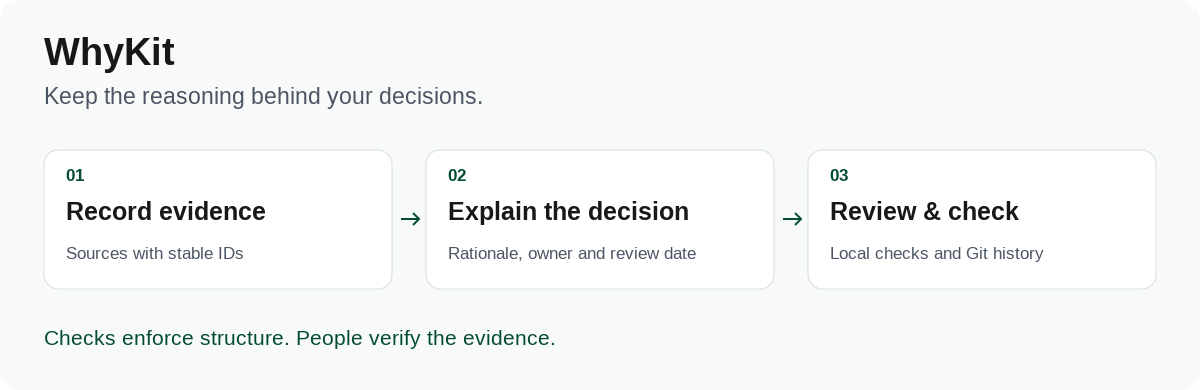
- Sources get stable IDs and can be retired or replaced; captured sources are pinned by their bytes.
- Decisions cite sources, declare their scope, carry an owner and a review date, and are append-only: you supersede, you don't rewrite.
- Changes are mapped to decisions by
whykit affected, locally, in CI and by agents, with review signals for retired, missing, stale or changed sources (including source files the change itself modifies) and overdue or failed reviews. Scopes can be suggested from Git history. - Agents read the same files through a read-only MCP server, and
whykit connecttells them to ask before they edit.
Try it
Install uv (0.13.4+) and use Python 3.11+. This creates a vault, a folder of Markdown files, with one source and one draft decision that cites it:
uv tool install whykit

# Create a vault.
whykit init my-ledger

# Record a source, then a draft decision that cites it.
whykit new --root my-ledger evidence \
  --source "Support ticket export, Q3" --type dataset \
  --location "https://example.com/exports/q3-tickets.csv" \
  --claims "Most onboarding tickets mention SSO"
whykit new --root my-ledger decision "Ship SSO before audit logs" \
  --owner Platform --status draft --source E-001

# See the connection, then check the vault.
whykit trace --root my-ledger --decision D-001
whykit lint --root my-ledger
whykit review --root my-ledger list --due-days 120
The trace shows the decision and the source it cites:
D-001  06-decisions/d-001-ship-sso-before-audit-logs.md  (draft)
    E-001 active
The lint check reports five expected warnings: one for the unfinished draft
and four for unanswered questions in the vault's AGENTS.md. Fill in the
draft's context, options and consequences, then
approve it. If whykit is not found, run
uv tool update-shell and open a new terminal.
Catch decision drift
Declare what each decision governs, then ask about any change, planned or committed:
whykit new --root my-ledger decision "Store money as integer cents" \
  --owner Payments --status draft --source E-001 --applies-to 'src/payments/**'
whykit affected --root my-ledger --files src/payments/ledger.py   # before you edit
whykit affected --root my-ledger --base origin/main --format markdown   # in a pull request
Don't want to write scopes by hand? Let Git suggest them from the commits that changed each decision or name it in their message, then confirm:
whykit scope suggest --root my-ledger            # preview
whykit scope suggest --root my-ledger --write    # fill in decisions without a scope
whykit scope check --root my-ledger --strict     # in CI: fail when a scope points at code that moved
A source kept in the repository (a benchmark, a spec) counts too: when a pull request modifies it, every decision citing it is flagged.
Decisions about a library or a convention can watch for words instead of
paths: with watch_terms: ["moment"], a change that adds import moment
surfaces the "Use Luxon" decision. An agent can send its planned patch before
applying it. We replayed real ADR repositories to
tune this, and publish what did not work too.
Already have ADRs? Skip the vault and point it at the folder; scopes are inferred from the paths each ADR mentions, and moved code is flagged:
whykit affected --adr docs/decisions --base origin/main
The ten-minute tutorial goes from an empty repository to a flagged decision and its successor; every command in it runs in the test suite. Affected decisions covers scope patterns, every signal and a pull-request workflow.
Connect your agents
One command prints the MCP configuration for your host and adds a short,
marked block to your code repository's CLAUDE.md or AGENTS.md telling the
agent to look up decisions before it changes what they cover:
uv tool install --upgrade 'whykit[mcp]'
whykit connect --root my-ledger --host claude-code          # preview
whykit connect --root my-ledger --host claude-code --write  # apply
Hosts: claude-code, cursor, vscode, codex, claude-desktop and
generic. The server is read-only with eight tools (query, context,
impact, status, pack, trace, backlinks, affected); records above your chosen
sensitivity ceiling are never returned. The instruction block also tells the
agent to call affected on the files it plans to change. whykit connect,
whykit affected and the affected tool are new in 0.5.0;
the MCP server itself is in 0.4.0.
Read the agent guide.
Gate pull requests
Instructions ask; CI enforces. On a pull request, the GitHub Action fails when an accepted decision's reasoning is rewritten, a cited source is missing or a credential slips into the vault:
- uses: actions/checkout@3d3c42e5aac5ba805825da76410c181273ba90b1 # v7.0.1
  with:
    fetch-depth: 0
- uses: CometWeb-io/whykit@<reviewed-40-character-commit-sha>
  with:
    root: decisions
    profile: ci
    affected: "true"   # add the decisions this change touches to the job summary
See gate pull requests for the full workflow and a good and a bad example, and CI integration for PR comments, SARIF and other CI systems.
What would you like to do?
- See it on a real-looking vault: live Explorer demo of the payments example.
- Record a decision and change your mind later: record, check and supersede.
- Bring existing notes or ADRs: adopt existing Markdown.
- Browse the vault in a web UI: run the Explorer.
- Edit in Obsidian or your editor: Obsidian · language server.
- Review a changed source and share a filtered export: import, review and export.
Why WhyKit
| Plain ADRs | Wiki / Notion | WhyKit | |
|---|---|---|---|
| Lives next to the code, in Git | ✓ | ✓ | |
| Maps a code change to the decisions that govern it | ✓ | ||
| Flags decisions whose sources were retired, replaced or changed | ✓ | ||
| Review dates that expire and get reported | ✓ | ||
| Rewriting accepted decisions blocked in CI | ✓ | ||
| Read-only MCP access for agents, sensitivity-filtered | ✓ | ||
| Works offline, no account, no service | ✓ | ✓ |
Already happy with ADRs? Keep them; here is when they are the better fit.
When you outgrow them, whykit adopt --profile adr-only brings them in.
Built to be trusted
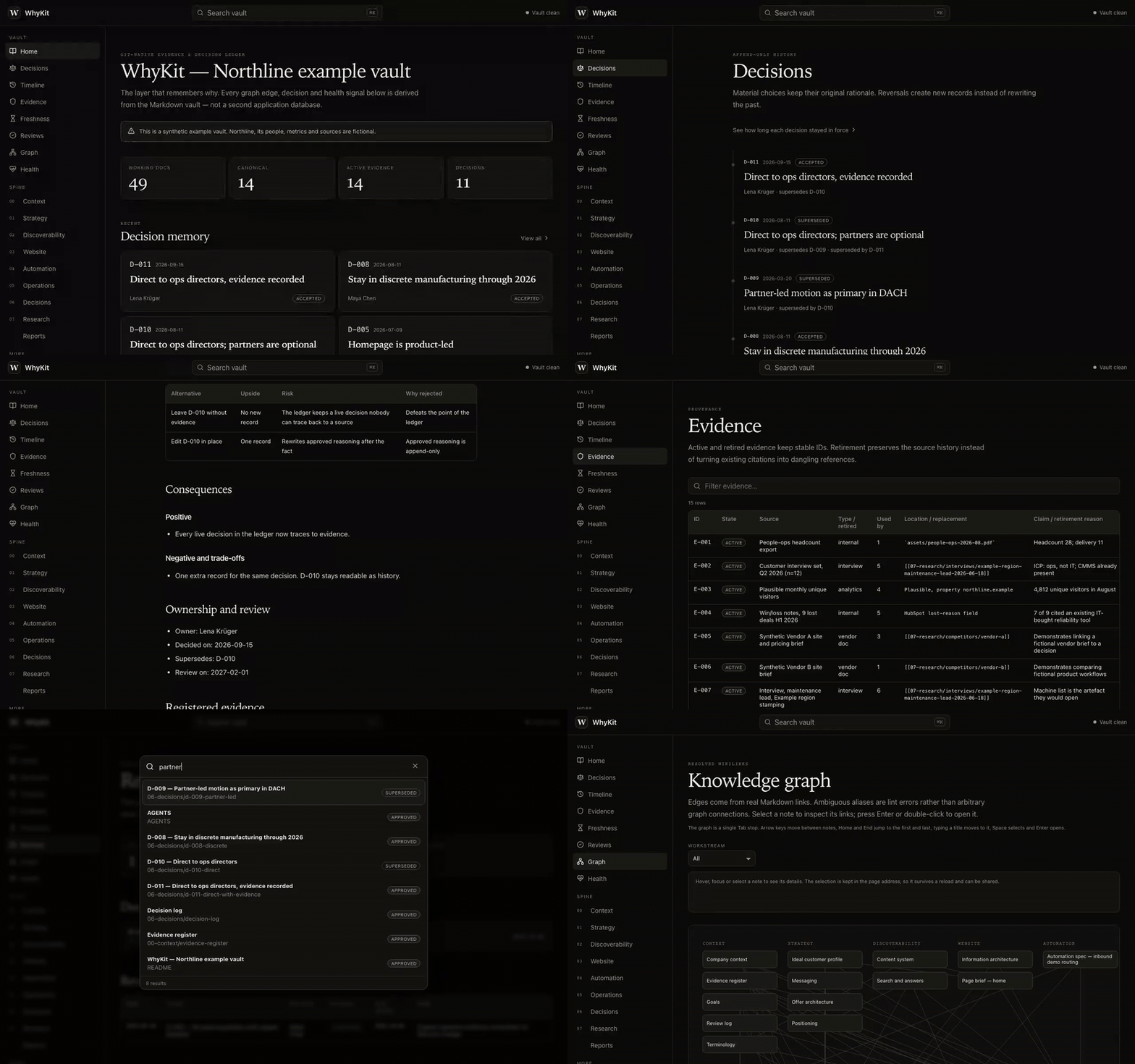
- Plain files are canonical. Every view (queries, graphs, MCP, the Explorer) is derived from Markdown you can read and diff.
- Nothing phones home. No telemetry, accounts or network calls; a test breaks the socket layer and runs every vault command.
- A stable machine contract. Every
--jsonoutput has a published JSON Schema; error codes and exit codes are documented in the automation contract. - Tested hard. About 1,800 tests, property and fuzz tests for the parsers, reproducible builds, an SBOM and OpenSSF Scorecard on every release.
Limits, stated plainly
WhyKit checks that reasoning is cited, dated and not rewritten. It does
not decide whether a source is true or a decision is right, and it does
not re-check external sources on its own. Sensitivity labels filter what the
MCP server and exports return; they are not access control, so keep real
vaults in private repositories. whykit affected matches files by path, not
by meaning, and sees only changes recorded in the vault. Agent instructions are
a request: pair them with the CI gate. The project is a public alpha; see the
feature status and the
0.4 upgrade guide.
Documentation
- Start here · Concepts · How-to guides · Connect agents · Affected decisions
- Command reference · Configuration · Lint rules
- CI integration · MCP server · Troubleshooting
- Example vaults: payments, tiny and Northline
Contributing
Issues and pull requests are welcome. Start with CONTRIBUTING.md; the whole suite runs offline with the standard library. If WhyKit is useful to you, a ⭐ helps other people find it.
Contributing · Code of Conduct · Security policy · Release checklist · Changelog · Roadmap
Copyright 2026 Maciej Zmitrukiewicz (hello@cometweb.io), licensed under Apache-2.0. CometWeb is the product name, not the copyright holder.







