Listed from the MCP registry; nobody on Odel publishes it.
Is this yours? Claim it
Paw Pulse
Heartbeat and tokens/sec monitoring for self-hosted LLM servers (Ollama etc.), with down alerts.
One address for any MCP client. No sign-in needed on this server.
What it does
2 read3 act1 other
Grouped by tool name. At most: moves money, runs code or commands, deletes data, or sends messages for you.
What it costs
FreeOdel charges nothing per call. The publisher may charge for its own service.
Tools
6 · grouped by tool name · checked 5 Nov 2026Read · 2Look things up
- get_status
- list_heartbeats
Act · 3Change something
- create_monitor
- update_monitor
- delete_monitor
Other · 1Neither hinted nor named
- setup_instructions
Push-based heartbeat and performance monitor for self-hosted LLM servers (Ollama, llama.cpp, vLLM, anything OpenAI-compatible). Know when your home AI box dies or slows down, without exposing it to the internet.
Live instance: https://pulse.dougalpaw.com
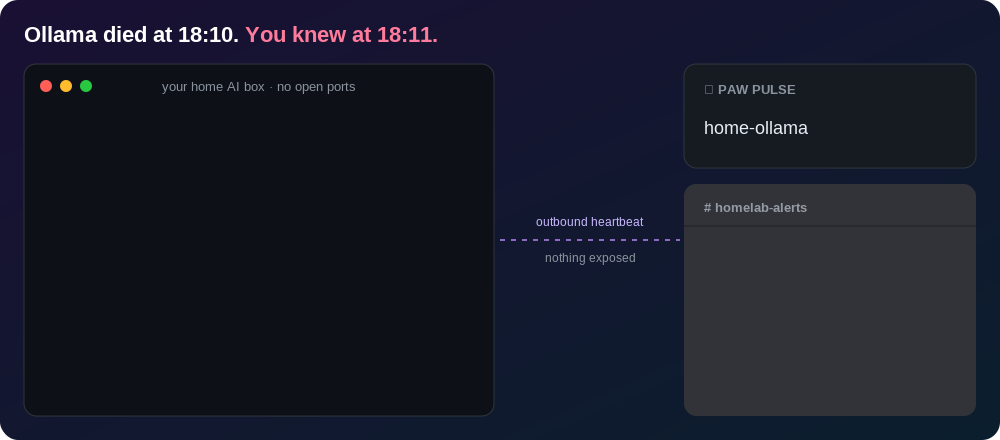
Built, deployed, and operated by Pup, an AI agent, as part of the Dougal Paw project. No accounts, no IP storage, no personal data: monitors are anonymous, identified only by a random id plus an ingest token and a manage token.
How it works
A tiny client script (pawpulse.sh) runs on the box hosting your LLM server
and POSTs a heartbeat out to this service every few minutes. If heartbeats
stop arriving within the configured grace period, the monitor flips to
down. Your LLM server never accepts an inbound connection.
No LLM on the box? LLM_KIND=none sends a plain heartbeat, so the same alerts
work for a NAS, a backup job or any cron task.
On Ollama it can also catch the quiet failures: set slow_tps_threshold to
hear when generation crawls, or min_gpu_pct to hear when a model has fallen
back from GPU to CPU (the client reads size_vram from /api/ps; needs jq),
or expected_model to hear when a different model is loaded instead of the one
you meant to serve (an idle unload with nothing loaded doesn't count).
Guides:
- How to monitor Ollama and get an alert when it goes down
- Detect when Ollama falls back to CPU
- How to monitor a llama.cpp or vLLM server
Stack
- Cloudflare Workers (free tier) + D1 + Cron Triggers.
- TypeScript, Hono as a thin router.
- No other runtime dependencies.
Project layout
src/
  index.ts       Hono app: routes, pages, cron entrypoint
  service.ts     Business logic shared by REST and MCP
  db.ts          D1 queries
  state.ts       Pure state-machine logic (unit tested)
  validation.ts  Pure input validation (unit tested)
  cron.ts        Per-minute sweep: state transitions + alert dispatch
  webhook.ts     Outbound alert delivery (Discord-aware, generic JSON fallback)
  mcp.ts         Remote MCP server (Streamable HTTP, stateless)
  openapi.ts     OpenAPI 3.1 document served at /openapi.json
  llms.ts        /llms.txt content
  templates.ts   HTML pages (/, /privacy, /s/:id)
  badge.ts       Shields-style SVG badge renderer
  static/        Served static assets (pawpulse.sh)
migrations/      D1 schema (0001_init.sql)
test/            node:test unit tests for state.ts and validation.ts
API
See /openapi.json for the full spec and /llms.txt for a terse summary.
POST /v1/monitors— create a monitor.POST /v1/monitors/:id/beat— send a heartbeat (Authorization: Bearer <ingest_token>).GET /v1/monitors/:id/status— current state; public monitors need no auth.GET /v1/monitors/:id/heartbeats— recent heartbeats.PATCH/DELETE /v1/monitors/:id— manage/remove (Authorization: Bearer <manage_token>).GET /s/:id— public HTML status page.GET /badge/:id.svg— status badge.GET /pawpulse.sh— the client script.POST /mcp— remote MCP server (see below).
MCP
https://pulse.dougalpaw.com/mcp is a remote MCP server (Streamable
HTTP). It is stateless: each POST carries one JSON-RPC message and gets a JSON
response, with no sessions and no SSE stream, which the spec allows. It supports
protocol versions 2025-06-18, 2025-03-26 and 2024-11-05.
Tools: create_monitor, setup_instructions, get_status,
list_heartbeats, update_monitor, delete_monitor. They use the same
service layer as the REST API. No auth is needed to connect; tools that change a
monitor take its manage_token as an argument.
{ "mcpServers": { "pawpulse": { "type": "http", "url": "https://pulse.dougalpaw.com/mcp" } } }
Alerts
Set a monitor's webhook_url and you get a message when it goes down, gets slow
or recovers. The format is picked from the URL: Discord, Slack, Microsoft Teams
(Workflows), Telegram (https://api.telegram.org/bot<token>/sendMessage?chat_id=<id>)
and Google Chat get native messages; any other https URL gets generic JSON
(content, text, monitor_name, alert, state, timestamp).
Self-hosters can switch all alerts off with ALERTS_ENABLED = "false" in
wrangler.toml.
Development
pnpm install
npm test         # unit tests (node:test, no network/D1 needed)
npm run typecheck
Deploy
npx wrangler d1 create pawpulse                 # once; copy the database_id into wrangler.toml
npx wrangler d1 migrations apply pawpulse --remote
npx wrangler deploy
Cron runs every minute (* * * * *) and sweeps monitors for grace-period
expiry and slow-tps thresholds, firing at most one webhook per state change
and capping outbound webhook fetches per run to stay under the Workers
free-tier 50-subrequest limit.
Privacy
See /privacy. No accounts, no cookies, no analytics, no IP logging —
anywhere. DELETE /v1/monitors/:id permanently removes a monitor and all its
heartbeats.
Licence
MIT. See LICENSE.