Listed from the MCP registry; nobody on Odel publishes it.

TempoGraph
Code graph context engine with 24 MCP tools. 170+ languages via tree-sitter.
Runs on your machine from its package; the steps are below.
What it does
- Reads
- Writes
- High impact
At most: only reads or looks up information.
What it costs
FreeOdel charges nothing per call. The publisher may charge for its own service.
Runs locally over stdio
This server isn't hosted — your MCP client launches it from a package registry. Use one of the commands below, or drop the config into your client (e.g. Claude Desktop).
Run
uvx tempograph
MCP client config
{
  "mcpServers": {
    "tempograph": {
      "command": "uvx",
      "args": [
        "tempograph"
      ]
    }
  }
}This is the frozen April-2026 Python line (PyPI
tempograph 0.7.4). The live engine is the all-Rusttempograph_rsinElmoaid/outpm(ruling D-1, 2026-08). The benchmark headline below (+18.6%, p=0.049) was re-analysed as p=0.055, not significant (ruling D-7); it is kept as the published record, not as a current claim. Banner added 2026-09-02.




Your AI agent finds the right files. Every time.
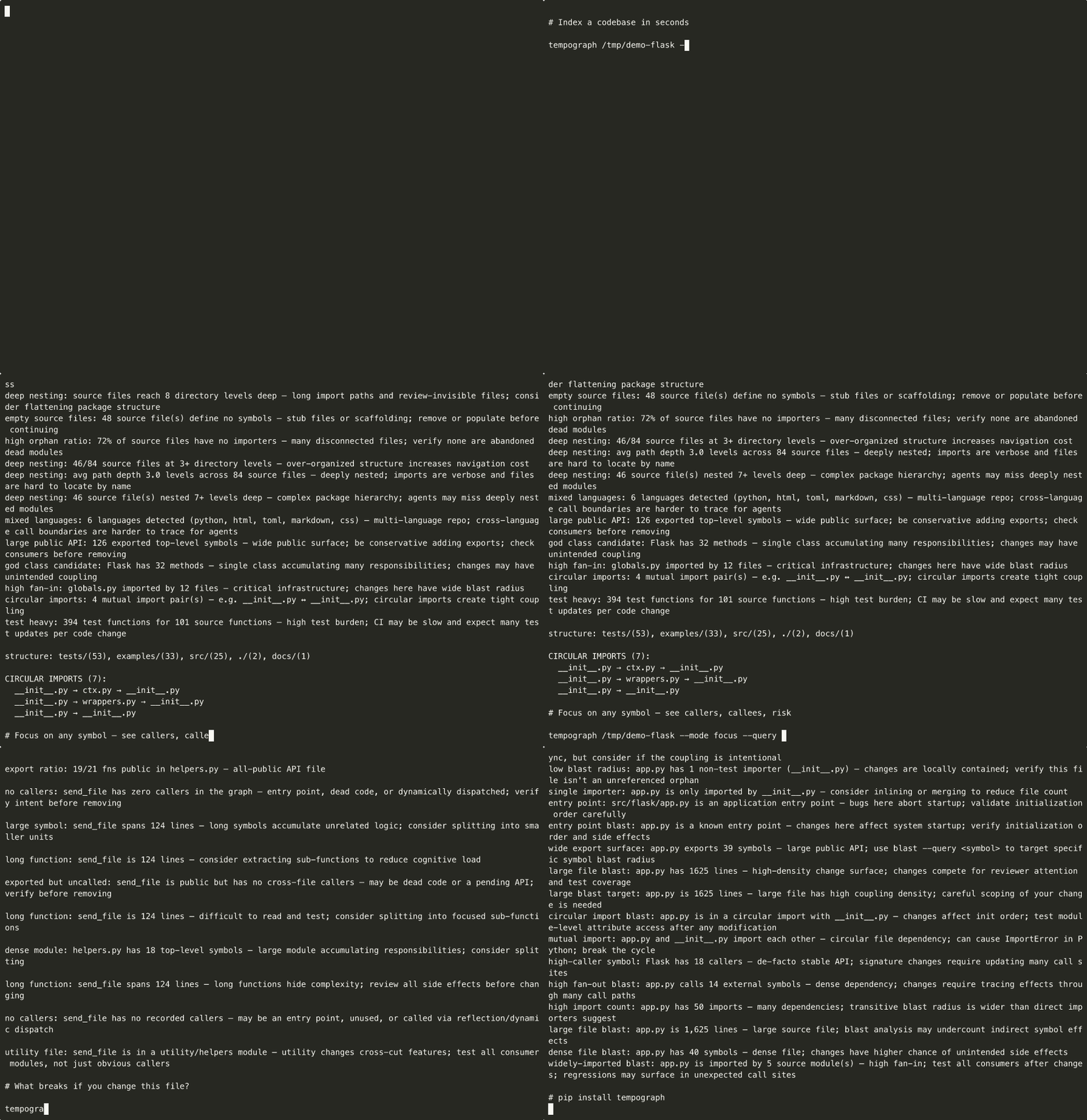
TempoGraph builds a dependency graph of your codebase and gives your AI coding agent exactly the files it needs before making changes. One tool call. No guessing.
The Problem
AI coding agents guess which files to look at. They search by filename, grep for keywords, and hope for the best. In large codebases, they miss critical dependencies, break things downstream, and waste tokens reading irrelevant code.
The Fix
pip install tempograph
Add to your MCP config (Claude Code, Cursor, Windsurf, or any MCP client):
{
  "mcpServers": {
    "tempograph": {
      "command": "tempograph-server",
      "args": []
    }
  }
}
Your agent calls prepare_context with a task description. TempoGraph returns the exact files that matter — based on real dependency analysis, not text matching.
Does It Work?
Tested on real PRs from django, flask, httpx, fastapi, requests, and pydantic. Task: predict which files need to change.
| Model | Without TempoGraph | With TempoGraph | Improvement |
|---|---|---|---|
| GPT-4o | 21.7% F1 | 27.5% F1 | +27% |
| GPT-4o-mini | 19.2% F1 | 24.5% F1 | +28% |
| qwen2.5-coder:32b | — | — | +18.6% (p=0.049) |
Consistent improvement across every model. 2-3x more tasks helped than hurt. No other code context tool publishes retrieval benchmarks with statistical significance.
How It Works
your repo ──→ tree-sitter parse ──→ symbols + edges ──→ SQLite graph
                                                            │
                    AI agent calls prepare_context ─────────┘
                                                            │
                              ◄── KEY FILES + callers + callees + risk signals
- Parses your code with tree-sitter into a structural dependency graph
- Content-hashed and stored in SQLite — only changed files get re-parsed
- Warm queries in ~21ms. Branch switching doesn't trigger a rebuild
- Knows when NOT to inject context (adaptive gating avoids harming diffuse commits)
What Else Can It Do?
Beyond prepare_context, TempoGraph exposes 24 MCP tools for deeper analysis when your agent needs it:
| Tool | When to use it |
|---|---|
blast_radius | "What breaks if I change this file?" |
focus | "Show me everything related to auth" |
hotspots | "Which files are riskiest to change?" |
dead_code | "What can I safely delete?" |
diff_context | "What's the impact of my current changes?" |
overview | "Orient me in this new codebase" |
All 24 tools
| Tool | What it does |
|---|---|
prepare_context | One-shot context for a task — the primary tool |
overview | Repository orientation: size, languages, entry points |
focus | Connected subgraph around a symbol — callers, callees |
blast_radius | What breaks if you change this file or symbol |
diff_context | Impact analysis of changed files |
hotspots | Ranked risk list — complexity x coupling x size |
dead_code | Unreferenced symbols — cleanup candidates |
lookup | "Where is X?", "What calls X?" |
dependencies | Circular imports, dependency layers |
architecture | Module-level dependency view |
symbols | Full symbol inventory |
file_map | File tree with top symbols per file |
search_semantic | Hybrid keyword + vector + structural search |
cochange_context | Files that historically change together |
suggest_next | Predicts the next useful tool call |
run_kit | Composable multi-tool workflows |
stats | Token budget estimates |
get_patterns | Codebase conventions and idioms |
report_feedback | Log whether output was useful |
learn_recommendation | Suggestions from feedback history |
index_repo | Build or rebuild the graph |
watch_repo / unwatch_repo | Live incremental updates |
embed_repo | Generate vector embeddings |
CLI
# Orient in a new repo
tempograph ./my-project --mode overview

# What's connected to auth?
tempograph ./my-project --mode focus --query "authentication"

# What breaks if I touch db.ts?
tempograph ./my-project --mode blast --file src/lib/db.ts

# Find dead code to clean up
tempograph ./my-project --mode dead
Python API
from tempograph import build_graph

graph = build_graph("./my-project")
results = graph.search_symbols("handleLogin")
importers = graph.importers_of("src/lib/db.ts")
dead = graph.find_dead_code()
Languages
Python, TypeScript, JavaScript, Rust, Go, Java, C#, and Ruby get deep extraction (custom tree-sitter handlers). 170+ additional languages are supported via generic handler. pip install tempograph[full] for everything.
Support & Sponsorship
If TempoGraph saves you time, consider sponsoring the project. Sponsors get early access to new features.

Commercial Licensing
TempoGraph is AGPL-3.0 — free to use, modify, and distribute. If you use TempoGraph in a network service (SaaS, hosted IDE, AI coding platform), AGPL requires you to open-source your service code. If that doesn't work for you, commercial licenses are available.
Contact eali@needspec.com for commercial licensing terms.
License
AGPL-3.0 — free to use. Network service use requires source disclosure, or a commercial license.







