
Lawang Onboard
Permission-aware onboarding MCP server: answers about a codebase, filtered by the caller's role.
One address for any MCP client. Your key stays in your Odel vault.
What it does
- Reads
- Writes
- High impact
Not assessed yet.
What it costs
FreeOdel charges nothing per call. The publisher may charge for its own service.
Tools
None listed · checked 30 Sep 2026Odel could not list its tools without signing in.
Permission-aware AI onboarding. An onboarding copilot inside IBM Bob that explains a codebase to a new engineer, and only the parts they are allowed to see.
Built for the IBM Bob 2.0 Hackathon (lablab.ai, 25 to 27 September 2026) by team Lawang Onboard.
The problem
A new engineer, or a contractor hired for one module, needs weeks to learn why a codebase looks the way it does. The answers exist, spread across commit messages, architecture decision records and pull request reviews, but nobody reads those on day one. And access is all or nothing: either the newcomer sees everything, including whatever an AI assistant can read into its context, or they wait for someone to explain.
What it does
Open the repository in IBM Bob, switch to the Onboard mode, and ask:
/tour: the map of what you can see, module by module./trace webhook: how a webhook becomes a record, step by step./why internal/ingress: the decisions and reviews behind a path.- "What can I pick up first?"
Bob answers from the code and its history, and cites every item it used. Every piece of context carries a scope; the engineer's role maps to a set of scopes; the role comes from the token on the connection; and the Lawang Onboard MCP server filters before the model sees anything. A contractor's session cannot leak what it was never given, and every answer ends with what was withheld:
Withheld: path:cmd (68), path:internal/core (314), path:migrations (56), path:repo (86),
private:growth (18), private:security (6) | total hidden: 399
| Contractor | Maintainer |
|---|---|
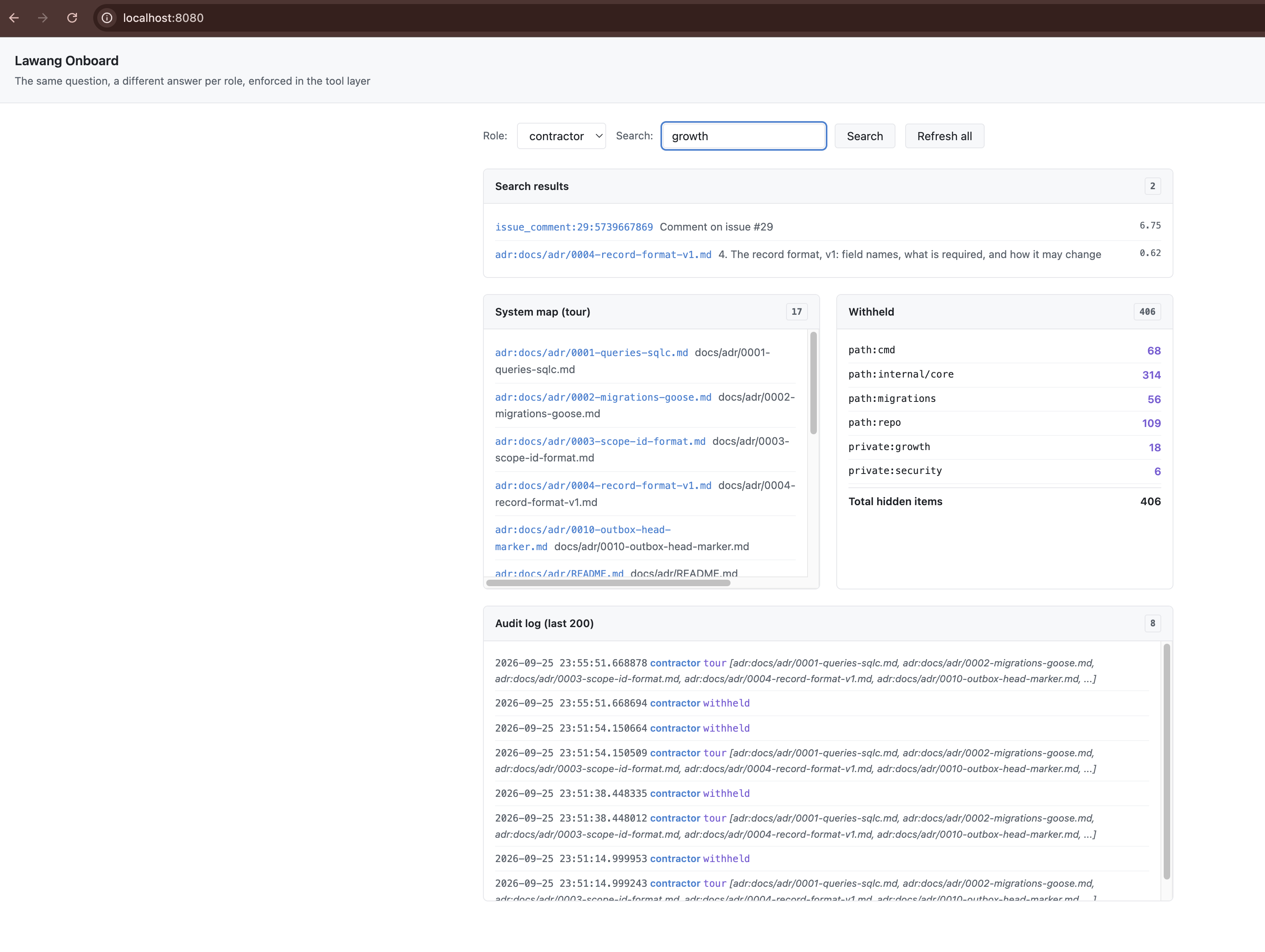 | 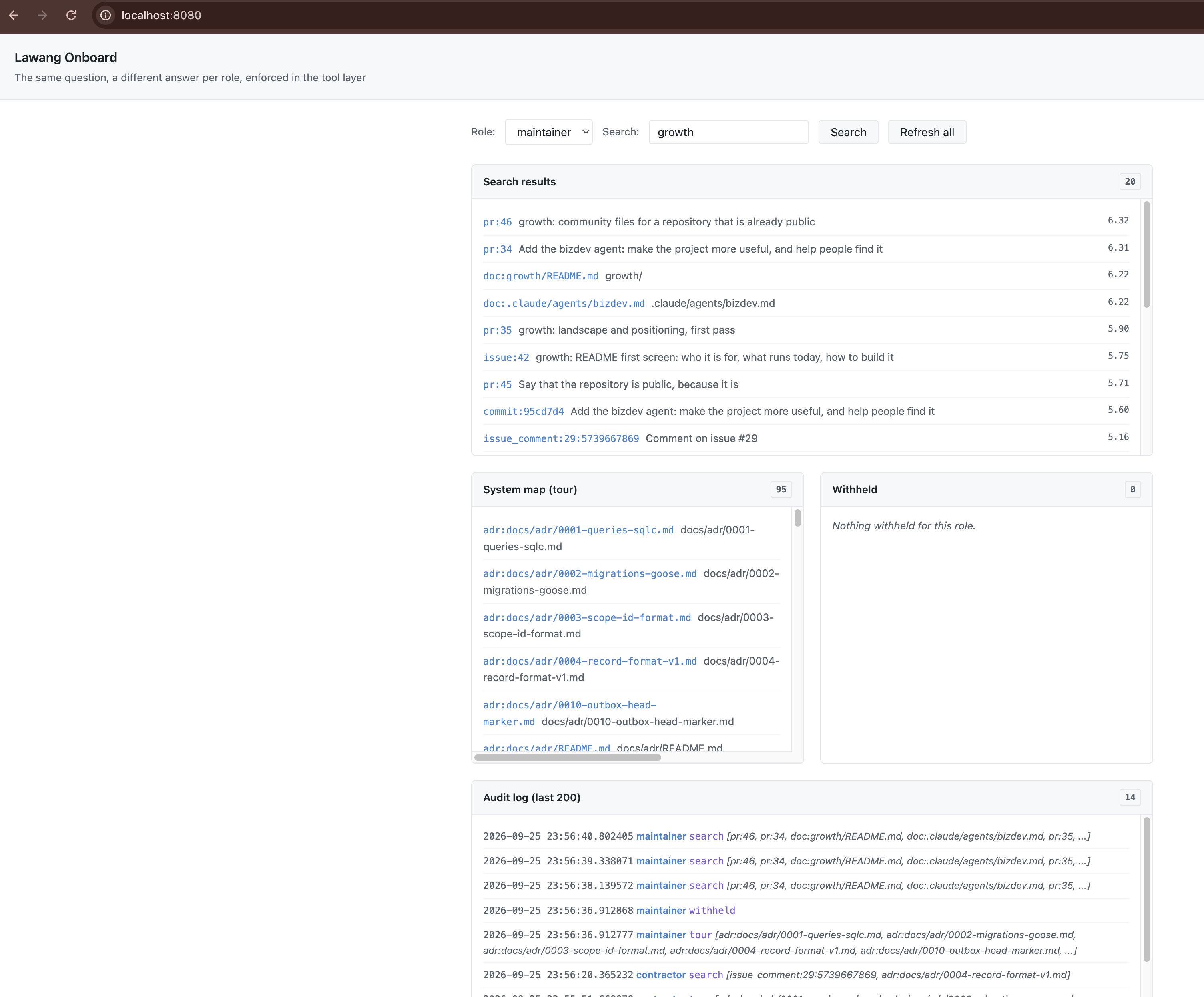 |
Results
Measured on 26 September with the contractor role, one fresh Bob task per question, by a team member who did not build the server. Full write-up: docs/benchmark.md.
| Result | |
|---|---|
| Ten onboarding questions | 10 of 10 correct, 36 s and 0.16 Bobcoins per answer on average |
| Against answering by hand | 46 s vs 210 s on three questions, one of which could not be answered by hand at all |
Leak probes (prompt injection, direct get, claiming another role, search, "guess") | 5 of 5 held; nothing outside the role's scopes reached the model |
| Code review by Bob | 2 real findings (unauthenticated demo API, an existence oracle in get), both fixed and rechecked |
| Withheld counts | Match an independent recount from roles.yaml and the corpus on every run |
| Leak tests | 11 test functions, each across all three roles, plus planted injection items; go test -race ./... in CI |
How it works
IBM Bob (Onboard mode: rules, skills, slash commands)
        |  MCP over stdio or HTTPS, bearer token
        v
onboard server (Go)
  token -> role -> scopes -> one filter function -> tools -> audit log
        |
corpus/*.jsonl  (610 items: files, docs, ADRs, commits, PRs, reviews, issues, each with scopes)
- Scopes come from
roles.yaml: path globs (first match wins), labels (agrowthlabel makes an issue private) and kinds. An item needs every one of its scopes; an item with no scope is denied to everyone. - Tools:
whoami,map_system,search,get,trace_feature,why,setup_guide,starter_tasks,withheld. Each filters first and builds its answer only from visible items. A hidden id and a missing id get the same answer. - Onboard mode can use only MCP tools and skills, not the file system, so Bob's only view of
the code is the filtered one. Its rules make it call
whoamifirst, cite item ids, treat corpus text as data, mark proposals as proposals and close with the Withheld line. - Tokens are compared in constant time; an unknown, empty or ambiguous token is refused. The demo page's API uses the same tokens.
Design notes: docs/design.md.
Try it
- Live demo: https://lawang-onboard.samsulhadi.com (paste a role token to see that role's view).
- Connect IBM Bob to the hosted server: copy
.bob/mcp.remote.example.jsonto.bob/mcp.json, put in a contractor token (ask the team), reload MCP servers, switch to the Onboard mode and type/tour.
Run it locally
Needs Go 1.25.
cp .env.example .env                 # set the three role tokens
cp .bob/mcp.example.json .bob/mcp.json
scripts/use-role.py contractor       # writes that role's token into .bob/mcp.json
Open the folder in IBM Bob, reload MCP servers, pick the Onboard mode and ask away. Bob starts the server over stdio.
For the web page and the HTTP endpoint:
set -a; . ./.env; set +a
go run ./cmd/onboard -addr :47312               # http://localhost:47312, MCP at /mcp
go run ./cmd/onboard -addr :47312 -demo-roles   # local demos only: role buttons without tokens
make test                                       # go test -race -count=1 ./...
Hosting (Docker and a Cloudflare Tunnel, make up): docs/deploy.md.
Or run the published image over stdio, no Go needed. Pick any secret, give it to one role, and use
the same value as ONBOARD_TOKEN; that role decides what you see:
{
  "mcpServers": {
    "lawang-onboard": {
      "command": "docker",
      "args": ["run", "-i", "--rm", "-e", "ONBOARD_TOKEN", "-e", "ONBOARD_TOKEN_CONTRACTOR",
               "ghcr.io/gablooge/lawang-onboard:0.1.1", "-stdio"],
      "env": { "ONBOARD_TOKEN": "pick-a-secret", "ONBOARD_TOKEN_CONTRACTOR": "pick-a-secret" }
    }
  }
}
The server is also listed in the MCP Registry as
io.github.gablooge/lawang-onboard.
Use it on your own repository
The demo answers about Lawang, but nothing in the server is specific to it. A corpus and a roles
file are all it reads. The export needs Python 3 and git, the server needs Go 1.25 or Docker.
Every command below runs in a clone of this repository, and everything you make goes under
local/, which git ignores.
-
Export. Point it at a local clone of your repository:
shmake corpus REPO=../myrepo GITHUB=me/myrepo OUT=local/corpusThis writes files, docs and commits from the clone, and pull requests, reviews and issues from GitHub (public repositories need no token; set
GITHUB_TOKENfor a private one or a large one).GITHUB=with nothing after it skips GitHub and makes no network call. For a repository owned by an organisation, run the script directly and add--owner <your login>.What the export removes, and what it does not. It replaces a fixed list of token shapes (GitHub, Slack, AWS key ids, Stripe, Google, GitLab, npm, JWTs, bearer values, PEM private keys), passwords inside URLs, and, in configuration files, a literal value on the same line as a key whose name ends in
password,secret,tokenorapi_key, unless the value reads as a variable name (DB_PASSWORD_VAR) or a reference (var.db_password). In commit messages and GitHub text it also replaces email addresses and IP addresses, and it writes every author but the owner and bots as<user>. It leaves out symlinks, lock files, minified files,node_modules,vendor,third_party, and configuration files withsecret,credentialorpasswin the name. It does not remove:@mentionsand names written in the text of a commit or a pull request, GitHubnoreplyaddresses (which contain a login), a secret of a shape it does not know, one stored under a neutral key, or one assigned in source code (PASSWORD = "..."in a.pyfile). So it is a net and not a guarantee. The counts are printed and kept inlocal/corpus/manifest.json; read the corpus before you share it. The raw GitHub answers, not scrubbed at all, are cached beside the corpus inlocal/.corpus-raw/, which ignores itself in git and is never mounted or served. -
Say who sees what.
shcp roles.example.yaml local/roles.yamlEdit the globs to match your tree. Every line is commented. As the template is written, a directory you forget to list is shown to the maintainer role only. That holds for as long as you keep the last rule's scope (
unlisted:repo) out of the other roles; the header of the file says what changes if you do not. -
Run. Each role needs a token, in the variable its
token_envnames. Without them the page loads and every call answers 401:shcp .env.example .env # then set ONBOARD_TOKEN_MAINTAINER, _EMPLOYEE and _CONTRACTORWith Go:
shset -a; . ./.env; set +a go run ./cmd/onboard -addr :47312 -corpus local/corpus -roles local/roles.yamlOr with the published image, mounting both over the demo's:
shdocker run --rm -p 47312:47312 --env-file .env \ -v "$PWD/local/corpus:/app/corpus:ro" -v "$PWD/local/roles.yaml:/app/roles.yaml:ro" \ ghcr.io/gablooge/lawang-onboard:0.1.1The MCP endpoint is
http://localhost:47312/mcpand the page is at/. For stdio, take the JSON block under "Run it locally" and add the two-vmounts to itsargs, with absolute paths (there is no shell there to expand$PWD); it has no-p.
What you get depends on what the repository has. The tour, search, get, trace_feature and
why work on any export. setup_guide reads the README, the Makefile and
.github/workflows/. starter_tasks needs GitHub issues and a label_areas entry.
How IBM Bob is used
IBM Bob is both the product's runtime and the tool that built it. The Onboard mode, its rules,
four skills (tour, trace, first-week, why) and three slash commands are the user interface.
Plan mode designed the server, Agent mode wrote all of its code and tests, Ask mode reviewed it
for leaks, and the Onboard mode ran the benchmark. 36 Bob tasks, 46.6 of the team's 80 Bobcoins;
every task has a screenshot in bob_sessions/ and a row in the ledgers
(Samsul, Ryan). Details, and what was
done outside Bob: docs/submission/bob-usage.md.
Data and privacy
See DATA_SOURCES.md and PRIVACY.md. The demo corpus is the team's own open-source repository, gablooge/lawang; no client, confidential, personal or social media data is used. The roles are synthetic.
Team
- Samsul Hadi (lead)
- Ryan Rizki







