Listed from the MCP registry; nobody on Odel publishes it.
Is this yours? Claim it
Glazecalc
Ceramic glaze chemistry: unity formulas, limit checks, substitutes, cones and potters' guides.
One address for any MCP client. No sign-in needed on this server.
What it does
16 read10 act8 other
Grouped by tool name. At most: creates or changes data: records, files, settings.
What it costs
FreeOdel charges nothing per call. The publisher may charge for its own service.
Tools
34 · grouped by tool name · checked 21 Nov 2026Read · 16Look things up
- search_materials
- get_material
- analyze_recipe
- check_limits
- convert_cone_temperature
- suggest_substitutes
- compare_recipes
- search_guides
- list_recipes
- get_recipe
- list_my_materials
- get_shelf
- list_firings
- get_firing
- list_notes
- get_my_settings
Act · 10Change something
- create_recipe
- update_recipe
- add_notebook_entry
- add_my_material
- update_my_material
- add_to_shelf
- remove_from_shelf
- move_to_trash
- create_firing_log
- add_firing_rows
Other · 8Neither hinted nor named
- specific_gravity_water
- match_from_materials
- solve_target
- blend_recipes
- vary_material
- match_with_what_i_have
- undo_shelf_change
- link_firing
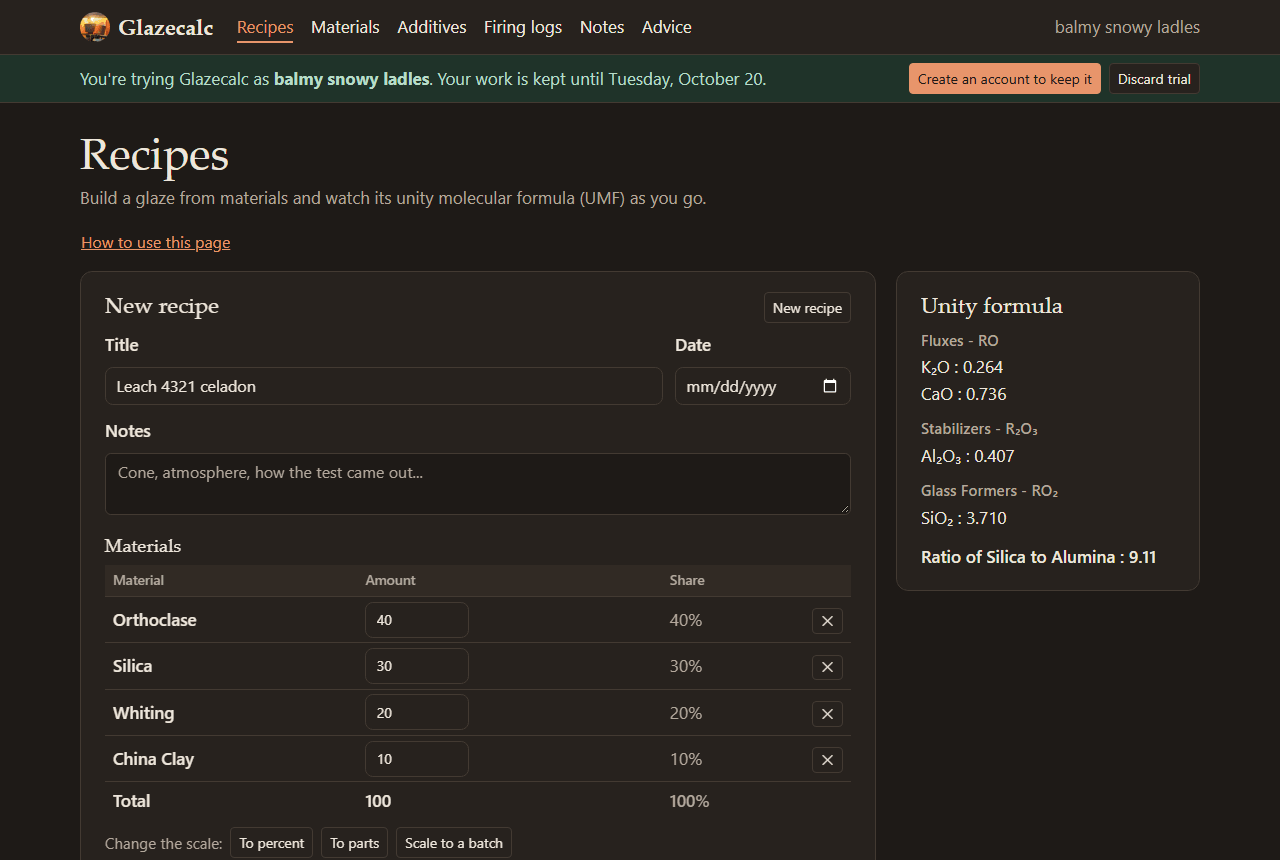
Free glaze chemistry for potters. Enter a glaze recipe and see its unity molecular formula (UMF): the fluxes, alumina and silica it becomes in the kiln, and their ratio. Keep your recipes, materials, colorants, firing logs and notes together in one private notebook.
glazecalcapp.com: try it without an account. A free, non-commercial project by Aaron Filson, in 57 languages, and usable from AI assistants through its MCP server.








 |  |
At a glance
For anyone reading the code; the highlights below give the details.
- Stack: Angular 22 (standalone components, signals, zoneless), TypeScript on Node 24 with Express 5 and Mongoose 9, MongoDB 9, Docker, and AWS (EC2, SSM, SES, S3, CloudWatch).
- Tested in CI on every pull request: over 1,950 server tests (98% of statements, 89% of branches), over 1,600 Angular unit tests (99% of statements, 91% of branches) and over 450 Playwright browser tests, with axe checks against WCAG 2.2 AA. Also the official MCP conformance suite, CodeQL on the code and the workflows, and Lighthouse on desktop: performance 98; accessibility, best practices and SEO 100. CI checks these numbers too.
- Security: sign-in with OAuth 2.0 and OpenID Connect (Google, GitHub, Microsoft) or a password; MFA with WebAuthn passkeys, TOTP and recovery codes; JWTs in httpOnly cookies with CSRF protection; a layered content security policy and a Permissions-Policy, graded A+ by Mozilla's HTTP Observatory; keyless CI/CD with no stored AWS keys, and images published with an SBOM and signed SLSA build provenance.
- AI assistants: an MCP server in the official MCP Registry, with its own OAuth authorization server: apps reach a person's records only with their consent, and, if the person chooses, an app's changes wait for their approval.
- Reach on a small budget: 57 languages, right to left (RTL) included; about 11,500 public pages prerendered (SSG) and hydrated; offline once visited (PWA); one $13-a-month Graviton instance, with automatic rollback. A load test on a container that size, at full CPU, serves about 250 requests a second, with a 95th percentile of 270 ms; the instance runs at full CPU only while its CPU credits last.
- How it is built: with Claude Code as a directed coding agent; commits made with it carry a
Co-Authored-By: Claudetrailer. Most larger features were planned in writing first (docs/*-plan.md), and a decision record keeps each decision that shaped the app, written as it landed; every change goes through the checks above; production deploys wait for approval. The case study tells how the 2017 app was revived, how the agent was directed, and what the checks caught.
Highlights
The details, with the decisions behind them:
- A 2017 AngularJS app rebuilt as Angular 22 (standalone components, signals, zoneless with no zone.js,
strict templates) and a TypeScript server on Express 5, Mongoose 9 and Node 24, which runs the
.tsfiles directly with no build step (ADR 8), and put back online. The case study tells how. - Tested at three levels, in CI on every pull request and push to master: over 1,950 server tests (98% of statements, 89% of branches) run against the app in-process; over 1,600 Angular unit tests (99% of statements, 91% of branches); over 450 Playwright browser tests, including axe accessibility checks against WCAG 2.2 AA of every page in light and dark mode, every page in a pseudo-locale to find text not marked for translation, and every page in each language at a phone's width. CodeQL scans the code and the workflows (its settings), and CI checks the numbers in this README against each run (scripts/readme-numbers.mjs).
- One glaze chemistry library for the browser and the tests, checked against values worked out by hand (ADR 4). It is plain JavaScript with hand-written declarations for the app and the server, and CI type-checks the JavaScript against them (lib/tsconfig.json). Its first run found five helpers the recipe tools share that the declarations had left out; they are declared now.
- Keyless CI/CD with approval: GitHub Actions gets short-lived AWS credentials through OIDC, for a role that can only run one SSM command document on this app's instance. There is no SSH, there are no stored AWS keys, and a failed health check means an automatic rollback (ADR 2). After every deploy, and daily, live checks test the site from outside (synthetic monitoring): its health and security headers, each language's home page, the pages in a browser with no CSP violation or script error, and the MCP endpoint against the protocol.
- A supply chain you can check: every action pinned to a commit, Dependabot, CodeQL, and the production image
published with an SBOM and SLSA build provenance, signed through GitHub
(
gh attestation verify oci://ghcr.io/aaronfilson/glazecalc:latest --owner AaronFilson). OpenSSF Scorecard rates the repository weekly (.github/workflows/scorecard.yml). - Production for about $13 a month: one Graviton EC2 instance with Docker Compose, nginx and Let's Encrypt, a layered content security policy (nginx's, a nonce per reply, and script hashes with 'strict-dynamic') with subresource integrity and a Permissions-Policy, graded A+ (120) by Mozilla's HTTP Observatory, structured JSON logs, nightly backups to S3, snapshots and CloudWatch alarms (ADR 1, ADR 3). A load test on a container held to the instance's size (2 vCPUs, 1 GB, arm64) served 50 visitors at once at about 250 requests a second, with a median of 215 ms, a 95th percentile of 270 ms and no failures (12 November 2026). That is at full CPU, which a t4g.micro gives only while its CPU credits last (it earns 12 an hour and keeps at most 288, about two and a half hours of both vCPUs flat out); after that it runs at its baseline of 10% of each vCPU, about a tenth of the rate for work the CPU limits.
- Careful accounts: bcrypt; HS256 JWTs with a version, so changing the password signs out every device, kept in an httpOnly, SameSite=Strict cookie with a cross-site request check (CSRF protection); hashed single-use reset links sent through Amazon SES with DKIM, SPF and DMARC; rate limits; ownership checks on every query; the current password to change the email or delete the account (ADR 5, ADR 6).
- Two-step sign-in (MFA) and outside providers: WebAuthn passkeys, authenticator apps (TOTP) and recovery codes (ADR 14); Google and GitHub (OAuth 2.0 and OpenID Connect) linked by the provider's id, never silently by email (ADR 15); Microsoft by tenant and subject (ADR 23).
- Privacy, written down: the records GDPR and the UK GDPR ask of a small service, kept with the code: a record of processing (Article 30), a breach plan (Articles 33 and 34), and how data-protection requests are answered (Articles 12 to 22).
- AI assistants as first-class clients: a stateless MCP endpoint that serves the protocol's 2026-07-28 revision (and the 2025 ones to older clients) and shares the app's recipe tools (ADR 17, ADR 19), listed in the MCP Registry and checked in CI against the official conformance suite; Glazecalc's own OAuth authorization server, built on the OpenID Certified oidc-provider library rather than by hand, since PKCE, refresh token rotation and resource indicators are each easy to get subtly wrong (ADR 24); and changes from an app that wait for the person's yes, when they choose (ADR 25).
- A translation pipeline (i18n) for 57 languages, right to left (RTL) included: Transloco with ICU messages and the language in the URL
(ADR 13); per-language glossaries sourced from suppliers'
catalogues, staged reviews, blind back-translation of the safety text, and a plain notice for
languages AI translates less well (process);
npm run check:i18nguards placeholders, plurals and stale English in CI. - Works offline once visited, as a PWA: Angular's service worker keeps the app, and the app keeps the reader's language and the guides in Cache Storage (ADR 28).
- Public pages prerendered at build (SSG) in every language and hydrated in place (Angular hydration), with hreflang and a sitemap per language under one index, about 11,500 pages, each reply compressed in Node with a fresh nonce (ADR 16).
- Trials as real accounts: a generated name, a placeholder email on the reserved
.invaliddomain so every email stays unique, conversion to an account in place (or into an existing account at sign-in), limits against abuse, and an hourly cleanup (ADR 7). - Lighthouse in CI, on a production build (desktop): performance 98; accessibility, best practices and SEO 100;
no layout shift. Four public pages, the median of three runs each; CI fails below the limits in
lighthouserc.json, and
npm run lighthousemeasures the same here.
What it does
Every feature, as a potter meets it.
Recipes and their chemistry, sharing, guides, regions and languages, and the rest
-
Recipe to unity formula, as you type. Build a glaze from your own materials or the standard ones and watch its oxides in unity, grouped as fluxes, stabilizers and glass formers, with the silica to alumina ratio. That is how glaze chemists compare recipes, fix faults and substitute materials. Change the scale to percent, to the smallest whole parts, or to a batch in grams or in pounds (each shown in pounds and ounces), with colorants as a percent of the base, in parts or in grams; save a recipe and keep working on it, or open a saved one to change it.
-
Compare two recipes side by side, oxide by oxide and by calculated thermal expansion, and try an old recipe with the modern materials that replace its discontinued ones (Custer Spar to G-200 EU), compared with the original. Where a swap is not like for like, it works the amounts out again, changing as few as it can, from materials sold in your region or any you add, and says what each one does and what to watch for past a recommended limit.
-
Match with what I have: make a recipe again from only the materials on hand, a list kept with your account.
-
Analysis and limits: the unity formula set against Hesselberth & Roy's stable glaze limits or Glazecalc's own, for the firing saved with the recipe, and a Stull chart of silica against alumina with its matte, semi-matte and bright regions.
-
Specific gravity and water: weigh a measured volume of the glaze to find its SG, then the water that brings the bucket to the SG you want, or the water for a new batch.
-
Paste in recipes from a website, a spreadsheet or your notes: see how each line was read and which material it was taken for before anything is saved.
-
Blends for test tiles: two, three or four of your recipes blended into numbered tiles, with what to weigh for each and the chemistry of each tile.
-
Cost per batch from the prices you pay, kept private with your account in one currency, and a mix ticket to print for the glaze room, with the batch number, the target SG and the materials' hazards (prices left off unless you choose).
-
Share a recipe with a read-only link that anyone can open without an account, with its unity formula and how it is worked out, step by step; stop sharing at any time.
-
Sign in with Google, GitHub or Microsoft, or with a password, two-step sign-in or a passkey.
-
Use it from your AI assistant: Claude, ChatGPT, GitHub Copilot, Cursor, Gemini and others can use the calculations through the Model Context Protocol (MCP) server at
/mcp, and your own records once you connect them: apps sign in to Glazecalc's own OAuth server and you say yes (read only unless you also allow changes), or you make an access token for them. Connected apps shows what each one did, puts back what it moved to the Trash and revokes it; the Assistants page says how to connect one. -
Guides for new potters, sourced: glazing from first principles with a glossary, how to make a glaze, safe mixing and ventilation, pottery at home with children and pets, and firing a basic kiln with cones, kiln sitters and manual switches; and, in English, a companion to John Britt's free online Glaze Course that links his videos unit by unit with exercises to try; and, in every language, a six-session pack for teaching glaze calculation.
-
Famous glazes, each a public page with its traditional recipe or historic analysis and a version from the materials sold where you live (İznik first, as history, with a lead-free version not yet test-fired).
-
Specific gravity and water, with the dry materials' SG estimated from the recipe (or typed, or measured as the making-a-glaze guide shows).
-
Lead off unless you choose it, and old lead glazes rebuilt without it: Replace lead keeps the glaze's silica and alumina and gives lead's work to boron and other fluxes, on a lead-free base frit sold in your region with up to four other materials chosen for it, or keeps the colour on a lead-free base.
-
Print it for the glaze room: the whole recipe with its unity formula and analysis, or just a batch list to tick off while weighing, with a running total for weighing into one bucket. One page on Letter or A4; weights in grams, or in pounds and ounces as set in your account.
-
Your region and your numbers: where you work sets numbers and dates as you write them (12,5 or 12.5 typed either way), °C or °F, Orton cones, SK cones (JIS R 8101) or firing by temperature, the standard materials sold there, and in the guides: who to call in an emergency for 72 countries, the closest materials sold there to those a recipe names, shops that sell glaze materials for 47 of them, the workplace limit for silica dust for 41 and food-contact limits for glazed ware for 42; each checked on an official or the shop's own page.
-
Translated into 57 languages: an official language of every country of the EU (Bulgarian, Croatian, Czech, Danish, Dutch, English, Estonian, Finnish, French, German, Greek, Hungarian, Irish, Italian, Latvian, Lithuanian, Maltese, Polish, Portuguese, Romanian, Slovak, Slovenian, Spanish, and Swedish), Japanese, Turkish, Traditional Chinese, Korean, Simplified Chinese, Thai, Vietnamese, Indonesian, Arabic and Urdu (right to left), Hindi, Bengali, Tamil, Marathi, Kannada, Telugu, Gujarati, Malayalam, Punjabi, Odia, Nepali, Sinhala, Latin American Spanish, Brazilian Portuguese, Swahili, Amharic, Afrikaans, Hausa, Yoruba, Zulu, Igbo, Somali and Quechua, each at its own addresses (
/de/recipe).Translated by AI with a glossary per language from suppliers' catalogues, reviewed, and the safety text checked by translating it back; every translated page says so and links to a form to suggest a better wording.
Every piece of text is a message (Transloco with ICU plurals), and the guides are Markdown per language (how translations are made).
-
Your own colors: light, dark or as the device is set, and six palettes named for glazes, each readable in both.
-
A standard library of 182 materials and 37 colorants and additives, from manufacturers' data sheets (and, for ashes and historical native materials, published research), for the US, UK, EU, Australia, New Zealand, Japan and the other regions, each with its source and other names, and hazards where the data sheet gives them, and each material with its own public page in every language. Discontinued materials stay for old recipes, each pointing to its modern replacement. Count colorants in the unity formula or leave them out, to compare with other calculators.
-
Your own materials, from a chemical formula or a supplier's analysis, and colorants and opacifiers on top of a base glaze.
-
A studio notebook: firing logs (times, temperatures, cones), notes, and plain-language advice on mixing, glazing and firing.
-
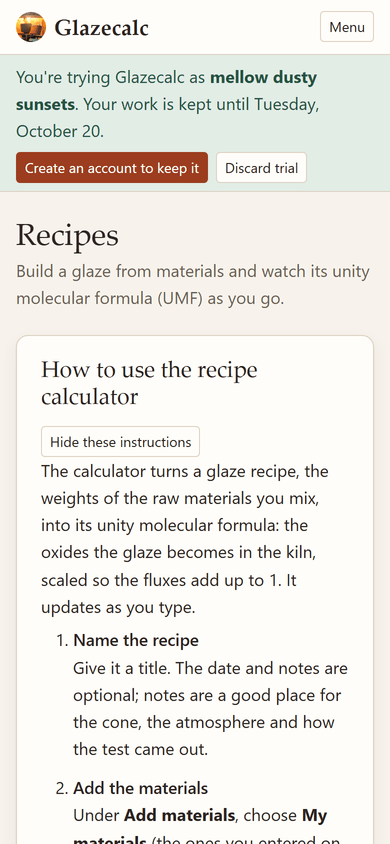
Try it now: the whole app works as a trial with a generated name such as "speckled quiet kilns". Creating an account keeps everything; trials are removed after 14 days.
-
Light and dark mode, from phone to desktop. Free and open source.
How it fits together
flowchart LR
  browser([Browser]) -->|HTTPS| nginx
  subgraph ec2 [EC2 t4g.micro, Debian 13]
    nginx["nginx<br/>Let's Encrypt, headers, gzip"] --> app["Node 24, Express 5<br/>/api and the Angular client"]
    app --> mongo[("MongoDB 9")]
  end
  app -->|SMTP| ses[Amazon SES]
  mongo -.->|nightly dump| s3[(S3 backups)]
  subgraph github [GitHub]
    ci["CI: lint, format, 3 test suites,<br/>image check"] --> ghcr[("GHCR image<br/>arm64 and amd64")]
    deploy["Deploy workflow<br/>approval, OIDC"]
  end
  deploy -->|"SSM: glazecalc-deploy"| ec2
  ghcr -.->|pull| app
The browser talks to one origin: nginx terminates HTTPS and passes everything to a single Node
process, which serves the JSON API under /api and the built Angular client for every other path.
A deploy runs deploy.sh on the instance through SSM: it pulls the new image, starts it, and goes
back to the previous one if the health check fails.
| Part | Built with |
|---|---|
| Client | Angular 22, TypeScript (strict), Transloco with ICU messages, Bootstrap 5 with a custom palette, Vitest |
| Server | TypeScript run directly by Node.js 24, Express 5, Mongoose 9, JWT, bcrypt, Mocha |
| Data | MongoDB 9 |
| Infrastructure | AWS (EC2, SSM, SES, S3, CloudWatch, IAM with OIDC), Docker Compose, nginx, certbot |
| Delivery | GitHub Actions, GHCR, Playwright with axe, ESLint, Prettier, Dependabot |
Run it locally
You need Node.js 24 (24.15 or later) with npm 11, and MongoDB Community Server 9.0 (4.4 or later works).
git clone https://github.com/AaronFilson/glazecalc.git
cd glazecalc
npm install
npm run db                        # MongoDB on ./db, in a second terminal; leave it running
npm run seed                      # standard materials, additives and advice
npm run dev                       # then open http://localhost:3000
Settings such as APP_SECRET and MONGODB_URI can go in a .env file (copy .env.example,
which describes each one); the scripts load it with Node's built-in --env-file support. Outside
production, emails (such as password reset links) are printed to the console.
On macOS before 14, Sass's native compiler cannot run, and the Angular build and tests stop at
"Building...". Set NG_BUILD_SASS_EMBEDDED=0 in your shell (in ~/.zshrc, say), not in .env, which
ng does not read: the build then uses Sass's JavaScript compiler, and so does the server's Bootstrap test.
All the tools, with install links and version checks
| Tool | Needed for | Install | Check the version |
|---|---|---|---|
| Git | Cloning the repository | Downloads | git --version |
| Node.js 24 LTS (24.15 or later) | Building and running the app | Download Node.js | node --version |
| npm 11 (comes with Node.js 24) | Installing packages, running scripts | Installing npm | npm --version |
| MongoDB Community Server 9.0 (4.4 or later works) | The database | Download MongoDB | mongod --version |
| A modern web browser, such as Firefox or Chrome | Using the app | Firefox download | Help → About in the browser |
Optional, depending on what you do:
| Tool | Needed for | Install | Check the version |
|---|---|---|---|
| nvm-windows or nvm (macOS, Linux) | Switching between Node.js versions | nvm-windows releases, nvm install script | nvm version (Windows), nvm --version |
| MongoDB Shell (mongosh) | Looking at the database by hand | Download mongosh | mongosh --version |
| Docker Engine with Docker Compose | Running the app and MongoDB in containers | Install Docker Engine | docker --version and docker compose version |
| WSL 2.1.5 or later (Windows only) | Running Docker inside Linux on Windows | Install WSL | wsl --version |
| Playwright Chromium | The browser tests | Install browsers: npx playwright install chromium | npx playwright --version |
The Angular CLI, TypeScript, ESLint and the test runners are installed into the project by
npm install, so they need no separate install; npx ng version shows the Angular versions.
Scripts
npm run dev      Angular dev server on port 3000 with live reload; it forwards /api to the
                 API server on port 4000, which restarts when server code changes
npm run build    production build of the client into dist/glazecalc/browser, then renders the
                 public pages in every language to dist/glazecalc/prerendered (docs/seo-plan.md)
npm start        builds, then runs one server on port 3000 (PORT) with the app and its API
npm run seed     loads the standard materials, additives and advice into MONGODB_URI
node scripts/usage-stats.mjs
                 totals for the README: accounts, what they keep, connected apps, countries;
                 counts only (on the instance: see the script's header)
npm run lint     checks the code with ESLint
npm run typecheck  checks the server's TypeScript (Node runs it without compiling), and the
                 chemistry library's JavaScript against its declarations (lib/tsconfig.json)
npm run format   formats files with Prettier (npm run format -- .)
npm run seed replaces standard records with the same id, so it is safe to run again after the
data files change, and it leaves users' own entries alone. All scripts work in any shell,
including PowerShell and cmd.
Tests
| Command | What it runs |
|---|---|
npm test | Server and chemistry tests (Mocha), the files in parallel (a worker for each core but one; --jobs sets it). Each worker serves the app inside its process on a free port with a database of its own (glazecalc_test_w0, _w1, …, emptied before each file and dropped after); only mongod must be running. |
npm run test:client | Angular unit tests (Vitest), with no server or database. |
npm run test:core | The chemistry core's own tests (lib/core/test, Node's test runner), with no server, database or packages. They fail below 98% of its branches, or 99% of its lines or functions. |
npm run test:catalog | The catalog's own tests (lib/catalog/test), the tables the core is given, with no server, database or packages. They fail below 100% of its lines, branches or functions. |
npm run test:e2e | Browser and accessibility tests (Playwright and axe), in parallel workers (half the cores; E2E_WORKERS sets how many) against one server. They build the app when dist/ is older than its sources (E2E_BUILD=always or never overrides), run it on port 3100 (E2E_PORT) with a glazecalc_e2e database (E2E_MONGO_URI) they reset, and need Chromium once: npx playwright install chromium. |
npm run test:e2e:linux | The browser tests on Linux in Docker, in the same Playwright image CI runs them in, so a layout that passes here passes there. It tests the working tree, uncommitted changes included, and copies what failed to test-results-linux/. On Windows it runs through WSL, which needs Docker inside it. |
npm run test:e2e:both | The browser tests here and on Linux at the same time, each with a quarter of the cores (E2E_WORKERS sets each run's workers), with each line marked with the run it came from. The two share nothing, so it takes about as long as the slower one. |
npm run check:i18n | The messages: every key the app uses has its English and every English is used, translations keep the English's placeholders, tags and plural forms, and the English written from code is current (how to write text). |
npm run check:outputs | Every output of the chemistry (standard materials, famous glazes in every region, seeded recipes, cones, slurries, typed text) against the hashes in scripts/chemistry-outputs.json, in about two minutes. A change that moves one says why in its PR and keeps the new hashes (--write); --rows prints every output, to compare two checkouts. |
npm run i18n:sources | Writes the English of the messages kept in code and data (the server's, the chemistry's, the standard records', who to call, the region data) for translators, and takes out every translation made from English that has changed since (docs/translating.md). It refuses while translations have uncommitted changes (--force overrides); -- --dry-run shows what it would change. |
npm run test:all | The server, Angular and browser tests, on this machine. |
npm run test:all:linux | The server and Angular tests, then the browser tests on Linux. Run it before pushing anything that changes layout or printing. |
npm run lighthouse | Lighthouse on a production build, as CI runs it: four public pages on the desktop setting, three runs each, against the limits in scripts/lighthouse/lighthouserc.json. It builds when dist/ is out of date, runs the app as production on port 3200 (LIGHTHOUSE_PORT) with a glazecalc_lighthouse database, and needs Chrome. The reports go to lighthouse-results/. |
npm run check:audit | npm audit, as CI runs it: it fails on any high or critical advisory but those allowed for a while in scripts/audit-allowed.json, each with why it can wait and its last day. |
npm run test:coverage and npm run test:client:coverage add coverage reports, and
npx playwright show-report opens the browser test results. GitHub Actions runs lint, the format
check, an npm audit, the build and all three suites on pushes to master and on pull requests,
against a MongoDB 9 service container, and builds and checks the Docker image
(.github/workflows/ci.yml). The jobs run side by side, and the browser tests are split across
three runners (--shard), whose reports are merged into one (the playwright-report artifact).
The server and Angular suites run with coverage, a Lighthouse job measures a production build, and
a last job checks the numbers this README gives against the run (scripts/readme-numbers.mjs): one
that is no longer true fails the run, and one that has fallen well behind gets a warning. CodeQL scans
the code and the workflows in a workflow of its own (.github/workflows/codeql.yml).
Project structure
client/           Angular 22 app (standalone components, signals, no zone.js)
  app/core/         API access, sign-in and trials, route guards, data models
  app/i18n/         languages: loading messages, the language in the address, the AI notice
  app/pages/        one folder per screen: landing, recipe, material, additive, firing, ...
  app/shared/       page header, messages, option lists
  public/           icons, images, manifest and robots.txt, copied into the build
  public/i18n/      the messages in each language, and the guides in Markdown
  i18n-fingerprints/  the English each translation was made from
  styles.scss       the palette and dark mode, on top of Bootstrap 5
lib/chemistry/    glaze chemistry: molar masses, material analyses, the unity formula
lib/recipe/       the recipe tools the app, the server and the MCP tools share: amounts,
                  analysis, limits, checks, substitutions, blends (ADR 19)
lib/cones/        pyrometric cones (Orton, SK) and a recipe's firing
lib/regions/      the regions and languages, and each country's facts for the guides:
                  who to call, shops, silica limits, food-contact rules
lib/pages.js      the pages worth finding in a search (sitemap, server, prerender)
lib/mfa.js        the numbers two-step sign-in's server and app share
server/           the API server, in TypeScript that Node runs as it is (no build step)
  main.ts           starts it: connects to MongoDB, listens, shuts down cleanly
  app.ts            the Express app: the API under /api, the built client for the rest,
                    and the sitemap (/sitemap.xml), written for each language
  routes/           accounts, password reset, trials, and records.ts: the six kinds of
                    record a user keeps, served by one route factory, and the Trash
  lib/              sign-in tokens, the record routes, trial limits and cleanup, email, logging
  mcp/              the MCP server for AI assistants (/mcp): its tools, prompts and guides
  models/           Mongoose schemas
  test/             server and chemistry tests (Mocha)
e2e/              browser and accessibility tests (Playwright, axe)
data/             the standard materials, additives and advice, loaded by npm run seed
scripts/          the dev runner (npm run dev), the seed script, the messages check and
                  sources (npm run check:i18n, i18n:sources), the browser tests on Linux
                  (npm run test:e2e:linux), Lighthouse (npm run lighthouse), the README's
                  numbers check, and one that adds records to the library
Dockerfile, compose.yaml
                  the production image, and the app plus MongoDB in containers
deploy/           production on EC2: Compose file, nginx, cloud-init, deploy and backup
                  scripts, AWS policies and setup commands, and the same AWS setup as
                  CDK stacks (deploy/cdk/)
docs/             decision records (adr/), the case study, the translation plan and guides
                  (translating.md, translations/), setup notes
.github/          CI, CodeQL, image publishing and deploy workflows, issue forms, Dependabot
Docker and deployment
The Dockerfile builds a production image: Node 24 on Debian slim, running as a non-root user, with
a health check on /api/health that also checks the database. compose.yaml runs it with
MongoDB 9, keeping the data in a named volume:
APP_SECRET=<long random string> docker compose up -d --build
docker compose run --rm app node scripts/seed-standard.js    # standard data, once
docker compose logs -f app
The app is published on 127.0.0.1:3000 only; put a reverse proxy in front for public access,
because ports Docker publishes bypass ufw. Production on AWS is described step by step in
deploy/README.md and deploy/aws/README.md. The same AWS
resources are declared as AWS CDK stacks in deploy/cdk, checked by cdk-nag
and tests in CI, with the steps to bring the live ones under them with cdk import
(ADR 29). On Windows,
Docker Engine runs inside WSL: docs/wsl-local-deploy-debian.md
has notes from setting it up in WSL Debian.
When the app is reachable by other people, set APP_SECRET to a long random value (production
requires it; changing it signs everyone out), set MAIL_TRANSPORT and SMTP_URL so password
reset emails can go out, and set SITE_URL (formerly APP_URL) to the address people open the app at, which the links
in those emails use. Put them in the environment or in .env; compose.yaml passes them to the
app (.env.example describes each one). Sign-in, sign-up, trials and password reset
are rate limited per client address; behind a reverse proxy the app trusts one hop of
X-Forwarded-For for that address.
More
- Decision records: why it is built the way it is.
- How translations are made and how to write text.
- Contributing and reporting a security problem.
- Changelog.
- Case study: reviving a 2017 app.
- Found a problem or have an idea? Open an issue.
Glazecalc is open source under the MIT License.