weave
Connected tables, relations, workflows and markdown documents in one SQLite file, over MCP.
Runs on your machine from its package; the steps are below.

What it does
- Reads
- Writes
- High impact
Not assessed yet.
What it costs
FreeOdel charges nothing per call. The publisher may charge for its own service.
Runs locally over stdio
This server isn't hosted — your MCP client launches it from a package registry. Use one of the commands below, or drop the config into your client (e.g. Claude Desktop).
Run
docker run -i --rm ghcr.io/grunion-ai/weave:0.4.91
MCP client config
{
  "mcpServers": {
    "weave": {
      "command": "docker",
      "args": [
        "run",
        "-i",
        "--rm",
        "ghcr.io/grunion-ai/weave:0.4.91"
      ]
    }
  }
}

weave
An open-source, self-hosted alternative to Airtable, Fibery, Notion databases, and ClickUp — built so that AI agents are first-class users, not an afterthought.
Connected tables, relations, workflows, formulas, rollups, and per-entity markdown documents. One SQLite file. Zero dependencies. No build step. MIT.





For agents · Quickstart · Comparison · Agents & MCP · Self-hosting · FAQ
For agents
weave stores structured work (tables, rows, relations, documents) in one SQLite file, and an agent drives it over MCP, REST or the CLI.
- Connect over MCP:
node bin/weave.js mcp --data <file.db>, the same asweave mcp --data <file>. In Claude Code:claude mcp add weave -- node /path/to/weave/bin/weave.js mcp --data /path/to/workspace.db - Or build from a file:
weave build <spec.json> --dry-run, then again without--dry-run. - Read AGENTS.md › Using weave first: the primer, every tool by job, plans with turn budgets, and common errors with their fixes.
What weave is
weave is a work platform you run yourself: spaces hold tables, tables hold entities, and entities connect to each other through real bidirectional relations — with lookups, rollups, formulas, workflow states, automations, and any number of markdown documents attached to each row.
It is meant to replace the SaaS your work already lives in — Airtable's bases and grids, ClickUp's tasks and boards, Fibery's connected databases with documents and automations — running on your laptop or your own server, with no per-seat bill and no vendor holding the export button.
The difference from every other tool in this category is the second audience. Work-management tools are built for humans first and APIs second. weave is built for humans and agents as equals: everything the web UI can do, the REST API, the CLI, and the built-in MCP server can do too — same engine, same data file on your disk. A local install needs no account and sends no telemetry. The hosted instance at https://weave.grunion.ai runs the same code behind a sign-in door.
- Local-first — your workspace is one SQLite file next to your project.
- Yours to host — one Node process and one file; run it on a laptop or a small VPS behind your own TLS and login (see Self-hosting).
- Zero dependencies —
git cloneand run. Storage is Node's built-innode:sqlite; the only third-party code is vendored and pinned. - Agent-native — an MCP server any stdio client can mount (Claude Code,
Codex CLI, Cursor, Gemini CLI), a scriptable CLI,
Table#12refs everywhere, and markdown documents addressable as plain URLs (/e/Task#12/doc.md,.html,.pdf). - Undoable — every entity mutation (edits, creates, deletes, links,
comments) can be stepped back with
weave undo,POST /api/undo, or theweave_undoMCP tool; agents get to make mistakes without making a mess. - Versioned documents — every document field keeps its revisions (one
per editing session), browsable and restorable from the page,
weave doc-revisions/weave doc-restore, or theweave_doc_revisions/weave_doc_restoreMCP tools.
Quickstart
Requires Node ≥ 22.16 (Node 24 LTS recommended). There is nothing to build and nothing to install from npm.
git clone https://github.com/grunion-ai/weave
cd weave
node bin/weave.js serve --port 4400 --data ./my-workspace.db
Or start it in a container from the same checkout:
docker compose up -d
Open http://127.0.0.1:4400 — press ⌘K to search everything. A
self-documenting weave docs workspace is provisioned alongside your data at
/w/weave/: handbook, wiki, the public issue tracker and roadmap, and a
Quality space mirroring the test suite.
If weave replaces a SaaS seat for you, star the repo. Stars are how the agent scouts and the directories find it.
Connect your agent
One config block, any stdio MCP client (Claude Code, Claude Desktop, Codex CLI, Cursor, Gemini CLI, Windsurf, OpenCode):
{ "mcpServers": { "weave": { "command": "node",
  "args": ["/path/to/weave/bin/weave.js", "mcp", "--data", "/path/to/my-workspace.db"] } } }
Or add it to Claude Code in one line:
claude mcp add weave -- node /path/to/weave/bin/weave.js mcp --data /path/to/my-workspace.db
A hosted instance with a sign-in provider (Door C) is one line too. The first call opens the provider's sign-in in your browser; no token to paste:
claude mcp add --scope user --transport http weave https://weave.example.com/mcp
/w/<name>/mcp serves another workspace. Your account has to be linked to
your provider sign-in first (open the invite weave account link <name>
prints, once, in a browser), and it needs the Architect role, since MCP
carries the schema tools.
Seventeen tools by default, the ones a workspace build uses, weave_build among
them, plus weave_call,
which reaches the other forty-eight. weave mcp --tools all (or
WEAVE_MCP_TOOLS=all) lists all 65. The same undo the UI has, and
weave_vocabulary so an agent reads the allowed values instead of guessing. Full map:
Agents: MCP, REST, and CLI.
Screenshots
| Documents on every row | Relation map | Universal search |
|---|---|---|
 |  |  |
Every entity carries markdown documents, addressable as .md, .html, and .pdf URLs. | The schema, drawn: relations with cardinality, plus the automation layer. | ⌘K across every workspace, backed by SQLite FTS5, with copyable permalinks. |
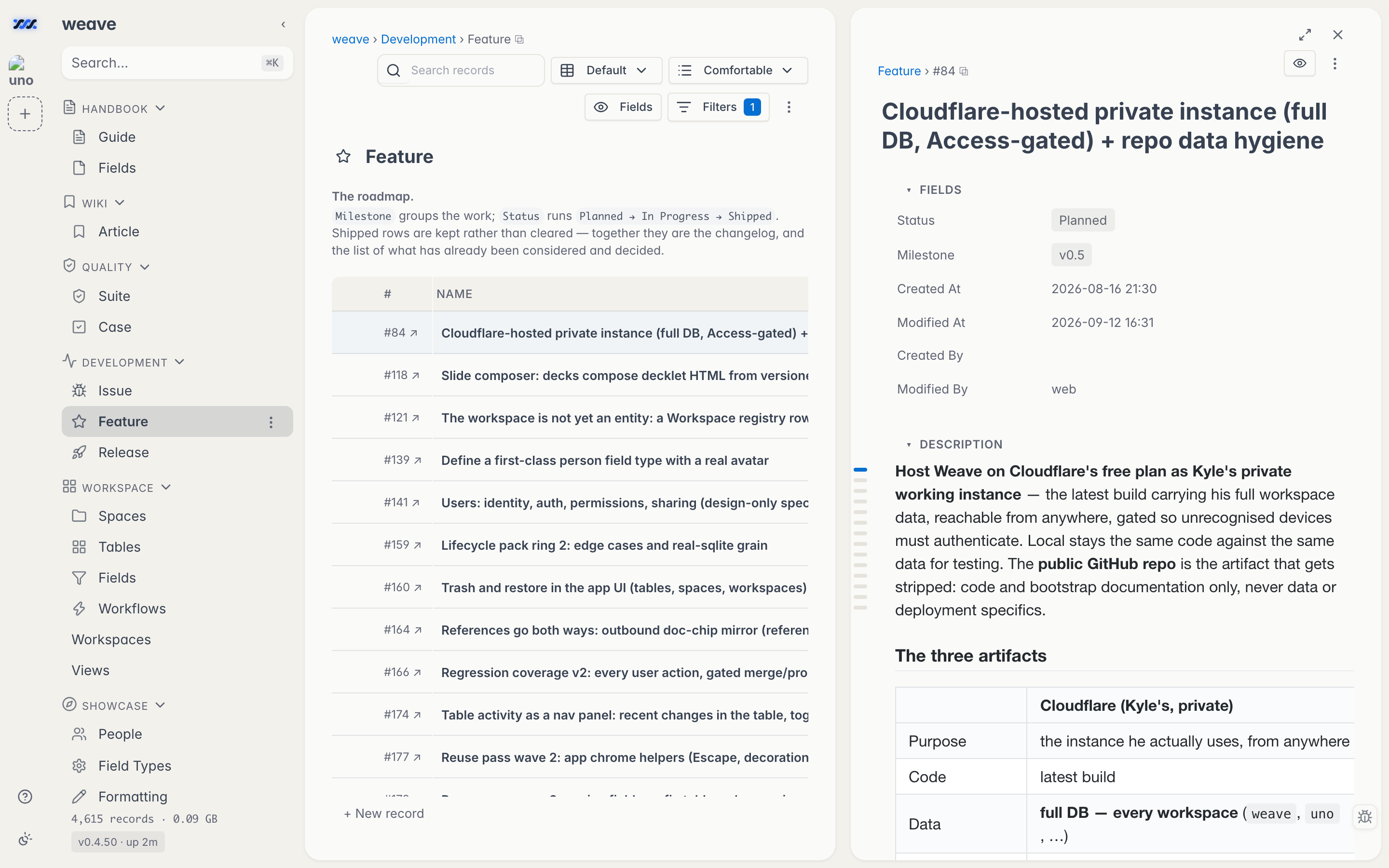
Open any row and it docks beside its table, so the entity and the rows around it stay in view together.
How weave compares
Against the SaaS it replaces
| weave | Airtable | ClickUp | Fibery | |
|---|---|---|---|---|
| License | MIT, open source | Proprietary | Proprietary | Proprietary |
| Where the data lives | A .db file you own | Vendor cloud | Vendor cloud | Vendor cloud |
| Pricing | Free — it's a repo | Per seat, per month | Per seat, per month | Per seat, per month |
| Row / record caps | Your disk | Plan-tiered | Plan-tiered | Plan-tiered |
| Agent access | MCP server + REST + CLI, all first-class | API + partner integrations | API + partner integrations | API + partner integrations |
| Runs offline | Yes | No | No | No |
| Telemetry | None | Vendor-defined | Vendor-defined | Vendor-defined |
Against other open-source Airtable alternatives
The open-source options in this space are all worth a look, and several are far more mature than weave. They differ mainly in what they optimize for:
| Project | License | Install shape | Optimized for |
|---|---|---|---|
| weave | MIT | One Node process, one file, no deps | Agent access, connected documents, disappearing into a repo |
| NocoDB | Sustainable Use License (since v0.301.0) | Docker + external DB | Putting a smart-spreadsheet UI on an existing MySQL/Postgres |
| Baserow | MIT (core; paid tiers separate) | Docker Compose + Postgres | A full Airtable-shaped product, cloud or self-hosted |
| Grist | Apache-2.0 | Docker or Node | Spreadsheet-grade formulas and data analysis |
| Teable | AGPL-3.0 (core) | Docker + Postgres | Postgres-native scale with an Airtable UI |
Licenses and packaging as of August 2026 — check each project for current terms. Pick weave if you want connected tables plus markdown documents plus an MCP server, with no container, no database server, and no dependency tree. Pick one of the others if you need multi-user permissions, a hosted option, or a mature plugin ecosystem — see what weave is not.
What's inside
| Area | Details |
|---|---|
| Data model | Spaces → tables → entities. Field types: text, number, rating (icons you click to fill, 0 to a max), date, date range, checkbox, toggle (a switch with two named states), url, email, select, multiselect, workflow states, bidirectional relations, lookups, rollups (count, sum, avg, median, min, max, range, stdev, distinct, filled, empty, join — over a relation, or over a whole table from the space's own row, which is what the grid footer draws), formulas, and any number of markdown document fields per entity. |
| Statistics | weave stats <table> (also weave_stats and GET /api/tables/:ref/stats): every column summarised — five-number summary, stdev and a histogram for numbers, ranked distributions for chips, earliest/latest/span for dates — grouped with --by, narrowed with --where, cut to one column and its rollups with --field. |
| Views | Table, entity pages (docked beside the table or opened full page), a relation map with the automation layer drawn in, and per-space/table filtering. Inline editing everywhere. |
| Documents | Every doc is a native URL: .md, .mmd, .html, .pdf. Mermaid diagrams, raw HTML and math render in place; [[Table#12]] mentions resolve to links. Whole-entity export paginates one page per document. Math is KaTeX only ($…$ / $$…$$, vendored + offline); the other fence engines Vditor knows (graphviz, echarts, plantuml, mindmap, abc, flowchart) are deliberately not vendored, so those fences stay plain code blocks. |
| Automations | Triggers (created / field changed / state changed) → set field, append doc, add comment, outgoing webhook. |
| Search | Universal ⌘K across workspaces with copyable permalinks, backed by a SQLite FTS5 index. |
| Storage | One workspace = one .db file (WAL, row-level writes, crash-safe). Legacy JSON workspaces migrate automatically; exportJSON/importJSON remain the human-readable interchange. CLI, server, and MCP can run concurrently. |
| Interfaces | Web UI (vanilla JS, no build step) · REST API · CLI (bin/weave.js) · MCP server (weave mcp). |
Agents: MCP, REST, and CLI
Every interface drives the same engine and the same file. Nothing is UI-only.
MCP — point any MCP client at the stdio server. Claude Code, Claude Desktop, Codex CLI, Cursor, Gemini CLI, Windsurf and OpenCode all mount stdio servers, so one config block works in each of them:
{
  "mcpServers": {
    "weave": {
      "command": "node",
      "args": ["/path/to/weave/bin/weave.js", "mcp", "--data", "/path/to/my-workspace.db"]
    }
  }
}
It exposes the whole platform as 65 tools. tools/list names the core build
set (weave_ontology, weave_schema, weave_query, weave_get_entity, weave_create_entity,
weave_update_entity, weave_create_space, weave_create_table,
weave_add_field, weave_update_field, weave_add_relation,
weave_import_csv, weave_vocabulary, weave_workspace, weave_search,
weave_build for spaces, tables, fields, relations and rows in one call) and
weave_call, whose description lists every other tool (weave_set_doc,
weave_link, weave_set_state, weave_update_table, weave_apply_schema,
weave_views, weave_automations, weave_activity and the rest) in one line
each; weave_call {name: "help", args: {tool}} returns a tool's full schema.
Add --tools all to the mcp args, or set WEAVE_MCP_TOOLS=all, to list all
65 directly. An agent designs a schema,
fills it, and configures how it reads — icons, option colors, column widths and
order, hidden columns, saved views — without a human opening the UI.
Two things make that practical. weave_vocabulary returns every value a config
key will accept and what the choice looks like on screen, so an agent picking
a color or an icon is reading rather than guessing. And the meta-model means the
schema is data: the rows of Workspace/Spaces, Workspace/Tables and
Workspace/Fields are the spaces, tables and fields, so an entity write on a
registry row runs the same validation as the schema verb — a field's whole shape
edits through its Definition, a table's column order through Field Order.
The registry lives once, at the weave root (the default workspace): a
Workspaces table holds one row per workspace the hub serves, every registry
row carries a Workspace relation, and a row edit routes to the workspace that
owns it.
REST and CLI cover the same ground:
# REST
curl -s localhost:4400/api/tables/Task/query -X POST -d '{"where":[["Status","=","Open"]]}'

# CLI
node bin/weave.js query Task --where '[["Status","=","Open"]]' --data ./my-workspace.db

# MCP (stdio)
node bin/weave.js mcp --data ./my-workspace.db
Entity refs accept UUIDs, #12, Table#12, or Space/Table#12 — in the UI, in
the API, in documents, and in agent tool calls. See AGENTS.md for
the full agent-facing map of the repo, including the one place the qualified
form is not yet accepted.
Self-hosting
A hosted install is the local install plus a door. The container is the same on every target and the Handbook carries the guides (open Handbook → Guide on any instance, including the one you just started):
- Self-host weave: choose your door: the two authentication surfaces (an edge gate, an identity provider) and the rule: the surface is the operator's choice. The built-in passkey door was removed after 0.4.52.
- Door A: an edge gate: Cloudflare Access, Tailscale, Caddy, oauth2-proxy, Authelia: one config block and one check each.
- Door C: sign in with a provider: one OpenID Connect provider (Clerk,
Auth0, Keycloak, Authentik, Google).
weave account link <name>mints a one-time invite link that opens an account to it; signing in creates none, and weave keeps one verified email per sign-in identity, nothing else.WEAVE_ORIGINnames the origin the provider sends people back to. Agents keepwv_tokens. - Deploy: Railway: project from GitHub, volume at
/data, variables, custom domain, one replica. - Deploy: Fly.io, Render, a VPS, Docker: one section each, same shape; the service unit lives here.
- Backup and restore:
weave backup(one sealed tar of every workspace, attachments and keystore),weave restore, the nightly switch, retention. - Environment reference: every variable, its default, and what breaks when it is wrong.
Quick start with Docker, using the Dockerfile and compose.yaml in the repo:
docker compose up -d # http://127.0.0.1:4400, data in the weave-data volume
railway.json and fly.toml are the platform manifests for the same image.
Whatever the target, put a door in front and run weave workspace require-auth
before the port is reachable from anywhere but your own machine. The threat
model behind that rule is in SECURITY.md.
What weave is not
Stated plainly, so you can rule it out fast:
- No fine-grained permissions. Each account holds one of three roles in a workspace: an observer reads and comments, an editor writes rows, an architect also changes structure, accounts and keys. Nothing narrows access to one space, row or field.
- Auth is off until you turn it on. Agents carry
wv_tokens and people sign in through one OpenID Connect provider, but only afterweave workspace require-auth. Until then, anyone who reaches the port can do everything an architect can. - Not a hosted product. There is no cloud tier, no signup, and no support contract. You run it.
- Not a plugin ecosystem. No marketplace, no extensions, no third-party apps.
- Not battle-tested at scale. It is a young project backed by a test suite, not by years of production mileage across thousands of installs.
If those are dealbreakers, Baserow, NocoDB, and Grist are the mature open-source options in this space.
FAQ
Is weave a good open-source Airtable alternative? If what you liked about Airtable was linked records, rollups, formulas, and views — yes, and you get markdown documents on every record plus an MCP server on top. If you relied on Airtable's collaborator permissions, hosted forms, or marketplace apps, no.
Is there a self-hosted Fibery alternative? That is the closest description of weave. Fibery's model — connected databases across spaces, documents attached to entities, automations, and a relation graph — is the model weave implements, in a single file you own. See docs/PARITY.md for the feature-by-feature matrix.
Can AI agents use it?
That is the point. The MCP server exposes 65 tools covering schema design,
CRUD, documents, relations, workflow states, search, automations, and CSV
import/export, seventeen of them listed by default and the rest one weave_call
away. Agents can build the schema, not just fill it in.
Do I need Docker, Postgres, or npm install?
No, no, and no. One git clone and a Node runtime. Storage is Node's built-in
node:sqlite; the only third-party code (mermaid, Tabler) is vendored and
pinned in the repo.
Where does my data actually live?
In <workspace>.db — a plain SQLite file — plus a files/ directory for
attachments. Open it with sqlite3, back it up with cp, commit it if you
like. node bin/weave.js export dumps the whole thing as readable JSON.
Can multiple people use one instance?
Yes. Give each person an account at a role (observer, editor or architect),
run weave workspace require-auth, and let them sign in through your OpenID
Connect provider. Every change lands in the audit log under the name of the
account that made it. Permissions stop at the workspace: no rule narrows access
to one space, row or field.
How do I migrate off it?
node bin/weave.js export --data <file> writes the entire workspace as JSON,
csv dumps any table, and the .db is standard SQLite. There is no lock-in to
escape.
Development
npm test
The test suite is mirrored as entities in the docs workspace (Quality space),
and the roadmap + issue tracker live there too (/w/weave/) — the tool tracks
its own development. See CONTRIBUTING.md before opening a PR;
README screenshots are regenerated with node scripts/screenshots.mjs.
Third-party (vendored, pinned)
- mermaid 11.4.1 — MIT © Knut Sveidqvist & contributors
- @tabler/core 1.4.0 — MIT © Paweł Kuna & The Tabler Authors
- Vditor 3.11.3 (pruned: only the assets weave loads) — MIT © Vanessa219
- KaTeX 0.18.11 (js + css + woff2 fonts + mhchem) — MIT © Khan Academy & contributors
- DejaVu Sans 2.37 (
DejaVuSans.ttf, PDF export Unicode fallback) — Bitstream Vera license © Bitstream, Inc.; DejaVu changes public domain; Arev glyphs © Tavmjong Bah (full text inpublic/vendor/fonts/DejaVuSans-LICENSE.txt)
Security
Authentication is off until an architect runs weave workspace require-auth
on a workspace. Until then, anyone who reaches the port does everything an
architect can in it. A local install binds 127.0.0.1, so it stays private to
your machine. The container binds 0.0.0.0 for the platform's proxy, so before
anyone else can reach a hosted install, put a door in front of it (see
Self-hosting) and run require-auth. Every page and API route
then refuses a caller without a wv_ token or a signed-in session.
Roles stop at the workspace. An observer reads and comments, an editor writes rows, and an architect changes structure, accounts and keys.
A document of kind html renders on the application's origin, so script an
editor places in one runs for whoever opens it. We are reviewing that
limitation. Until it changes, grant editor access the way you grant write
access to a repository.
The threat model, the scope and private reporting are in SECURITY.md.
License
MIT — see LICENSE.