OctoCounts MCP Server
Analyze and compare public GitHub repo line counts (SLOC) via OctoCounts, from any MCP client.
Runs on your machine from its package; the steps are below.
What it does
- Reads
- Writes
- High impact
At most: only reads or looks up information.
What it costs
FreeOdel charges nothing per call. The publisher may charge for its own service.
Runs locally over stdio
This server isn't hosted — your MCP client launches it from a package registry. Use one of the commands below, or drop the config into your client (e.g. Claude Desktop).
Run
npx -y octocounts-mcp
MCP client config
{
  "mcpServers": {
    "octocounts-mcp-server": {
      "command": "npx",
      "args": [
        "-y",
        "octocounts-mcp"
      ]
    }
  }
}
OctoCounts – GitHub SLOC Counter
GitHub shows language bars. OctoCounts shows the actual line counts.



GitHub's sidebar shows language percentages, but misses actual file and line counts. OctoCounts adds this missing SLOC (Source Lines of Code) view to public repos without cloning.
Install the extension for instant stats directly on GitHub, or use the web app for public GitHub repositories. It downloads the repo archive, runs tokei, and caches the results—delivering a breakdown faster than git clone.
Use OctoCounts
| Surface | Use it for |
|---|---|
| Web app | Analyze any public GitHub repository and share a permanent report. |
| Browser extension | Show SLOC directly inside GitHub's repository sidebar in Chrome, Edge, or Firefox. |
| Public stats | See aggregate report totals, largest repos, language coverage, and source breakdown. |
| GitHub Action | Comment SLOC changes on pull requests. |
| CLI | Run npx octocounts https://github.com/owner/repo --json. |
| MCP server | Give agents and developer assistants access to SLOC reports. |
| README badges | Add a live SLOC badge that links to a permanent report page. |
| Launch kit | Copy product descriptions, launch posts, links, screenshots, and badges. |
| Research | Original research: a pilot study on how test/doc/generated file filtering affects SLOC counts. |
Preview
Why?
Sometimes you just want to know whether a repo is 2k lines, 200k lines, or a weekend-devouring monolith. GitHub already has the repo, the language stats, and the sidebar. OctoCounts fills in the missing numbers.
What it does
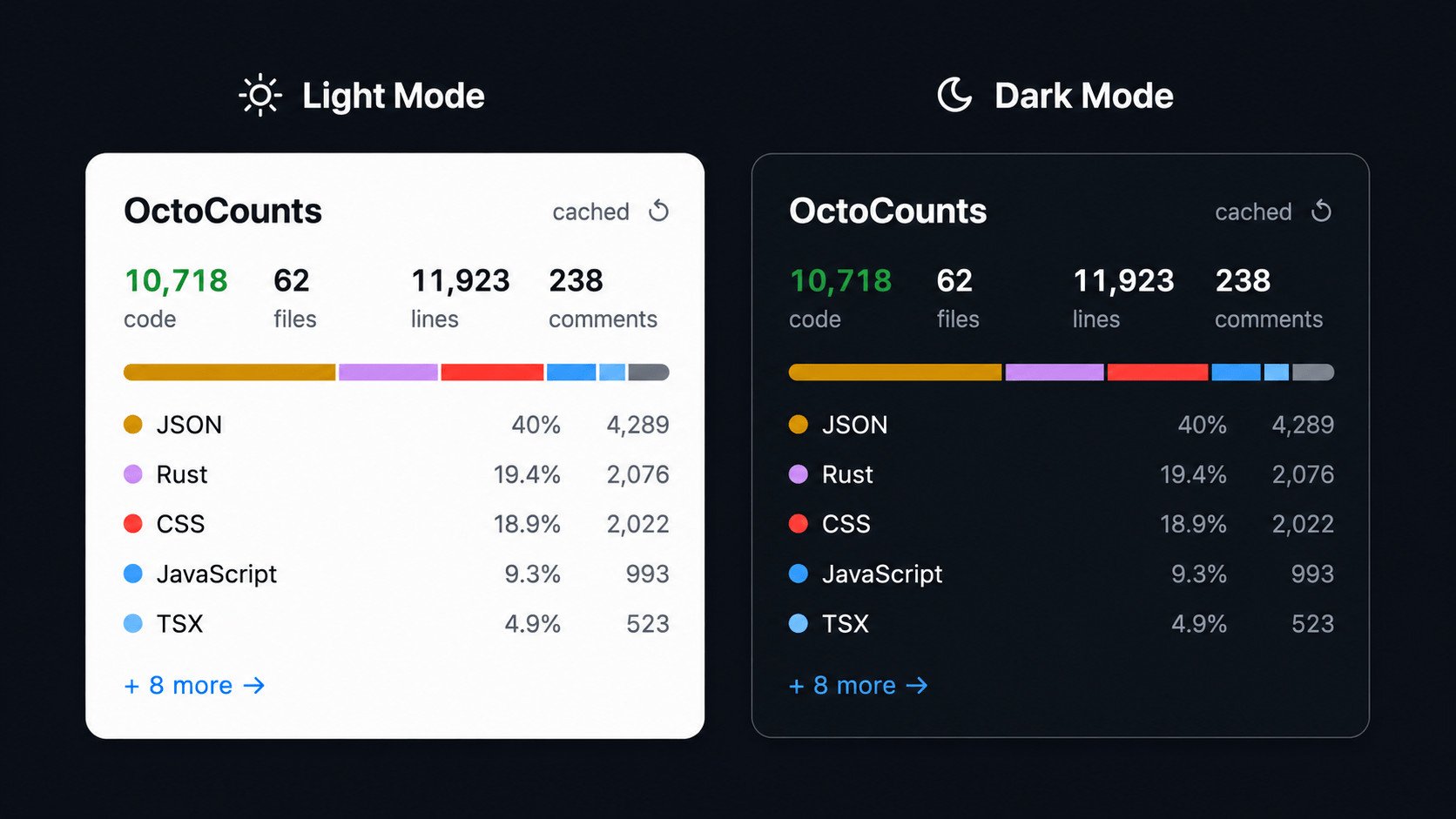
- Adds a browser extension card to GitHub repo pages with files, total lines, code, comments, blanks, and language count
- Provides a web app where you can paste any public GitHub repo URL
- Resolves any branch, tag, or commit SHA — pins results to an exact commit so the cache is actually meaningful
- Downloads the GitHub archive tarball instead of cloning (much faster, no git history overhead)
- Counts files, lines, code, comments, and blanks per language via tokei
- Caches reports by
owner + repo + commit + tokei version— repeat runs are instant - Queues analysis jobs so concurrent requests don't bring the server to its knees
- Exports reports as plain text, JSON, or a shareable PNG card
Stack
| Layer | Tech |
|---|---|
| Backend | Rust · Axum · Tokio · SQLx · Postgres · tokei |
| Frontend | React · TypeScript · Vite · TanStack Query |
| Infra | Cloudflare Pages (Pages Functions SSR) · GHCR image + sloc-infra dual VPS (VPS-A/VPS-B) + Cloudflare Tunnel · Postgres on VPS-B (Neon frozen snapshot as fallback) · Docker Compose (local dev only) |
Badges
Drop a live SLOC badge into any README:
<!-- Default branch — full SLOC summary -->
[](https://octocounts.com/github/:owner/:repo)
<!-- Specific branch -->
[](https://octocounts.com/github/:owner/:repo/tree/:branch)
<!-- Specific tag (immutable, cached forever) -->
[](https://octocounts.com/github/:owner/:repo/tree/:tag)
<!-- Specific commit SHA (immutable, cached forever) -->
[](https://octocounts.com/github/:owner/:repo/commit/:sha)
Add ?lang=<language> to any of the above to get a per-language badge instead:
<!-- Lines of code for a single language -->
[](https://octocounts.com/github/:owner/:repo)
[](https://octocounts.com/github/:owner/:repo/tree/:branch)
Language names are case-insensitive (rust, Rust, and RUST all work). If a language is not found in the report the badge shows —. While a fresh analysis is running the badge shows ··· — most badge CDNs will retry automatically.
| Cache behaviour | Header |
|---|---|
| Default branch / branch | s-maxage=3600, stale-while-revalidate=86400 |
| Tag / commit | max-age=31536000, immutable |
API
POST /api/analyze          { "repoUrl": "...", "refName": "main" }
GET  /api/jobs/:id
GET  /api/reports/:id
GET  /api/stats

GET  /badge/:owner/:repo
GET  /badge/:owner/:repo/branch/:branch
GET  /badge/:owner/:repo/tag/:tag
GET  /badge/:owner/:repo/commit/:sha
All badge routes accept an optional ?lang=<language> query parameter that switches the response from the full SLOC summary badge to a per-language shields.io-style badge.
Running it
See how-to-run-and-deploy.md for local development setup, host-native instructions, GitHub token configuration, and production deployment.
Growth report inventory
Popular public repositories are listed in data/popular-repos.txt. The scheduled workflow seed-popular-repos.yml refreshes that curated inventory weekly.
refresh-github-trending.yml discovers GitHub's daily Trending repositories, validates and publishes the current snapshot to /trending, and pre-generates their stable /github/:owner/:repo SLOC reports. Trending provenance stays separate from real /popular access counts; no date-stamped archive pages are generated.







