Listed from the MCP registry; nobody on Odel publishes it.

Agentpack
Repo-native task continuity for AI coding agents: a reviewed task-state ledger served over MCP.
Runs on your machine from its package; the steps are below.

What it does
- Reads
- Writes
- High impact
At most: creates or changes data: records, files, settings.
What it costs
FreeOdel charges nothing per call. The publisher may charge for its own service.
Runs locally over stdio
This server isn't hosted — your MCP client launches it from a package registry. Use one of the commands below, or drop the config into your client (e.g. Claude Desktop).
Run
npx -y agentpack-cli
MCP client config
{
  "mcpServers": {
    "agentpack": {
      "command": "npx",
      "args": [
        "-y",
        "agentpack-cli"
      ]
    }
  }
}


Repo-native task continuity for AI coding agents.
Agent memory remembers how you work. Agentpack remembers where the task stands.
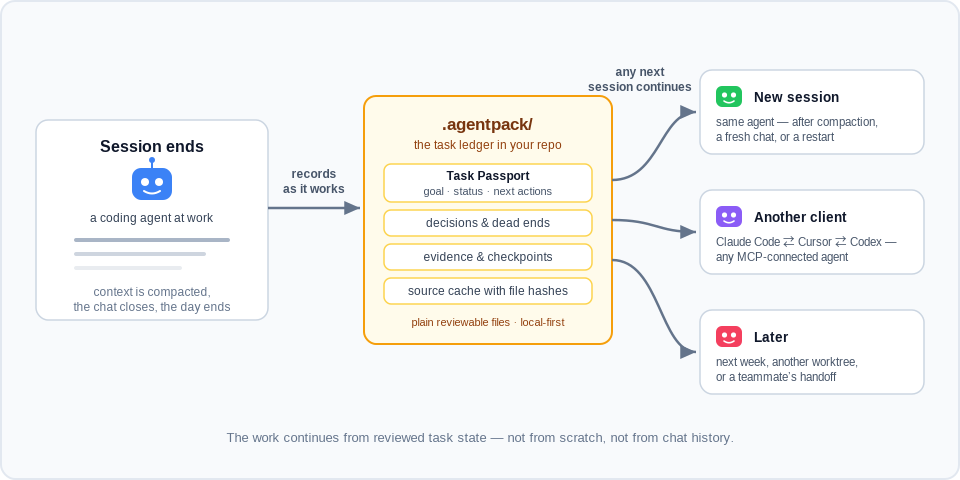
Your agent spent an hour on a task. It found the cause, rejected two approaches, and wrote down the next step. Then the context was compacted, or the chat closed. The next session starts from zero and does the same investigation again.
Agentpack keeps the task state in your repo. Connected agents record the goal, decisions, dead ends, verification evidence, and checkpoints in .agentpack/ while they work. Then the next session loads that state and continues: the same agent after compaction, a different client, or you next week.
Here it is in action. In session 1, an agent works on a flaky test and records a decision, a dead end, and a checkpoint through the Agentpack MCP tools. In session 2, the next day with an empty context, one load_context call brings the task back:
▶ Watch the 80-second explainer, with sound
To try the same flow by hand from the CLI, see docs/DEMOS.md.
- Local-first. Plain files in your repo. No cloud, no telemetry, no network calls.
- Made for agents. A local MCP server and generated project instructions (
AGENTS.md,CLAUDE.md, Cursor rules) tell agents when to load and record state. - Open to people. The CLI shows the same state, so you can inspect it, fix it, or hand it off yourself.
How is this different from agent memory?
Claude Code memory, Codex memories, and CLAUDE.md or AGENTS.md keep how to work: your preferences, project conventions, and facts that stay true. Agentpack keeps where the work is: the goal of the current task, its constraints, decisions, dead ends, next actions, and verification result.
| Agent memory | Agentpack | |
|---|---|---|
| Holds | Preferences, conventions, long-lived facts | The state of one task |
| Lives in | The profile or account of one client | .agentpack/ in the repo, local by default, portable with task bundles |
| Read by | That client only | Any MCP client: Claude Code, Codex, Cursor, Claude Desktop |
| Shape | Free-form notes, recalled by relevance | A Task Passport per task: goal, lifecycle, the paths it may change, and verification bound to a commit |
| Staleness | Not tied to file changes | Notes about files store the file hash, so Agentpack flags a note when its file changes |
Use both. Memory keeps how you like to work. Agentpack keeps what the task needs next.
Quick start
Agentpack needs Node.js 20 or later.
npm install -g agentpack-cli

cd path/to/your/repo
agentpack init                     # once per repo
agentpack install claude --write   # per client: codex | claude | cursor | claude-desktop
agentpack install git-hooks --write  # optional: task gate check before each commit
Restart or reconnect your coding agent, and approve the Agentpack server or hooks when the client asks. From then on, the agent loads the task state when a session starts, records decisions and evidence while it works, and creates checkpoints at meaningful points.
To check the setup, run agentpack doctor. To see the task state yourself, run agentpack resume --preset agent --query "<topic>".
In a Git repository, init adds the local Agentpack files to .git/info/exclude. The list includes .agentpack/, .mcp.json, .claude, .codex, .cursor, AGENTS.md, and CLAUDE.md. Agentpack does not change your .gitignore. Files that Git already tracks stay tracked.
For each client, docs/INTEGRATIONS.md shows what the installer writes and why.
How it works
- When a session starts, the agent loads a compact summary: the current Task Passport, recent checkpoints, decisions, and source conclusions.
- While it works, the agent records what is worth keeping: decisions, failed approaches, and verification evidence. It can also record a source conclusion: a short note about what a file does, stored with the file hash. If the file changes later, Agentpack flags the conclusion. A matching hash shows that the file is unchanged, not that the conclusion is correct.
- At a natural stop, the agent creates a checkpoint with the status, the next actions, and the Git state.
- The next session, in any MCP client, continues from that state. It does not rebuild the task from chat history.
Each task has a Task Passport: the goal, status, constraints, write scope (the paths the task may change), next actions, and verification. You can start, park, switch, and finalize tasks, so each handoff is explicit.
The task gate checks edits against the current Passport. The client installers add native hooks for Claude Code, Codex, and Cursor. install git-hooks adds a pre-commit check. By default, the gate only warns. Set "gateMode" in .agentpack/config.json to "block" to stop edits outside the write scope or outside an active task, or to "off" to turn the gate off. Hooks are a guardrail, not a sandbox. See docs/CLI.md.
The summary stays inside a token budget. The agent gets the useful state back, not the full history.
More features
- Task bundles. Export a task to one JSON file, and import it in a fresh clone or on another machine. See docs/TASK-PASSPORT.md.
- Tasks across repositories. One Passport can cover changes in several repositories, each with its own write scope.
- Monorepo focus. Give each part of a monorepo (
api/,frontend/,cron/) short tasks with their own write scope. The task gate warns when the agent leaves that part. - Usage reports.
agentpack usage reportreads local Claude Code and Codex transcripts and shows the token use of a task, including the Agentpack share. Nothing leaves your machine. - Read-only inspector.
agentpack tuishows tasks, evidence, and checkpoints in the terminal. See docs/TUI.md. - Builder subagent. Codex, Claude Code, and Cursor installs include an optional builder for larger implementation work. The main agent says what it will hand off before it uses the builder. Small tasks stay with the main agent.
When it helps
- The context is compacted in the middle of a task, and the next turn needs the state back.
- You start a new chat on a task that is still open.
- You change between Claude Code, Cursor, Codex, or another MCP client.
- You come back to a refactor or a bug fix days later.
- Another agent continues from your checkpoint.
Agentpack context also uses tokens. The compact output keeps the task state available without the full ledger history.
Security posture
- Zero runtime dependencies, exact dev dependencies, a committed lockfile, and
ignore-scripts=true. - No telemetry and no network calls in normal CLI or MCP operation.
- Best-effort redaction of values that look like secrets in stored context and handoff output.
- GitHub Actions publishes each release with npm provenance (Trusted Publisher, no long-lived tokens). To verify, run
npm audit signatures.
See SECURITY.md for the full policy, including what Agentpack reads outside the repo.
Documentation
- docs/INTEGRATIONS.md: setup for Codex, Claude Code, Cursor, Claude Desktop, and Git hooks
- docs/TASK-PASSPORT.md: task lifecycle, handoffs, additional repositories, and task bundles
- docs/CLI.md: full CLI reference, budgets, and manual workflows
- docs/MCP.md: MCP server contract and tools
- docs/DEMOS.md: short continuity demos to run yourself
- docs/TUI.md: the read-only terminal inspector
- docs/LEDGER-HYGIENE.md: keep the ledger small and useful
Contributing
Clone the repo and use Node.js 20 or later:
npm ci --ignore-scripts
npm test
npm run mcp:smoke
node dist/src/agentpack.js --help
See docs/SETUP.md for the development setup and docs/RELEASING.md for the release steps.
Mirror: Codeberg. Issues, releases, and npm provenance stay on GitHub.







