Listed from the MCP registry; nobody on Odel publishes it.
MITRE ATLAS MCP Server
Threat-model AI and agentic systems against MITRE ATLAS: surfaces, techniques, controls
Runs on your machine from its package; the steps are below.
What it does
- Reads
- Writes
- High impact
At most: only reads or looks up information.
What it costs
FreeOdel charges nothing per call. The publisher may charge for its own service.
Runs locally over stdio
This server isn't hosted — your MCP client launches it from a package registry. Use one of the commands below, or drop the config into your client (e.g. Claude Desktop).
Run
npx -y @imouiche/mitre-atlas-mcp-server
MCP client config
{
  "mcpServers": {
    "mitre-atlas-mcp-server": {
      "command": "npx",
      "args": [
        "-y",
        "@imouiche/mitre-atlas-mcp-server"
      ]
    }
  }
}MITRE ATLAS MCP Server
18 MCP tools that threat-model AI and agentic systems against MITRE ATLAS










Install · The idea · Tools · Example prompts · Data governance · Who owns the fix
Describe your system's architecture - an agent with tool access over a RAG corpus, say - and get back the ATLAS techniques that apply, the mitigations that cover them, the compounding risks your specific combination of surfaces creates, and the real-world incidents that have already happened to systems shaped like yours.
This is not a lookup wrapper around the ATLAS matrix. Lookup is included, but the point is the mapping from how you built it to what can be done to it.
Pinned to ATLAS v2026.10: 16 tactics, 221 techniques, 44 mitigations, 77 case studies. Mitigations are enriched with control ownership from the CoSAI Risk Map, and techniques cross-map to ATT&CK, STRIDE, OWASP Top 10 for LLM and NIST AI RMF.
Published in the official MCP Registry
as io.github.imouiche/mitre-atlas-mcp-server.
Install
npx -y @imouiche/mitre-atlas-mcp-server
Requires Node 18+ and Python 3.12+ on PATH. On first run it prepares a
private virtualenv under ~/.mitre-atlas-mcp-server/runtime, which takes a few
seconds: both datasets are already in the package, so only mcp and pyyaml
are installed and nothing is downloaded. Nothing touches your system or active
Python environment.
| Variable | Effect |
|---|---|
MITRE_ATLAS_PYTHON | Use this interpreter directly and skip virtualenv creation. It must already satisfy the dependencies in pyproject.toml. |
MITRE_ATLAS_RUNTIME_DIR | Relocate the cached virtualenv. |
The PyPI release is not published yet, so these do not work today:
uvx mitre-atlas-mcp-server            # pending PyPI
pip install mitre-atlas-mcp-server    # pending PyPI
uvx will become the recommended path once the package is on PyPI, since it
needs no Node at all.
Claude Desktop / Claude Code
{
  "mcpServers": {
    "mitre-atlas": {
      "command": "npx",
      "args": ["-y", "@imouiche/mitre-atlas-mcp-server"]
    }
  }
}
The idea
ATLAS is organised by adversary intent - tactics and techniques. Engineers describe systems by architecture. That mismatch is why ATLAS is harder to apply than it should be, and it is the gap this server closes.
It defines ten surfaces, each a yes/no question about your architecture, each anchored to the ATLAS techniques that become reachable when the answer is yes:
| Surface | Applies when |
|---|---|
untrusted_input | Content from outside your trust boundary reaches the model |
tool_use | The model's output drives function, shell, HTTP, or MCP calls |
rag | Retrieved documents land in the context window |
agent_memory | State persists across turns or sessions |
agent_config | Config, system prompts, or tool manifests are reachable |
multi_agent | Agents delegate to, spawn, or message other agents |
rendered_output | Output is rendered as markdown, HTML, or links |
inference_api | A model endpoint is reachable over the network |
model_supply_chain | Weights, adapters, datasets, or MCP servers come from a registry |
training_pipeline | You train or fine-tune on data you collect |
The surfaces that matter most are the ones that combine. untrusted_input
alone is a content-filtering problem. untrusted_input + tool_use is the
agentic equivalent of remote code execution: injected text becomes
attacker-chosen actions. profile_ai_system reports those compounds
explicitly rather than leaving you to infer them from two separate lists.
ATLAS v2026.10 tags 148 of its 221 techniques as applying to Agentic AI, which is what makes this framing tractable - the agentic coverage is MITRE's, not invented here.
Tools
Threat modelling
| Tool | Does |
|---|---|
list_surfaces | The ten surfaces, with the question that decides each. Start here |
profile_ai_system | Surfaces in → techniques ranked by exposure, mitigations ranked by coverage, compound risks, and techniques ATLAS has no mitigation for |
map_surface_to_techniques | One surface at a time, for drilling in |
find_analogous_incidents | Case studies ranked by technique overlap, each naming the overlapping techniques so the relevance is checkable |
Reference
| Tool | Does |
|---|---|
get_atlas_info | Release served and collection sizes |
list_tactics | All 16 tactics with technique counts |
get_technique | One technique: tactics, sub-techniques, mitigations, case studies, ATT&CK parallel |
search_techniques | Text search, filterable by platform and maturity |
get_techniques_by_tactic | By tactic id or name |
get_mitigation | One mitigation, with everything it covers |
get_mitigations_for_technique | Mitigations for a technique, inheriting from the parent when a sub-technique has none |
get_case_study | One case study with its ordered attack flow - each step's tactic, technique, and what the operator actually did |
search_case_studies | By text, by type (27 Incident, 50 Exercise), or by technique employed |
get_software | Attacker tooling ATLAS catalogues |
update_atlas_data | Download a newer ATLAS release and serve it instead of the shipped one |
Cross-framework
| Tool | Does |
|---|---|
map_atlas_to_attack | The ATT&CK technique an ATLAS technique parallels |
map_attack_to_atlas | The reverse, for teams already modelling against ATT&CK |
map_technique_to_frameworks | ATT&CK, STRIDE, OWASP Top 10 for LLM and NIST AI RMF for one technique, plus the CoSAI risks and controls behind them |
ATLAS asserts an ATT&CK parallel for 48 of 221 techniques. Every tool reports its coverage figure, so an empty result is never mistaken for "no parallel exists".
Resources: atlas://matrix (the matrix as markdown), atlas://surfaces
(the taxonomy).
Prompts: threat_model_this_agent, review_mcp_tool_surface.
Who owns the fix
ATLAS tells you what to do about a technique. It does not tell you who does it.
So every mitigation this server returns is enriched from the CoSAI Risk Map (Coalition for Secure AI, an OASIS open project), which maps its engineering controls to ATLAS mitigation ids. Where a mapping exists you also get the control, the personas who own it, and the components it applies to:
AML.M0004  Limit AI Service Query Volume and Rate
  CoSAI control : Agent Execution Bounds
  owners        : Agentic Platform and Framework Providers, Application Developer,
                  AI Platform Provider
  components    : Agent Reasoning Core, Orchestration Input Handling,
                  Orchestration Output Handling
That turns a ranked mitigation list into assignable work, which is the point of threat-modelling a system you are actually building.
Coverage, stated plainly. 13 of ATLAS's 44 mitigations have a CoSAI
control, and all 13 cited ids resolve against the pinned ATLAS release. Per
surface, roughly a quarter to a half of returned mitigations carry an owner;
agent_config currently has none. Where CoSAI maps nothing, the tools say so
rather than returning a silent blank.
Example
Threat-model this: a customer-support agent that reads incoming email, retrieves from our knowledge base, and can issue refunds through our billing API. It remembers prior conversations per customer.
That is four surfaces, so profile_ai_system(["untrusted_input", "rag", "tool_use", "agent_memory"]). Actual output, abridged:
27 techniques in scope, across 11 tactics. 18 mitigations. 5 techniques ATLAS has no mitigation for.
It leads with what the combination creates, not the individual techniques:
untrusted_input + tool_use
  Injected content becomes attacker-chosen tool calls, the agentic equivalent
  of remote code execution. Treat every tool the agent can reach as callable
  by whoever authors the untrusted content.

rag + tool_use
  Anyone who can write into the indexed corpus can steer tool calls without
  ever interacting with the system directly.

untrusted_input + agent_memory
  A single injection persists across sessions and can carry a delayed trigger,
  so the payload outlives the request that delivered it.
Then the mitigations, ranked by how much they cover, each naming who implements it:
AML.M0020  covers 14  Generative AI Guardrails
           owners: AI Model Serving, AI Platform Provider,
                   Agentic Platform and Framework Providers
AML.M0035  covers 11  AI Red Team
AML.M0024  covers  7  AI Telemetry Logging and Monitoring
           owners: AI Model Serving, AI Platform Provider,
                   Agentic Platform and Framework Providers
Then find_analogous_incidents for the same surfaces, ranked by how many
in-scope techniques each case study actually employed:
AML.CS0063  overlap 10  Prompt-Based Attacks Against Gemini via Calendar Invitations
AML.CS0026  overlap  9  Financial Transaction Hijacking with M365 Copilot as an Insider
AML.CS0066  overlap  9  ZombieAgent: Data Exfiltration Attack on ChatGPT
AML.CS0024  overlap  7  Morris II Worm: RAG-Based Attack
A support agent that can move money, matched against a documented financial
transaction hijack with nine techniques in common. get_case_study returns any
of these as an ordered attack flow: each step's tactic, the technique used, and
what the operator actually did.
Example prompts
Ask these as plain messages once the server is connected. Each one was run against this release; the figures are what it actually returns.
Threat-modelling a system you are building
What architectural surfaces can you threat-model against?
Returns the ten surfaces with the question that decides each. A good first call, since the rest build on it.
Threat-model this: an internal assistant that answers questions from our
Confluence space and can file Jira tickets.
That is untrusted_input + rag + tool_use. Expect the compound risks to
lead, including corpus-write-to-tool-call.
We have agents that delegate to sub-agents, and each can call tools.
What is our exposure?
multi_agent + tool_use: 15 techniques in scope and the compound risk that
tool authority is transitive across delegation.
What does RAG specifically expose us to, and what mitigates it?
Five techniques and five mitigations for the rag surface alone, which is
useful when you want to drill into one decision rather than a whole system.
Finding precedent
Show me real cases that overlap a system with a RAG corpus.
Four matches, led by Financial Transaction Hijacking with M365 Copilot as an Insider and Data Exfiltration from Slack AI via Indirect Prompt Injection.
Which documented incidents involve poisoned models or MCP servers from a registry?
Eleven incidents for model_supply_chain, including Poisoned Postmark MCP
Server Email Exfiltration and Malicious Models on Hugging Face.
Walk me through the Morris II worm case study step by step.
AML.CS0024 as an ordered attack flow: twelve steps, each with its tactic,
technique and what the operator actually did.
Looking things up
Search ATLAS for techniques about memory that apply to agentic systems.
Eight hits, filtered to the Agentic AI platform.
Which ATLAS techniques achieve the Exfiltration tactic?
What mitigates RAG poisoning, and who implements it?
AML.T0070, its two mitigations, and the CoSAI control owners where they
exist.
Tell me about the attacker tool AML.S0001.
Cross-framework, for compliance and review
Map AML.T0086 to OWASP, STRIDE and NIST.
Exfiltration via AI Agent Tool Invocation, returning ids from all three, with each attributed to the CoSAI risk or control it came from.
We already threat-model against ATT&CK T1566. What AI-specific
techniques attach to it?
Here are the tools our agent exposes: [paste your tool list].
What could an attacker who controls its input make it do?
Uses the review_mcp_tool_surface prompt, mapping each tool to the technique
that covers its abuse.
Setup instructions for Claude Desktop, including the environment pitfalls that stop a server from starting, are in atlas_usage.md.
Data governance
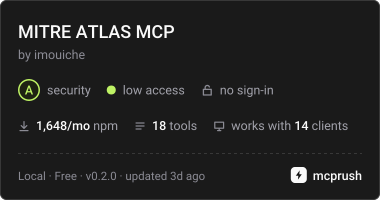
MCPRush rates this server security A with low access scope and no sign-in required. That is their assessment rather than an independent audit, but it follows from the properties below.
Security tooling is only as trustworthy as the data under it, and most MCP servers fetch theirs at call time from whatever the upstream API returns today. This one does not. Both datasets ship inside the package, pinned to an exact release, and the server makes no network calls while serving.
| Property | How it holds |
|---|---|
| Reproducible | Two identical calls return identical answers. The data cannot shift under a running assessment. |
| Offline | Runs air-gapped. Nothing is fetched at startup or per call; verified by there being no HTTP client anywhere in src/. |
| Pinned and attributable | ATLAS at v2026.10 recorded in RELEASE; CoSAI at commit 622605a recorded in COMMIT. Both Apache-2.0, attributed in NOTICE. |
| Integrity-checked | 123 tests assert collection sizes, that every technique id in the surface taxonomy resolves, and that every ATLAS id CoSAI cites exists in the pinned release. |
| No third-party reach | No telemetry, no analytics, no credentials, no API keys. Nobody outside this repository can change what the server reports. |
| Reviewed updates | A weekly workflow pulls upstream, runs the suite and opens a pull request only when something changed. Refreshes are merged deliberately, never applied silently. |
That last row matters more than it sounds. Upstream renumbers things: a recent CoSAI revision dropped a mapping the enrichment relied on, and a stale ATLAS id would quietly shorten a threat model rather than erroring. The tests catch that before a refresh lands.
Moving to a newer ATLAS release
You do not have to wait for a new package. Ask the assistant:
Update your ATLAS data to the latest release.
That calls update_atlas_data, which downloads the newest release into
~/.mitre-atlas-mcp-server/data and serves it from then on. Pass a tag to pick
a specific release, or ask it to check first without changing anything.
To go back to the release shipped with the package, delete the directory:
rm -rf ~/.mitre-atlas-mcp-server/data
A release is only installed if it still fits. ATLAS retires ids as well as
adding them: eight technique ids were removed between 2026.05 and 2026.10,
including all three AML.T0024 sub-techniques. The surface taxonomy and the
CoSAI bridge name ids directly, so before switching, every technique id the
taxonomy needs and every mitigation id CoSAI cites is checked against the
candidate. A release that would break those is refused, naming the missing ids,
and the current data keeps serving. The alternative is a threat model that
quietly returns fewer techniques, which is worse than an error.
get_atlas_info reports which copy is live and which release shipped with the
package, so an answer can always be traced to its data.
This is the only tool that uses the network, and only when you call it. Ordinary queries never do.
Updating the pinned data
python scripts/refresh_data.py --release v2026.10   # ATLAS, 1.1MB
python scripts/refresh_cosai.py --latest            # CoSAI Risk Map, 348KB
uv run pytest                                        # both pins are asserted
get_atlas_info reports both pins at runtime, so a caller can always see
exactly which releases produced an answer.
Development
uv sync
uv run pytest
uv run python -m mitre_atlas_mcp.server    # stdio
Licence
Apache-2.0. The ATLAS dataset is © 2021–2026 MITRE, redistributed under Apache-2.0 - see NOTICE. This project is not affiliated with or endorsed by MITRE.
Issues and pull requests are welcome at github.com/imouiche/mitre-atlas-mcp-server.
Author
Inoussa Mouiche, Ph.D. - University of Windsor, WASP Lab. Research in threat intelligence automation, machine learning, agent AI security, and LLM-powered security operations.
GitHub · LinkedIn · Google Scholar · mouiche@uwindsor.ca
Also the author of the MITRE ATT&CK MCP Server, which covers conventional adversary TTPs; this server covers the AI-specific ones and cross-maps between the two.