Listed from the MCP registry; nobody on Odel publishes it.

MITRE Attack
MCP server providing 50+ tools for MITRE ATT&CK techniques, groups, and mitigations
Runs on your machine from its package; the steps are below.
What it does
- Reads
- Writes
- High impact
At most: only reads or looks up information.
What it costs
FreeOdel charges nothing per call. The publisher may charge for its own service.
Runs locally over stdio
This server isn't hosted — your MCP client launches it from a package registry. Use one of the commands below, or drop the config into your client (e.g. Claude Desktop).
Run
npx -y @imouiche/mitre-attack-mcp-server
MCP client config
{
  "mcpServers": {
    "mitre-attack": {
      "command": "npx",
      "args": [
        "-y",
        "@imouiche/mitre-attack-mcp-server"
      ]
    }
  }
}MITRE ATT&CK MCP Server
65 MCP tools giving LLMs and agentic systems machine-callable access to the MITRE ATT&CK knowledge base








Installation · Quick Start · Security · Data Cache · Tools · Examples
Overview
The MITRE ATT&CK MCP Server exposes the MITRE ATT&CK framework over the Model Context Protocol, giving LLMs and agentic systems structured, machine-callable access to adversary tactics, techniques, threat groups, software, campaigns and mitigations.
It reads the official STIX 2.1 bundles published by MITRE through the
mitreattack-python library. No scraping, no third-party API, no
reverse-engineered endpoints.
65 tools across three domains
| Area | Tools | Covers |
|---|---|---|
| Tactics, data sources and ICS | 12 | tactics, data components and what they detect, ICS assets, procedure examples |
| Techniques | 11 | lookup by ATT&CK ID, keyword search, parent and sub-technique traversal, platform and tactic filters |
| Generic STIX access | 10 | any object by STIX or ATT&CK ID, description search, created and modified filters, ID to name resolution |
| Groups | 10 | threat actors, aliases, the techniques and software they use, campaign attribution |
| Software | 8 | malware and tools, aliases, the techniques they implement, who deploys them |
| Campaigns | 6 | campaigns, aliases, their techniques and software, attribution to groups |
| Infrastructure and metadata | 5 | data status, entity counts, matrices, Navigator layer generation |
| Mitigations | 3 | mitigations and the techniques they address |
Covering Enterprise, Mobile and ICS, with relationship traversal throughout — which groups use a technique, which software a campaign deployed, what mitigates what — plus ATT&CK Navigator layer generation for coverage and gap visualisation. All output is shaped for LLM consumption.
Registered in the official MCP Registry as
io.github.imouiche/mitre-attack-mcp-server.
Installation
Python (PyPI)
pip install mitre-mcp-server
Or with uv:
uv pip install mitre-mcp-server
Node (npm)
npm install -g @imouiche/mitre-attack-mcp-server
Or without installing:
npx -y @imouiche/mitre-attack-mcp-server
The npm package needs a few minutes on first run. It ships the Python source, not the Python dependencies. On first launch it creates a private virtualenv under
~/.mitre-mcp-server/runtime/, installs the pinned dependencies into it, and downloads the ATT&CK STIX data. Subsequent runs start in a few seconds.Some MCP clients time out waiting for a server to respond, so warm the cache once from a terminal before configuring your client:
bashnpx -y @imouiche/mitre-attack-mcp-server --setupPython 3.12 or newer must be on
PATH.uvis used when available andvenvpluspipotherwise. Nothing is installed into your system or currently active Python environment.
Environment variables
| Variable | Effect |
|---|---|
MITRE_MCP_PYTHON | Use this interpreter directly and skip virtualenv creation entirely. It must already satisfy the dependencies in pyproject.toml, including mcp<2. |
MITRE_MCP_RUNTIME_DIR | Relocate the cached virtualenv. Default ~/.mitre-mcp-server/runtime/. |
MITRE_MCP_DATA_DIR | Relocate the ATT&CK data cache. Default ~/.mitre-mcp-server/data/. |
From source
git clone https://github.com/imouiche/complete-mitre-attack-mcp-server.git
cd complete-mitre-attack-mcp-server
uv sync
uv run python -m mitre_mcp_server.server
Quick Start
1. Configure your client
Add the server to claude_desktop_config.json:
- macOS —
~/Library/Application Support/Claude/claude_desktop_config.json - Windows —
%APPDATA%\Claude\claude_desktop_config.json
{
  "mcpServers": {
    "mitre-attack": {
      "command": "npx",
      "args": ["-y", "@imouiche/mitre-attack-mcp-server"]
    }
  }
}
2. Restart the client
Quit Claude Desktop completely (Cmd+Q on macOS) and reopen it.
3. Query
"What techniques does APT29 use for initial access?"
"Generate an ATT&CK Navigator layer for ransomware groups"
"Show me all Windows persistence techniques"
Security
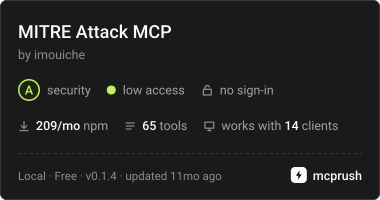
MCPRush rates this server security A with low access scope and no sign-in required. That assessment is MCPRush's own, not an independent audit, but it reflects properties you can verify directly in this repository:
- No credentials. The server reads no API keys, tokens or secrets. The only environment variables it consults are the three cache-location overrides documented above.
- Narrow network scope. The sole outbound request is the ATT&CK STIX
download, performed by MITRE's own
mitreattack-pythonlibrary. There are no telemetry, analytics or third-party calls. - Integrity-checked data. Downloads are verified against the expected hash published in MITRE's release manifest, so a corrupted or substituted bundle is rejected rather than loaded.
- Local execution. The server runs as a local stdio process. It opens no listening port and exposes no HTTP surface.
- Read-only behaviour. All 65 tools are queries over the cached STIX data. Nothing mutates state outside the cache directory, and no tool executes shell commands or evaluates caller-supplied code.
Found a security issue? Please open an issue.
Data Cache
The server does not bundle ATT&CK data. On first start it downloads the official STIX 2.1 bundles for all three domains and caches them on disk, then loads them into memory. Later starts reuse the cache and skip the download.
Location — ~/.mitre-mcp-server/data/v{version}/, overridable with
MITRE_MCP_DATA_DIR.
Current release — ATT&CK v20.1, about 64MB across three files:
| Domain | File | Size |
|---|---|---|
| Enterprise | enterprise-attack.json | 52.7MB |
| Mobile | mobile-attack.json | 5.9MB |
| ICS | ics-attack.json | 5.1MB |
Clearing the cache to force a re-download
The cache is never invalidated automatically. If the data is stale, partially downloaded, or corrupted, clear it and the server will fetch a fresh copy the next time it starts.
Inspect what is currently cached:
python -m mitre_mcp_server.data.download --stats
Re-download the current release, replacing what is there:
python -m mitre_mcp_server.data.download --force
Or simply delete the cache and let the server re-fetch on next start. This is
the most reliable method and the one to use with the npm install, which has no
convenient python on PATH:
rm -rf ~/.mitre-mcp-server/data
To refresh a single domain rather than all three:
python -m mitre_mcp_server.data.download --domain enterprise --force
Reclaiming disk space from superseded releases
When MITRE publishes a new ATT&CK version, the server downloads it into a new
v{version} directory and leaves the previous one in place. Over time
these accumulate — a machine that has run through two releases will hold both:
~/.mitre-mcp-server/data/
├── v18.1/   56MB   <- superseded, safe to delete
└── v20.1/   64MB   <- in use
Only the directory matching the current mitreattack-python release is read.
Delete the others:
ls ~/.mitre-mcp-server/data/                       # list cached releases
python -m mitre_mcp_server.data.download --stats    # show which one is in use
rm -rf ~/.mitre-mcp-server/data/v18.1               # remove a superseded release
The npm install path keeps a second cache, the virtualenv under
~/.mitre-mcp-server/runtime/. It is keyed by package and Python version, so
upgrades create a new directory and leave the old one behind. Removing the
whole runtime directory is safe; it is rebuilt on the next launch.
Available Tools
65 tools covering the major ATT&CK entities and their relationships. All tool
handlers are asynchronous. Most accept an optional domain argument of
enterprise, mobile or ics, defaulting to enterprise.
Infrastructure and metadata
| Tool | Description |
|---|---|
get_data_stats | Download status, file paths, sizes and ATT&CK release version |
get_stats | Entity counts for a loaded domain |
get_all_matrices | All ATT&CK matrices in a domain |
generate_layer | Generate an ATT&CK Navigator layer as JSON |
get_layer_metadata | Return a Navigator layer metadata template |
Generic STIX access
Lower-level accessors that work across every object type, useful when you hold a STIX ID rather than an ATT&CK ID.
| Tool | Description |
|---|---|
get_object_by_attack_id | Any object by ATT&CK ID and STIX type |
get_object_by_stix_id | Any object by STIX ID (UUID) |
get_objects_by_type | All objects of a given STIX type |
get_objects_by_name | Objects by exact name match (case-sensitive) |
get_objects_by_content | Objects whose description contains given text |
get_attack_id | Convert a STIX UUID to its ATT&CK ID |
get_name | Resolve the display name for a STIX ID |
get_stix_type | Determine the STIX object type for a STIX ID |
get_objects_created_after | Objects created after a timestamp |
get_objects_modified_after | Objects modified after a timestamp |
Techniques
| Tool | Description |
|---|---|
get_technique_by_id | Get a technique by ATT&CK ID, for example T1055 |
search_techniques | Search techniques by name or description |
get_all_techniques | Retrieve all techniques |
get_all_parent_techniques | Parent techniques only |
get_all_subtechniques | All sub-techniques |
get_subtechniques_of_technique | Sub-techniques of a parent |
get_parent_technique_of_subtechnique | Parent of a sub-technique |
get_technique_tactics | Tactics associated with a technique |
get_techniques_by_tactic | Techniques under a tactic |
get_techniques_by_platform | Techniques for a platform |
get_revoked_techniques | Revoked techniques |
Groups
| Tool | Description |
|---|---|
get_group_by_name | Find a group by name or alias |
search_groups | Search groups |
get_all_groups | All ATT&CK groups |
get_groups_by_alias | Look up groups by alias |
get_groups_using_technique | Groups using a technique |
get_groups_using_software | Groups using software |
get_groups_attributing_to_campaign | Groups attributed to a campaign |
get_group_techniques | Techniques used by a group, by group name |
get_techniques_used_by_group | Techniques used by a group, by STIX ID |
get_techniques_used_by_group_software | Techniques reachable via a group's software (group to software to techniques) |
Software
| Tool | Description |
|---|---|
get_software | Get all software |
search_software | Search software |
get_software_by_alias | Look up software by alias |
get_software_used_by_group | Software used by a group |
get_software_used_by_campaign | Software used in campaigns |
get_software_using_technique | Software using a technique |
get_all_software | All malware and tools in a domain |
get_techniques_used_by_software | Techniques used by specific software or malware |
Campaigns
| Tool | Description |
|---|---|
get_all_campaigns | Get all campaigns |
get_campaigns_by_alias | Look up campaigns by alias |
get_campaigns_using_technique | Campaigns using a technique |
get_campaigns_using_software | Campaigns using software |
get_campaigns_attributed_to_group | Campaign attribution |
get_techniques_used_by_campaign | Techniques used in a campaign |
Mitigations
| Tool | Description |
|---|---|
get_all_mitigations | Get all mitigations |
get_mitigations_mitigating_technique | Mitigations for a technique |
get_techniques_mitigated_by_mitigation | Techniques mitigated by a mitigation |
Tactics, data sources and ICS
| Tool | Description |
|---|---|
get_all_tactics | Get all tactics |
get_all_datasources | Get all data sources |
get_all_datacomponents | Get all data components |
get_datacomponents_detecting_technique | Data components detecting a technique |
get_all_assets | Get ICS assets |
get_assets_targeted_by_technique | Assets targeted by a technique |
get_techniques_targeting_asset | Techniques targeting an ICS asset |
get_tactics_by_matrix | Tactics belonging to a matrix |
get_tactics_by_technique | Tactics associated with a technique, by STIX ID |
get_techniques_detected_by_datacomponent | Techniques a data component can detect |
get_procedure_examples_by_technique | Procedure examples showing how groups used a technique |
get_procedure_examples_by_tactic | Procedure examples for all techniques in a tactic |
Example Queries
What techniques does APT29 use for initial access?
Which groups use Cobalt Strike?
What are the aliases for the Lazarus Group?

What data sources detect credential dumping?
What can detect T1055 (Process Injection)?
List all techniques for Windows privilege escalation
Show me lateral movement techniques for Linux

What mitigations exist for phishing attacks?
What techniques does MFA mitigate?

Generate a layer for all techniques our EDR covers
Compare APT29 TTPs against our detection capabilities
Show unmitigated techniques in our environment
ATT&CK Navigator Visualisation
The generate_layer tool produces ATT&CK Navigator-compatible JSON.
- Ask your client to generate a layer, for example "Generate an ATT&CK Navigator layer for all techniques used by APT29"
- Save the JSON output to a file, for example
apt29_layer.json - Upload it to ATT&CK Navigator
Typical uses include mapping red-team exercise coverage, highlighting unmonitored techniques, profiling a threat actor's TTPs, and showing which techniques are mitigated against which are exposed.
Worked example with LangGraph
- Article — From MITRE ATT&CK to agentic threat investigation, on building a multi-agent LangGraph system over these tools
- Live demo — Interactive Gradio demo on Hugging Face Spaces
Technical Details
Architecture
- Language — Python 3.12 or newer
- Protocol — Model Context Protocol via FastMCP, served over stdio
- Data source — official STIX 2.1 bundles through
mitreattack-python - Concurrency — asynchronous tool handlers
- Caching — all three domains loaded into memory at startup, so queries need no disk access
Data
| Property | Value |
|---|---|
| ATT&CK release | v20.1 |
| Domains | Enterprise, Mobile, ICS |
| Techniques | 706 Enterprise, 125 Mobile, 104 ICS |
| Groups | 178 Enterprise, 20 Mobile, 14 ICS |
| Software | 842 Enterprise, 129 Mobile, 25 ICS |
| Mitigations | 44 Enterprise, 13 Mobile, 53 ICS |
| Tactics | 15 Enterprise, 12 Mobile, 12 ICS |
| Cache size | about 64MB |
| Cache location | ~/.mitre-mcp-server/data/v{version}/ |
Counts track the pinned ATT&CK release and change when MITRE publishes a new one. See Data Cache for refreshing.
Requirements
- Python — 3.12 or newer
- Node.js — 16 or newer, for the npm installation path only
- Disk — about 64MB of ATT&CK data plus about 200MB of Python
dependencies. The npm path keeps its dependencies in its own virtualenv, so
budget roughly 290MB under
~/.mitre-mcp-server/. - Memory — about 490MB resident with all three domains loaded, since every domain is held in memory for fast queries. Measured on Python 3.12 against ATT&CK v20.1.
mcp— pinned to>=1.1.0,<2. The server uses the v1mcp.server.fastmcpAPI, which mcp 2.0 renamed toMCPServer. An unpinned install resolves 2.x and fails at import.
License
Apache License 2.0. See LICENSE.
Issues and pull requests are welcome at github.com/imouiche/complete-mitre-attack-mcp-server.
Author
Inoussa Mouiche, Ph.D. — University of Windsor, WASP Lab. Research in threat intelligence automation, machine learning, multi-agent security systems and LLM-powered security operations.
GitHub · LinkedIn · Google Scholar · mouiche@uwindsor.ca
Acknowledgments
Built on MITRE ATT&CK using mitreattack-python, MITRE's official library, and implementing the Model Context Protocol. Thanks to the MCP developer community, including R. Jasper.
MITRE ATT&CK is a registered trademark of The MITRE Corporation. This project is not affiliated with or endorsed by The MITRE Corporation.