Listed from the MCP registry; nobody on Odel publishes it.

SpecTorque
Review agent specs, plans and tasks against EPIC practices with cited evidence.
Runs on your machine from its package; the steps are below.
What it does
- Reads
- Writes
- High impact
Not assessed yet.
What it costs
FreeOdel charges nothing per call. The publisher may charge for its own service.
Runs locally over stdio
This server isn't hosted — your MCP client launches it from a package registry. Use one of the commands below, or drop the config into your client (e.g. Claude Desktop).
Run
npx -y spectorque
MCP client config
{
  "mcpServers": {
    "spectorque": {
      "command": "npx",
      "args": [
        "-y",
        "spectorque"
      ]
    }
  }
}
















See where your coding agent would have to guess.
SpecTorque is a local workbench for writing and reviewing software specifications. It takes you from a rough idea or an existing Markdown workspace to a spec, plan and tasks with traceable requirements, reviewable changes and explicit open decisions.
Try it · Install · Quickstart · What's new · How the engine works · Research basis · Tested compatibility · Guía en español
40 EPIC practice checks · 10 quality dimensions · English and Spanish · One deterministic engine
Try it in one command
From the root of a git repository that holds your specs (Node.js 22.20+):
npx -y spectorque serve --root .
It opens the workbench on a loopback address and analyzes that work tree locally: no account, model or telemetry. To give your coding agent the six read-only tools instead, add the MCP server in one line:
claude mcp add spectorque -- npx -y spectorque mcp
codex mcp add spectorque -- npx -y spectorque mcp
Other MCP clients take the same command (npx -y spectorque mcp) as a stdio server (configuration). The server analyzes the git work tree of the folder the client starts it in; set SPECTORQUE_ROOT to point it elsewhere. The npm package is published from release.yml with npm provenance. For the native panels (/spectorque in Claude Code, OpenCode and Pi, the Codex viewer, the VS Code workbench), install the plugin for your host below.
Install
SpecTorque 0.3.0 is a prerelease, published on the next channel until the pilot's stable candidate gate passes. As the first version on npm it is also latest there, so npm i spectorque installs it. Every route runs the same local engine and needs Node.js 22.20+ on PATH. No account, model or telemetry is needed for analysis.
| Platform | Install | Then |
|---|---|---|
| Claude Code (CLI and Desktop Code tab) | claude plugin marketplace add jayanez/spec-torqueclaude plugin install spectorque@spectorque | /spectorque |
| Codex (CLI and Desktop) | codex plugin marketplace add jayanez/spec-torquecodex plugin add spectorque@spectorque | Bind a trusted worktree, then open_spectorque |
| OpenCode | Add "opencode-spectorque@0.3.0" to plugins in ~/.config/opencode/cli.json (a terminal-only plugin) | /spectorque in a session |
| Pi | pi install npm:pi-spectorque@0.3.0 | /spectorque |
| ThinkRail (runs Pi) | Install the Pi package pi-spectorque from ThinkRail's extensions, or run the Pi command above | /spectorque in a trusted project |
| VS Code | Extensions view → search SpecTorque → Switch to Pre-Release, or code --install-extension jayanez.spectorque --pre-release | SpecTorque: Open Specification Workbench |
| Cursor, Windsurf, VSCodium | The VSIX from the GitHub release (Install from VSIX…); the Open VSX listing follows once the jayanez namespace is approved. Installable, not yet qualified | Same command |
| Any MCP client | npx -y spectorque@0.3.0 mcp as a stdio server (configuration); listed in the MCP Registry as io.github.jayanez/spectorque | Six read-only tools |
| Browser workbench / CLI | npx -y spectorque@0.3.0 serve --root . | Open the printed loopback URL |
Where it is published: npm (spectorque, spectorque-claude, spectorque-codex, opencode-spectorque, pi-spectorque), the VS Code Marketplace (pre-release), the MCP Registry, this repository's Claude Code and Codex catalogs, and the GitHub release. The Pi and ThinkRail galleries list pi-spectorque from npm. Open VSX follows once its namespace is approved.
Install details, updates and removal for each host are in the integration guides. Offline or air-gapped installs use the ZIP, VSIX and tarball assets of each GitHub release. Check tested compatibility for the host versions we observed.
Quickstart
From source, with Node.js 22.20+ and npm:
git clone https://github.com/jayanez/spec-torque.git
cd spec-torque
npm ci --ignore-scripts
npm run build
node dist/cli.js serve --root fixtures/en-draft
Open the printed loopback URL. Select the finding for FR-001, jump to its source line, and review the suggested clarification. To use your own Markdown workspace, replace fixtures/en-draft with its path. The EN/ES pilot walkthrough (Spanish) covers review and export step by step.
What's new in 0.3.0
- Native marketplace installs for Claude Code and Codex (this repository is a marketplace for both), npm packages for OpenCode, Pi and ThinkRail, and the VS Code Marketplace for editors (Open VSX once its namespace is approved). One release workflow publishes them all from one commit with npm provenance.
- Engine 0.1.16 after the 0.2.x precision series: requirement IDs count only in a defining position (H3a), hard-wrapped continuations stay with their item (H5a), acceptance scenarios and validation tables count as verification evidence (H6, H6a), plan-local
R-nlabels and references qualified by another specification are no longer reported as undefined (H8, H9), demonstratives no longer read as pronoun subjects (H85), and Spec Kitchecklists/are review context, not requirements (H7a). Each change went through the pre-registered replay, and those from engine 0.1.10 on show no change in corpus predictions; see precision decisions. - Work-tree-scoped discovery with feature, folder and changed-on-branch scopes in every host, a shared presentation layer so every panel shows the same title, summary, finding card and disclaimer, and a refined workbench with collapsible, resizable panels.
- One product version across the CLI, every host package, the catalogs and the citation, checked in CI. See the changelog and the versioning policy.
See the difference
The booking draft starts with a requirement an agent cannot test as written.
FR-001 The system MUST be fast.
-
Find the gap. SpecTorque flags fast as unbounded wording at
specs/booking/spec.md:5. An agent still has to decide which operation to time, what limit to meet and under what load. -
Ask what changes acceptance. Which booking operation should we measure, what response time is acceptable, and under what load? The answers determine the performance test and can change implementation choices.
-
Keep the decision open. Preview the change before accepting it. The proposed wording preserves the requirement ID and obligation and records what the team still needs to decide.
FR-001 The system MUST be [NEEDS CLARIFICATION: define the response-time limit and measurement conditions].
Once the team answers, it can write a testable requirement. For example, if the team chooses booking confirmation, a 500 ms limit at the 95th percentile and a load of 50 concurrent users, the requirement could read:
FR-001 The system MUST return a booking confirmation within 500 ms at the 95th percentile under a load of 50 concurrent users.
These values illustrate a possible team decision. Follow the pilot walkthrough to preview the clarification and see how the workbench records it as pending.
Why wording matters
Precision makes an obligation testable by naming observable behavior and its conditions. Selectivity directs questions to decisions that affect implementation or acceptance. The studies below examine specification quality, wording signals and clarification behavior.
- EPIC defines what to review. Claudino et al. assessed specifications, plans and tasks from 114 open-source repositories using ISO/IEC/IEEE 29148 as a reference. They derived 40 practices across ten dimensions, then sought feedback from 15 practitioners. The study observed a lower share of bug-fix commits in repositories with higher-rated specifications. Its observational design supports an association. The EPIC Framework for Spec-Driven Development
- Wording can flag requirements that need review. Femmer et al. found that lightweight checks surfaced relevant requirements problems, with detection accuracy varying substantially across cases. Requirements Smells
- Ambiguity can change program behavior. Mu et al. used divergent outputs from candidate implementations to identify requirements worth clarifying in function-generation benchmarks. ClarifyGPT
- Agent studies examine when to ask. On an underspecified variant of SWE-bench Verified, Edwards and Schuster's uncertainty-aware setup asked fewer questions on simpler tasks and sought more information on complex ones. That finding applies to the systems and tasks evaluated in the study. Ask or Assume?
EPIC is the basis for SpecTorque's rubric. SpecTorque implements explainable English and Spanish heuristics, cites the evidence behind each finding, and keeps unsupported evidence and unresolved decisions visible. Scores are advisory. Estimating the tool's effect on implementation defects would require a separate outcome study. Rubric · Research methods and limitations · EN/ES corpus and reproduction
Explore the workbench
Expand a view to read its description and see the capture. Click the image for the original size.
Analyze
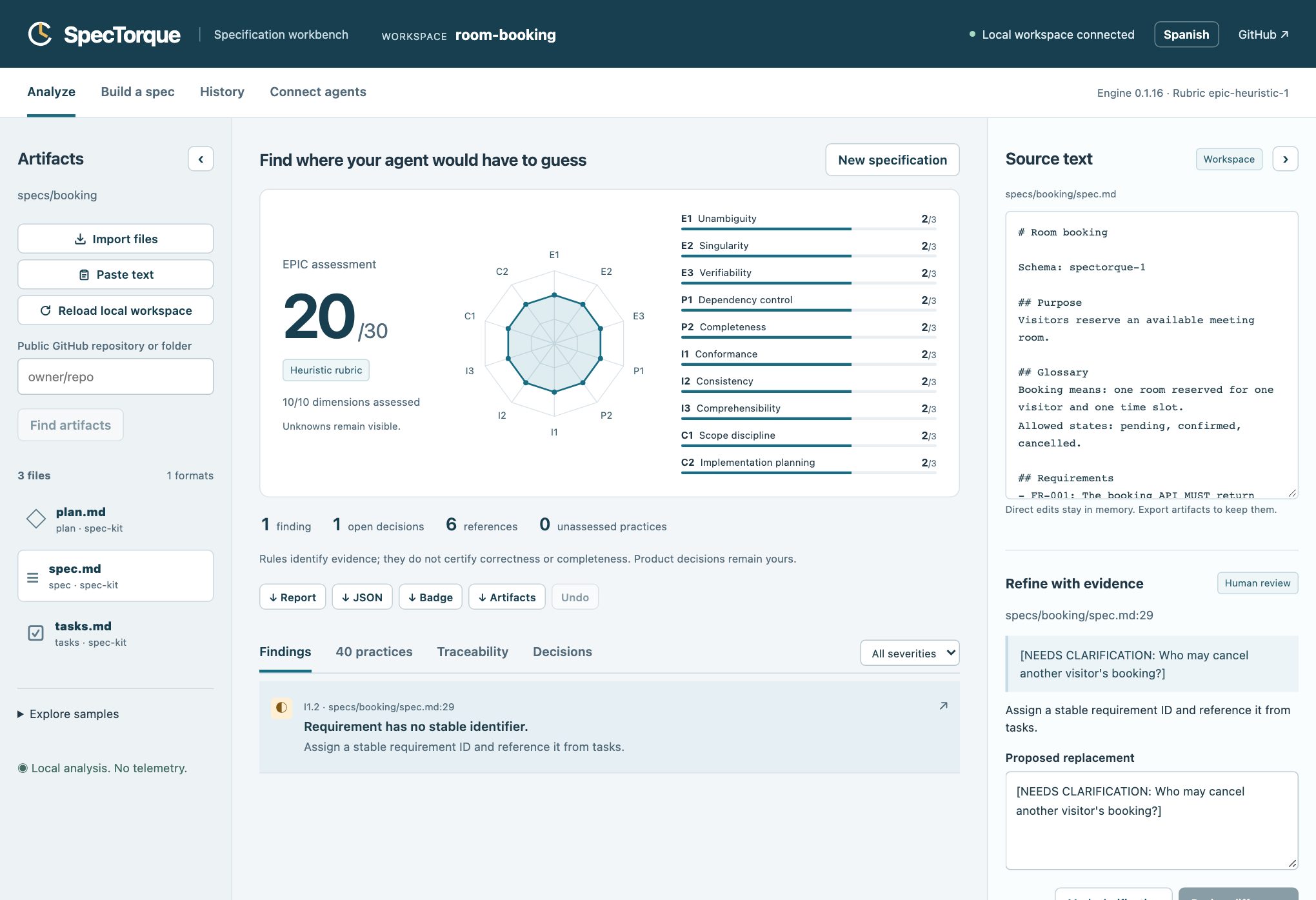
Inspect findings at their exact source lines and see which dimensions are still unknown.

Build a spec
Answer guided questions to turn a project brief into a spec, plan and tasks.

History
Revisit earlier assessments, check their revision and rubric version, and export the report you need.

Connect agents
Find the host integration guides and copy the local MCP configuration for your project.

Native panels
Each integration brings the same engine into the host you already use. npm run docs:capture regenerates the workbench, Codex viewer, Claude Code, OpenCode, Pi and VS Code captures from the bundled booking draft in real hosts with isolated profiles and no model calls; the desktop captures are recorded in docs/assets. Check tested compatibility for the host versions we observed.
Claude Code (CLI) · /spectorque pane
Read dimension scores and the current finding beside the conversation, step through findings, propose a replacement, refresh the analysis or open the common workbench. The pane calls no model. Install for Claude Code

Claude Code Desktop · /spectorque pane
Install the plugin from the marketplace, start a session in the Code tab, then run /spectorque to view dimension scores and findings in the native pane. Starting the session takes a model turn. The pane runs its analysis locally. Install for Claude Desktop · capture from the 0.2.0 qualification

Codex · inline viewer
The viewer opens in the conversation from the project's local MCP server. Choose a scope and finding, preview a change, then hand off to the local workbench to approve or export. Opening it in Codex Desktop takes one model turn. The capture shows the viewer as Codex renders it, driven by a local MCP Apps host. Install for Codex · Codex Desktop capture

OpenCode · /spectorque panel
Press s for scope, e for the exact source line, r for reviewed changes and w for the local workbench URL. Install for OpenCode

Pi · /spectorque widget and finding picker
The widget shows the scope and dimension scores; pick a finding to open its exact evidence, then review the before and after wording. Headless runs print the same report without a model turn. Install for Pi

ThinkRail · Pi package in a desktop host
ThinkRail runs Pi natively and installs the same pi-spectorque package. /spectorque runs as a project extension command without a model turn: the widget line and the finding picker appear above the message box. Install in ThinkRail

VS Code · embedded workbench
The shared workbench opens in an editor tab, with findings that jump to source. The capture is the end of the automated extension-host walkthrough, after a reviewed change was applied. Install for VS Code

See the integration guides for each host's behavior and limits.
How it works

- Create or import. Start with guided questions or load existing documents. Select the scope you want the local engine to assess.
- Review and decide. Follow a finding to its source and compare the exact wording. Rejection leaves the source intact. Approval updates the draft, with a separate opt-in for writing to disk.
- Reanalyze and hand off. Inspect the new revision and its pending decisions. Export the current assessment and selected artifacts, or undo the change where applicable. You can also export an assessment before proposing an edit.
How the engine works
One deterministic TypeScript engine (src/core) runs in Node and the browser. The CLI, MCP server, workbench and every host adapter call it; adapters may change presentation, never scoring.
- Discover. Inside a git work tree, candidates come from
git ls-files(tracked plus unignored drafts); elsewhere a bounded walk. A path-only index lists features without reading content, and only the selected scope (feature, folder or changed on the branch) is read, up to 500 artifacts. Discovery criteria - Classify. Layout hints for Spec Kit, Spec Kitty, OpenSpec, Kiro, BMAD, ZeeSpec and generic Markdown assign each file a role: spec, plan, tasks, instruction file, or context such as
quickstart.md(validation evidence only) and Spec Kitchecklists/(review context, never requirements). - Recognize requirements. Normative words are recognized as whole words in English and Spanish (
MUST,SHALL,DEBE,DEBERÁ…), keeping obligation, recommendation and permission apart. An ID defines a requirement only in a defining position; a hard-wrapped line belongs to the item it continues. Normative recognition · Requirement classification - Resolve references. Plan and task references resolve inside the selected feature's ID namespace. Plan-local labels and references qualified by another specification are not reported as undefined.
- Check 40 practices. Explainable line and document rules for the 40 EPIC practices produce findings with the exact path, line and text as evidence. Each practice is supported, partial, missing, not applicable or unknown.
- Score ten dimensions. Supported = 1, partial = 0.5, missing = 0, averaged per dimension and rounded to 0–3. An unknown practice leaves its dimension unscored, and the /30 total appears only when every dimension is known. The assessment carries the engine and rubric versions and a SHA-256 revision of its inputs.
- Refine with review. A clarification question is offered only when the cited wording identifies a decision. A proposal changes one line, must preserve requirement IDs, quantities, obligations and negative clauses, is bound to the source hash, and is written only after explicit human approval. MCP never writes files.
Precision changes follow a pre-registered replay against a frozen comparator and a labeled EN/ES corpus before they ship. Architecture · Rubric · Precision method
From draft to reviewed handoff
| Step | What you can do |
|---|---|
| Create or import | Generate spec, plan and tasks from guided questions with stable requirement IDs. Start from a sample, paste text, import Markdown files, load a local workspace or explicitly import a public GitHub repository. |
| Scope the review | Discover features and document roles across Spec Kit, Spec Kitty, OpenSpec, Kiro, BMAD, ZeeSpec and generic Markdown/PRDs using layout hints. Review all active artifacts or one feature. Archived artifacts stay outside active analysis. |
| Inspect the evidence | Explore a ten-dimension radar, all 40 practices, findings, requirement references and pending decisions. Jump to the cited path and line. Missing evidence remains visible as unknown. |
| Decide and revise | Compare exact before and after wording. Guarded proposals check identifiers, quantities and obligations. Reject or explicitly approve, reanalyze and undo where applicable. Disk writes require a separate opt-in and reject stale source. |
| Share the result | Export editable artifacts as a scoped ZIP with original paths, download Markdown or JSON reports and a revision-bound SVG badge, or revisit a prior assessment in session history. Save or export unsaved drafts before ending the session. |
The basic workflow runs locally without an account, a model, a GPU or telemetry. Model assistance is optional through a host prompt, local Ollama or an explicitly configured OpenAI request. See privacy and data flows.
Browser, CLI and coding agents
The workbench, CLI and six read-only MCP tools share the same analysis engine. Integrations and portable skills cover Claude Code, Codex, OpenCode, Pi and ThinkRail, and the VS Code extension installs in Cursor, Windsurf and VSCodium from its VSIX (Open VSX once the namespace is approved); they are not yet qualified. See the native panels and check the tested routes and versions before installing. Integration guides · Compatibility matrix
node dist/cli.js analyze fixtures/en-complete --json
node dist/cli.js create --answers fixtures/builder-en.json
node dist/cli.js mcp
For CI, opt into policies such as --require-complete, --fail-on-open or --min 23. An unknown total fails the minimum-score check. Use npm run check and npm run package:integrations to verify a source checkout.
Architecture · Requirements · Roadmap · Contributing · Español
Original code and documentation are licensed under Apache-2.0. EPIC-derived paraphrases carry separate CC BY 4.0 attribution in NOTICE.







