
crapkit
Twelve tools to inspect CRAP scores, find work, and check edited functions against their ceiling.
Runs on your machine from its package; the steps are below.
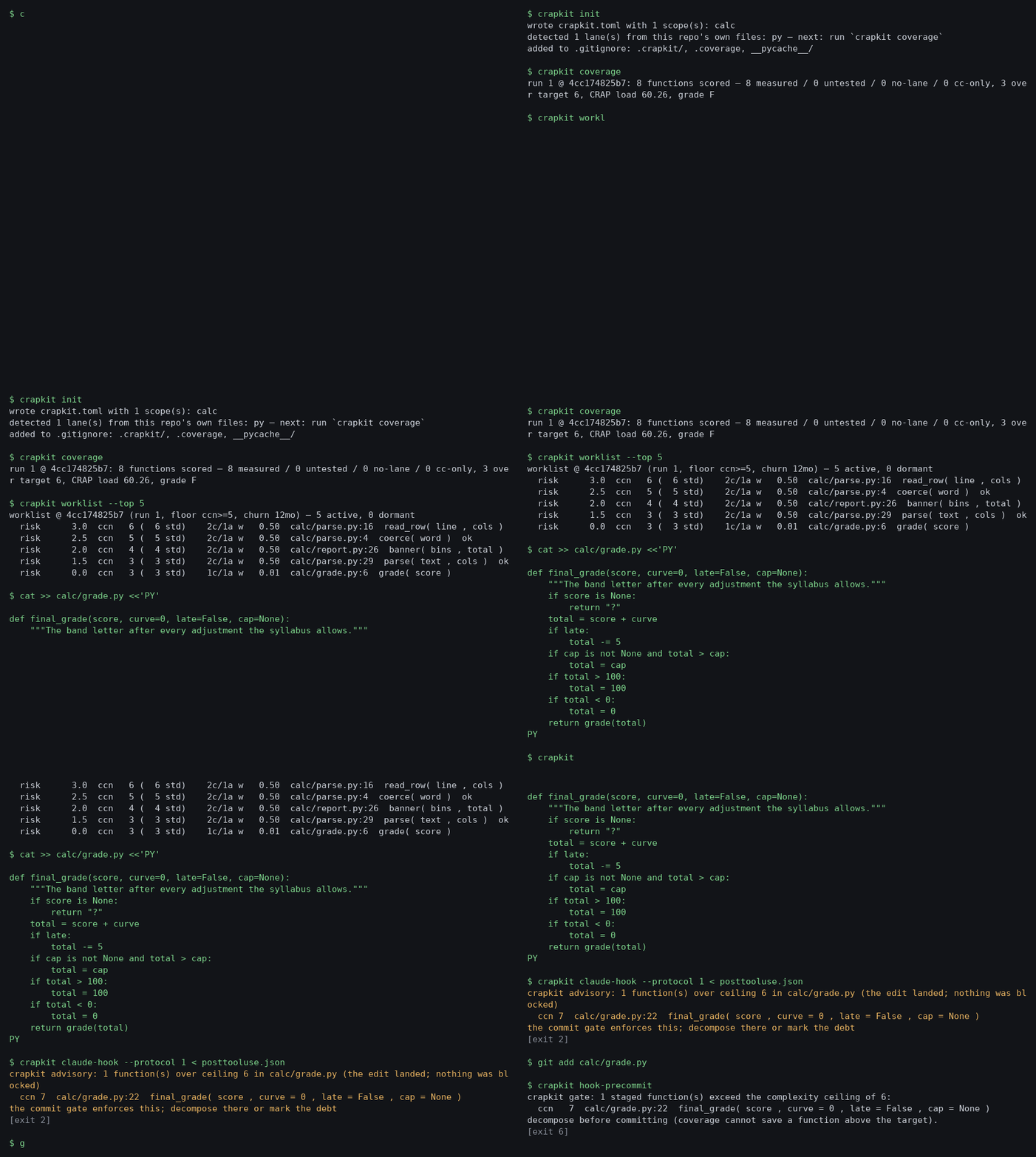
What it does
- Reads
- Writes
- High impact
At most: moves money, runs code or commands, deletes data, or sends messages for you.
What it costs
FreeOdel charges nothing per call. The publisher may charge for its own service.
Runs locally over stdio
This server isn't hosted — your MCP client launches it from a package registry. Use one of the commands below, or drop the config into your client (e.g. Claude Desktop).
Run
uvx crapkit
MCP client config
{
  "mcpServers": {
    "crapkit": {
      "command": "uvx",
      "args": [
        "crapkit"
      ]
    }
  }
}




crapkit scores every function in your repo on complexity times uncovered risk, ranks the worst ones by how often the file changes, and blocks commits that add more. It reads Python, TypeScript, TSX, JavaScript, Swift, Go, Rust, shell, PowerShell, C and C++, Objective-C, Vue, Java and Zig through lizard, and joins per-function branch coverage from the istanbul or coverage.py artifact your own test command already writes. JSON commands use sorted keys and a versioned schema for scripts, coding agents and the optional MCP server.
CRAP = ccn^2 * (1 - cov)^3 + ccn
The name is not ours: C.R.A.P. (Change Risk Anti-Patterns) was coined for crap4j by Alberto Savoia and Bob Evans in 2007.
ccn is the smaller of standard and modified cyclomatic complexity, both read off one
lizard pass. cov is branch coverage inside the function's span; with no branches it
falls back to statement coverage, and with no statements to invoked-or-not, so a
half-executed straight-line function never reads as fully covered.
Above the ceiling, coverage cannot save you. Decompose. At the default ceiling of 6, a function at ccn 7 with 100% coverage still scores 7 and still fails the gate. The only move that clears it is splitting the function.
Why 6 and not 30. crap4j's conventional threshold of 30 is a CRAP score: it lets an
untested ccn 5 through (25 + 5 = 30) and a fully covered ccn 30 too. crapkit's default
is a complexity ceiling, because coverage can at best collapse CRAP to ccn, and a
function you cannot cover past ccn 6 is one you decompose. Set target = 30 in
crapkit.toml if you want the crap4j number. A repo with existing debt does not need to:
ratchet seed marks today's over-ceiling functions at today's score, the gate then judges
only the functions a change touches, and marks may only fall, so adoption never starts with
a wall of red. Next to crap4py, radon, xenon, wily and SonarQube:
docs/comparison.md.
crapkit scores git-tracked files only. Source you have not git added is invisible to
it; init and verify name the first three such files they find.
| Start with | When |
|---|---|
| Install and the 60-second start | You want the first score in an existing Git repository. |
| Python or TypeScript quickstart | You want a worked example from setup through a passing verify. |
| Adoption | You need to choose scopes, wire tests or introduce a ratchet to existing debt. |
| Upgrading | You already have saved runs, ratchet marks or an installed plugin. |
| Subcommands and JSON/MCP reference | You are scripting commands or connecting a coding agent. |
The 60-second start
pip install crapkit
cd your-repo
crapkit init        # write crapkit.toml and ignore measurement output
crapkit doctor      # check scopes, test commands and coverage dependencies
crapkit coverage    # runs the lane, joins coverage, stores a scored run
crapkit worklist    # the ranked risk map
crapkit ratchet seed
git add crapkit.toml crapkit-ratchet.tsv .gitignore
git commit -m "adopt crapkit"
crapkit verify      # the first passing verdict
Not a Python repo? uvx crapkit init runs the same commands and adds nothing to your
manifest: see A repo that is not Python. A Python repo
skips uvx and installs crapkit as above, or with uv tool install or pipx install; that
section says why. pip stops with externally-managed-environment? See
When pip refuses.
coverage measures a commit, so a fresh git init repo needs its first commit before
it. Until then it exits 4 and says so:
$ crapkit coverage
crapkit: the git repository at /repo has no commit yet: crapkit measures a commit, so make the first one (git add, then git commit) and run it again
init detects pytest, Vitest and Jest from the repository's own files. Review the
generated config before running its commands. When detection leaves a commented
lane, fill it in using the lane recipes.
Commit the adoption files, then run crapkit verify to establish a passing verdict.
Install the commit gate when the config and ratchet are ready.
Each step prints the next one: init names coverage, coverage names worklist,
worklist names ratchet seed, and ratchet seed names the commit and verify.
coverage scores, worklist ranks:
$ crapkit coverage
run 1 @ fae4db93108: 2 functions scored: 2 measured, 1 over ceiling 6, CRAP load 41.0, grade F
-> next: crapkit worklist

$ crapkit worklist
worklist @ fae4db93108 (run 1, floor ccn>=5, churn 12mo) - 1 of 1 active (worklist_top 50), 0 dormant
  risk     14.0  ccn  14  crap    38.5  cov  50%    1c/1a  calc/grade.py:7  classify( score , attempts , late , bonus )
no crapkit-ratchet.tsv yet: seed marks each function over its ceiling at today's score, and from then on a mark may only fall
-> next: crapkit ratchet seed
risk 14.0 is ccn times a churn weight of one: a one-commit repo has no spread of commits
to weight, so each commit counts once and the ranking is complexity order until the
history grows (Risk). crap 38.5 and cov 50% are the
score and the coverage behind it.
ratchet seed signs today's debt at today's score. From then on marks only ever fall, so
the repo can get better and never worse while you burn it down.
One thing stops most first runs: the coverage plugin. init writes a lane that shells
out to your own test runner, and the runner needs its coverage package installed:
pytest-cov for pytest, @vitest/coverage-v8 (pinned to your vitest major) for vitest.
Without it the lane produces no artifact and coverage exits 5 quoting the runner's own
error. A pytest lane also needs coverage.py 7.13.1 or newer, which writes the function
start lines crapkit reads; an older one fails the lane at exit 5. For pytest, init probes the python its lane will run and prints the install
command when pytest_cov is missing; pip install "crapkit[py]" pulls the plugin
alongside crapkit when the two share a venv. On a Windows PATH holding only the py
launcher it writes py, not a python3 the lane could never run, and when cmd.exe cannot
start the interpreter at all (exit 9009, the Store alias) it names that instead of guessing
at pytest-cov. A repo that pins no lockfile and carries its own .venv gets that venv's
interpreter in the lane, when that interpreter can import pytest, rather than whichever
python the shell answers with. The two quickstarts below walk a real repo end to end.
On Windows a lane command is read by cmd.exe, the shell that will run it, not by sh. Double quotes are the portable quoting. A single-quoted value is refused at config load with exit 3, because cmd.exe would hand pytest five words and the lane would write no artifact:
# the lane in crapkit.toml
command = "python -m pytest -m 'not live and not perf' --cov=calc --cov-branch --cov-report=json:.crapkit/cov/py.json"

$ crapkit doctor
crapkit: lane 'py': positional argument 'live' narrows a full-suite coverage run; drop it, attach it to the flag it belongs to (-n8, --numprocesses=8), or set full_suite = false deliberately (cmd.exe does not treat ' as a quote: write the value in double quotes); a suite whose testpaths cannot be collected in one process needs one lane per testpath, each with full_suite = false and its own artifact
Write it -m "not live and not perf". Carets, && and | segments, redirections and
empty quoted arguments all read the way the shell reads them, so a chained lane
(cd tests && python -m pytest --cov ...) is checked one segment at a time. doctor reads
a lane the same way, and FAILs one whose runner will not start.
Install
pip install crapkit
That is the release on PyPI. For the unreleased tip
of main, or from a local clone (run at the clone root):
pip install git+https://github.com/JeanFrancoisGagne/crapkit.git
pip install .
Commits on main between two releases carry the same version string, and pip keeps an
installed crapkit whose version matches, so running the git line again after a new
commit leaves the old code in place. This line replaces it with the tip:
pip install --force-reinstall --no-deps git+https://github.com/JeanFrancoisGagne/crapkit.git
pip install . in a clone rebuilds on every run and needs no flag.
When pip refuses
Debian 12, Ubuntu 23.04 and later, Homebrew and uv mark the Python they install as
theirs (PEP 668), and pip refuses to write into it with
error: externally-managed-environment:
$ pip install crapkit
error: externally-managed-environment
Give crapkit an environment of its own. Either line installs it into one and puts a
crapkit command in ~/.local/bin (%USERPROFILE%\.local\bin on Windows), the
command the agent plugins start:
pipx install crapkit
uv tool install crapkit
When that directory is not on PATH yet, the installer says so and names the fix:
pipx ensurepath, or uv tool update-shell. Open a new shell after either. The
python on PATH does not hold this install, and the commit hook runs the
crapkit command before it tries python, so it reaches either install as printed.
A Python repo can carry crapkit in its own venv instead, beside the test dependencies its lane runs:
python3 -m venv .venv
. .venv/bin/activate
pip install "crapkit[py]"
The same from cmd.exe on Windows:
python -m venv .venv
.venv\Scripts\activate
pip install "crapkit[py]"
--break-system-packages makes pip write into the system Python anyway, where the next
OS package update can break crapkit or the OS's own tools. None of the routes above
needs it.
A repo that is not Python
crapkit is a command-line tool, never a dependency of the code it scores. A TypeScript,
Go or Rust repo adds nothing to its own manifest. With uv
on the machine, uvx fetches crapkit into a cache of its own and runs it:
$ uvx crapkit init
wrote crapkit.toml with 1 scope(s): src
detected 1 lane(s) from this repo's own files: js - next: run `uvx crapkit coverage`
added to .gitignore: .crapkit/

$ uvx crapkit coverage
$ uvx crapkit worklist
uvx puts no crapkit on PATH, so every next step crapkit prints under uvx starts with
uvx crapkit. The lane still runs your own test runner, so Vitest or Jest and its coverage
package come from the repo's node_modules as they do today. uv tool install crapkit or
pipx install crapkit puts a crapkit command on PATH once, which is what the
commit gate and the Claude Code plugin call. The ratchet's merge driver takes
either form; the git merge driver
gives the uvx line. uv brings its own Python when the machine has none.
A Python repo installs crapkit instead: in the environment its suite runs in
(pip install "crapkit[py]"), or with uv tool install crapkit or pipx install crapkit.
uvx puts its own environment first on the PATH the lane inherits, so the lane's python
starts uv's cached interpreter, which holds neither the suite's packages nor pytest-cov.
init then says that interpreter cannot import pytest_cov, and installing pytest-cov into
uv's cache fixes nothing the suite needs.
Requires Python 3.11 or newer and Git on PATH. On an older Python pip stops with
No matching distribution found for crapkit, and uvx crapkit runs crapkit on a Python
3.11 or newer that uv finds or downloads. The CLI has one runtime dependency,
lizard>=1.24.0,<1.25; a package mirror needs both distributions. Install into the environment
you intend to use, then check crapkit --version. The pip install -e ".[dev,accuracy-push]" under
Development is a different thing: it adds the test extras, for people
changing crapkit.
pip install --user crapkit puts the crapkit command in your user scripts directory:
~/.local/bin on Linux, ~/Library/Python/3.12/bin for a python.org Python 3.12 on
macOS, %APPDATA%\Python\Python312\Scripts for Python 3.12 on Windows. When that
directory is not on PATH, pip ends its install with WARNING: The script crapkit is installed in '...' which is not on PATH. Add the directory it names to PATH and open a
new shell. Until then the shell answers crapkit with command not found (is not recognized on Windows), and the Claude Code plugin lists its server as
Failed to connect.
Python projects can install pip install "crapkit[py]" in their test environment to
include pytest-cov and subprocess-capable coverage.py. A separate tool installation
still needs the coverage plugin in the environment that runs the suite.
Analysis and scoring run locally and send no telemetry. Configured lane, mutation and alert commands run with your permissions and can contact services or change files. Review those commands before running crapkit in a repository you do not trust (SECURITY.md).
$ crapkit --version
crapkit 0.8.1
python -m crapkit works identically to the console script and is what to use from a
source checkout. A next step crapkit prints names crapkit when PATH finds this
installation's console script, and otherwise the interpreter running it, spelled with
forward slashes (C:/venv/Scripts/python.exe -m crapkit coverage) so Git Bash, cmd.exe
and PowerShell all run it as printed. A segment that holds a space is quoted on its own
(C:/"Program Files"/Python312/python.exe -m crapkit coverage), so the line never opens
with a quote and runs in PowerShell too. One case loses cmd.exe: a venv's python.exe in
a spaced directory with no 8.3 short name, where you put the whole path in double quotes
by hand (docs/adr/0003).
Every subcommand accepts --repo PATH (default: the nearest crapkit.toml
at or above the current directory, so a monorepo workspace finds the root's), and with it
you never have to cd into the repo you are scoring; Subcommands shows
where the flag goes. A leading ~ in PATH is your home directory, also in cmd.exe and in
an MCP client's args, where no shell expands it.
Upgrading
Keep the CLI and plugin versions aligned, measure fresh coverage after upgrading,
and review any ratchet identity refusal before reseeding. The current reader is
analysis version 13. It reads a coverage.py function's span from the start_line
coverage.py 7.13.1 and newer write, and refuses a report without one. It scores a source
saved as UTF-16 and keys an identifier that holds one of the five bytes cp1252 leaves
undefined by its name. It moves numbers in every language but Python and some of
Python's cognitive and nesting, puts JavaScript and TypeScript coverage on the function
that owns it, and computes CRAP alike on every platform. So every marks file re-seeds once. Version 11, in 0.8.0, renamed once each Python def with a PEP 695
type parameter list and each def nested three or more deep, and listed a def whose body
sits on its colon line; crapkit ratchet prune drops the marks left under the old names.
Older JavaScript and TypeScript callback marks can require a reviewed mapping.
Follow the upgrade guide
for the upgrade line each installer takes (pip, pip --user, pipx, uv tool, uvx and a git
install), saved state, portable records and Windows launcher locks.
CHANGELOG.md says
what each release changed.
Upgrading from 0.8.0 to 0.8.1
- Install coverage.py 7.13.1 or newer where each Python lane runs:
pip install -U "coverage>=7.13.1", orpip install -U "crapkit[py]"when crapkit shares the suite's venv. - Upgrade crapkit in every clone, then re-seed each repo once:
crapkit coverage,crapkit ratchet prune,crapkit ratchet seed. When a failed verify pins the baseline, pass--baseline Nto prune and to seed. - Commit the re-seed together with every pin that runs crapkit: the CI install pin, the
Action's
uses:pin and the pre-commitrev. 0.8.1'sverifyrefuses marks stamped with analysis version 11, and 0.8.0's refuses marks stamped 13. - Keep
{python}and{python:DIR}out of a committedcrapkit.tomluntil every clone runs 0.8.1: 0.8.0 hands the token to the shell as written, and the lane fails.
Until the re-seed, crapkit verify refuses the marks 0.8.0 stamped, at exit 3:
crapkit: ratchet marks were recorded under [crapkit-analysis=11 lizard=1.24.0] but this run measures [crapkit-analysis=13 lizard=1.24.0] - CRAP scores are not comparable across metric versions; run `crapkit coverage`, then `crapkit ratchet prune`, then re-baseline with `crapkit ratchet seed`
The upgrade guide lists every step in order, and analysis version 13 says what moves. A metric-stamp refusal from an older upgrade is quoted under analysis version 8.
The exe lock on Windows
A running crapkit.exe mcp holds its launcher open, and each installer meets that lock
its own way. From pip 23.3 on, pip succeeds: it moves the busy crapkit.exe aside and
installs the new release, and the running server keeps serving the old code until you
restart its client. pipx does the same when it installs through pip. An older pip, such
as the 22.3.1 a Python 3.11.2 venv ships, fails with ERROR: Could not install packages due to an OSError: [WinError 5] Access is denied and puts the old release back: run
python -m pip install --upgrade pip first, or stop the server as for uv. uv tool upgrade crapkit fails with os error 32. uv tool install crapkit@latest, and pipx upgrade crapkit when pipx installs through uv, fail with Access is denied. (os error 5); after that uv tool install the crapkit command fails with ModuleNotFoundError: No module named 'crapkit' until the install runs again. After any of those failures,
stop the server or its agent session, rerun the same command, then restart the client. The
Windows upgrade procedure
lists what each installer printed.
Removing crapkit
Take the commit hook and the merge driver out before the package: both call crapkit.
After pip uninstall crapkit alone, the sh hook Route 1 and Route 2 write keeps judging
every commit through uvx crapkit on a machine with uv, with whichever crapkit release uv
has cached or can download, and on a machine without uv stops every commit on
No module named crapkit, or on exec: python: not found where there is no python at
all, as on a Debian, Ubuntu or macOS that has only python3. The PowerShell hook Route 1 and the handbook write names the launcher
that pip uninstall crapkit deletes, so it stops every commit on
No such file or directory, with uv or without it.
Every merge that touches crapkit-ratchet.tsv conflicts after the driver's
crapkit: not found. The upgrade guide's
Removing crapkit
lists each piece, in a repo and on the machine.
The Claude Code plugin
claude plugin marketplace add JeanFrancoisGagne/crapkit --sparse .claude-plugin plugin
claude plugin install crapkit@crapkit
Two commands, installed once per user, and every repo on the machine gets it. The plugin
ships three skills, the read-side MCP server, and one advisory PostToolUse hook that names
any function an edit pushed over its ceiling. Claude reaches two of the skills by itself,
crapkit and crapkit-recover; the third you type, as /crapkit:crapkit-onboard, because
wiring a repo up happens once and its description has no business in every turn's window.
It adds no files to your repo, and it needs the crapkit CLI on PATH.
The hook is one shell command, crapkit claude-hook --protocol 1, so it runs as written in
any Claude Code version with plugin support, and in the other agents that load Claude Code
plugins: Cursor (which imports them), GitHub Copilot CLI and VS Code. Claude Code gets the
advisory on stderr with exit 2 and wakes the model with it. Those three read exit 2 as a
deny, a message for the user alone, or a blocking error, so there the hook exits 0 and
hands the model the same lines as added context
(other harnesses).
--sparse .claude-plugin plugin checks out the two small directories the plugin ships
from. Without it Claude Code clones the whole repository under a 120-second clone
timeout, which one measured add ran out of. A marketplace added without --sparse
keeps that full clone; claude plugin marketplace remove crapkit drops it and uninstalls
the plugin, and the two lines above put both back.
A repo with no crapkit.toml costs a silent no-op per edit: 68 ms on Windows through the
crapkit.exe launcher, where a bare python -c pass took 32 ms on the same machine. Every
edit starts it, whatever the file type; an edit to a type crapkit does not measure stops at
a suffix check before any config is read. On Windows, Claude Code starts the hook through
Git Bash, whose own startup comes on top, and runs it async, so no edit waits for it. After
upgrading the CLI, refresh the marketplace before updating the installed plugin:
claude plugin marketplace update crapkit
claude plugin update crapkit@crapkit --scope user
crapkit doctor --plugin-root
The installed plugin moves only at a release. claude plugin update compares version
strings, and main carries the last release's version until the next one, so between
releases it reports the plugin up to date. Restart existing Claude Code sessions to apply
the plugin update. The check above compares installed files with the CLI on PATH; it does
not reload a running session. When they disagree it prints the commands for the side that
is behind, and when claude plugin update answered "already at the latest version" over
files main has moved past, it prints the uninstall and install lines that replace them. The update above is for a user-scope
install. For one made with --scope project or --scope local, doctor names that scope and
the project directory to run it in; for a plugin installed from a marketplace you added as a
local directory, which Claude Code loads in place, it names git -C <that directory> pull.
A headless claude -p has no one to grant a tool call, so it refuses every crapkit call
and the model reads Claude requested permissions to use ..., but you haven't granted it yet. Pass --allowedTools mcp__plugin_crapkit_crapkit for the plugin's server, or
--allowedTools mcp__crapkit for one you added yourself.
The hook registers on Edit|Write, which is every write that names a file. An agent that
writes its source through a shell heredoc names none, so a Bash event is judged off the
working tree instead. That half is yours to register, because it costs two
git spawns per shell call. Add a second PostToolUse entry to your own settings, same
command, matcher Bash:
{
  "hooks": {
    "PostToolUse": [
      {
        "matcher": "Bash",
        "hooks": [
          { "type": "command", "command": "crapkit claude-hook --protocol 1", "timeout": 20 }
        ]
      }
    ]
  }
}
The cost is one git rev-parse --show-toplevel and one git status --porcelain -z -uall
per shell call in any git repo, whether or not crapkit measures it: about 50 ms together
on crapkit's own checkout on Windows, and more on a bigger tree. What comes back is the dirty or
untracked *.py files written in the last 12 seconds, 25 at most, each judged the way an
edit is. Python only, so a TypeScript or Go repo pays the two spawns and hears nothing.
The hook remembers, per Claude Code session, the bytes each judgement read: one small
record per file under .git/crapkit/claude-hook/<session_id>/, and a session idle for 7
days is pruned when another one starts. A recent file whose bytes match its record is
skipped, so a touch, a rewrite of the same bytes, or a test run right after an Edit
does not repeat an advisory the session already heard. Content that arrives with an old
mtime is never judged by the Bash half: a file moved or copied in (mv, cp -p, an
unpacked archive), or one a long command wrote well before it returned. The commit gate
still judges those.
Codex
Codex 0.131.0 or newer installs the same marketplace's plugin through its own manager;
0.130.0 has no codex plugin add:
codex plugin marketplace add https://github.com/JeanFrancoisGagne/crapkit.git --ref v0.8.1 --sparse .claude-plugin --sparse plugin
codex plugin add crapkit@crapkit
Use the three skills and MCP server in Codex. Codex loads no crapkit hook: the plugin's
Codex manifest leaves hooks out, because Codex reports an edit as apply_patch patch text,
which the advisory does not read. Codex offers crapkit and crapkit-recover to the model
by itself; crapkit-onboard stays out of the model's list until you type
$crapkit:crapkit-onboard, as Claude Code waits for /crapkit:crapkit-onboard. A plugin
from 0.8.0 or earlier ships no Codex manifest: Codex 0.156.1 lists its hooks as untrusted
PostToolUse hooks that run a bare crapkit, and they should stay untrusted.
--ref pins the marketplace to this release's tag, and crapkit's release step rewrites
it to the tag it cuts. Codex 0.156.1 checks every Git marketplace each time it starts
and reinstalls the marketplace's plugins when it moved. Added without a ref, the marketplace
follows main, and a push to main moves the plugin past the CLI you installed from PyPI
with no command from you. --sparse fetches the two small directories the plugin ships
from rather than the whole repository.
A marketplace added at a tag stays there: codex plugin marketplace upgrade keeps it
at that tag. After upgrading the CLI, remove the marketplace, add it at the new tag,
and install the plugin again. The listing's --json needs Codex 0.137.0; drop it on an
older Codex.
codex plugin marketplace remove crapkit
codex plugin marketplace add https://github.com/JeanFrancoisGagne/crapkit.git --ref v0.8.1 --sparse .claude-plugin --sparse plugin
codex plugin add crapkit@crapkit
codex plugin list --marketplace crapkit --json
The installed plugin moves only at a release. Removing the marketplace keeps it, and it
stays at the old version until codex plugin add installs the new one. The same four
lines move a marketplace added without --ref onto the tag.
Check the installed Codex plugin with crapkit doctor --plugin-root: with no PATH it
reads Codex's plugin cache when Claude Code has no install, and PATH names one install
under ~/.codex/plugins/cache/crapkit/crapkit/. A gap there names these refresh lines,
never a claude command.
See plugin upgrades
for choosing that path and starting a fresh MCP session. A runtime with a skills
directory but no compatible marketplace can copy plugin/skills/* into it instead:
~/.claude/skills for Claude Code, $CODEX_HOME/skills (~/.codex/skills by default)
for Codex, ~/.gemini/skills for Gemini CLI. Gemini CLI lists crapkit-onboard to its
model with the other two; gemini skills disable crapkit-onboard --scope user takes it out
once the repo is adopted.
Other agents
Every other agent starts crapkit mcp from its own config file, and each one reads its own
key and fields. The mcpServers block Cursor takes starts nothing in OpenCode, Amp or VS
Code's .vscode/mcp.json, and none of them says so; in Gemini CLI it connects, but a
headless gemini -p offers the model none of the tools without "trust": true.
Wiring crapkit into your agent
gives the block for each of 27 agents, Gemini CLI, Goose, Zed and Continue among them, with
the file it goes in and where the agent starts the server.
Languages
14 languages, two coverage parsers. Coverage joins where a parser exists; everything else scores on complexity alone.
| Language | Files | Coverage |
|---|---|---|
| Python | .py | coverage.py |
| TypeScript | .ts | istanbul |
| TSX | .tsx | istanbul |
| JavaScript | .js .jsx .mjs .cjs | istanbul |
| Vue | .vue | istanbul, when your vitest run reports on .vue files |
| Swift | .swift | none: cc-only |
| Go | .go | none: cc-only |
| Rust | .rs | none: cc-only |
| shell | .sh .bash | none: cc-only |
| PowerShell | .ps1 .psm1 | none: cc-only |
| C and C++ | .c .cc .cpp .cxx .h .hpp | none: cc-only |
| Objective-C | .m .mm | none: cc-only |
| Java | .java | none: cc-only |
| Zig | .zig | none: cc-only |
A cc-only scope declares coverage_optional = true, scores crap = ccn, and needs no
lane. Nothing about it is provisional: the ceiling still binds and the gate still refuses
a function over it. Add a coverage lane the day a parser exists and the same scope starts
joining coverage.
crapkit init writes that key itself, on every scope whose languages all lack a parser,
and leaves it off any scope a lane could still measure. So the 60-second start above runs
unchanged on a Go, Rust or shell repo: crapkit coverage scores it with no lane at all,
and that run is the baseline worklist, next-item, ratchet seed and verify read.
Shell, PowerShell and Rust run on crapkit's own readers. lizard ships none for shell or
PowerShell, so crapkit counts their functions itself, and reads the command inside a
quoted "$(...)" as code: its &&, ||, -and and -or count as they do written
bare. lizard's Rust reader scores a 7-arm match as ccn 2 (filed as lizard #494), so crapkit counts each non-wildcard arm like a C
case. It also reads a Rust signature, a closure's empty ||, a let-else and a for
that is no loop the way Rust means them (see
per-language
gotchas),
and retires each correction the day upstream fixes it. It lists #[inline] fn f() {
written on one line, which lizard took for a C preprocessor line. The cognitive column charges a
match once, the way Sonar charges a switch. The Rust, shell and PowerShell readers count each match, case or switch arm in the modified column too, so both columns agree and the arms are gated: a seven-arm match gates at ccn 8, where lizard's modified count, and so the gated ccn, of a C switch with seven cases is 2.
Go and Zig read through crapkit's subclasses of lizard's readers, which end a signature
where the language does. A function type such as var cb func(int) error opens no
function, a result type's braces are not the body, and a parameter of function type counts
once.
Python and Swift read through crapkit's subclasses of lizard's readers too. lizard's Python
reader ends a def at the first ) of a signature that runs past it, so crapkit reads the
signature to the body's colon. lizard's Swift reader takes super.init(...), r.get() and
Socket(protocol: p) for declarations and #fileID for the start of a preprocessor line,
which hid the functions after them, and lists no function named by a raw identifier with a
space in it (func `keeps onboarding if offline`()), so crapkit reads each one as the
name or literal it is. It also reads the expression in a string's \( ) as code, which
lizard read as part of the string.
C, C++, Objective-C and Java run on lizard's readers with crapkit's fixes on top. lizard
hid every function after some constructs, named rows after an attribute or a macro, and
left unnamed and array parameters out of params; the
per-language notes
list what crapkit reads differently.
Expression arrows in arrays and argument lists are measured separately. In TypeScript,
wrap an arrow body in parentheses when it contains < before a comma, such as
x => (pair<T,U>(x)) or x => (x < 0). Without that delimiter, analysis refuses
the file because this reader cannot distinguish type arguments from an expression
separator. A run scores the refused file as zero functions and names it, and every gate
refuses it once a change touches it (The gate). Generic arrow parameter
declarations remain supported.
Functions on the same line have separate occurrence identifiers. Existing ratchet marks with ambiguous old identities require a reviewed mapping; see same-line function identity.
The gate
Use the advisory while editing, the gate when committing, and verify for the
full verdict. The preview and hooks differ in what their available evidence can prove:
| Surface | Fires | Power |
|---|---|---|
crapkit claude-hook | after an agent's edit lands | advisory. Names the breach to the agent: on stderr in Claude Code, as added context in Cursor, Copilot CLI and VS Code. Blocks nothing, because PostToolUse runs after the write |
crapkit rescore FILE --gate | when you ask, after the first coverage run | preview. A stricter preview of the commit gate, sub-second, before you stage: a ratchet mark pardons a function only while its CRAP is at or under the mark. With no run behind it, exit 1 and no snapshot |
crapkit hook-precommit | git commit, or by hand | blocks. The hook exits 6; git reports 1. Inside a commit it judges the staged blobs only, so it costs the size of the commit and needs no coverage. Run outside a commit with nothing staged, as pre-commit run --all-files does, it judges every tracked file and fails on committed debt no ratchet mark covers; crapkit coverage, then crapkit ratchet seed, records that debt |
crapkit verify | before you push, and in CI | the verdict. Gate, ratchet, new test failures, diff coverage, against the trusted baseline |
Both hooks pardon a function that the marks file in the working tree carries a mark for,
whether or not that mark is staged or committed, so touching signed debt never refuses a
commit. In CI the file on disk is the committed one, so verify there fails a function
whose mark never reached a commit. verify is also what fails a mark that rises. Since 0.4.5
its gate pardons a touched function whose fresh CRAP sits at or under its mark, the
rule rescore --gate already applied; push it past the mark and the gate fires again. The
pre-commit hook still pardons on the mark's existence alone, on purpose: a staged blob has
no coverage, so there is no fresh CRAP to compare against. It reports how many it pardoned
on stderr (staged function(s) carry a ratchet mark and were not gated), and says the same
about a staged file no [[scope]] claims, so a new top-level directory cannot go ungated
in silence.
Every gate refuses a changed file no reader could read, exit 6, because it judged none of
the functions in it: crapkit gate: 1 staged file(s) could not be read, so no function in them was judged:, then UNREAD src/a.ts: ... with the reader's reason, then what to
do. A TypeScript expression-arrow body with < before a comma is the common case; wrap the
body in parentheses or a block. claude-hook names the same file after the edit, and an
override grants nothing while one is in the change. crapkit coverage scores such a file
as zero functions and names it on stderr, and crapkit doctor WARNs about each one the
newest run could not read, so you meet the file before the commit gate refuses it. A file
the change never touched still passes, so an old unanalyzable file blocks nothing until
someone edits it.
The crapkit root can sit below the Git top. A config in packages/api gates
that package's staged files as project-relative paths such as app/m.py. A CI step
starts at the top, where no crapkit.toml is, so Route 4 and
the GitHub Action take working-directory: packages/api. Any
command other than the hook that runs at the top exits 3, and the refusal names the root
below it:
crapkit: no crapkit.toml at /repo - nothing to analyze; crapkit.toml sits below it in packages/api: pass --repo packages/api
Path and root rules
also cover absolute arguments, literal filenames and Git diff settings. Routes 1 to 3
below need no --repo in such a monorepo when you run them at the git top. Git runs the
hook there, and with no crapkit.toml at the top the gate runs in each crapkit root below
that owns a staged file and names paths from the top (packages/api/app/m.py). A commit
that stages nothing under any crapkit.toml, a docs-only commit or any commit in a repo
armed before crapkit init, passes with one note on stderr. To pin the gate to one root
instead, end each hook-precommit line of the hook below with --repo packages/api,
as in exec python -m crapkit hook-precommit --repo packages/api, and Route 3 adds
args: [--repo, packages/api] under id: crapkit-gate. Route 4's crapkit verify takes
--repo packages/api.
Route 1 and Route 2 write this hook body. It runs the first of three that the hook's
PATH offers: the crapkit command a pipx, uv tool or venv install puts there, then
uvx crapkit, then python -m crapkit:
command -v crapkit >/dev/null 2>&1 && exec crapkit hook-precommit
command -v uvx >/dev/null 2>&1 && exec uvx crapkit hook-precommit
exec python -m crapkit hook-precommit
The uvx line is what gates a machine that runs crapkit only through uvx. It runs the
release uv fetched first, or the newest one when uv has none, which need not be the
release the rest of your team runs. It also keeps the gate running after
pip uninstall crapkit on any machine with uv, so take the hook out before the package
(Removing crapkit).
Route 1's PowerShell form writes the launcher's own path instead, as that route explains.
Route 3's framework writes a hook of its own that runs crapkit hook-precommit from the
environment it installs crapkit into, and Route 4 gates in CI with no hook.
Git hands the hook the PATH of whatever ran git commit. A terminal with your venv
activated passes the venv on; an IDE or GUI client you did not start from that terminal
does not. When that PATH reaches no crapkit command, no uvx and no python that
imports crapkit, git refuses every commit. With no python at all, as on a Debian,
Ubuntu or macOS that has only python3, the hook exits 127 with
exec: python: not found. With a python that does not import crapkit, such as a system
python, it exits 1 with No module named crapkit. Spell the path out for that client:
exec /path/to/venv/bin/crapkit hook-precommit, or Scripts/crapkit.exe on Windows.
Run git config core.hooksPath before you pick a route. When it prints a directory,
set globally or by husky, lefthook or another hook manager, git runs hooks from there
and never reads .git/hooks: Route 1 arms nothing, and husky sets the path back over
Route 2's on the next npm install. Add the gate to the pre-commit file that directory
already runs. Under husky, that is crapkit hook-precommit as a line of its own in
.husky/pre-commit, with no exec: husky runs the file under sh -e, so the gate's
exit 6 stops the commit, and the lines after it still run when it passes.
Route 1: .git/hooks/pre-commit (local, not committed)
hook="$(git rev-parse --git-common-dir)/hooks/pre-commit"
cat > "$hook" <<'EOF'
#!/bin/sh
command -v crapkit >/dev/null 2>&1 && exec crapkit hook-precommit
command -v uvx >/dev/null 2>&1 && exec uvx crapkit hook-precommit
exec python -m crapkit hook-precommit
EOF
chmod +x "$hook"
git rev-parse --git-common-dir finds the repository's .git directory from any
subdirectory and from a linked worktree, where .git is a file and cat > .git/hooks/pre-commit fails with Directory nonexistent. Every worktree runs the hook
kept there. It ignores core.hooksPath on purpose: --git-path hooks follows a global
hooks path, and would write this repo's gate into every repo on the machine.
The same hook from PowerShell. Windows PowerShell 5.1 puts a byte-order mark in front of
the shebang, UTF-16 from > and Out-File and UTF-8 from Out-File -Encoding utf8,
and git then refuses every commit with error: cannot spawn .git/hooks/pre-commit: No such file or directory (measured on git 2.43 for Windows) without ever running the
gate. PowerShell 7 writes no mark, and Set-Content -Encoding ascii writes none in
either. Git runs the hook with its own sh, so the launcher's path is spelled with
forward slashes and quoted, and no chmod is needed on Windows:
$crapkit = (Get-Command crapkit -ErrorAction Stop).Source -replace '\\', '/'
$hook = "$(git rev-parse --git-common-dir)/hooks/pre-commit"
Set-Content -Path $hook -Encoding ascii -NoNewline -Value "#!/bin/sh`nexec '$crapkit' hook-precommit`n"
This hook names the crapkit your shell finds today, so a GUI client that never saw your
venv runs the same one. It has no uvx line: while that path is gone, as after you move the
install or pip uninstall crapkit, every commit stops on
.git/hooks/pre-commit: line 2: .../crapkit.exe: No such file or directory. Paste the
block again after you move or rebuild that install.
Get-Command stops the block when no crapkit is on PATH (a uvx-only machine): install
one with uv tool install crapkit or pipx install crapkit, or write the sh form above
from Git Bash.
crapkit doctor warns when the hook file git would spawn starts with a byte-order mark,
and when a core.hooksPath set elsewhere (a global one, or husky's .husky/_) sends git
away from .git/hooks, where git then runs no hook at all.
PowerShell 5.1's > writes UTF-16 behind the same mark wherever it saves a file, and crapkit
reads each such file as far as the program that owns it can:
- A source file saved that way scores its functions as its UTF-8 twin does. git diffs it as
binary, so
crapkit doctornames it in a note. - A
.gitignorein UTF-16 is one git cannot read.initnames it on stderr with the fix and leaves it as it was. - A root
package.jsonin UTF-16 is oneinitwill not guess a lane from: it exits 3 before it writes any file, naming the file and the fix. - The marks file (
crapkit-ratchet.tsv) saved that way reads as its rows, and a write puts it back in UTF-16 behind its mark and in its own line endings. A mark whose name holds a cp1252 byte reads with that byte as U+FFFD, andratchet seed,prune,move,merge,verify's tighten and both overrides refuse at exit 3, naming the byte, rather than save U+FFFD in place of the name: how the marks file is read.
Set-Content -Encoding utf8 saves any of them as UTF-8.
Route 2: a committed hooks directory
The whole route, from a repo that has no githooks/ yet:
mkdir -p githooks
cat > githooks/pre-commit <<'EOF'
#!/bin/sh
command -v crapkit >/dev/null 2>&1 && exec crapkit hook-precommit
command -v uvx >/dev/null 2>&1 && exec uvx crapkit hook-precommit
exec python -m crapkit hook-precommit
EOF
chmod +x githooks/pre-commit
printf 'githooks/pre-commit text eol=lf\n' >> .gitattributes
git add .gitattributes githooks/pre-commit
git update-index --chmod=+x githooks/pre-commit
git commit -m "add crapkit gate hook"
git config core.hooksPath githooks
PowerShell stops that block at its heredoc, before any hook is written, and the next commit goes through ungated. From PowerShell, the same route:
New-Item -ItemType Directory -Force githooks | Out-Null
Set-Content -Path githooks/pre-commit -Encoding ascii -NoNewline -Value "#!/bin/sh`ncommand -v crapkit >/dev/null 2>&1 && exec crapkit hook-precommit`ncommand -v uvx >/dev/null 2>&1 && exec uvx crapkit hook-precommit`nexec python -m crapkit hook-precommit`n"
Add-Content -Path .gitattributes -Encoding ascii -Value 'githooks/pre-commit text eol=lf'
git add .gitattributes githooks/pre-commit
git update-index --chmod=+x githooks/pre-commit
git commit -m "add crapkit gate hook"
git config core.hooksPath githooks
The committed hook keeps the PATH lookup rather than one machine's launcher path, since every clone runs it.
The --chmod goes between the add and the commit. It writes the executable bit to
the index, so a commit that already happened does not carry it: run it after and git ls-tree HEAD still says 100644, which is a hook Unix checkouts silently skip. The
.gitattributes line is the harder half of the same failure: under Windows' default
core.autocrlf the hook checks out CRLF and #!/bin/sh\r dies on Linux and macOS with a
bad-interpreter error. crapkit doctor warns when a file under core.hooksPath is not
100755 in the index and prints the update-index line for it.
Git will not read a hooks path out of a committed file, so that git config line belongs
in your CONTRIBUTING setup steps. Every clone arms the gate with it. crapkit doctor names
a clone that skipped it:
WARN githooks/pre-commit runs crapkit's gate, but core.hooksPath is unset and git runs .git/hooks/pre-commit, so every commit here skips the gate without a word; run `git config core.hooksPath githooks` in this repo, or call crapkit hook-precommit from .git/hooks/pre-commit
After husky's npm install takes core.hooksPath back to .husky/_, the same WARN names
.husky/pre-commit as the file to call crapkit from.
Route 3: the pre-commit framework
crapkit ships a .pre-commit-hooks.yaml declaring id: crapkit-gate. In your
.pre-commit-config.yaml:
repos:
  - repo: https://github.com/JeanFrancoisGagne/crapkit
    # crapkit's release step rewrites this line to the tag it just cut
    rev: v0.8.1
    hooks:
      - id: crapkit-gate
That file arms nothing on its own. The framework writes .git/hooks/pre-commit when you
tell it to, and until then git commit runs no gate and says nothing:
pip install pre-commit
pre-commit install
pre-commit install is the line every clone needs, the way Route 2 needs its
git config core.hooksPath line. prek reads the same
.pre-commit-config.yaml: prek install arms the hook in its place, and the gate
refuses and accepts the same commits. crapkit doctor WARNs on a config naming crapkit-gate
while the hook git runs is not the one the framework writes.
pre-commit run --all-files, the form pre-commit.ci and pre-commit/action run, starts no
commit and stages nothing. Outside a commit, with nothing staged, the hook judges every
tracked file instead of a staged diff that is empty: a function over its ceiling fails
unless the marks file in the working tree marks it, which in CI is the committed file. So
a breach committed from a clone that never ran pre-commit install fails the CI job.
Inside a commit the hook judges only what is staged, as before. It tells the two apart by
GIT_INDEX_FILE, which git sets for the hooks a commit runs. For a CI gate that also
weighs coverage and the marks, use Route 4.
rev is a git ref pre-commit resolves against that remote. Pin a release tag, not a
branch: pre-commit autoupdate only moves between tags, and a moving main would change
your gate under you.
Route 4: CI
A CI job runs on a fresh clone, which has no .crapkit/ store, so bare crapkit verify
exits 1. Running coverage first would make the PR's own tree the baseline, a gate that
can never fail. The portable baseline is the mechanism:
# on the default branch, after a passing verify: commit this file
crapkit verify --emit-baseline crapkit-baseline.tsv

# in the PR job, against the committed baseline
crapkit verify --baseline-tsv crapkit-baseline.tsv --github
--github emits ::error file=... annotations that land on the PR diff; --sarif PATH
writes SARIF 2.1.0 for code-scanning upload. Refresh the committed baseline whenever the
default branch's verify passes.
The file carries each lane's test count and failure list on its first line, so the PR job forgives a test that already failed on the default branch and warns when a lane runs fewer tests. A file written by crapkit 0.8.0 or older carries neither: against it every failing test is a new failure, exit 8, and verify says so and names the line that rewrites it:
warning: the baseline file crapkit-baseline.tsv holds no test results, so every test failure counts as new and no suite size is compared; write it again with `crapkit verify --emit-baseline crapkit-baseline.tsv` to carry them
Two things the job has to do before those lines run. Install crapkit, pip install crapkit, and pin the version the way Route 3 pins rev: an unpinned install moves your
gate on whatever day a release lands. Fetch the whole history. actions/checkout
clones one commit by default, verify reads the diff against the baseline's commit out of
git, and a shallow clone does not have that commit:
$ crapkit verify --baseline-tsv crapkit-baseline.tsv
crapkit: baseline commit a74260f321f is not an ancestor of HEAD in this shallow clone, which does not hold it; set fetch-depth: 0 on the checkout or run git fetch --unshallow
That is exit 4 on a git clone --depth 1 of a repo whose baseline verifies at full depth.
On a full clone that holds the commit, the same exit names the branch that holds it, or,
when no branch does, blames a rebase or an amend that rewrote history, and asks for a
fresh baseline instead. A clone that does not hold it at all, because .crapkit/ came
from another clone or from a CI cache keyed on a branch, says so and names the fetch:
$ crapkit verify
crapkit: baseline commit a74260f321f is not in this clone, so git cannot say whether it is behind HEAD; fetch it with `git fetch origin a74260f321f4e0b9d2c61a8f3e57d0c1b2a9e8f7`, or run `crapkit coverage` here for a baseline this clone holds
verify --base and hook-precommit --base look up the fork point with git merge-base,
and in the shallow clone above they refuse with exit 4 and the same fix:
$ crapkit hook-precommit --base c47a37b1df69c434ba42eec5979ddad03d2bf1e4
crapkit: git merge-base c47a37b1df69c434ba42eec5979ddad03d2bf1e4 HEAD failed in /home/runner/work/app/app: fatal: Not a valid commit name c47a37b1df69c434ba42eec5979ddad03d2bf1e4; this shallow clone does not hold every commit: set fetch-depth: 0 on the checkout or run git fetch --unshallow
When the clone holds both commits but not the one they fork from, the line reads
no merge base between REF and HEAD in ROOT, followed by the same fix.
ratchet report --enforce with debt_max_age_months or repayment_min_per_30d set
refuses in a shallow clone, exit 4 with the same fix: every mark reads 0 days old there and
no repayment shows, so an age limit a full clone fails would pass and a repayment quota a
full clone passes would fail.
Set fetch-depth: 0 on the checkout step, which is what crapkit's own
.github/workflows/ci.yml does.
The whole PR job, on GitHub Actions:
on: pull_request
jobs:
  crapkit:
    runs-on: ubuntu-latest
    steps:
      - uses: actions/checkout@v4
        with:
          fetch-depth: 0        # verify needs the baseline's commit
      - uses: actions/setup-python@v5
        with:
          python-version: "3.12"
      - run: pip install "crapkit==0.8.1"
      - run: pip install -e ".[dev]"   # your own test dependencies
      - run: crapkit verify --baseline-tsv crapkit-baseline.tsv --github
The second install is the one people leave out. verify reruns your lanes, so the job
needs whatever your test command needs: the coverage plugin, npm ci, a database, all of
it. Without them the lane writes no artifact and verify exits 5 quoting the runner's own
error, which is a broken job and not a verdict.
What a refusal looks like
$ git commit -m "add route"
crapkit gate: 1 staged function(s) exceed the complexity ceiling of 6:
  ccn   7  app/m.py:9  route( a , b , c , d )
decompose before committing (coverage cannot save a function above the target).
That commit exited 1, not 6. Git collapses any failed hook to 1, so 6 is a code you
only ever see by running the hook yourself: crapkit hook-precommit exits 6 on a
violation and 0 otherwise. The stderr block above is the same either way.
CRAPKIT_OVERRIDE_REASON is not a bypass. Setting it routes the commit through the full
three-record audit: an alert line through alert_command, a ratchet entry staged into the
commit, and a row in the override log. All three land or nothing does, and an unset
alert_command refuses the override outright. See
docs/ratchet.md.
The GitHub Action
action.yml at this repository's root is a composite action, so a reviewer sees crapkit's numbers on the pull request without installing anything. Four lines add it to a workflow, and every input has a default:
      - uses: actions/checkout@v4
        with:
          fetch-depth: 0
      - uses: JeanFrancoisGagne/crapkit@v0.8.1
The whole job those four lines sit in:
on: pull_request
jobs:
  crapkit:
    runs-on: ubuntu-latest
    permissions:
      contents: read                   # actions/checkout clones the repository
      pull-requests: write             # the comment
    steps:
      - uses: actions/checkout@v4
        with:
          fetch-depth: 0               # the diff, and verify's baseline commit
      - uses: actions/setup-python@v5
        with:
          python-version: "3.12"       # the interpreter the install below lands in
      - run: pip install -e ".[dev]"   # whatever your lanes need to run
      - uses: JeanFrancoisGagne/crapkit@v0.8.1
        with:
          gate: "false"
That pip install step is the one people leave out, and it is the same one Route 4 above
names: the action installs crapkit and nothing else, so your lanes still need whatever
your test command needs. Without it the lane writes no artifact and the comment says so.
fetch-depth: 0 is the other one. actions/checkout clones a single commit; the action
reads the pull request's changed files out of git and verify reads the diff against the
baseline's commit. A shallow clone lacks the base commit, so git refuses the diff: the step
logs git's error, and the comment ranks the whole repository and says why under its
heading, quoting git's first line and naming fetch-depth: 0. A shallow clone also
flattens every number counted from history: churn sees one commit per file, so the
worklist ranks on ccn alone, and a
ratchet mark's age reads as 0 days. worklist, next-item, brief and ratchet report
print one line on stderr and carry shallow: true in their JSON (false in a full clone),
and the comment repeats the worklist's line above its table:
warning: churn counts read only the commits this clone holds; this shallow clone does not hold every commit: set fetch-depth: 0 on the checkout or run git fetch --unshallow
brief names churn counts and mark ages in that line, and ratchet report mark ages and
repayments.
The action installs crapkit from $GITHUB_ACTION_PATH, which is its own checkout of the
ref you pinned in uses:. So a pin left at last month's tag scores your tree with last
month's crapkit rather than with whatever released since, and pinning a tag is the whole
version policy; the snippets above name the current release. Move the pin in the same commit
that re-seeds the marks under a new analysis version: an Action one release behind the marks
refuses them with exit 3 on every pull request
(a team's upgrade).
What the comment looks like
One comment per pull request, edited in place on every push. A hidden
<!-- crapkit-action --> line opens it, and the next run edits the first comment that
starts with that line, so a fifteen-push branch carries one comment and not fifteen. A
reviewer's reply that quotes the comment does not start with it and is left alone. When
GitHub answers a page of the comment list with an error, the step edits the crapkit
comment it found before the error. When it found none, it lists the comments once more
before it posts fresh; if that listing fails too, it posts a fresh comment, so the pull
request still gets this push's verdict, and the job log says the listing failed twice.
On a push event there is no pull request to carry it, and the same text goes to the job
log instead.
Rendered from three saved payloads: a pull request that adds an untested route() (ccn 8)
beside a ratchet-marked legacy_router(), in a repository whose diff_uncovered_max is 3.
The payloads are under tests/fixtures/action_comment/, and the unit suite pins this block
to their render:
<!-- crapkit-action -->

## crapkit

4 functions in 2 files, 2 over ceiling 6, CRAP load 149.59, grade F.

**verify failed, exit 6: complexity gate.**

- gate: `app/calc.py:34` `route( a , b , c , d )` ccn 8, cov 0%, crap 72.0 -> decompose
- uncovered lines in `app/calc.py`: 35, 36, 37, 38, 39, 40, 41, 42, 43, 44, 45

Run 3 against baseline 1, 1 changed file (`app/calc.py`): 1 gate violation, 0 ratchet regressions, 0 new test failures, 11 uncovered changed lines.

### Worklist: 1 changed file

| File | Function | ccn | risk | remedy |
|---|---|---:|---:|---|
| `app/calc.py:34` | `route( a , b , c , d )` | 8 | 4.0 | decompose |
| `app/calc.py:19` | `legacy_router( a , b , c , d , e )` | 8 | 4.0 | decompose (accepted debt) |
The first line is the run crapkit coverage wrote: functions and files, how many sit over
the ceiling (over ceiling 6, or over their ceilings (6; reports 12, util 4) when scopes
set their own), CRAP load and grade, then ; scope `src` scored no function: it claims no file for each scope that scored nothing, and a failed lane's first error line appended as
; lane 'js' failed: .... When coverage --json died before a summary, the line quotes the
error object it printed instead: `crapkit coverage` exited 5: lane 'py' cannot import pytest-cov; pip install pytest-cov.
The verdict opens with the exit code and the rule it stands for (complexity gate,
ratchet regressions, new test failures, diff-coverage ceiling N), then one bullet per
finding: each gate violation with its function, ccn, coverage, CRAP and remedy; each
changed file no reader could read, as - unread: `src/a.ts`, so the gate judged none of its functions: and the reader's reason; each ratchet regression as recorded -> fresh;
each new test failure by id; and the first twenty uncovered changed lines, one bullet per
file, with a count of the rest. Each kind prints fifty bullets at most, then - and 1450 more new test failures; crapkit verify lists them all. The counts line closes it,
naming up to three of the files verify judged and counting the rest:
1 changed file (`app/calc.py`). An unread file fails the gate as a function over the ceiling does, so the counts line counts
it among the gate violations and says how many were files:
1 gate violation (1 unread file). A verify that passed is one line: **verify passed.** Run 2 against baseline 1, 7 changed files (a.py, b.py, c.py and 4 more). A verify
older than 0.8.1 lists no changed_paths, and its line gives the count alone. A lane that recorded no test results (it declares no results_artifact)
adds New test failures went unchecked in lane `py`: it recorded no test results. to
that line, and a new failure in a lane whose baseline recorded no failure list gets a
bullet of its own, - lane `py`: the baseline recorded no failure list, so its new failures may predate this change: the fork point's lane declared no results_artifact, so nothing
can tell the pull request's failures from older ones, and verify still counts them.
GitHub refuses a comment over 65,536 characters, and a pull request then gets no comment
at all. A body that still runs over (long names under a large top) is cut at the last
line that fits, the marker line still first, and ends with the comment stopped at GitHub's 65,536-character limit; the job log above holds the whole text. The step prints
the whole comment to the job log before it posts.
The rows are the ranked worklist for the files the pull request changed, worst first,
top of them, with the rows a finding names listed first. risk is ccn times churn
weight, the number crapkit worklist ranks on, and remedy is the run's own verdict for
that function: decompose, split-lines, add-tests or ok. (accepted debt) marks a function the
committed ratchet carries a mark for, so an untouched legacy_router does not read like
the pull request's own new function. A pull request that touches no ranked function gets
the heading and No ranked function in these files. When crapkit worklist wrote no
ranking, the table's place says why rather than reading as an empty one: the error it
printed (`crapkit worklist` exited 1: no snapshot in ...: run `crapkit coverage` first.),
or, when it printed nothing, `crapkit worklist` printed no ranking; its error is in the job log.
The two file counts describe the same diff, counted twice. 39 changed files is
git diff --name-only --relative base.sha...HEAD run in working-directory, the
branch's own commits under it, and it is what the table is filtered to; the step's log
names up to three of them. The count on the verdict line is what verify measured from
the same fork point. With delta: "false" the second one is 0, because there is nothing
behind the checkout to measure from.
The inputs
| Input | Default | What it does |
|---|---|---|
gate | "false" | "true" exits with crapkit verify's own code, so a finding fails the check. On a pull request with delta on it also exits 1 when the base run was not made, because a verdict with no base run judged no changed function. Anything else exits 0 and the comment is the whole output |
delta | "true" | scores the pull request's base commit first, so the verdict covers the commits the pull request adds. Costs a second lane run; "false" scores the checkout alone, and the verdict then judges no changed function |
top | "5" | worklist rows rendered in the table. An empty value renders 5. A value that is not a whole number ("ten", "5.0", "-1") renders 5 and puts a warning naming the input on the run's summary page |
python-version | "3.12" | the interpreter actions/setup-python installs crapkit into. Match it to the version your own setup-python step named, or the lanes run on an interpreter your dependencies never reached |
| `wo |







