
Agent Webbridge
Drive your real, logged-in Chrome (many profiles, parallel tabs) from any MCP client. Local only.
Runs on your machine from its package; the steps are below.
What it does
- Reads
- Writes
- High impact
Not assessed yet.
What it costs
FreeOdel charges nothing per call. The publisher may charge for its own service.
Runs locally over stdio
This server isn't hosted — your MCP client launches it from a package registry. Use one of the commands below, or drop the config into your client (e.g. Claude Desktop).
Run
npx -y agent-webbridge
MCP client config
{
  "mcpServers": {
    "agent-webbridge": {
      "command": "npx",
      "args": [
        "-y",
        "agent-webbridge"
      ]
    }
  }
}WebBridge (Agent WebBridge)





WebBridge (
agent-webbridge): Drive your real, logged-in Chrome with Claude Code, Cursor and any MCP client — across multiple Chrome profiles with true per-tab DevTools parallelism. 100% open-source (MIT), zero cloud, no telemetry, all on127.0.0.1.🌐 Interactive site & demo recordings: jeet-dhandha.github.io/agent-webbridge
Add it to your agent (30 seconds)
npm i -g agent-webbridge && awb setup "Work" # once: installs the daemon + the Chrome extension
Then add the MCP server to Claude Desktop, Claude Code, Cursor or Windsurf:
{
  "mcpServers": {
    "chrome": { "command": "npx", "args": ["-y", "agent-webbridge", "mcp"] }
  }
}
Claude Code: claude mcp add chrome -- npx -y agent-webbridge mcp
Or install it as an agent skill (Claude Code, Cursor, Codex and others): npx skills add jeet-dhandha/agent-webbridge
Your agent now has browser_navigate, browser_snapshot, browser_click, browser_fill, browser_evaluate, browser_screenshot and more — all running in your Chrome, with your sessions. Pass profile to choose an account and tabId to run tabs in parallel. If a call fails, browser_status tells the agent which profile isn't connected.
Why not Playwright or a cloud browser?
| Cloud browsers (Browserbase, Steel…) | Headless Playwright / Puppeteer | agent-webbridge | |
|---|---|---|---|
| Cost | usage-based | free | free, MIT |
| Your logins, passkeys, 2FA | re-auth or upload cookies | re-login; 2FA breaks | already signed in |
| Browser identity | cloud and datacenter IPs are often challenged | headless browsers are often challenged | your own Chrome profile (sites can still limit automation) |
| Where your data goes | a third-party server | local | local only, 127.0.0.1 |
| Several accounts at once | separate sessions to manage | manual orchestration | one profile per account, parallel tabs |
It automates a browser you are already signed in to — use it only on accounts and sites you are entitled to automate, and respect each site's terms.
agent-webbridge is a tiny Node daemon (one runtime dependency: ws) plus a clean-room MV3 Chrome extension. An agent POSTs a command to a local router → the router fans it out to the right profile's daemon → the extension attaches the Chrome DevTools Protocol per tab.
See it work
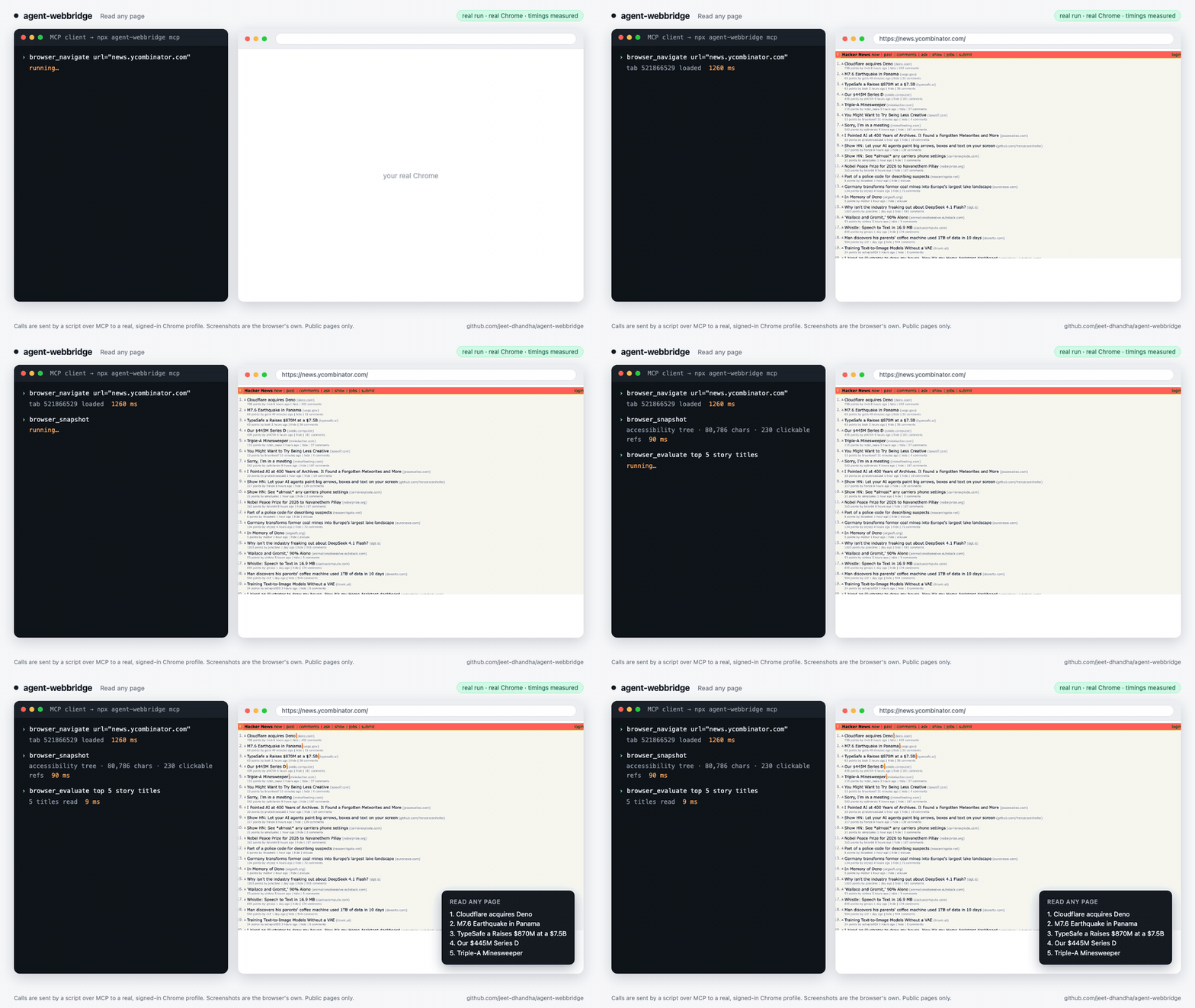
Real runs, not mock-ups: a script sends MCP calls to npx agent-webbridge mcp, which drives a real, signed-in Chrome profile. The screenshots are the browser's own and the timings are measured. Public pages only; nothing is submitted to any account.
| Read any page: snapshot + evaluate on Hacker News | Five tabs at once: 3.5 s in parallel vs 9.3 s one at a time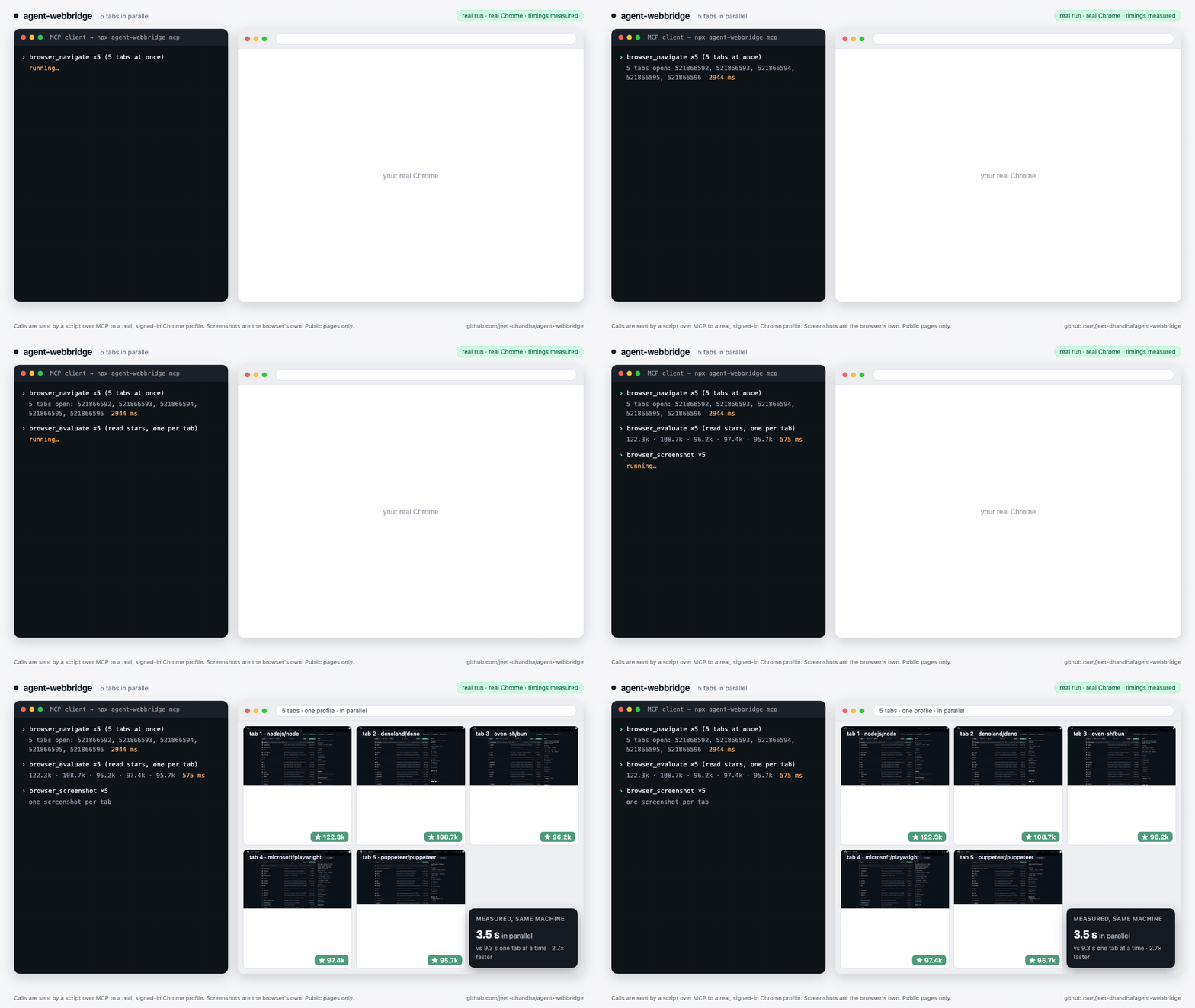 |
Use your real login: a signed-in editor, filled in, stopped before publishing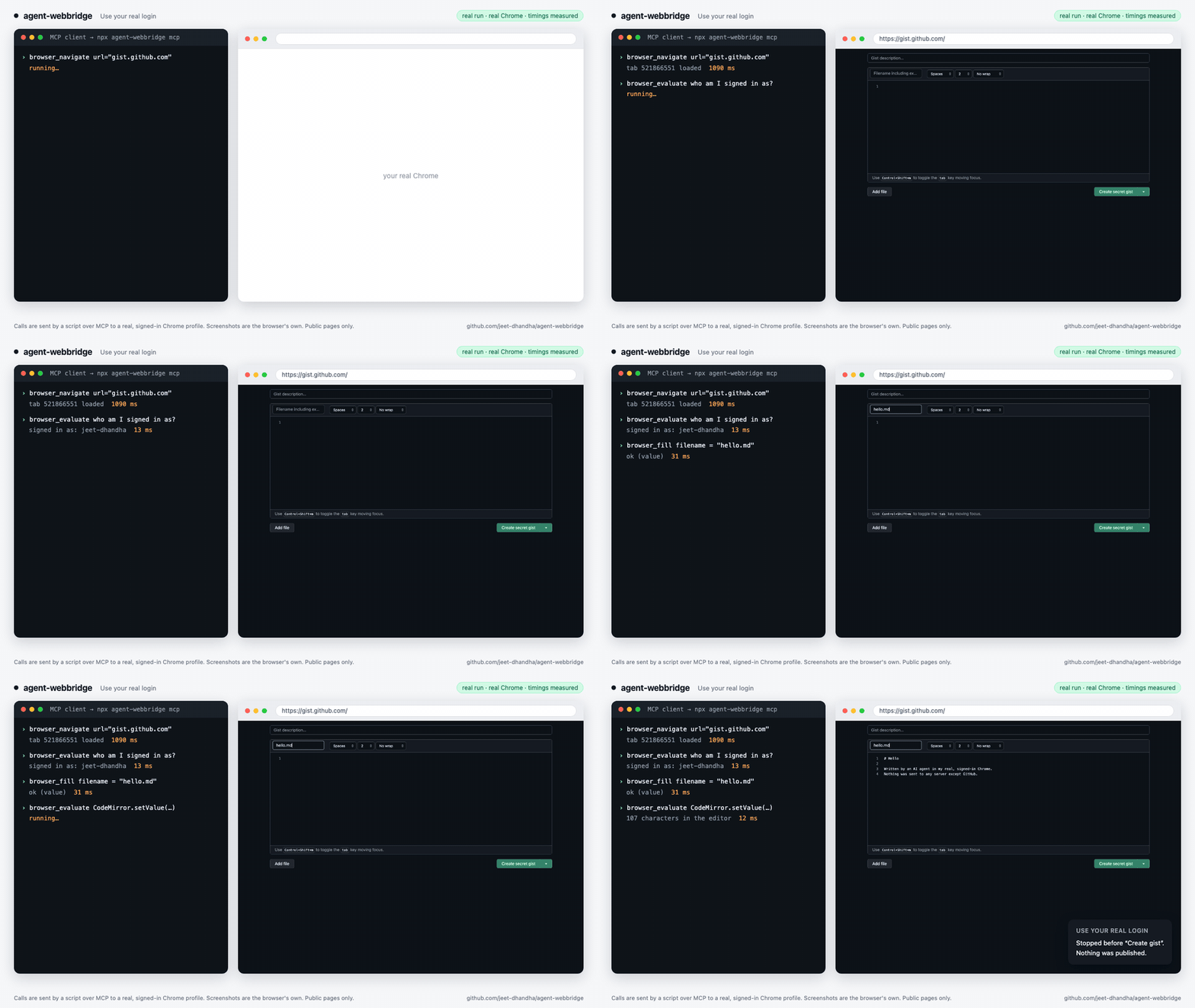 | Fill and submit forms (fields, radios, checkboxes)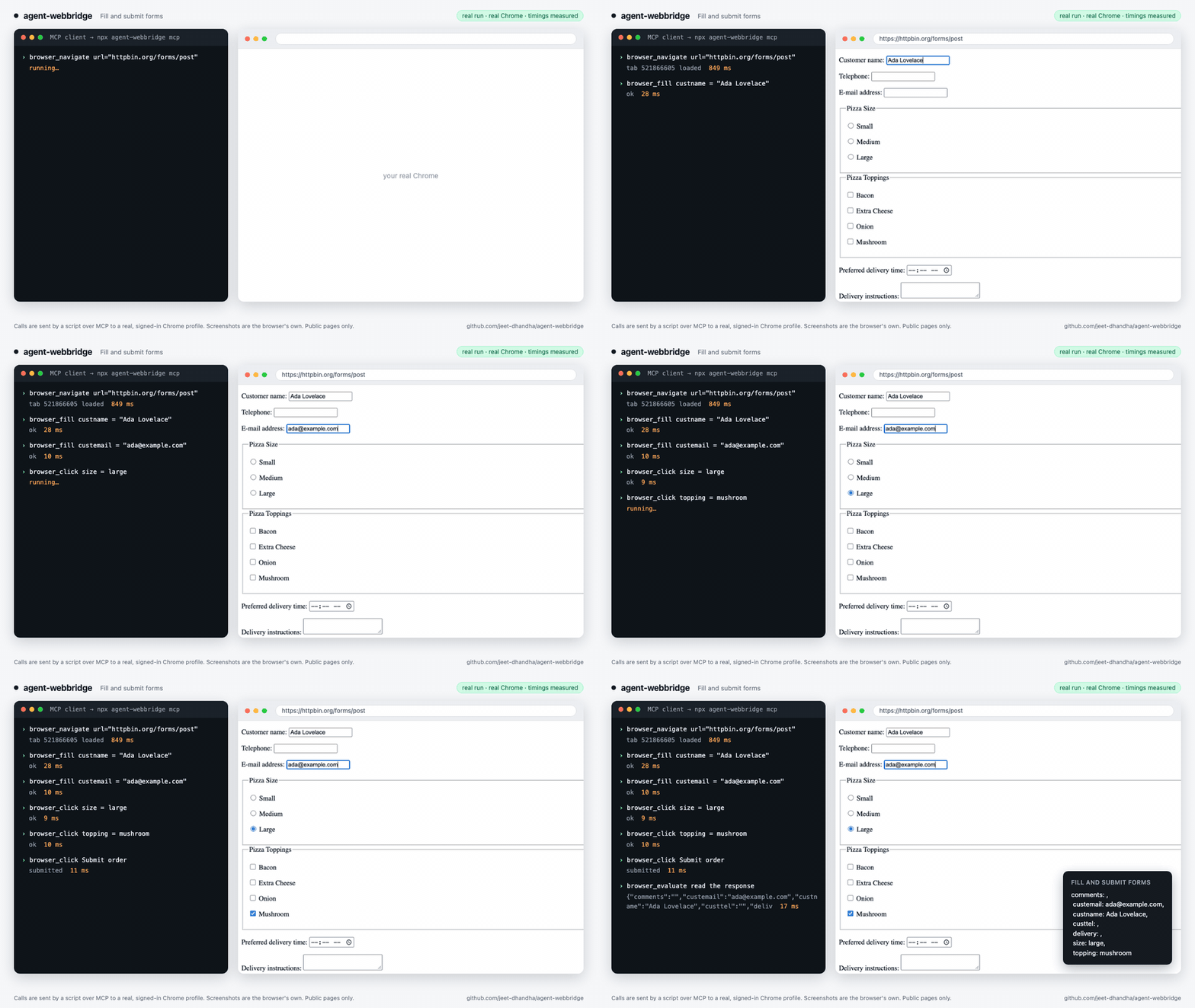 |
Timings come from one MacBook on home broadband; yours will differ.
Overview
- Drive your real browser — your actual Chrome, your actual login sessions. No headless re-login, no scraping around auth.
- Run tabs in parallel — the extension attaches
chrome.debuggerper tab, so N tabs in one profile run concurrently. In our benchmark, 5 tabs took 3.5 s in parallel vs 9.3 s one at a time (one MacBook; yours will differ). - Span multiple profiles — one daemon per profile. Total concurrency = profiles × tabs, all from one endpoint.
- Stay private — own daemon, own MV3 extension, no closed-source dependency, no account. Everything is local.
Install
npm i -g agent-webbridge        # 1. the daemon + the `awb` CLI
awb setup "Work"                # 2. opens the Chrome Web Store; click "Add to Chrome"
awb setup opens the Agent WebBridge listing in your chosen profile and polls while you click Add to Chrome. As soon as it detects the install, it wires the profile to its daemon and brings the fleet up.
Requirements: macOS or Windows · Google Chrome · Node.js ≥ 18.
Quickstart
awb up "Work" "Personal"        # bring profiles up (setup did this on first run)

# Drive any profile by name — using the handy cmd helper function:
cmd(){ curl -s -m 60 -X POST http://127.0.0.1:10086/command -H 'Content-Type: application/json' -d "$1"; echo; }

cmd '{"action":"navigate","args":{"url":"https://news.ycombinator.com"},"session":"scan","profile":"Work"}'

awb down                        # stop the fleet when done
Every call is a POST /command on 127.0.0.1:10086. Wrap payloads in single quotes ('...') to prevent shell quote-escaping issues. "session" groups a task's tabs into one Chrome tab group; "profile" picks which Chrome profile to drive. Pass {"action":"screenshot","args":{"path":"/path/to/img.png"}} to save screenshots directly to disk.
Tools (15 Native Tools + Status)
| Tool | Does |
|---|---|
navigate | Open a URL in a new or existing tab |
find_tab | Locate a tab by URL / title |
evaluate | Run JavaScript in the page, return the result |
snapshot | Accessibility tree with stable @e element refs |
click | Click an element by @e ref (synthetic DOM click) |
trusted_click | Real mouse click (CDP, isTrusted) for pages that ignore click |
fill | Set native inputs and contenteditable rich text fields |
upload | Programmatically assign files to <input type="file"> |
file_chooser_intercept | Suppress native OS file picker dialogs (Finder/Explorer) during programmatic upload |
screenshot | Capture full-page or element screenshot directly to disk |
save_as_pdf | Save the page as a PDF |
network | Capture network requests (start, stop, list, detail) |
list_tabs | List open tabs with IDs and tab group info |
close_tab | Close a tab |
close_session | Close a session and its entire tab group |
Programmatic SDKs (Node.js & Python)
Node.js ESM SDK
import { WebBridgeClient } from "agent-webbridge";

const client = new WebBridgeClient({ profile: "Work", session: "my-task" });
await client.navigate("https://example.com");
const title = await client.evaluate("document.title");
console.log("Title:", title);
Python 3 SDK (Zero Dependencies)
from scripts.awb_client import WebBridgeClient

client = WebBridgeClient(profile="Work", session="my-task")
client.navigate("https://example.com")
title = client.evaluate("document.title")
print("Title:", title)
How it works
  AI agent  ──HTTP POST /command──▶  router (127.0.0.1:10086)   routes by "profile"
                                          │
                       ┌──────────────────┼──────────────────┐
                       ▼                  ▼                  ▼
                  daemon "Work"      daemon "Personal"     daemon …      one per profile
                       │  WebSocket
                       ▼
                  MV3 extension      ──chrome.debugger (a Map: one attach PER TAB)──▶
                       │
                       ▼
                  Chrome DevTools Protocol      tab 1 ║ tab 2 ║ tab 3   (concurrent)
The router proxies each command to the per-profile daemon on its deterministic hashed port; the daemon relays over WebSocket to that profile's extension; the extension keeps a Map of chrome.debugger attachments — one per tab — and issues CDP calls. That per-tab map is the whole trick: bridges that funnel everything through a single "current tab" can only drive one tab per profile; this drives N.
CLI
| Command | Does |
|---|---|
awb setup <profile…> | One-time install: walk through "Load unpacked", connect, bring the fleet up |
awb up <profile…> | Start the named profiles' daemons + router, open windows, connect |
awb down | Stop the router + fleet |
awb connect <profile…> [--no-restart] | Point each profile's extension at its daemon. Chrome stays open when the extension is current; --no-restart never closes Chrome (fails instead) |
awb check [profile…] [--json] | Read-only readiness probe (folder? dev-mode? loaded? connected?) — what an agent polls during install |
awb status | Per-profile daemon + extension-connection status |
awb doctor | Diagnose the environment (Chrome, profiles, daemon, extension) |
awb mcp | Run the stdio MCP server (what the config above launches) |
awb profiles | List Chrome profiles, their hashed ports, and extension presence |
<profile> is anything that resolves uniquely — the profile name ("Work"), an email, or the Chrome directory ("Profile 2").
Use it from an AI agent
Ship it as a Claude Code skill / plugin — the bundled agent-webbridge skill teaches an agent the full flow (install via awb check --json, then drive over POST /command). To hack on the extension itself, awb install-dev Load-unpacks the in-repo build (chrome://extensions → Developer mode → Load unpacked → agent-webbridge-extension/); it ships its own key, so the dev id is stable across reloads.
Community recipes (awb-recipes)
Websites update their markup and deploy anti-bot traps all the time. Rather than forcing your agent to guess selectors or fail on edge cases, browse community-maintained, verified playbooks in awb-recipes.
github-gist-create: Create secret or public GitHub Gists via browser UI with active session.google-search-results: Organic SERP extraction from your own signed-in browser.hn-reply-box: Interact with Hacker News threads using authentic user cookies.linkedin-feed-posts: Extract authentic feed updates without session hijacking.npm-most-depended: Extract package download metrics and dependency hierarchies.
Hand a recipe to your agent: "Do the github-gist-create recipe from awb-recipes with my Work profile."
To contribute, claim an open issue labelled good first recipe and open a PR!
Ecosystem & listings
- Official MCP Registry: Registered as
io.github.jeet-dhandha/agent-webbridge(the registry currently shows 1.3.1) - Awesome MCP Servers: pull request open on punkpeye/awesome-mcp-servers (waiting on a Glama listing)
- Awesome Claude Skills: pull requests open on BehiSecc/awesome-claude-skills, karanb192/awesome-claude-skills and travisvn/awesome-claude-skills
- Skills CLI: Installable via
npx skills add jeet-dhandha/agent-webbridge - Chrome Web Store: Published extension Agent WebBridge
- Website & Interactive Demos: jeet-dhandha.github.io/agent-webbridge
Platform
| macOS | Windows | |
|---|---|---|
| Profile discovery | ~/Library/Application Support/Google/Chrome | %LOCALAPPDATA%\Google\Chrome\User Data |
| Chrome binary | /Applications/Google Chrome.app | Program Files\Google\Chrome\Application\chrome.exe (auto-detected) |
| Daemon, router, MCP, all tools | ✅ | ✅ |
Install flow (awb setup) | opens the profile window via AppleScript | opens it by launching Chrome with the profile |
| Tab/window housekeeping (focus, tidy blank windows) | ✅ | skipped — cosmetic only |
Set AWB_CHROME_BIN / AWB_CHROME_DIR if Chrome or its data directory is somewhere non-standard (Chrome Beta, portable installs). Linux paths are wired up but untested.
On Windows, run commands from PowerShell or cmd (the curl examples below use bash quoting; in PowerShell use curl.exe and a here-string, or just use the MCP server). The daemon and the Windows code paths are covered by CI on windows-latest; the Chrome-launching steps (awb setup / awb up) are the least-tested part — please open an issue if one misbehaves.
Security
- Everything listens on
127.0.0.1only. As of 1.3.1 the router and daemons also refuse requests that carry a webOriginor a non-loopbackHost, so a website you visit cannot drive the bridge (see the changelog). Upgrade from earlier versions and restart the fleet withawb down && awb up. - It acts as you, in your signed-in browser. Any local program that can reach
127.0.0.1:10086can do the same, so only run it on a machine and account you trust, and keep irreversible actions (posting, paying, deleting) behind a human confirmation in your agent. - Report vulnerabilities privately through GitHub's "Report a vulnerability" on the Security tab.
License
MIT © jeet-dhandha





