Listed from the MCP registry; nobody on Odel publishes it.

NestWeaver
Local code knowledge graph: search symbols, trace callers, and inspect change impact across repos.
Runs on your machine from its package; the steps are below.
What it does
- Reads
- Writes
- High impact
At most: only reads or looks up information.
What it costs
FreeOdel charges nothing per call. The publisher may charge for its own service.
Runs locally over stdio
This server isn't hosted — your MCP client launches it from a package registry. Use one of the commands below, or drop the config into your client (e.g. Claude Desktop).
Run
npx -y nestweaver
MCP client config
{
  "mcpServers": {
    "nestweaver": {
      "command": "npx",
      "args": [
        "-y",
        "nestweaver"
      ]
    }
  }
}

Your codebase as a queryable graph — built for AI agents.




Website · Docs · npm · Releases
NestWeaver indexes source code and Markdown into a local knowledge graph.
Search symbols, trace callers and dependencies, and get task-focused context
from the CLI or your AI coding tool through MCP.
NestWeaver uses Tree-sitter to parse 32 languages and resolves cross-file references with confidence scores. Its graph helps you explore an unfamiliar repository, assess a change's impact, and give an agent relevant symbols and relationships. Indexing and structural queries run locally; semantic embeddings and shared-server connections are optional.
Quick Start · Install options · CLI reference · MCP server · Agent setup verification · Upgrade guidance
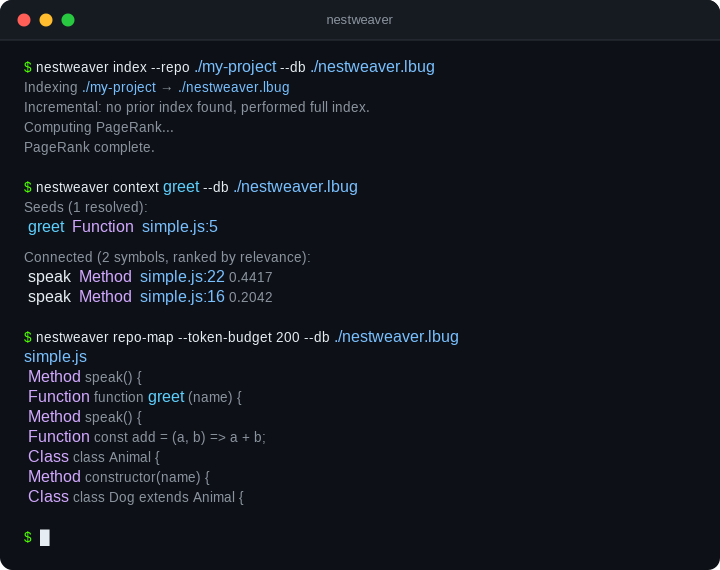
Index a repo and query it in seconds
|
32 Languages |
Markdown Brain |
|
Intent-Aware Context |
43-Tool MCP Server |
|
PR Impact & Dead Code |
16 AI Tool Integrations |
|
Agent Interaction Memory |
Quick Start
1. Install the CLI
Upgrading an existing database? Stop the old daemon and back up with the previous binary first.
With Node.js 18+ on macOS 13.3+ or Linux with glibc 2.35+ (x86_64 or arm64):
npm install --global nestweaver
nestweaver --version
npm installs the matching prebuilt binary as an optional dependency; no Rust compiler or install-time script is needed. Keep optional dependencies enabled. Windows and musl/Alpine do not have published binaries. For a verified GitHub Release archive or a source build, see Install and INSTALL.md.
2. Index and query your repository
Run these commands from your repository root:
nestweaver index --repo . --db "$(pwd)/nestweaver.lbug"
nestweaver search "main" --db ./nestweaver.lbug
# Replace processPayment with a symbol name found in your search results
nestweaver context processPayment --db ./nestweaver.lbug
search finds symbols by name; context returns related symbols and their
relationships around a name, UID, or repo-relative file path. The database and
its sidecars stay on disk so subsequent queries can reuse the index. A local
background daemon owns the database and starts automatically on first use.
Index reports its selected database target on stderr unless --quiet is set;
the target is not a field in the --json payload. When querying from another
directory, pass the same absolute database path with --db. The first
command uses an absolute path for daemon startup. Explicit
--db keeps these examples bound to the same graph even if you have other
instances configured.
3. Connect your AI coding tool (optional)
From the same repository root:
nestweaver setup --db "$(pwd)/nestweaver.lbug"
# Or choose a specific installed integration:
nestweaver setup claude-code --db "$(pwd)/nestweaver.lbug"
setup detects supported tools and writes their MCP registration and
instructions. Use an absolute database path so clients launched from another
directory still query the same graph. It supports 16 integrations, including Claude Code, Cursor,
Codex, Gemini CLI, and GitHub Copilot in VS Code. Most config files are written in the repo;
Windsurf uses its user-level config, and Cline gets a printed snippet to paste.
setup attempts every tool, lists what it wrote for each, and exits non-zero
if any tool failed. Restart or reload your client and check
its tool list to confirm activation. Cursor gets the six-tool lite set; other
MCP integrations use the full set. For a client you configure manually, launch
nestweaver mcp --db /absolute/path/to/nestweaver.lbug as its stdio server; see
MCP Server for tool filtering and lifecycle details.
The first interactive
indexrun from inside your repo also offers setup. The prompt is skipped in CI, scripts, and non-TTY runs;index --setupexplicitly requests setup at the indexed repo root. Usesetup --forceonly when you want to overwrite customized skill/guide files or rebind an existing registration to a different--db(a changed--dbis reported otherwise). It never overwrites.github/copilot-instructions.md, or anAGENTS.mdwithout NestWeaver's begin/end markers.
# Keep the graph current as you edit (runs until interrupted)
nestweaver watch . --db ./nestweaver.lbug
Run nestweaver --help for the full command list. Most commands support
--json for machine-readable output. Existing users should read the upgrade
notes below before using an older database with a new binary.
Upgrading — re-index before you trust a ranking
Upgrading an existing database? Check compatibility before querying it:
Builds with LadybugDB 0.22.3 read the 0.21.2 database format, but a writable open/checkpoint can upgrade its storage format from 47 to 49. Stop the old daemon and back up with the previous binary before upgrading. To downgrade, reinstall that binary and restore the pre-upgrade backup; do not point it at the upgraded file. See the storage upgrade guidance.
Previous release 12.2.6 uses resolver generation 22 and parsed cache 16. LadybugDB 0.22.1 is unchanged from 12.2.5. Anonymous JavaScript/TypeScript default functions now own calls in their bodies; Svelte, Vue and Astro function spans skip destructured/default parameters. Generation 21/cache 15's PHP static-method ownership and inheritance facts and the preceding Dart/PowerShell grammar updates remain included. Force re-index each repository once after upgrading to publish the new parser facts; invalidating the parse cache alone does not replace symbols and edges already stored in the graph.
12.2.7 uses LadybugDB 0.22.3 (the same storage format 49), resolver
generation 23 and parsed cache 17. Scala grammar 0.26.9 repairs Scala 2
given/enum identifiers and other grammar boundaries. Force-index each
repository once after upgrading from generation 22 as well.
12.2.8 uses resolver generation 24 and parsed cache 18. Re-index each repository to pick up corrected declaration spans, Rust module call edges, and partial SQLite parse diagnostics. Markdown derivation version 4 refreshes eligible vaults on daemon startup.
Canonical publication PageRank now consistently covers the unified code and notes graph after indexing, watching and rebuilding. Older canonical sidecars with a code-only scope are disclosed and recomputed lazily on the first ranked query; no graph rebuild is required for this ranking migration alone. Explicit scoped ranking APIs retain their requested scope.
daemon status --json reports both client and daemon resolver generations.
An older daemon without this provenance reports null; differing builds with
the same product version disclose skew without automatically replacing a writer.
- A database from before LadybugDB 0.21 needs a publication rebuild, not just a forced index. Back it up and follow the error's recovery command and storage-engine upgrade guide.
- For a compatible database, run
nestweaver stale-check --db <db>. 12.2.8 requires resolver generation 24 (12.2.7 used 23). If your binary reports a generation-stale graph, runnestweaver index --repo <path> --db <db> --forcefor each repository. A plain incremental index does not repair generation-stale graphs. - Generation 16 preserves declaring-package origin through Go factory-call receiver chains and revisits unchanged importers when Go package methods are added or recreated. Existing graphs may retain missing CALLS edges until the forced index above.
- Generation 17 confines Go initializer and case-clause bindings to their statement or clause, restoring valid calls after those scopes end. Cached parses are invalidated to discard the old lexical lifetimes; existing graphs need the forced repository index above. Resolution-dependency format is unchanged.
- Generation 18 and parsed cache 12 invalidate Scala parses from
before the grammar 0.26.3 update, which recovers declarations such as local
case classes and Scala 2
exportidentifiers. After upgrading to a release containing this change, force re-index each repository using the command above. An unchanged incremental run does not repair an older graph;stale-checkcontinues to report it as outdated until the forced index succeeds. - 12.2.4 generation 19 and parsed cache 13 additionally repair PHP function
resolution by namespace across directories, including
use functionaliases and duplicate refusal. Existing graphs need the forced repository index above. PHP changes conservatively re-resolve repository PHP callers because a new declaration can satisfy a previously unresolved call or create ambiguity. Ordinary index/watcher scans reuse valid cached parses; Git/server incremental repair reparses PHP peers. No-change runs remain no-ops. - Markdown derivation version 3 repairs percent-encoded Markdown URL paths and
proven absolute in-vault note paths. Eligible vaults disclose stale derivation
until re-derived; run
nestweaver brain refresh <vault> --db <db>after upgrading. This is separate from repository resolver generation; literal wikilinks keep their existing spelling semantics. - The current source also infers method receivers from typed Go slice range
elements, including qualified types and exact factory returns. Generation 14
requires the same forced repository re-index to add the missing call edges;
generation15 additionally handles inferred
varslices, parenthesized range sources and single named factory results. Parsed cache10 reparses unchanged declarations for normalized return types and complete var/const/parameter shadow guards. - Upgrading to 12.2.8 needs a forced re-index of every repository. Run
nestweaver index --repo <path> --forceonce per repository, using your usual--dband--configbindings. Plain incremental indexing can leave an unchanged graph on its old generation.stale-checkexits 2 until repaired. - Refresh any vault that still reports stale Markdown derivation. Run
nestweaver brain refresh <vault>with the same bindings to re-derive note-to-code relationships against the rebuilt graph. If upgrading from before 12.2.2, this also repairs frontmatter wikilinks and block references. - New databases do not need migration. Vaults do not carry a code resolver generation; see the detailed notes for separate Markdown derivation changes.
Detailed migration notes and changes for scripts and server clients
12.2.6 uses RESOLVER_GENERATION 22; 12.2.5 used 21. Every
graph indexed by a generation different from the running binary must be re-indexed. Compatibility is an EXACT MATCH, not a floor, so a graph written
by any other generation — older or newer — is treated as untrustworthy.
9.0.0 took it from 3 to 4, and generations 5 and 6 followed. The 9.0.0 bump
changed edge SHAPE; 5 and 6 changed which symbols are persisted as ENTRY
POINTS, which is what dead-code walks from. Generation 7 (nw-687) adds
missing CALLS/definition edges for CommonJS module.exports.X/exports.X
function definitions, which a stale graph is missing entirely. Generation 8
(nw-688) renames JS/TS test-runner blocks so describe('getTier') no longer
shadows the real getTier. Generation 9 replaces file-level import proxies with
actual binding users, corrects receiver and export resolution, and persists
exported executable roots. Upgrading from generation 8 requires a forced
re-index of every repository; stale-check exits 2 and dead-code refuses
until the graph matches. Generation 10 (nw-113) restricts a block-scoped
JS/TS callable to its block, and gives the calls a JS/TS/Python/PHP file makes
at its top level a per-file <module> owner (parsed cache 6). The same bump
carries these JS/TS parser and resolver fixes:
| Change | Effect on the graph |
|---|---|
Generators (function*, async function*, const g = function* …, CommonJS exports.g = function*) are Function symbols (nw-791) | Their callers gain edges; their body calls are no longer top-level code |
Generators scope their parameters and vars | A generator's parameter no longer shadows a same-named module function |
A .js bare-parameter arrow (const f = x => …) is a function | It was a Constant, so its callers had no edge |
A catch (f) parameter and a for loop variable are scoped to their clause (nw-800) | f() inside them no longer binds a same-file f |
An unparenthesised arrow parameter (f => f()) is scoped to its arrow, like (f) => f() | [1].map(g => g()) no longer gives a false edge to an imported g |
| ESM import bindings are hoisted to the top of their scope (nw-803) | A function written above an import sees the binding. A function above a CommonJS require sees it too, including an expression-body arrow (const fb = () => f()); top-level code above the require does not |
TS import x = require('m') and export import x = require('m') bind like an import (nw-801) | Calls through x resolve. A bare call on a whole-module binding (x()) is unresolved |
.ts and .tsx keep their own type bindings (nw-805) | type_aware edges are deterministic; on mixed .ts/.tsx repos they may differ from 12.0.x |
A broken file with no real symbols gets no owner; a lowercase JSX tag (<div/>) never mints one | Such files stay disclosed as parse errors and add no empty owners |
| A top-level call through an import written below a one-line function resolves (JS/TS/Python/PHP), and a sibling's nested homonym no longer hides the caller's own nested function | Those calls keep their edges |
A member access or call through an imported receiver (Modal.latestProps after import { Modal }) never binds a same-file symbol of the member's name | The false self-ACCESSES edge in a file named like its import (Modal.test.js) is gone |
.mjs/.cjs files are indexed as JavaScript and .mts/.cts as TypeScript; an extensionless import also reaches them, a directory import reaches its index.mjs/.cjs/.mts/.cts, and index, main, app and server files in those extensions are entry files like their .js/.ts twins | Those files, and the calls into them, appear in the graph |
Generation 11 (nw-787, nw-789) scopes a nested JS/TS function declaration to
where it is visible, stops a bare JS/TS call binding a method or accessor,
scopes a Python def nested in a function to that function, and gives a nested
class's members MEMBER_OF their own class (parsed cache 7). Graphs indexed at
generation 9 or 10 need the same forced re-index.
Generation 12 resolves imports by package instead of by file name, and resolves more method calls (parsed cache 8):
| Change | Effect on the graph |
|---|---|
Go imports read go.mod, go.work and local replace lines, map an import to every non-test file of the package, and honour import aliases. Files marked //go:build ignore (or // +build ignore) are left out of package resolution | Cross-package calls in a real Go module resolve; they did not before |
Go methods carry their receiver type (MEMBER_OF edges), and every build-tag variant of a function is a callee (except ignore-tagged files) | Typed Go method calls resolve, and Type::method names look up |
Python from . import mod, from pkg import mod as m, import pkg.mod as m and aliased re-exports through __init__ bind the submodule or definition | Those calls gain edges |
Kotlin and Java imports resolve through the declared package (any file of it, wildcard imports, nested classes), not a file named after the symbol, with the language's precedence: a single-type import, then a type in the same package, then an on-demand (*) import. A single-type import brings in only the declaration it names | Imports of classes in differently named files resolve, and a same-package type is no longer shadowed by a wildcard import |
A method called on a call or new receiver (new K().m(), K.make().m(), chains) resolves through the declared return type. Where the receiver is not typed, a method links only when its name is unique in the repository AND every step of the receiver chain has a repository return type (or plainly returns Name(..), new Name(..) or cls(..)) that is the method's owner or a subtype, so A.find().get() on an Optional, .size() on a List or .then() on a Promise does not link to a same-named repository method. Kotlin/Scala expression-body factories, Ruby implicit returns, multi-line returns and methods returning self are deliberately not typed | More method calls gain edges, conservatively; library-typed chains stay unlinked |
new Foo() links the class in Java, C#, PHP, C++, Scala, Groovy and Dart; Rust trait default methods and turbofish calls resolve; a bare TS/JS @decorator references its function | Constructors, trait defaults and decorators are no longer unreachable |
Duplicate JS/TS this.x = properties collapse to one symbol, and a bodiless Rust mod x; no longer owns the lines below it | Fewer duplicate symbols and no false IMPORTS edges |
Generations 13–17 add nested Go module and receiver ownership, typed slice range elements, inferred slice and named-return forms, factory-call receiver origins, recovery when package members are recreated, and correct if/switch/case binding lifetimes. 12.2.3 includes all of these changes (parsed cache 11). Existing missing edges require the forced re-index described above.
All these kinds of staleness have the same remedy and the same symptom list. Until you re-index:
- Rankings are stale.
hubs,bridges,repo-map,clusters, and every PageRank-ordered result are computed over edges the old resolver wrote. MEMBER_OFedges are missing for C and C++ members, so reachability under-counts.dead-coderefuses to answer on such a graph and exits2rather than printing a deletion list built from missing edges.- C++
IMPORTSedges are missing. The resolver used to extract#includeand then discard it. .hheaders were parsed with the C grammar, which has noclasskeyword. Re-indexing routes them to C++: on a real 874-header corpus, header symbols went 7,166 → 17,872 andclassdefinitions 0 → 1,373.
nestweaver index --repo <path> --force # per repo — a full index, not incremental
--force is required. A generation-stale repo is sitting exactly at git
HEAD with every file unchanged, so plain nestweaver index --repo <path> takes
the incremental path, reports 0 added, 0 modified, 0 deleted, writes nothing,
and leaves the repo on the old generation. Only a full re-index rewrites the
edges.
Vaults are not Repo nodes and carry no resolver generation, so the forced
re-index does not touch them. When crossing the 12.2.4 Markdown derivation change, run one
brain refresh <vault> per vault to re-derive links against the rebuilt code graph.
stale-check detects this as of 9.0.0. A repo whose edges predate the
running resolver reports status: "outdated_resolver", needs_reindex: true,
and the command exits 2 — the same code it already used for
stale/incomplete/missing, so an existing CI gate catches the upgrade with
no edit:
nestweaver stale-check                    # [OLD-RESOLVER] rows + the remedy, exit 2
nestweaver stale-check --json             # "resolver_stale_repos": [...], per-repo "resolver_stale"
cat <db>.resolver_generation.json         # per-repo generation; anything that is not the current one is stale
In 8.x it did not: the status ladder was missing/incomplete/SHA-behind-HEAD
only, so a generation-3 graph reported ok and exited 0.
Generations 5 and 6 turned on PERSISTED PER-SYMBOL COLUMNS rather than edge
shape: is_entry_point and entry_point_kind are read straight off disk, so a
symbol indexed as false stays false no matter which binary asks. Generation
6 roots bash and Python top-level calls, Swift main.swift/shebang files, bash
trap handlers, and package.json entry points at any depth in a monorepo.
Those additions can only ADD reachability roots, so they can only REMOVE
symbols from a dead-code list — an un-re-indexed graph over-reports dead
code.
hubs, bridges, repo-map, ranking rank and summary --level hub also
disclose it (rankings_stale / stale_repos on --json, a warning on stderr
otherwise). Other ranking-derived surfaces still do not — clusters,
blast-radius, generate-guide, PPR-backed context, and the whole web UI —
so on those, absence of a warning is not evidence of freshness.
_meta moved to the payload and lost its nestweaver.io/ prefix
Only affects raw HTTP MCP clients that read result metadata. The CLI, the MCP stdio server and the daemon are unchanged for callers.
Through 8.x the HTTP /mcp boundary stamped provenance onto the outer
tools/call envelope under namespaced keys — nestweaver.io/sources,
nestweaver.io/scope, nestweaver.io/stale_repos. It is now written once, at
the tool layer, as an unprefixed _meta object on the result payload:
// 8.x — outer envelope
{ "result": { "_meta": { "nestweaver.io/sources": ["local"] }, "content": [...] } }

// 9.0.0 — on the payload itself
{ "map": "...", "_meta": { "scope": "local", "sources": ["local"], "stale_repos": [] } }
A client reading result._meta["nestweaver.io/sources"] gets nothing. Read
_meta.sources on the payload instead. The payload location is what the
server's own initialize instructions have always promised and what both CLI
routes already emitted; the envelope was the odd one out, and MCP over stdio
sent no provenance at all.
Note that _meta.stale_repos is federation staleness (which upstreams were
behind). It is a different population from the top-level stale_repos on
hub_nodes / repo_map, which is resolver-generation staleness, and from
stale_repos on stale_check, which is behind-HEAD.
Daemon bypass is CI-only
Standard development and distributed binaries cannot honor --no-daemon,
NESTWEAVER_NO_DAEMON, or an explicit permit. Refused requests print a warning
and keep the normal daemon route.
Only a separate internal CI test artifact may enable direct-store tests. It
requires the ci-direct-tests build feature, NESTWEAVER_ALLOW_NO_DAEMON=1,
and a GitHub Actions runner context (GITHUB_ACTIONS=true plus nonempty
RUNNER_TEMP, RUNNER_OS, and GITHUB_RUN_ID). Ambient CI=true never grants
access, including when set locally. This artifact must never be published.
Local development, fixtures, debugging, and recovery use the daemon; setting CI
locally is not an exception. See release fixture instructions.
Note that hubs --json carries two different stale_repos: the top-level
one is resolver-generation staleness, and _meta.stale_repos is federation
staleness (repos where the local index is behind an upstream server). They
answer different questions and can disagree.
Also changing behaviour in this release, in ways a script may notice:
| Change | What to do |
|---|---|
Re-index and refresh required (12.2.2). RESOLVER_GENERATION moves from 11 to 12 and the parsed cache from 7 to 8 (Go, Python, Kotlin/Java import resolution; method calls on call or new receivers; new Foo() edges; see the generation 12 table above). The filemeta and resolution-deps sidecars move from 4 to 5, so the first index after upgrading rebuilds in full. Vault link fixes (frontmatter [[wikilink]] relationships, [[Note#^id]] block references) apply only when a vault is re-derived, and the Markdown derivation version did not change, so that does not happen by itself | Run nestweaver index --repo <path> --force once per repo and nestweaver brain refresh <vault> once per vault; until the re-index stale-check exits 2, dead-code refuses and blast-radius misses the new edges |
affected-tests diffs one repository. With --base-ref it is the indexed repo checked out at the working directory's git root; with --files it is the only indexed repo, and when several are indexed the new --repo <name or UID> is required (exit 64 otherwise). Repo-relative paths resolve only in that repo, and --json names it. MCP affected_tests takes repo the same way and refuses files/changed_files together with base_ref (it used to ignore base_ref) | Pass --repo (MCP repo) when more than one repo is indexed; send either changed files or a base ref, not both |
daemon status exits 69 when the daemon is unhealthy (running but unreachable, or an owner it cannot verify). setup attempts every tool and exits non-zero if any failed. remove-repo with an ambiguous name exits 3. An empty query argument exits 64, and so do pre-push-impact with a bad --format or --min-severity, list-features without --config and interactions show with no arguments. memory consolidate --apply with nothing to apply exits 0. A database error under --json prints a JSON envelope | Treat 69 as "restart the daemon" (nestweaver daemon --db <db> restart), 64 as a usage error |
An explicit read-symbols --root (MCP root) must be inside an indexed repository or vault, or a linked worktree of one. A body read never follows a symlink out of the repository, and the web /source route walks from the repo root without following symlinks | Omit --root, or point it at the indexed checkout |
Git runs isolated for every repository NestWeaver reads, including pre-push-impact --local-changes, the code watcher and blast-radius. The repository's core.fsmonitor, hooks, clean/smudge/process filters, textconv and external-diff drivers, core.askPass and signature verification never run; a repository whose driver configuration cannot be listed is refused. Working-tree status/diff calls pass --ignore-submodules=dirty, so a submodule's own filters never run either (a moved gitlink still counts as changed; submodule contents were never indexed). A file a repo-local filter (for example Git LFS installed with --local) would have normalised may now show as modified in change detection | Nothing to change for normal repositories; expect LFS-tracked files to appear modified where a filter used to hide the difference |
Git metadata a repository borrows from another (a forged .git/commondir, a gitfile into another repo) is refused, and such a layout never takes the other repo's identity. /proc, /sys, /dev (at any depth) and other system roots are refused as repo or vault roots, and an instance id containing /, \ or .. is rejected | Index the real checkout, not a path through a pseudo-filesystem |
An unreadable source in a language that cannot carry API contracts is skipped and disclosed (read_error row, coverage_status: "degraded") instead of failing the index or watcher batch. An unreadable JS/TS/Java/Kotlin source still fails closed, because skipping a controller would publish an incomplete contract set. A file that vanishes mid-scan is a deletion. A malformed OpenAPI spec that never published contracts is skipped and disclosed instead of failing every index | Gate on coverage_status / --fail-on-skip; fix the named file's permissions |
Edits to .gitignore, .ignore and .git/info/exclude are reconciled: newly hidden sources leave the graph and newly visible ones are indexed, at watcher time and at startup. Global-excludes patterns with a slash are anchored at the repo root. A watcher that cannot publish, an interrupted vault refresh and an interrupted embedding pass now show in brain status until they finish | Nothing to change |
An incremental index that was killed part-way leaves a per-repo "publication incomplete" record: stale-check reports the repo incomplete and the next index rebuilds it in full. A full index whose bulk-load checkpoint fails now fails instead of reporting success. A daemon whose database file was deleted or replaced refuses writes | Re-run nestweaver index --repo <path> for a repo stale-check reports incomplete |
Client-supplied lists and values are capped and stated in each MCP tool's inputSchema: context seeds at most 256 (duplicates collapsed), kinds 32, repo/tag filters 100 (1000 for hub_nodes/bridge_nodes), file lists 1000, count_patterns.patterns 64. set_extension: uid 1 KiB (not blank, no invisible format or bidi characters such as U+202E), key 256 bytes, value 64 KiB of JSON nested at most 64 deep, no control characters, the sidecar written as compact JSON, last_indexed_at reserved, node and property counts capped. brain_add_source names: 1-255 characters with no control characters (CLI and store too; an already-stored bad name is listed escaped and can be removed by path or UID). MCP stdio frames are capped at 64 MiB | Split oversized requests; read the limits from tools/list |
brain_remove_source refuses a target that matches sources of different kinds (a repo and a vault sharing a name) or several sources, with candidates; repo URLs match exactly (no suffix match). It also accepts the derived repo name the other tools use. prune_stale removes a source only when its root is not found; an unreadable root is kept with a warning | Retry with a UID from candidates |
Metadata writes (set_extension, unset_extension, interactions forget) wait at most NESTWEAVER_METADATA_WRITE_WAIT_SECS (default 15) for the write lock, then answer write-busy; a cancelled request is never applied. MCP count_patterns has one max_millis budget for the whole call (default 10 s), shared by all patterns, and marks a pattern it cut truncated: true with lower-bound counts. The CLI's count-patterns takes the same budget as --max-millis (1-600000) and, when the budget cuts any pattern, prints a stderr warning and exits 75 (EX_TEMPFAIL) instead of 0 | Retry a write-busy answer; raise max_millis (--max-millis) for a large pattern set, and treat exit 75 as lower-bound counts |
brain_context and brain_search rank an exact-case symbol match first and apply repo filters before the result cap. regex_search without a trigram index finds what count_patterns finds. blast_radius gives the same risk on identical calls. Concise MCP rows keep uid and location, so they are larger | Nothing to change; budget for slightly larger concise responses |
New response fields: missing_sections (note_get), did_you_mean_by_target (read_symbols), changed_symbol_count, proposals_already_applied (brain_memory_consolidate, whose limit is now applied before any proposal moves), refresh_vault_paths, truncated on pattern counts, and publication_in_progress. note get, backlinks and MCP note_get resolve a path-qualified title without .md; [[Note#^id]] block references resolve | Read the new fields where useful; they are additive |
contracts diff reports parameter and response-status changes, and --fail-on-breaking fails on them | Review the newly reported changes before gating |
The CLI sends the daemon absolute --config, root and backup save paths, and the daemon refuses relative ones. watch-stop no longer starts a daemon. Tracing respects --no-color, NO_COLOR and non-TTY stderr, and an invalid numeric NESTWEAVER_* value warns once instead of being silently ignored. Terminal control sequences from indexed content are escaped when stdout is a terminal. Secret env var values no longer appear in --help | Nothing to change |
backup save --force refuses a destination that is the live database or one of its files (also through a symlink or hard link), and backup restore --force replaces only a NestWeaver data directory. config validate checks that fusion weights sum to 1.0, rejects duplicate repos and caps the file size | Pick a backup path outside the database's files |
setup was checked against each tool's documented config location: VS Code and Copilot get .vscode/mcp.json under servers; Continue gets .continue/mcpServers/nestweaver.json; Kiro .kiro/settings/mcp.json; Cline gets a printed snippet; Aider's invalid repo-map: line is gone. Hook commands quote an absolute --db. A changed --db is reported and --force rebinds it. setup refuses to write through a symlinked directory outside the project. The Claude Code hooks (shipped and installed) now read tool_input and return hookSpecificOutput, so they actually fire; re-running setup claude-code repairs an older install | Re-run nestweaver setup after upgrading |
hooks --install takes --db (written into the hook as an absolute path) and never writes through a symlink. Run from a subdirectory, it binds the repository root's database. It mentions core.hooksPath only when that is set. --uninstall restores the newest backup only when the installed hook is NestWeaver's; otherwise it leaves the hooks alone | Pass --db when the database is not ./nestweaver.lbug |
The code watcher now resolves each batch with the full index's resolver over the whole-repository view, so a watcher-maintained graph matches a fresh index (re-exports through __init__.py and type-aware member calls used to be lost on large batches). A file the batch cannot re-parse keeps its edges. The daemon keeps one parse cache per database in memory and refreshes it each batch | Nothing to change; expect somewhat higher daemon memory on large repositories |
Claude Code integration: the shipped search hook searches the grep/rg pattern, not the path. The Bash hook setup installs fires only when grep, rg, find, fd, ack or ag is the command actually invoked, and does nothing without jq. setup recognises only the exact hook commands it writes, so a user's similar-looking hook survives a re-run | Re-run nestweaver setup claude-code to refresh the hooks |
setup trae, setup devin and setup hermes write .trae/config.json, devin.json and .hermes/config.json. Those paths are not where the tools read MCP servers (Hermes reads mcp_servers in ~/.hermes/config.yaml; Devin reads .devin/mcp_config.json or ~/.config/devin/mcp_config.json), so the registrations are ignored | Register NestWeaver by hand in those tools' own config until setup is fixed |
Interaction memory (--track-interactions) is now a re-rank, not part of the walk. A node the query's walk reached is scaled by at most +5% by how often agents used it; a node the seed cannot reach stays out, however often it was used. Results a query only showed no longer count toward the three-session floor, and the end-of-session success signal reinforces only results the agent then opened (B3). Before this, interacted nodes were teleport targets, so context could list dozens of unrelated symbols | Optionally run nestweaver interactions clear once to drop sessions recorded under the old rules, whose shown-only results still carry a floor |
MCP brain_impact sends its dependents once, as impact_nodes; the duplicate nodes list is gone from MCP (the CLI --json keeps both). A cut made to fit the output budget is disclosed in output_budget.cuts, and truncated_by_limit is set only when limit was the cause (M3) | Read impact_nodes |
A repo filter that names no repo (hubs --repo nosuch, every --repo listed below) writes "error": "not found" in --json, the word every other not-found envelope uses; it was "not_found". status still reads "not_found" (B6) | Branch on status, or on error == "not found" |
New exit codes: summary --level <invalid> exits 64 (was 1); summary --target matching nothing exits 2 with a not-found message and envelope (was 0, "graph may be empty"); context --feature <name> naming no [[features]] entry exits 2 and suggests declared names in did_you_mean (was 1); investigate-expand resolving none of its targets exits 2 (a partial resolution still exits 0); investigate --scope project:<unknown> exits 2 and a malformed --scope exits 64, each reported once instead of inside an "Internal error" (B9, V4) | Treat 2 as a miss and 64 as a usage error |
pr-impact reviews one repo: the indexed repo checked out at the working directory's git root, or the one named by the new --repo <name or UID>. A repo-relative --files path now resolves in that repo only, not in every indexed repo with a file at the same path. When neither names exactly one repo every repo is matched, as before. --repo keeps its class on both routes: not found 2, ambiguous 3 (with candidates), over 512 bytes 64. An empty --repo '' is ignored (every repo is matched), and a selector that names nothing, such as repo:::, is not found (2) (B4) | Run pr-impact from the repo under review, or pass --repo |
Web: a <module> owner reads path::<module> in /api/v1/symbols/top (name and display_name), overview landmark labels, search hits (name, title, display_name) and snapshot.msgpack node names; the Cypher export keeps the raw name and adds a display_name property (R1, B5) | Read display_name where present; do not treat name in these responses as the raw symbol name |
brain status reports the daemon's manifest reconciliation as manifest_recovery (state, attempts, retry_after_seconds, error) and warns while it is deferred, retry_scheduled or blocked. A capture slowed by contention defers the rebuild and refuses no repo; a repo that runs out of its own 60 s budget on 3 passes in a row is refused with a contention: reason (no index --repo remedy needed) and the other repos publish. The write gate is held for at most 60 s of captures per reconciliation (D3). The text output shows the state too | Nothing to change; a contention refusal clears itself once the repo captures in time |
A watched vault batch that collides with another writer's transaction retries with backoff (2575 ms in all, the write lease released while it waits). If the collision outlasts the retries the batch's notes are owed and replayed on the retry backoff and at the next start, instead of the watcher exiting; brain status lists them under "Watcher reconciliation pending" and shows the daemon's last_watcher_failure, which now survives the watcher's restart (also in text) (V1) | Nothing to change; nestweaver brain refresh also replays owed notes |
A note-to-code relink no longer forces a PageRank recompute on every ranked read: the code-only ranks stay warm and .pagerank.json is rewritten at the new generation (D1) | Nothing to change |
A database error is called corruption more carefully. A write-transaction collision, an index publication in flight and a busy daemon are never corruption. A file shorter than its catalog read while another process writes says so and names the next step (if it repeats, nestweaver daemon --db <db> stop and re-run); an engine assertion or an unclassified corruption is corruption whether or not the daemon is up, and so is a truncation reported inside a timed-out health check or a refused publication (V2) | Follow the step the message names before restoring a backup |
investigate answers through a live watcher batch with publication_in_progress, but does not save that map as a bundle: the result carries bundle_not_saved (also printed in text) and its bundle_id cannot be expanded or hydrated (V4, I3) | Re-run investigate once the batch finishes to get a bundle to drill into |
A call a JS/TS/Python/PHP file makes at its top level, outside every function, class and method (a bare call, an IIFE, an Express-style route handler, a decorator, a __main__ guard, a top-level await), is now owned by a per-file <module> symbol (Module, entry point module_init). impact shows it as the caller, dead-code treats it as a root (so a function called only at module load is no longer listed, and <module> itself is never listed), and a one-line function above such a call no longer owns it. An owner that calls something is its own process, named <repo-relative path>::<module>, so detect-changes lists more processes in repos with decorators, route registration or top-level test setup; an owner with no outgoing CALLS is not a process. Name search hides <module> unless you search for exactly <module>. Resolver generation 10 and parsed cache 6 (nw-113) | Run nestweaver index --repo <path> --force for each repo after upgrading; search <module> by its exact name |
Module owners are labelled <repo-relative path>::<module> everywhere (impact rows, read-symbols, context, flow-trace, investigate neighbours, ambiguity candidates, process names, Mermaid export, the GraphML label, the web UI). symbol --json keeps each symbol's raw name and adds a labelled display_name to the symbol and every caller and callee. A file that is only top-level code gets a summary --level file line with no exports 0 symbols clause, and no line at all when that code calls nothing indexed in another file. read-symbols, impact, flow-trace and context look one up as path::<module>; the path is the exact repo-relative path or a suffix on a / boundary (app.js, or conftest without the extension), and a suffix that several files share is ambiguous | Name an owner path::<module>; lengthen the path when it is ambiguous |
A qualified name now narrows every name lookup, not only owners. The segments before the name are read two ways and both readings are kept: the first as a file (an exact repo-relative path, a suffix on a / boundary, or that suffix without its extension, such as conftest) followed by a class chain, or all of them as a class chain. So path::name works, and Class::method and path::Class::method work when the index records the method as a member of that class. A Rust impl block in a different file from its struct is not recorded that way, so Struct::method is not found there; its Did you mean: line names the path::name that resolves. Outer::Inner::method works in Java and C#, where a nested class is a member of its outer class. Python nested classes and TypeScript namespaces are not recorded as containers, so there it is not found, with the same not-found message. A class name that is also a file stem (Svc::run with a/Svc.ts and a class Svc in b.ts) is ambiguous rather than answered by the file. A leading / is ignored and \ reads as /. impact, flow-trace, symbol, context, brain context, context --feature entry points and MCP brain_context all resolve qualified names this way. A qualifier that names neither is not found (exit 2), where it used to resolve by the last segment. Every one of these commands answers such a miss the same way impact does: a Did you mean: line of path::name specs (path::Class::method for a member) on stderr, and did_you_mean in the --json not-found envelope and the MCP envelope. Suggestions are substring matches first, then names a small typo away (edit distance up to 2; up to 1 for a 3- or 4-letter name), and a path::name whose path names a file is answered from that file's members (the close ones, else all of them in source order). read-symbols and MCP read_symbols answer a miss the same way: not found (exit 2) with the Did you mean: line on stderr and did_you_mean in JSON and MCP. Before calling it a miss they try shorter readings that are still qualified, dropping the outermost qualifier each time (zzz::Svc::run reads as Svc::run), and say so when one answers. A leading qualifier that could be a file (it has a / or a ., or an indexed file has it as its stem) is never dropped: nothere.ts::Svc::run is not found, and the shorter reading that does answer (Svc::run) is the first did_you_mean entry, so another file's Svc::run is never read in its place. When one is dropped they say so: a warning: line on stderr and a qualifier_ignored entry (query, note) in JSON and MCP. They never fall back to the last segment alone, and a path::<module> is never shortened: a file with no top-level calls has no owner, so its path::<module> is not found rather than a list of every owner in the graph. Ambiguity candidates carry file_path, and each ambiguity carries a hint that only offers what tells the candidates apart: "pass a UID or path::Class::name" when each candidate has its own class, "pass a UID or path::name" for an unqualified name whose candidates are each in their own file, "pass a UID or path::Class::name" again when candidates share a file but a class tells them apart, and otherwise "pass a UID" | Qualify a name as path::name or Class::method, or pass a UID |
Module owners are callers only. They are left out of clusters, repo-map and investigate entries; of the changed-symbol lists and counts of detect-changes, affected-tests (including its tier-1 test count), pr-impact, brain diff and pre-push-impact; and of embeddings and vector search. An owner that calls a changed symbol is still reported as affected. A detect-changes process listed only because a member file's top-level code changed has affected_symbol_count: 0 (owners are not changed symbols) and carries top_level_code_changed: true to say why | Nothing to change |
context, brain context and context --feature rank owners after every real symbol and list at most 3. The rest are counted in module_owners_omitted (JSON and MCP), printed as "+N more files' top-level code", and left out of the totals; when an owner is listed or left out, each command's Connected (...) heading says so and how many (… owners listed last, N more not counted); otherwise the heading is unchanged. Owners the --limit cuts are counted the same way. When owners are hidden, by the cap or because so many files call the seed at load time that the owners sink under the walk's usual relevance floor themselves, their places are refilled with real symbols the walk scored under that floor (at most as many as owners were hidden, never past --limit), so a helper called at load time from many files keeps its real neighbours; the totals count them | Read module_owners_omitted |
summary --level symbol and MCP get_summary list every real caller but at most 3 owner callers, then +N more files' top-level code | Nothing to change |
dead-code seeds its walk from owners but counts them in neither "entry points" nor "excluded"; --json gains module_owner_roots. A walk seeded only by owners is not degraded: coverage needs entry_points + module_owner_roots > 0. With --repo (MCP repos) both counts are that scope's own roots, like the other totals; coverage still asks whether the whole-graph walk had any root, so a library reached only from another repo is not degraded. --json (and MCP) carry that whole-graph count as walk_roots, and the text warning "no entry point was found" is printed only when walk_roots is 0 | Read module_owner_roots beside entry_points |
read-symbols path::<module> returns the file's top-level code: the lines outside every function, class and method, with each elided body shown as ⋮ | Nothing to change |
pr-impact, blast-radius and detect-changes report a changed source file that is only top-level code (a script, a seeder, an entry file) instead of a silent Low with nothing changed: a changed-file-top-level-only warning (on all three) names its path::<module> owner and the first 10 symbols that code calls (+N more after that). Files that load it only for its side effects (import './x', a bare require) have no edge in the graph, so the warning says its importers were not assessed and the run is partial with gate degraded-unknown. In pr-impact and blast-radius JSON the callees are listed apart in top_level_callees (edge_type: TOP_LEVEL_CALL, depth 1). They are not dependents, so they stay out of affected_symbols, affected_symbol_count, the clusters and the risk level, which is Low unless the file has real dependents. The owner is still not a changed symbol | Read top_level_callees as what the changed top-level code calls, not as dependents; check the file's side-effect importers by hand |
affected-tests selects a test file whose own top level calls a changed function. When none of that file's tests was reached, its tests list is empty and selected_by: "top_level_code" (JSON and MCP) says why; it counts as one test, so the summary never reads 0 beside a selected file, and the text output shows it as (top-level code). A test file that only imports the changed module, without calling it, is not selected | Nothing to change |
affected-tests lists each test file once, in the best tier any of its tests reached, with all of its affected tests there (nw-799). A file used to appear in both tier 1 and tier 2 | Count files per tier, not tests |
read-symbols --token-budget (MCP token_budget) cuts a first symbol larger than the budget to its leading lines, closed by a marker line, and sets body_truncated: true; it used to return it whole. The text output then ends with body truncated to fit the token budget, not truncated: 0 symbol(s) dropped. A budget of 0 still returns the first symbol whole | Check body_truncated before treating a body as complete |
After an edit, the watcher and incremental index always re-resolve a changed file's direct importers; the 200-file cap now bounds only the transitive expansion. Past 5,000 direct dependents the pass is skipped with a warning naming index and index --force; past 200 the count and time are logged. Barrel files that only re-export are re-resolved too, so their reexport_resolved edges survive edits | Nothing to change |
A nested JS/TS function declaration binds only where it is visible: inside its enclosing function (including nested functions and callbacks there) and, in strict code (TypeScript, an ES module including any .mjs/.mts file, a "use strict" directive in the file's or an enclosing function's prologue), only inside its block. A call before it in that scope still binds it (hoisting); a module-level declaration still binds file-wide. A Python def nested in a function binds only inside it. A bare JS/TS call never binds a method, getter or setter (this.x() and obj.x() are unchanged), so a same-named free function wins. A nested class's members are MEMBER_OF that class, not a same-named top-level one. The full index and the watcher now agree on all of these (nw-787, nw-789) | Calls that bound a sibling's nested function, a block function after its block, or a same-file method now bind the import, the caller's own function or nothing. Re-index with --force (generation 11) |
The index CPU budget (NESTWEAVER_INDEX_CPU_PERCENT) is off by default (nw-814). It was added because macOS was believed to kill a daemon using 90s of CPU in 180s; it does not. macOS's CPU usage monitor is per thread, armed only by a spawner that asks (launchd does), and non-fatal: it writes a *.cpu_resource.diag report ("Action taken: none") and the daemon keeps running. Parse workers still run at utility QoS on macOS, which keeps the machine responsive. An explicitly set 1–40 still applies the budget, with 1–11 raised to 12 (the smallest budget with room beyond the 20s write reserve); 41–99, including an older plist's 50, mean off | Nothing to change. To keep a budget, set NESTWEAVER_INDEX_CPU_PERCENT to 12–40 and re-run daemon start so the launchd plist carries it |
daemon gc also prunes the authority registry (~/.local/state/nestweaver/authority), which grew one lock record per database scope ever locked (nw-811). It removes records whose database, publication root or operation journal is gone, and empty records from earlier releases that are older than 24h, unheld and match no live database; a record some process holds is never removed. --dry-run reports what would go and changes nothing (it skips the launch-agent and directory sweeps). --db X limits the prune to X's records and leaves the older empty records alone. A registry gc cannot sweep is a warning, not a failure | Run nestweaver daemon gc --dry-run to preview, then nestweaver daemon gc |
A watcher pass over a file with a class keeps its MEMBER_OF edges and resolves this.m() / self.m() as type_aware, as a fresh index does. Before, it dropped every MEMBER_OF edge of the edited file, so dead-code on a watcher-maintained graph could list constructors | Nothing to change; graphs kept by an older watcher regain the edges on the file's next edit or a --force index |
| A code watcher keeps running when a committed batch's evidence cannot be saved. It notifies the committed graph and discloses the outstanding repair, retaining replay paths in memory across retries. Successfully persisted replay debt also survives restart; startup repairs imports across bounded source batches. | Restore access to the reported evidence files and let the watcher retry. If replay debt itself could not be persisted, keep the watcher running until repair completes; after interruption, run nestweaver index --repo <path> --force to rebuild missing evidence and relationships. |
Rebuild required. LadybugDB 0.21 (0.21.2 in published 12.2.4) changes how text keys are hashed and its on-disk format marker did not change, so NestWeaver now refuses a database built by an earlier version before opening it: exit 1, nestweaver::db_rebuild_required, the exact rebuild command, no daemon started, no byte changed. Snapshot format is now 4; older snapshots are refused, and backup restore of a pre-upgrade archive warns that the result needs a rebuild | Stop the daemon, run nestweaver backup save <file> (it reads the old database read-only and marks the archive as pre-upgrade), then nestweaver publication rebuild --config <instance.toml>; the old database stays in place until the new one validates. To roll back, reinstall the previous version and restore your backup. Do not open a rebuilt database with an older NestWeaver. See docs/guide/publication-rebuild.md |
A daemon killed by a fatal signal (SIGSEGV, SIGBUS, SIGABRT, SIGILL) while answering is now named. A database with damaged index pages can open under LadybugDB 0.21 and fault on a later lookup; the command used to print a bare transport error … broken pipe, and the respawned daemon reported a healthy brain status. The command now exits 1 with nestweaver::daemon_engine_crashed and the recovery, MCP tool calls return the same message with isError: true, and brain status prints a warning (--json: a warnings[] entry of kind daemon_unclean_exit with exit, signal, at_unix, pid, count). A daemon killed from outside (kill -9, the OOM killer) is reported as exited_unexpectedly, with no claim about the storage engine. daemon stop (with or without --force), Ctrl-C on a foreground daemon run and an idle exit leave no warning, and the warning clears when a daemon next shuts down cleanly. Nothing in the database is changed | Restore the most recent backup with nestweaver backup restore <archive>, or rebuild with nestweaver publication rebuild --config <instance.toml>. Do not retry the request that crashed: it will crash the daemon again. See Troubleshooting |
Renaming a registered vault with --name (brain add <root> --name X, brain refresh <root> --name X, brain watch, MCP brain_add_source) is now refused, exit 1, when another root's vault already holds that name (case-insensitively), with the same message and remedy as registering a new root under it. It used to succeed and leave two vaults answering to one name. Without --name, brain refresh, brain watch, brain add and MCP brain_add_source now keep a registered vault's stored name instead of renaming it to its directory's (a new vault is still named after its directory) | Pick a free --name, or remove the other vault first |
brain context --kinds and --intent, and context --intent, now refuse a value outside their fixed vocabulary at parse time with exit 64 and a message naming the valid values (they exited 1 with an internal error). MCP brain_context, regex_search and count_patterns report an unknown kind as an invalid argument | Fix the flag value; the message lists the accepted ones |
Every repo filter now resolves through the one repo resolver and keeps its failure class: clusters --repo, dead-code --repo, brain context --repos, investigate --scope repo:<name>, cross-repo-contracts --repo, impact --repo, flow-trace --repo, contracts list --repo, contracts drift --repo and service-summary --repo exit 2 (status: "not_found") for a repo that is not indexed, 3 (status: "ambiguous", with candidates) for a name several repos share, and 64 for a selector over 512 bytes. A malformed selector such as repo::: names no repo and exits 2. An empty --repo '' exits 64 on hubs, clusters, dead-code and affected-tests, but impact, flow-trace and pr-impact ignore it and match every repo. dead-code, brain context and cross-repo-contracts used to exit 1 with an internal error; clusters --repo on the daemon route reported an ambiguous name as not found; investigate --scope repo:<name> matched repo UIDs by substring and merged every match, so a fragment that matched only a repo UID (not its name, URL or root) now misses; impact/flow-trace --repo fell back to substring matches on file paths and UIDs. Over MCP a repo filter that names no repo is isError: true with the not-found envelope, and an ambiguous one names its candidates | Branch on the exit code, or on status in the JSON envelope; pass a repo UID or root path to pick one of several same-named repos |
A wikilink that exactly and uniquely names a note (case-insensitive, any folder: its filename stem is unique in the vault and no other note has that title) now resolves at confidence 1.0 and is no longer reported. brain broken-links, MCP brain_broken_links, memory lint's broken_wikilinks (and broken_wikilinks_total) and doc-stats now count only BROKEN links: unresolved (0.0) or ambiguous (several notes match; rows gain candidate_count). Links that resolved to one note by a fuzzier tier (a shared stem narrowed by folder, a path whose basename alone matched, an alias) move to a separate list that is not broken: broken-links JSON low_confidence is now that array (was a count; the count is low_confidence_total, with low_confidence_truncated), and ambiguous is added; total/returned/truncated describe broken links only, and offset/limit window both lists. memory lint gains low_confidence_wikilinks (+ _total); doc-stats gains ambiguous_link_targets, and low_confidence_link_targets no longer includes ambiguous links | Read low_confidence_total for the old count; gate on total (or unresolved + ambiguous) for broken links. Existing vaults are re-resolved automatically: the Markdown link derivation version moves to 2, so the daemon re-derives each vault once in the background (or run brain refresh <vault>) |
A resolver-generation-stale repository now degrades blast-radius / pr-impact, detect-changes and affected-tests only when it owns a changed file, or is reachable from a repository that does through any chain of recorded or declared repo links (any symbol-to-symbol edge, or a [[links]] entry, in either direction). Any other stale repository is disclosed in a resolver-generation-stale-unrelated warning notification (naming it and the index --force remedy) and no longer degrades the gate, refuses affected-tests, or appears in resolver_stale_repos, which now lists only the repositories that degrade the answer. Declared links count when the daemon or MCP server was started with --config, and on the direct CLI route from --config or else the config the database's daemon last started with | Gate on resolver_stale_repos / gate_state as before; read the resolver-generation-stale-unrelated notification to find stale repositories elsewhere, or run stale-check |
The 409 for an empty seed container on POST /api/v1/brain/context carries the CLI's coded body, {"error": "seed container is empty", "status": "empty", "message"}. The remedy fits the container: add notes to a vault, re-index a repo that has no symbols | Branch on error: "seed container is empty" |
investigate-expand / investigate-hydrate on an unknown or expired bundle exit 2 (was 1), and --json writes {"error": "not found", "bundle_id", "message"} | Branch on exit 2, then run investigate again for a new bundle |
Every web API error body is JSON {"error": …}: axum's own rejections (a query parameter or JSON body that does not parse, a body over the limit, a wrong method) used to answer text/plain (or an empty body), and an unknown /api/… path answered an empty 404. Statuses are unchanged. Outside server mode, /admin/api/* on the UI is a JSON 404; it used to serve the SPA's HTML with 200 | Parse error bodies as JSON |
A declared project repo removed with remove-repo (or indexed since the last materialization) is now disclosed, or cleared, by the daemon's next code-link pass: list-projects and project-context print `Wa |







