
Mockups Gallery
Self-hosted gallery for AI-generated mockups. MCP interface; token-efficient curl uploads.
Runs on your machine from its package; the steps are below.
What it does
- Reads
- Writes
- High impact
At most: creates or changes data: records, files, settings.
What it costs
FreeOdel charges nothing per call. The publisher may charge for its own service.
Runs locally over stdio
This server isn't hosted — your MCP client launches it from a package registry. Use one of the commands below, or drop the config into your client (e.g. Claude Desktop).
Run
docker run -i --rm ghcr.io/kgnatx/mockups-mpc:1.5.1
MCP client config
{
  "mcpServers": {
    "mockups-gallery": {
      "command": "docker",
      "args": [
        "run",
        "-i",
        "--rm",
        "ghcr.io/kgnatx/mockups-mpc:1.5.1"
      ]
    }
  }
}Mockups MPC


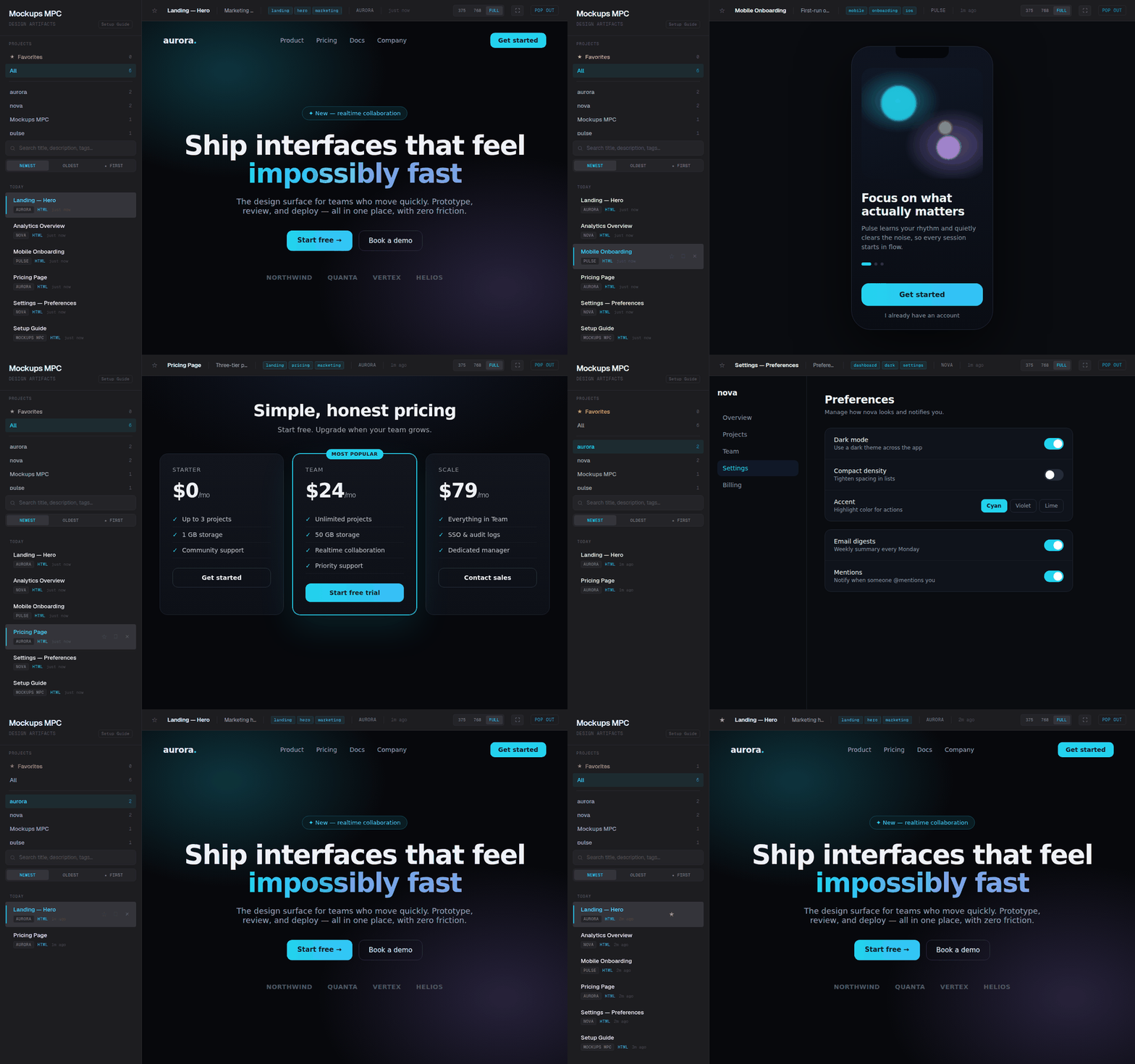
A self-hosted gallery for AI-generated mockups — with an MCP interface. Instead of cluttering your repo, mockups get a permanent home and a clean web gallery you can browse. AI tools upload them over a direct curl call; MCP handles only the lightweight coordination — listing, metadata, tagging, and retrieval.
Token-efficient by design. MCP tool parameters flow through the model context, so sending a large HTML file via a tool call wastes tokens. Mockups MPC provides an HTTP upload endpoint (POST /api/upload) — the AI writes the file locally and curls it to the server, keeping file content entirely out of the model context. MCP tools handle lightweight operations only: listing, metadata, tagging, and deletion.
Prerequisites
- Docker (for deployment) or Python 3.12+ (for local development)
- An MCP-compatible AI client (Claude Code, Claude Desktop, etc.)
- Optional: Traefik reverse proxy (for production with TLS)
Why
Every time an AI tool generates a mockup, there's no consistent place for it to go — so they pile up in your repo or get scattered across temp dirs, sessions lose track of them, and there's no history. Mockups MPC gives them a permanent home instead: the AI pushes the mockup to the gallery, you browse it there, and the local file gets cleaned up. One place for everything, nothing cluttering your project.
Architecture
┌─────────────────┐     MCP (HTTP/SSE)     ┌──────────────────────┐
│  Claude Code /  │ ◄───────────────────── │                      │
│  Claude Desktop │  send/list/get/update  │    Mockups MPC       │
│  Any MCP Client │  delete/tag            │    (FastAPI)         │
└─────────────────┘                        │                      │
                                           │  ┌────────────────┐  │
       Browser                             │  │  MCP Server    │  │
    ┌──────────┐      GET /                │  │  (fastmcp)     │  │
    │ Gallery  │ ◄──────────────────────── │  └────────────────┘  │
    │ Viewer   │                           │  ┌────────────────┐  │
    └──────────┘                           │  │  JSON API      │  │
                                           │  │  /api/*        │  │
                                           │  └────────────────┘  │
                                           │  ┌────────────────┐  │
                                           │  │  SQLite (WAL)  │  │
                                           │  │  + Filesystem  │  │
                                           │  └────────────────┘  │
                                           └──────────────────────┘
Single Docker container running a FastAPI app that serves two roles:
- MCP Server — mounted at
/mcp/(HTTP transport) and/mcp/sse(SSE transport). AI tools connect here to send and manage mockups. - Web Gallery — served at
/. Sidebar with project list and chronological feed, main viewer with iframe/image display.
Data Layer
- SQLite in WAL mode — metadata catalog (project, title, description, tags, content type, timestamps)
- Filesystem — mockup files stored in
data/{project_slug}/{uuid}.{ext} - Storage is a bind-mounted
data/directory next to the compose file
Tech Stack
- Python 3.12
- FastAPI + uvicorn
- fastmcp v3.x (standalone)
- SQLite via aiosqlite
- Jinja2 templates + vanilla JS
- Docker + Traefik
Security
There is no built-in authentication. All API endpoints and MCP tools are open to anyone who can reach the server. This is designed for trusted networks (LAN, VPN, Tailscale) or behind a reverse proxy that handles auth. If you deploy this on a public network, add authentication at the proxy layer.
Versions
A mockup ("design") can hold more than one version — every revision of the same screen, kept in one place instead of scattering separate mockups.
- Add a version to an existing design: upload with
-F parent=<id>(a design or alias id). It's added as the next version; earlier versions and their files are kept. - Auto-fold: upload without
parentand the server still checks for a match. If exactly one design in the same project has the same base title — the title with trailing markers likev2,draft 3,rev 2,r5, a bare trailing number, or trailing parentheticals such as(rail fixed)stripped — the upload becomes a new version of it automatically. Variant markers (option B,variant C, a standalone trailing letter) are never stripped, so "Hero — option B" and "Hero — option C" stay separate designs. Zero or several matches also create a new design. Pass-F fold=falseto always create a new design regardless of title. An auto-folded upload's response carriesfolded: trueand anotesaying how to split it back out if the match was wrong. - Direct link to one version:
/view/{id}/v/{n}serves that exact version./view/{id}serves the latest version when{id}is a design id, and the pinned version when{id}is an alias id (see below). - Folding keeps old links working. When a mockup is folded into another design, its id becomes an alias pinned to the version it turned into, and every read (
/view/…,get_mockup, etc.) resolves it transparently. A version link minted before the fold (/view/{old id}/v/1) keeps working too. - Splitting and deleting a version do remove links. A split-out version moves to its new design as v1, so its old
/view/{design}/v/{n}link returns 404 (the new design reuses the version's alias id when it has one, so that id keeps working). Deleting a version removes it and any alias pinned to it. - Undo a fold:
split_version(id, version)pulls one version back out into its own standalone design, reusing its old alias id if it has one.
Merging existing duplicates (opt-in, one-time)
If you were already uploading revisions as separate mockups before this feature existed, python -m app.fold finds and merges them:
python -m app.fold --dry-run     # print the proposed groups, change nothing
python -m app.fold --apply       # perform them
python -m app.fold --dry-run --data-dir /path/to/copy   # run against another data directory
--data-dir points the command at a different data directory (the one holding mockups.db) instead of the configured one — useful for trying the fold on a scratch copy of your data before running it for real.
It groups designs that share a project and a base title, oldest first, and folds each group into one design (the oldest survives; the rest become versions, with their old ids kept as aliases). This never runs automatically — it's a command you run by hand, and only after reviewing the dry-run output, since merging is not reversible in bulk (each design can still be split back out individually with split_version).
MCP Tools
| Tool | Description |
|---|---|
send_mockup | Send HTML/SVG (raw string) or PNG/JPG (base64) to the gallery. Supports parent and fold (see Versions). Returns a gallery URL. |
list_mockups | List mockups reverse-chronologically, optionally filtered by project. |
get_mockup | Get a specific mockup by UUID with view and gallery URLs, plus its version list. Curl the view_url to read the file content. |
update_mockup | Update metadata (title, description, tags), or add a new version by supplying content (earlier versions are kept). |
split_version | Split one version out of its design into its own standalone mockup — reverses a fold. |
delete_mockup | Delete a mockup, or (with version) just one version — removes the DB record(s) and file(s) on disk. |
tag_mockup | Add or remove tags on an existing mockup. |
set_created_at | Change the created date of a mockup (or one version). Useful for backdating uploads or reordering the timeline. |
The server stores all content permanently. AI clients can clean up local files when they're no longer needed, or retrieve content later via get_mockup.
API Routes
| Route | Purpose |
|---|---|
GET / | Gallery UI |
GET /view/{id} | Raw mockup: the latest version for a design id, the pinned version for an alias id (HTML rendered, images served with correct MIME type) |
GET /view/{id}/v/{n} | Raw mockup, one specific version |
GET /api/mockups | JSON listing with limit, offset, project filter |
GET /api/mockups/{id} | Single mockup metadata, including its versions list; ?v={n} points view_url at that version |
POST /api/mockups/{id}/versions/{n}/split | Split that version out into its own standalone mockup |
DELETE /api/mockups/{id}/versions/{n} | Delete one version (refused on the last remaining one) |
GET /api/projects | Project list with counts |
POST /api/upload | Upload a mockup file (multipart form: file, project, title, description?, tags?, parent?, fold?) — see Versions |
GET /health | Health check |
Setup
1. Clone and configure
git clone https://github.com/kgNatx/mockups-mpc.git
cd mockups-mpc
2. Deploy
Quick start (pre-built image):
docker compose -f docker-compose.local.yml up -d
# Gallery available at http://localhost:8000
Build from source:
docker compose -f docker-compose.local.yml up -d --build
Production (with Traefik):
cp .env.example .env
# Edit .env with your domain and Traefik network name
docker compose up -d --build
3. Verify
curl http://localhost:8000/health
# {"status":"ok"}
4. Connect Claude Code
claude mcp add-json mockups-gallery '{"type":"http","url":"https://your-domain.com/mcp"}'
Or add to .mcp.json (project-level) or ~/.claude/.mcp.json (global):
{
  "mcpServers": {
    "mockups-gallery": {
      "type": "http",
      "url": "https://your-domain.com/mcp"
    }
  }
}
5. Connect Claude Desktop
Add to your Claude Desktop config file:
- macOS:
~/Library/Application Support/Claude/claude_desktop_config.json - Windows:
%APPDATA%\Claude\claude_desktop_config.json - Linux:
~/.config/Claude/claude_desktop_config.json
{
  "mcpServers": {
    "mockups-gallery": {
      "type": "sse",
      "url": "https://your-domain.com/mcp/sse"
    }
  }
}
6. Tell your AI to use it
Add instructions to your CLAUDE.md (or equivalent) so your AI uploads mockups via curl instead of passing file content through the model context:
# Mockups

When generating UI mockups, design concepts, or visual prototypes,
write the file locally then upload it to the Mockups MPC gallery via curl:

    curl -s -X POST https://your-domain.com/api/upload \
      -F file=@/path/to/file.html -F project=name -F title=name \
      [-F description=text] [-F "tags=a,b,c"]

To revise a mockup you already uploaded, add `-F parent=<id>` (the id
from the earlier upload response): the gallery keeps it as a new version
of the same design. Use `-F fold=false` only for a deliberate separate variant.

To read a mockup's content later, use `get_mockup` to get its
`view_url`, then curl it.
Add to ~/.claude/CLAUDE.md for all projects, or a project's CLAUDE.md for specific ones. The in-app Setup Guide carries the same snippet; an existing install gets the updated guide as a new version of its Setup Guide on the first start after upgrading.
Gallery UI
The gallery auto-seeds a Setup Guide as the first entry on fresh installs. The guide covers all configuration methods with copy-able code blocks.
Layout: Sidebar (project list + chronological feed with title filter + infinite scroll) + main viewer (iframe for HTML, img for images/SVG) + metadata bar + pop-out link.
Theme: Techno Chic Minimalist — Space Grotesk, cyan accents, zinc/neutral dark backgrounds.
Project Structure
app/
├── main.py          # FastAPI app, lifespan, MCP mount, router includes
├── config.py        # Settings (DATA_DIR, DB_PATH, BASE_URL from env)
├── db.py            # SQLite init + CRUD (WAL mode, aiosqlite)
├── models.py        # Pydantic models
├── storage.py       # Slug generation, file write/read/delete, 25MB limit
├── mcp_server.py    # FastMCP instance, tool logic, tool wrappers
├── seed.py          # Auto-seed setup guide on empty DB
├── routes/
│   ├── api.py       # JSON API endpoints
│   └── gallery.py   # Gallery page + raw mockup serving
├── templates/
│   └── gallery.html # Jinja2 gallery template
└── static/
    ├── style.css         # Gallery theme
    └── setup-guide.html  # Self-contained setup guide page
Development
python -m venv .venv
source .venv/bin/activate
pip install -r requirements.txt
pytest tests/ -v
uvicorn app.main:app --reload
The test suite covers storage, database, MCP tools, API routes, upload, and gallery.
License
MIT — see LICENSE.







