Listed from the MCP registry; nobody on Odel publishes it.

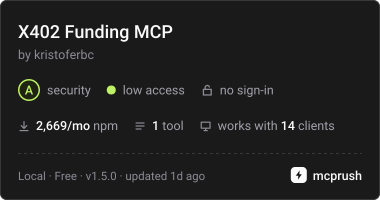
X402 Funding
Hyperliquid funding divergence vs Binance or OKX, annualized, with execution capacity.
Runs on your machine from its package; the steps are below.
What it does
- Reads
- Writes
- High impact
At most: only reads or looks up information.
What it costs
FreeOdel charges nothing per call. The publisher may charge for its own service.
Runs locally over stdio
This server isn't hosted — your MCP client launches it from a package registry. Use one of the commands below, or drop the config into your client (e.g. Claude Desktop).
Run
npx -y x402-funding-divergence
MCP client config
{
  "mcpServers": {
    "x402-funding": {
      "command": "npx",
      "args": [
        "-y",
        "x402-funding-divergence"
      ]
    }
  }
}
x402 Funding Divergence




Perpetual funding rates, compared across venues. Hyperliquid against a liquid CEX benchmark — Binance, or OKX where Binance restricts the region — annualized with each venue's real funding interval, filtered for pairs liquid on both legs, with the direction of the basis trade already resolved.
One call returns every pair where the two venues disagree, sorted by the size of the gap. No API keys, no signup, no rate-limit negotiation.
import { fundingDivergence } from "x402-funding-divergence";

const { top } = await fundingDivergence({ topN: 5 });
[
  {
    "coin": "AAVE",
    "hl_apr_pct": 10.95,
    "cex_apr_pct": -7.29,
    "divergence_bps": 1823.8,
    "hl_interval_hours": 1,
    "cex_interval_hours": 8,
    "oi_usd": 58969834,
    "vol_24h_usd": 8784527,
    "cex_vol_24h_usd": 103668389,
    "anomaly": false,
    "trade": "short_hyperliquid_long_binance",
    "stability": { "window_hours": 72, "cex_samples": 9, "hl_samples": 72, "cex_mean_apr_pct": -0.03, "cex_std_apr_pct": 7.47, "hl_mean_apr_pct": 6.2, "hl_std_apr_pct": 9.79 }
  }
]
That trade field is the whole point: it tells you which leg to short and which to long, and it names the venue those numbers came from. No interpretation needed downstream.
Why this exists
A funding rate on one venue tells you what that venue thinks. The gap between two venues tells you how far apart their carry expectations sit — the raw input for a basis decision, not a return forecast.
Doing it by hand means reconciling funding intervals that differ per venue and per instrument, two unit conventions, and a filter for pairs where both order books are deep enough to trade. This package does that in one call.
- Intervals are read, not assumed. Hyperliquid funds hourly. Binance defaults to 8-hour funding, but 4-hour is common — of the 820 contracts it lists, 465 settle every 4 hours, 2 every hour — so the interval comes from
/fapi/v1/fundingInfoper symbol. OKX varies per instrument, so it is derived fromnextFundingTime − fundingTime. Assuming 8 hours everywhere halves the annualized figure on every 4-hour contract, with no visible error. - Both legs must be liquid. Open interest ≥ $1M and 24h volume ≥ $2M on Hyperliquid, plus 24h quote volume ≥ $2M on the benchmark venue. A pair that is deep on one side and empty on the other cannot be traded, however wide the gap looks.
- Dislocations are flagged, not promoted. Beyond 2,000 bps the row is marked
anomaly: trueand ranked after the ordinary rows. A gap that wide is usually one venue dislocating, not a carry you can hold. - It works from a blocked region. Binance answers HTTP 451 from US addresses, and Bybit's CDN refuses them too. The sensor tries Binance, falls back to OKX, and tells you which one it used in
benchmark.venue. Nothing to configure — it takes whichever responds. - The sensor module has zero dependencies. Native
fetch, nothing else, so it runs in Node 20+, in a serverless function, or on an edge runtime. The full package adds the x402 payment server on top.
Three ways to consume it. Locally, through the library or the MCP tool — free, and the only network calls are to the venue APIs. Remotely over HTTP, at two prices:
/fundingat $0.02 per call for the divergence itself, or/ultraat $0.25 per call to add measured execution capacity — how much size each gap actually carries. Same sensor underneath; Ultra adds order-book depth. See Use the hosted endpoint and Ultra.
Whether you use the free local package or the paid hosted endpoint, you never manage blockchain complexity: no RPC endpoint, no ETH, no KYC.
Install
npm install x402-funding-divergence
Requires Node.js 20 or newer.
Integrate in two minutes
TypeScript. The package ships its own declarations — nothing to install, nothing to write by hand.
import { fundingDivergence, type FundingResponse } from "x402-funding-divergence";

const data: FundingResponse = await fundingDivergence({ topN: 5 });
const best = data.top[0];                 // fully typed
if (best) console.log(best.coin, best.trade, best.divergence_bps);
Any other language. The response validates against JSON Schema Draft 2020-12. The schema ships inside the package (schema/funding-divergence.schema.json), so you can generate a client from it instead of reading this page:
npx ajv-cli@5 validate \
  -s node_modules/x402-funding-divergence/schema/funding-divergence.schema.json \
  -d response.json
An agent (MCP). One entry in Claude Desktop, Cursor, or any MCP client:
{
  "mcpServers": {
    "x402-funding": { "command": "npx", "args": ["-y", "x402-funding-divergence"] }
  }
}
Coinbase AgentKit. Coinbase's X402ActionProvider is built to call any x402-protected endpoint, and both prices here sit below its default 1.00 USDC per-request cap. It only calls services it knows about, so register the URL once:
const provider = x402ActionProvider({
  registeredServices: ["https://x402-funding.onrender.com"],
  // maxPaymentUsdc defaults to 1.00, which already covers both routes
});
That is the whole integration. Every field is documented under Response shape.
Only want the data? This package ships the full payment server along with its dependencies. If you just need the sensor, install
hyperliquid-binance-funding— same sensor file, same output, zero dependencies.
Use it as a library
import { fundingDivergence } from "x402-funding-divergence";

const data = await fundingDivergence({ topN: 10 });

console.log(data.benchmark.venue);   // "binance" or "okx"
console.log(data.pairs_tradable);    // pairs that cleared both liquidity floors
console.log(data.top);               // first topN rows, ordinary rows before anomalies
console.log(data.all);               // every tradable row
Tune the floors when the defaults are too strict for your universe:
MIN_OI_USD=500000 MIN_VOL_USD=1000000 MIN_CEX_VOL_USD=1000000 node your-script.mjs
Use it as an MCP tool
Any MCP-compatible client can call the sensor directly. Add this to your client configuration:
{
  "mcpServers": {
    "x402-funding": {
      "command": "npx",
      "args": ["-y", "x402-funding-divergence"]
    }
  }
}
The tool is exposed as get_funding_divergence and accepts an optional limit (1–50, default 5). An agent that speaks MCP gets funding divergence with no integration work and no payment setup.
Use the hosted endpoint (pay per call)
A hosted instance runs at https://x402-funding.onrender.com and is billed per request over x402, the HTTP-native payment protocol: the server answers 402 Payment Required, your client attaches a signed USDC authorization, the request completes.
GET https://x402-funding.onrender.com/funding?limit=5            # $0.02
GET https://x402-funding.onrender.com/ultra?limit=5&capacity=5   # $0.25
- Prices:
/fundingis $0.02 per call,/ultrais $0.25 per call, both in USDC on Base. - Optional query parameters:
limit(1–50 on/funding, 1–20 on/ultra);capacityandfees_bpson/ultraonly. - No account, no key: the paying address is the only identity involved.
- Free diagnostics:
GET /healthfor liveness,GET /sourcesfor which benchmark venues that host can actually reach.
Zero configuration. Your agent needs no ETH and no exchange account.
Automatic payment. The x402 SDK signs the USDC payment and handles authentication in the background.
100% gasless. Coinbase, acting as facilitator, pays the network fee. You only pay the call price.
To your code this is an API call like any other: one request in, one JSON body out. No wallet UI, no signing prompt, no blockchain library to configure beyond the snippet below.
Client example, using the x402 SDK:
npm install @x402/fetch @x402/evm viem
import { x402Client, wrapFetchWithPayment } from "@x402/fetch";
import { registerExactEvmScheme } from "@x402/evm/exact/client";
import { privateKeyToAccount } from "viem/accounts";

const account = privateKeyToAccount(process.env.PRIVATE_KEY);

const client = new x402Client();
registerExactEvmScheme(client, { signer: account });

const pay = wrapFetchWithPayment(fetch, client);
const res = await pay("https://x402-funding.onrender.com/funding?limit=5");

console.log(await res.json());
Ultra: what the gap can actually absorb
A divergence says the venues disagree. It does not say whether anyone can act on it. A 1,800 bps gap on a pair whose Hyperliquid book holds $15k is not the same opportunity as the same gap on an $8M book — and nothing in a funding feed tells you which one you are looking at.
GET /ultra — $0.25 per call — adds, for each pair:
| Field | Meaning |
|---|---|
capacity.usd | Largest notional executable on both legs at once before their combined market impact exceeds impact_budget_bps (10 by default) |
capacity.hl_impact_bps, capacity.cex_impact_bps | The impact of each leg at that size — so the number can be checked, not trusted |
capacity.hl_book_usd, capacity.cex_book_usd | Visible depth on each side |
capacity.entry_cost_bps | Taker fees (assumed, overridable with fees_bps) plus impact at that size |
capacity.breakeven_days | Entry cost divided by the funding carry per day |
How the number is computed — and the closed-form case that validates the solver — is in CAPACITY.md. The short version: each book is consumed level by level, the volume-weighted price of each leg is compared to its best quoted price, and the largest size whose two impacts still fit the budget is found by bisection. Depth beyond what a venue publishes is never extrapolated, and when the internal safety ceiling is hit the response says usd_lower_bound: true rather than presenting a bound as a measurement.
curl -i "https://x402-funding.onrender.com/ultra?limit=5&capacity=5"
# HTTP 402, accepts[0].amount = "250000"  (6 decimals = $0.25)
Query parameters: limit (1–20, default 5), capacity (1–10 rows measured, default 5), fees_bps (0–200, default 9.5).
One row from a live call, verbatim — every number in it can be recomputed from the others, which is the point:
"coin": "ZEC",
"divergence_bps": 1238.3,
"trade": "short_hyperliquid_long_binance",
"capacity": {
  "available": true,
  "usd": 329154,              // notional executable before impact exceeds the budget
  "usd_lower_bound": false,   // true would mean "at least this much", not "exactly this"
  "impact_budget_bps": 10,
  "hl_impact_bps": 6.38,      // Hyperliquid leg at that size
  "cex_impact_bps": 3.62,     // 6.38 + 3.62 = 10.00, the budget, exactly
  "hl_book_usd": 1235946,     // visible depth, Hyperliquid
  "cex_book_usd": 592188,     // visible depth, benchmark venue
  "side_hyperliquid": "bid",  // sell Hyperliquid
  "side_benchmark": "ask",    // buy Binance
  "fees_assumed_bps": 9.5,    // 4.5 Hyperliquid + 5 CEX, base tier
  "entry_cost_bps": 19.5,     // 9.5 fees + 6.38 + 3.62 impact
  "carry_bps_per_day": 3.393, // 1238.3 / 365
  "breakeven_days": 5.75,     // 19.5 / 3.393
  "reason": "impact_budget"   // or "capped_by_visible_depth", "capped_by_request"
}
Ultra is measurement, not advice. It never suggests a position size or an allocation: it publishes what the market can absorb and what entering costs. If no pair's book can be measured, the endpoint answers 502 instead of 200, so the facilitator cancels settlement and you are not charged for an empty answer.
Response shape
{
  "updated_at": "2026-10-30T20:15:21.409Z",
  "benchmark": {
    "venue": "binance",              // or "okx" where Binance restricts the region
    "funding_interval": "read per instrument from the venue",
    "fallbacks": []                  // venues tried and failed before this one
  },
  "methodology": "Annualised funding, each leg with its own funding interval: ...",
  "liquidity_floor": { "min_oi_usd": 1000000, "min_vol_usd": 2000000, "min_cex_vol_usd": 2000000 },
  "anomaly_threshold_bps": 2000,
  "pairs_considered": 49,             // cleared the Hyperliquid floor
  "pairs_not_checked_on_venue": 0,    // skipped because of the per-venue call cap
  "pairs_compared": 46,               // of those, also listed on the benchmark venue
  "pairs_rejected_illiquid": 130,     // failed the Hyperliquid floor
  "pairs_rejected_cex_illiquid": 0,   // failed the benchmark-venue floor
  "pairs_tradable": 46,               // published
  "pairs_flagged_anomaly": 11,
  "top": [ /* first topN rows */ ],
  "all": [ /* every tradable row, ordinary rows first */ ]
}
Each row:
| Field | Type | Meaning |
|---|---|---|
coin | string | Base asset, e.g. BTC |
hl_apr_pct | number | Hyperliquid funding, annualized, in percent |
cex_apr_pct | number | Benchmark venue funding, annualized, in percent |
divergence_bps | number | hl_apr_pct − cex_apr_pct, in basis points |
hl_interval_hours | number | Hyperliquid funding interval, always 1 |
cex_interval_hours | number | Benchmark venue funding interval for this instrument |
oi_usd | number | Hyperliquid open interest, USD |
vol_24h_usd | number | Hyperliquid 24h notional volume, USD |
cex_vol_24h_usd | number | Benchmark venue 24h quote volume, USD |
anomaly | boolean | Divergence beyond anomaly_threshold_bps |
trade | string | short_hyperliquid_long_<venue> or long_hyperliquid_short_<venue>, where <venue> is benchmark.venue |
stability | object | null | Recent mean and standard deviation of both legs. Costs two upstream calls per row, so it is computed for the first STABILITY_MAX_ROWS rows only; null elsewhere |
Methodology
- Hyperliquid publishes funding hourly:
rate × 8760. - Binance defaults to 8-hour funding, but 465 of the 820 contracts it lists settle every 4 hours and 2 every hour. The interval is read per symbol, then
rate × (8760 / interval). - OKX publishes one rate per instrument. The interval is derived from the response, then the same formula.
- Divergence is
HL − benchmark, expressed in basis points. - A positive divergence means Hyperliquid funding is richer, so the carry shorts Hyperliquid and longs the venue named in
benchmark.venue. - Rows are sorted by absolute divergence, with anomalies placed after ordinary rows.
Both venues are public and unauthenticated. On the Binance path the sensor issues three parallel requests and returns in about 1.5 s. The OKX fallback costs one request per pair, so roughly 3.5 s for the liquid universe.
What this is not
The divergence is an instantaneous annualization, not a forecast. A funding rate that reads −200% annualized today can read +50% tomorrow, because the annualization multiplies whatever the last settlement was by 1,095 or 2,190. That is why every row carries stability: how much this pair's rate has actually moved over the recent window, and where it sat on average.
A gap of 3,000 bps does not mean a 30% annual return. It usually means one venue is briefly dislocated, which is exactly what anomaly is there to tell you.
Self-host it
The package ships the full server. Clone the repository, install, and point it at a receiving address:
npm install
cp .env.example .env
npm start
| Variable | Required | Purpose |
|---|---|---|
PAY_TO | yes | EVM address that receives payments. Public address only; no private key on the server. |
NETWORK | no | eip155:8453 (Base mainnet, default) or eip155:84532 (Base Sepolia) |
CDP_API_KEY_ID / CDP_API_KEY_SECRET | mainnet | Coinbase CDP credentials; the hosted facilitator authenticates with them |
PRICE | no | Per-call price for /funding, default $0.02 |
ULTRA_PRICE | no | Per-call price for /ultra, default $0.25 |
CAPACITY_IMPACT_BPS | no | Impact budget used to solve capacity, default 10 |
CAPACITY_FEES_BPS | no | Taker fees assumed in entry_cost_bps, default 9.5 |
ULTRA_TIMEOUT_MS | no | Hard timeout on /ultra, default 20000 (then 502, no charge) |
MIN_OI_USD / MIN_VOL_USD | no | Hyperliquid liquidity floor |
MIN_CEX_VOL_USD | no | Benchmark-venue liquidity floor |
ANOMALY_BPS | no | Anomaly threshold, default 2000 |
X402_BENCHMARK_ORDER | no | Venue order, default binance,okx |
OKX_MAX_COINS | no | Max pairs compared on the OKX path, default 50 (one request each) |
STABILITY_MAX_ROWS | no | Rows enriched with stability, default 10 |
STABILITY_WINDOW_HOURS | no | Lookback for stability, default 72 |
PORT | no | Default 4021 |
GET /health and GET /sources are free. GET /funding and GET /ultra are the paid routes.
Mainnet requires CDP credentials because the public x402 facilitator serves testnets only. The server refuses to start on eip155:8453 without them rather than failing at the first payment.
The first 1,000 settlements each month are free; beyond that the facilitator charges $0.001 per settlement. That figure sets your floor for a viable per-call price.
Hosted vs. self-hosted: what you are actually paying for
Self-hosting costs nothing in money. It costs an afternoon of setup and a standing obligation to keep the service running. Both paths run the same two routes; only who receives the payment changes.
- Zero maintenance. No upstream API changes to track, no restarts, no CDP credentials to rotate.
- Always warm. The hosted instance runs continuously, so an agent loop never pays for a cold start. You configure no keep-alive job of your own.
- One line of code. No clone, no
.env, no full dependency install. Afetchcall is the whole integration.
| Hosted | Self-hosted | |
|---|---|---|
| Time to first call | one fetch | clone, install, credentials, deploy |
| Ongoing work | none | Node runtime, facilitator config, restarts |
| Marginal cost | $0.02 or $0.25 per call | your own infrastructure |
| Liquidity floors | fixed at OI ≥ $1M, HL volume ≥ $2M, CEX volume ≥ $2M | you choose |
| Payments go to | the operator | you |
| Uptime | handled | yours to arrange |
Choose the hosted endpoint when this data is an input to something else you are building. Self-host when you need your own liquidity floors, your own receiving address, or a different network.
License
MIT
Built on public venue APIs. Funding rates change continuously; the numbers this package returns are a snapshot, not a forecast.