
fleet
Every machine you have, for your coding agent: live GPU, VRAM, RAM and disk, and SSH.
Runs on your machine from its package; the steps are below.
What it does
- Reads
- Writes
- High impact
Not assessed yet.
What it costs
FreeOdel charges nothing per call. The publisher may charge for its own service.
Runs locally over stdio
This server isn't hosted — your MCP client launches it from a package registry. Use one of the commands below, or drop the config into your client (e.g. Claude Desktop).
Run
uvx agents-fleet
MCP client config
{
  "mcpServers": {
    "fleet": {
      "command": "uvx",
      "args": [
        "agents-fleet"
      ]
    }
  }
}fleet — let your coding agent use every machine you have
Claude Code, Codex and Gemini see one machine: the one they run on.
fleet shows them all of yours — every GPU, how much is free, and how to get there.
No account, no cloud service, nothing installed on the machines you add: just the SSH you already use.





The problem
Ask your agent to train a model and it starts on your laptop — while a 4090 sits idle across the room and a rented A100 bills you by the hour. It cannot use what it cannot see.
- Your agent is stuck on one machine. It has no idea your other boxes exist.
- Finding a free GPU is manual. SSH into five hosts, run
nvidia-smi, compare in your head. - Handing it a server means pasting credentials into the chat, and hoping.
Get started: ask your agent
Paste this into Claude Code, Codex, Gemini CLI, or any agent that can run commands, on the machine you work from:
Install fleet from https://github.com/lion-zhang/fleet
Agents: the steps are in INSTALL.md.
That machine becomes your fleet's center: it keeps the list of your machines and decides which may reach which. A desktop or home server that is usually on suits it best, but a laptop works too, and you can move the role later.
That is the whole setup. fleet is installed once on this machine, and every supported agent you have here learns it — not only the one you asked. From here on you say what you want in plain words, with no commands to remember.
Then add your machines
Tell the agent how you reach a machine — the SSH command you already use is enough:
You: add my GPU server,
ssh ubuntu@10.0.0.7Agent: Added as
gpu-box: 2× RTX 4090, both idle, 46 GB free. It's ready to use.
Each one takes a sentence, whatever the machine is:
| The machine | What you tell the agent |
|---|---|
| a server you can already SSH into | "add ssh ubuntu@10.0.0.7" — fleet uses the key you already have |
| one you reach with a particular key file | "add ssh -i ~/.ssh/my_key ubuntu@1.2.3.4" — or a Host from your ~/.ssh/config |
| a new rental (vast.ai, RunPod, AutoDL) | "add ssh -p 40001 root@1.2.3.4, it costs $1.89/hr" |
| one that only takes a password | "add it" — then you type the password once yourself; it is stored nowhere |
| one fleet cannot get into from here | "invite my laptop" — you get one line to paste there, and it joins by itself |
| one that does not exist yet | "give me the key for a cloud-init template" — it joins with no password at all |
Nothing is installed on the machines you add: they only need SSH, on Linux, macOS or Windows. fleet probes each one for its GPUs, memory and disks, and keeps that current.
Then let the agent pick
You describe the work; the agent finds where it fits. It checks what each machine has and what is free on it right now, so it will not send a job to a busy card:
You: train
train.pyon whatever has a free 24 GB cardAgent:
rtx4090has 23.1 GB free and an idle GPU;a100-spotis free too but costs $1.89/hr. Starting onrtx4090, logging totrain.log.
| You say | How the agent finds it |
|---|---|
| "what's free right now?" | every machine checked, the free ones listed |
| "find me a box with a 24 GB card" | matched by what machines have — NVIDIA, VRAM, cores, RAM — not by name |
| "run the tests on the Linux box" | the machine that runs Linux, results brought back |
| "what's costing me money?" | idle paid rentals flagged, with their hourly price |
| "let the laptop reach the NAS" | access granted, applied at once |
Keys and passwords never go into the conversation, and anything irreversible waits for your yes.
Only install fleet where you use it. The machines you add above need nothing but SSH: fleet measures them and connects to them from the center. Install fleet on another machine only if you also run agents there, or want to check the fleet from it. That machine becomes a member: ask the center's agent to "invite" it, and paste the line it gives you into a terminal there, or give it to the agent there.
| Runs fleet | How it gets there | |
|---|---|---|
| center | yes — one per fleet | the first install |
| member | yes | an invite line from the center |
| every other machine | no, only SSH | "add ssh user@host" on the center |
An app that cannot run commands?
Desktop apps and editors get fleet in one click; it runs as an MCP server:
| App | Install |
|---|---|
| Claude Desktop | open fleet.mcpb from the latest release |
| Cursor |  |
| VS Code |  |
Plus plugins for Claude Code, Codex, Copilot CLI and Gemini CLI, and OpenCode, Amp, Windsurf, Cline, Zed, Qwen Code, Goose, Kiro, Hermes — 35+ agents in all: every agent →
Built to be safe
- Nothing to install on your machines. fleet probes with one script over one SSH
connection — Linux, macOS or Windows. A NAS or a fresh rental works as it is. What
it does leave there, a marked block in
authorized_keysand a key of the machine's own, is listed in full in What fleet changes, with how to remove it, with fleet or by hand. - Keys, not passwords. A password, if needed at all, is typed once by you. Nothing that could be stolen is stored, and the agent never sees a credential.
- Access you control. The center decides which machine may reach which, and a revoke
is pushed at once.
fleet access gpu-box --allow laptop,--denyto take it back. - The agent asks, not guesses. It is told to ask which machine you mean, and to leave irreversible commands to you.
- Nothing phones home. Apart from installing and updating itself, fleet talks to your machines and nothing else: no account, no telemetry, no update check. Found a flaw? SECURITY.md says how to report it privately.
Prefer the command line?
Everything the agent does is a plain fleet command. To install fleet yourself, run this
on the machine you work from (this is also what your agent runs when you ask it):
curl -LsSf https://raw.githubusercontent.com/lion-zhang/fleet/main/install.sh | sh
Windows: powershell -ExecutionPolicy ByPass -c "irm https://raw.githubusercontent.com/lion-zhang/fleet/main/install.ps1 | iex"
Then drive it yourself:
fleet ls                            # every machine, with what is free right now
fleet ls --tag cuda --tag vram-24g  # by capability: NVIDIA, a card of 24 GB or more
fleet top                           # live view, like htop for the whole fleet
fleet show gpu-box                  # one machine in detail: GPU processes, services, disks
fleet ssh gpu-box -- nvidia-smi     # run something there
fleet add "ssh ubuntu@10.0.0.7"     # add a machine; fleet invite NAME for a join line
fleet access nas --allow laptop     # let one machine reach another
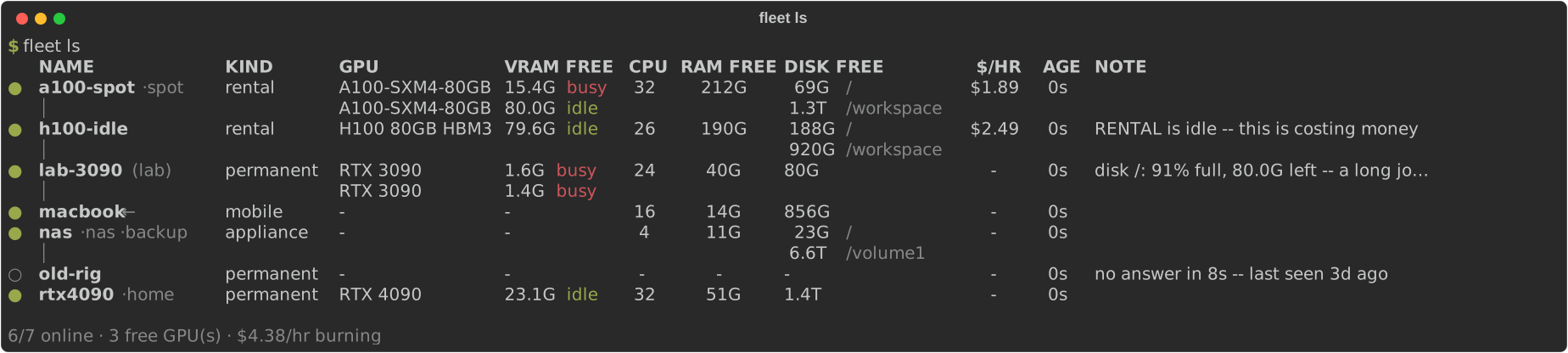
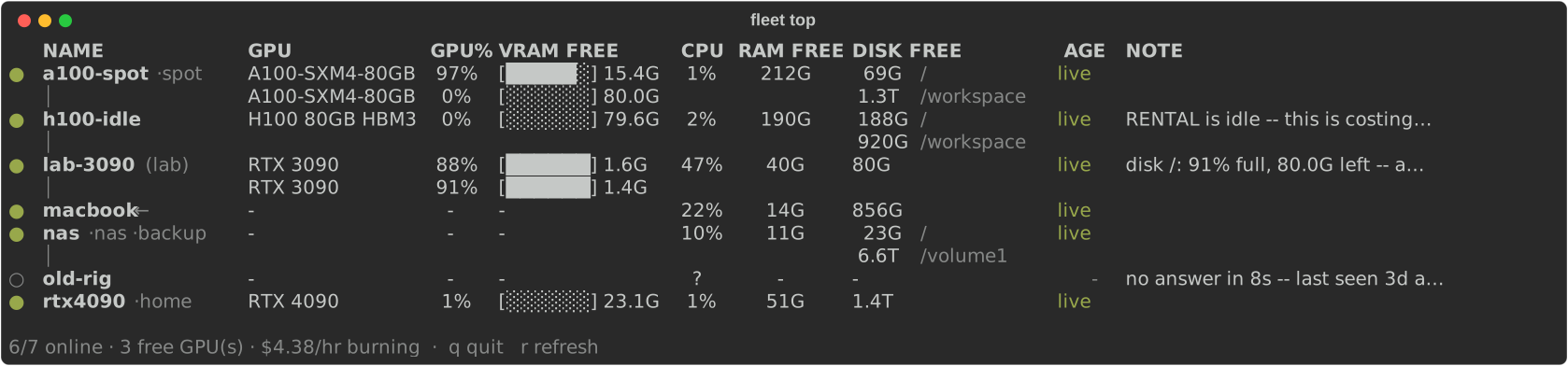
Rentals from vast.ai, RunPod or AutoDL show their price (fleet edit a100 --cost 1.89),
the fleet's burn rate, and an alert when a rental sits idle. On Tailscale, ZeroTier
or WireGuard? fleet just needs an address it can route to.
How fleet compares
fleet is about the machines you already have. It complements tools that launch new ones.
ssh + nvidia-smi | nvitop / gpustat | SkyPilot / dstack | fleet | |
|---|---|---|---|---|
| All your machines in one view | ✗ | ✗ one machine | ✓ the ones it manages | ✓ |
| Built for coding agents (skill / MCP) | ✗ | ✗ | partly | ✓ |
| Nothing installed on target machines | ✓ | ✗ | ✗ | ✓ |
| Manages SSH access between machines | ✗ | ✗ | for its own clusters | ✓ |
| Launches new cloud VMs | ✗ | ✗ | ✓ | ✗ |
Why not just Tailscale, Ansible, or an ~/.ssh/config? Use them with fleet, not
instead of it. Tailscale connects your machines, and fleet runs over it happily, but it
does not tell your agent which machine has a free GPU. Ansible changes machines to match
a playbook you write, and has no idea what is busy right now. An ~/.ssh/config names
your hosts, but has to be copied to every machine and edited by hand. fleet is the part
in between: what you have, what is free on it, and who may reach it, in a form your
agent can use without you.
FAQ
Setting up
Do I need to install fleet on every machine?
No. Install it where you use it: the machine you work from (the center), and any other machine where you also run agents or want to check the fleet from (a member). The machines you only use — GPU servers, rentals, a NAS — need SSH and nothing else; fleet measures them and connects to them from the center.
What are the center and members?
The center is the machine you installed fleet on first. It keeps the list of machines, holds the key that reaches them, and is the only machine that grants or removes access. There is one per fleet. A member is any other machine that runs fleet, joined with an invite line from the center; its agents see the whole fleet too. Every other machine is just in the fleet: reachable over SSH, nothing installed. See The center.
Which machine should be the center?
One that can reach all your devices and is online most of the time — a desktop or a home
server. A laptop works too. You can hand the role to another machine later with
fleet center NAME.
What if the center is off?
Normal — it can be a laptop that is closed half the day. Everything already granted keeps working, and members keep listing and connecting from what they know; only changes — granting, removing, inviting — wait for it.
I use Claude Code and Codex (and more) on one machine. Does that work?
Yes — that is the normal case. fleet is installed once per machine: one command, one
inventory, one set of keys. Each agent only gets a small skill or MCP entry pointing at
it, so Claude Code, Codex, Gemini CLI and a desktop app all see the same machines, and can
use them at the same time. Install a new agent later? Ask an agent that has fleet to run
fleet setup.
What does my agent actually get?
Agents that can run commands (Claude Code, Codex, Gemini CLI, Copilot CLI, OpenCode, …)
get a skill — text that tells them the fleet commands; it costs nothing until a task
needs a machine. Apps that cannot (Claude Desktop, Cursor, VS Code, …) get an MCP server
that runs the same commands for them. See Agents. After
installing, start a new session so the agent loads it.
Safety
Does fleet store my passwords? Does my agent see my keys?
No and no. A password is typed by you, once, for a machine that accepts nothing else; it
is used for one connection and stored nowhere. After that fleet uses its own key. The
agent runs fleet ssh NAME and never sees a key or a password; it may see a machine's
address, as fleet show prints it.
What does fleet leave on the machines I add?
A block in ~/.ssh/authorized_keys, marked with your fleet's id, and the machine's own
fleet key in fleet's folder (~/.config/fleet on Linux). No program, no service. Your
own keys and the provider's are never touched, and fleet rm takes fleet's blocks off
again. What fleet changes has the full list, how to
check it, and how to remove it by hand.
Can the agent do something I cannot undo?
It is told not to. Removing a machine, taking the fleet down and moving the center are left to you, and are not available to apps over MCP at all. When a request is ambiguous — which machine, which user — the agent asks instead of guessing.
What if a machine is compromised?
Remove it on the center (fleet rm NAME): its key comes off every other machine. But a
key is a key — revoking it does not undo what someone with root on that machine already
did — and the center is the one machine whose compromise reaches everything. The
threat model spells it out.
Machines
The disk space fleet reports is wrong.
Some systems — containers, GPU rentals — show / as a small overlay while the space is on
another volume. Tell fleet which paths to watch: "on gpu-box, watch /workspace", or
fleet edit gpu-box --disk-path /workspace. See
Disks.
My rental came back on a new IP or port.
Re-point it, keeping its name, tags, cost and history: "gpu-box is now at
ssh -p 40123 root@5.6.7.8", or fleet edit gpu-box --ssh "ssh -p 40123 root@5.6.7.8".
My machines are behind different NATs, or at different sites.
fleet does not solve connectivity; it uses the routes you have. It needs only one: the center must reach every machine over SSH (and members must reach the center). The machines do not need to reach each other, unless you grant one access to another. For machines behind different NATs, put them on a mesh network such as Tailscale or ZeroTier and add them by their mesh address. See Networks.
Windows?
Yes, both ways. A Windows machine works in a fleet with OpenSSH Server and nothing else, and fleet runs on Windows too, center included. See Windows.
Does anything keep running in the background?
On the center only: a small service, run as you, that listens on port 7373 so members can refresh and new machines can join. Nothing runs on the other machines; members run fleet only when you or an agent use it.
How do I remove fleet?
fleet uninstall (--purge to delete its files too): it leaves the fleet, removes fleet
from your agents and the background service, and prints the last step,
uv tool uninstall agents-fleet. On the center of a fleet with other machines,
fleet center --dissolve comes first -- it takes every key off every machine. See
Removing fleet.
Learn more
- Getting started — your first fleet, in ten minutes
- Guides — adding machines, finding the right one, access, the center, Windows
- Every agent — install commands and config for 35+ agents
- Command reference — every command and option
- How fleet works — what happens, step by step, under the hood
- Design — one core per machine, a skill per agent, MCP for the rest; access and sync
- All documentation
Status: v0.5. The test suite runs on Linux, macOS and Windows, and every command is run end to end on a real machine of each OS in CI — from a script, as an agent runs it, and at a real terminal, as you do. Multi-machine fleets (key, password, invite, handover) are tested on Linux machines built from scratch.
Issues and pull requests are welcome — see CONTRIBUTING.md. If fleet saved you a GPU-hour, a ⭐ helps other people find it.




