Listed from the MCP registry; nobody on Odel publishes it.

Lynx
LynxMCP: 100% local MCP server for the code questions grep can't answer: call graph, hybrid search
Runs on your machine from its package; the steps are below.
What it does
- Reads
- Writes
- High impact
At most: creates or changes data: records, files, settings.
What it costs
FreeOdel charges nothing per call. The publisher may charge for its own service.
Runs locally over stdio
This server isn't hosted — your MCP client launches it from a package registry. Use one of the commands below, or drop the config into your client (e.g. Claude Desktop).
Run
uvx lynx-mcp
MCP client config
{
  "mcpServers": {
    "lynx": {
      "command": "uvx",
      "args": [
        "lynx-mcp"
      ]
    }
  }
}LynxMCP
A local code index and call graph for Claude Code, Cursor, Windsurf, Antigravity and VS Code. Search by meaning and by name, trace who calls or implements what, and index library docs or PDFs alongside your code. Everything runs on your machine.




Quickstart
No config file, no Docker, no API key, no PyTorch. Embeddings run locally on ONNX Runtime (~460 MB on disk), the index lives in your user cache so git status stays clean, and the code graph is on by default.
Claude Code
uv tool install lynx-mcp       # or: pipx install lynx-mcp
lynx connect claude
Every project you open in Claude Code gets its own index, built in the background the first time. lynx connect claude also wires a prompt hook into ~/.claude/settings.json so each request arrives with a compact map of relevant code (up to 12 locations with file, line range and signature) before the first turn. Pass --no-hook to skip it. Restart Claude Code (or run /mcp) and start asking questions.
Prefer to test it in a single project first?
claude mcp add lynx -- uvx --from lynx-mcp lynx serve .
Optional: add the prompt hook to just that project (.claude/settings.json)
{"hooks": {"UserPromptSubmit": [{"hooks": [{"type": "mcp_tool", "server": "lynx",
  "tool": "prompt_hook", "input": {"prompt": "${prompt}"}}]}]}}
Cursor, Claude Desktop, Windsurf, Antigravity, VS Code
uv tool install lynx-mcp
cd /path/to/your/project
lynx connect cursor            # or: claude-desktop | windsurf | antigravity | vscode
lynx connect writes only the lynx entry into your editor's MCP config, keeps a timestamped backup, and leaves every other server untouched. Restart your editor to pick it up.
Prefer a desktop installer?
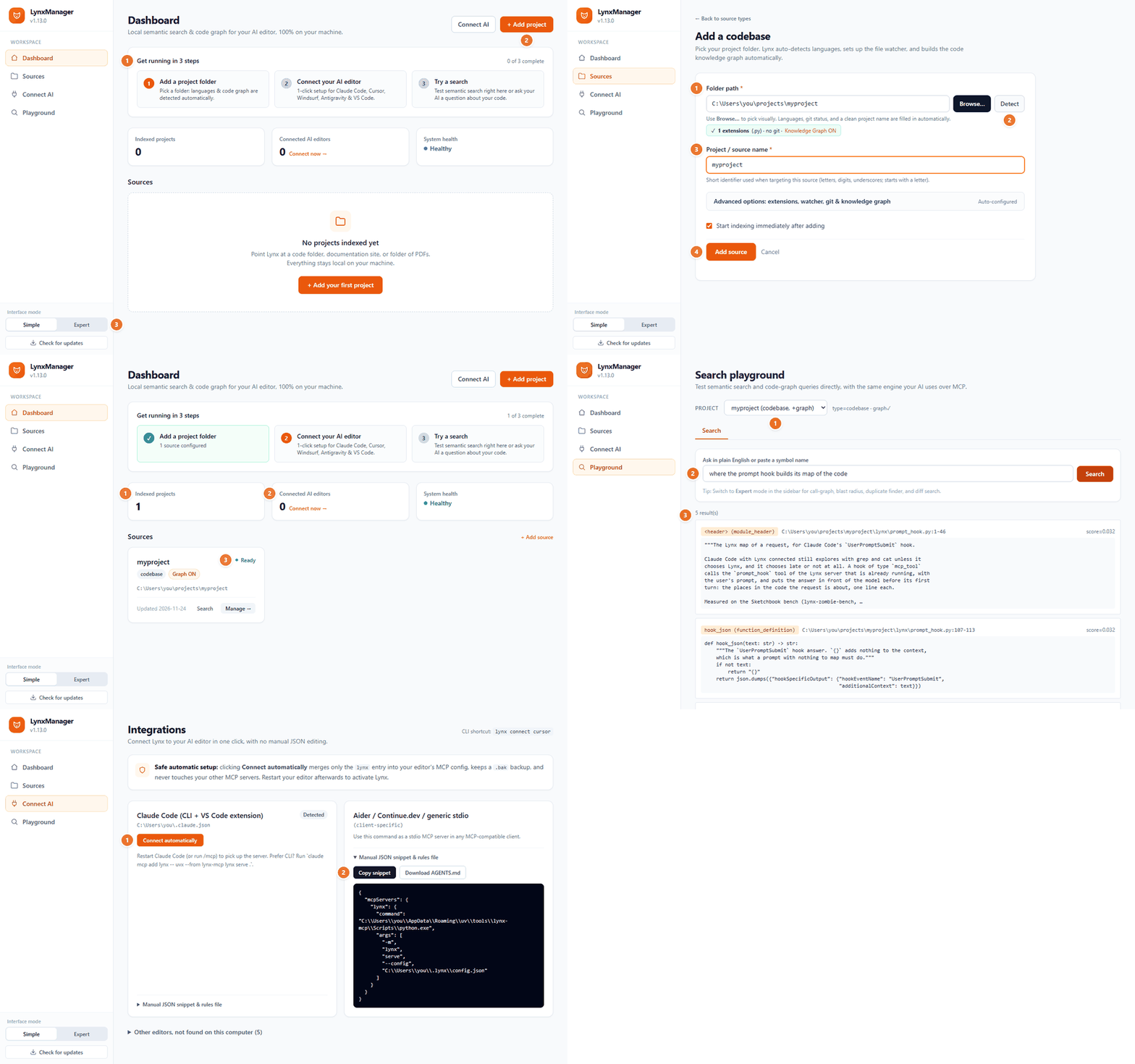
Download the macOS or Windows installer to open LynxManager in your browser (lynx manager ui opens the same UI from the CLI). Simple mode guides you through three steps: pick a folder, connect your editor in one click, and run a search. Expert mode unlocks the JSON config editor, Doctor diagnostics, the graph/diff playground and the OpenAPI endpoints.
Updating
lynx update
Detects uv, pipx, pip and uvx installs and upgrades in place without touching your config or indexes. On Windows, close your AI editors first so no running Lynx process holds index files open (the update button in LynxManager closes itself, updates in a separate window, and reopens automatically).
Why Lynx alongside grep
grep is fast and right whenever you already know the exact identifier. Lynx handles the rest: finding code by what it does, navigating call and inheritance graphs before you edit, checking for duplicate implementations, and searching docs or other repositories that aren't even in your current workspace.
Keyword grep | Lynx | |
|---|---|---|
| Matches | Exact strings or regexes | Meaning (ONNX embeddings) + code-aware BM25, fused |
| Different wording | Returns nothing | Matches by concept even when names differ |
| Output | Individual lines; you still open the file | Whole AST chunks (function or class) with symbol name and line range |
| Ranking | File order on disk | Ranked by relevance; tests, data and docs ranked below production code |
| Structure & impact | None: a name match doesn't show callers or subtypes | Code graph resolved from imports and declarations: callers, callees, subclasses, blast radius and tests |
| Across sessions | Starts from zero every time | Persistent local index; re-indexes saved files in ~2s |
| Beyond the current repo | Only files in the open folder | Multiple local repos, version-pinned web docs and PDFs in one server |
| Trade-off | Zero setup | One-time index build |
Questions grep can't answer directly
| Question | With grep | With Lynx |
|---|---|---|
"What breaks if I change ApplyDamage?" | Textual mentions of the string | impact: transitive callers with hop distance + affected tests |
"Who implements IWeapon or inherits from Field?" | Regex guesses + manual file reads to filter comments | graph_query: resolved inheritance and call edges with file:line |
| "Do we already have a helper like this?" | Guess possible function names | find_similar: ranks existing implementations by semantic similarity |
| "How does this API work in the library version we ship?" | Model memory (often outdated) | Indexed web docs & PDFs, cited with exact URL or page number |
Built-in grep is still the right choice on small repos or when you already know the exact symbol name. Lynx shines on larger codebases, unfamiliar architectures, multi-repo workspaces, and library docs or PDFs the model hasn't seen.
Multiple repos, library docs & PDFs in one server
Index your main project alongside a shared internal library, framework documentation, or a folder of PDF specs, all searchable from the same editor session:
lynx manager init
lynx source add myproject --type codebase --path /path/to/your/repo
lynx source add mylib     --type codebase --path /path/to/shared/lib
lynx source add reactdocs --type webdoc   --url  https://react.dev/reference/
lynx source add manuals   --type pdf      --path /path/to/pdfs
lynx build
lynx connect cursor --config ./config.json
One config.json holds all sources. You can scope any editor window to a subset with --source myproject --source reactdocs, and multiple editor windows share the same index safely.
Visual tour
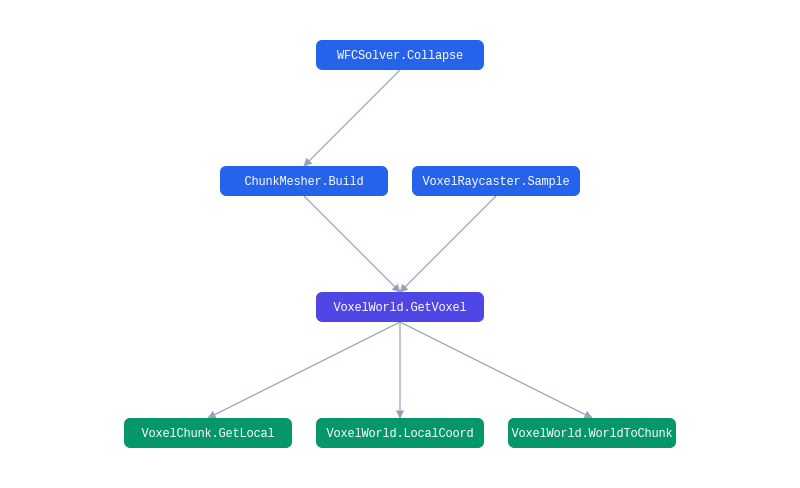
lynx graph export --symbol GetVoxel writes a single self-contained HTML file with callers above and callees below, handy for PR reviews or architecture audits.
LynxManager in Simple mode: add a project, try a search, connect your editor. The full tour covers Expert mode too.
Benchmarks (reproducible)
Single-shot retrieval quality on three public codebases in three languages, using behavioural questions with known ground-truth files, compared against an IDF-weighted multi-keyword grep baseline. Per-task tables: Django · Json.NET · Guava.
| grep / Lynx (v1.12.0) | Django 5.2 (Python) | Json.NET (C#) | Guava (Java) |
|---|---|---|---|
| Corpus | 883 files, 158k lines, 20 questions | 240 files, 69k lines, 15 questions | 606 files, 181k lines, 15 questions |
| hit@1 (top result right) | 45% / 70% | 33% / 67% | 73% / 67% |
| hit@5 (in top 5) | 95% / 90% | 67% / 73% | 93% / 87% |
| MRR | 0.64 / 0.79 | 0.47 / 0.70 | 0.81 / 0.76 |
Key takeaways:
- Behavioural queries (Django, Json.NET): Lynx puts the right file first far more often (70% vs 45% on Django, 67% vs 33% on Json.NET) because it matches intent, not just literal tokens.
- Exact-name queries (Guava): when class names like
BloomFilterorRateLimiteralready match the question's wording, keyword grep edges ahead, and the two work best side by side. - Compact context:
search(outline=true)returns signatures and first doc lines instead of full bodies (2.4× smaller, measured), and three tool profiles keep schema overhead bounded (core: 6.0k chars,standard: 10.6k,full: 16.2k).
Commands to reproduce all three benchmarks
# Python (Django 5.2)
git clone --depth 1 --branch 5.2 https://github.com/django/django.git benchmarks/_target/django
python benchmarks/run_benchmark.py && python benchmarks/structural_demo.py

# C# (Json.NET)
git clone --depth 1 https://github.com/JamesNK/Newtonsoft.Json.git benchmarks/_target/jsonnet
python benchmarks/run_benchmark.py --tasks benchmarks/tasks_jsonnet.json \
  --target-dir benchmarks/_target/jsonnet --storage-dir benchmarks/_storage_csharp \
  --results-json benchmarks/results_csharp.json --results-md benchmarks/RESULTS_csharp.md

# Java (Guava)
git clone --depth 1 https://github.com/google/guava.git benchmarks/_target/guava
python benchmarks/run_benchmark.py --tasks benchmarks/tasks_guava.json \
  --target-dir benchmarks/_target/guava --storage-dir benchmarks/_storage_java \
  --results-json benchmarks/results_java.json --results-md benchmarks/RESULTS_java.md
How it works
flowchart LR
    A["Your code + docs + PDFs"] --> B["Tree-sitter<br/>AST chunker"]
    B --> C["bge-small<br/>ONNX embeddings"]
    B --> D["code-tokenized<br/>BM25"]
    B --> G["Code knowledge graph"]
    C --> R{{"RRF fusion"}}
    D --> R
    Q(["Your query"]) --> R
    R --> RR["Optional<br/>reranker"]
    RR --> RES["Ranked code<br/>file : line : symbol"]
    G --> GT["Graph tools<br/>callers · subclasses · impact"]

    classDef store fill:#fff3e6,stroke:#e8742c,color:#24292f;
    classDef out fill:#e8742c,stroke:#e8742c,color:#fff;
    class C,D,G store;
    class RES,GT out;
- AST chunking (20 languages): Tree-sitter splits code along function and class boundaries, never arbitrary character windows. Supported grammars include Python, TypeScript/TSX, JavaScript, C#, C, C++, Rust, Go, Java, GDScript, Kotlin, Swift, Ruby, PHP, Lua, Scala, SQL, Bash and Objective-C.
- Hybrid retrieval: Every search fuses dense ONNX embeddings (
BAAI/bge-small-en-v1.5) with a code-tokenized BM25 index (covering bodies, symbol names and file paths) via reciprocal rank fusion, ranking production code above tests, data and docs. An optional local cross-encoder reranker is built in. - Code graph: Built from imports, declarations and call sites across files. It powers
impact,describe_symbol,find_usages,graph_queryandexport_graph. - 100% local & offline: The embedding model downloads once (with a GitHub Release fallback for firewalled or air-gapped networks). No cloud index, no telemetry, no code leaves your machine.
- Fast startup: The MCP handshake completes in 1 to 2 seconds while indexes open in the background; a file watcher re-indexes saved files in ~2 seconds.
The tools your AI gets
The tool surface is fixed regardless of how many sources you configure, split into three profiles:
| Profile | Tools | Schema size |
|---|---|---|
core (7) | search, describe_symbol, module_summary, find_usages, impact, plus the two hook tools (prompt_hook, read_guard) | ~1,500 tokens |
standard (12, default) | core + find_definition, find_similar, graph_query, repo_overview, search_diff | ~2,650 tokens |
full (19) | standard + deep_search, find_tests_for, export_graph, feedback, list_sources, get_rag_status, update_source_index | ~4,050 tokens |
Select a profile with --profile core|standard|full, LYNX_TOOL_PROFILE, or tools.profile / tools.include in config.json. Every tool is also a CLI subcommand (lynx search ..., lynx find-definition ApplyDamage, lynx impact ApplyDamage, lynx graph query --op callers --symbol ApplyDamage) with --json for scripts.
All 19 tools and what each answers
| Tool | Profile | What it answers |
|---|---|---|
search(query, identifiers?, source?, outline?) | core | Hybrid search across one or all sources. Pass known symbol names in identifiers, or outline=true for signatures only (2.4× smaller). |
describe_symbol(symbol, file?) | core | Definition, callers, callees and tests in one call; for a class, also bases, subtypes and member signatures. Optional file disambiguates same-name definitions. |
module_summary(file) | core | Every symbol in a file with its signature and doc line, plus its imports and dependents. |
find_usages(symbol) | core | Callers from the graph, subtypes and textual references with line numbers. |
impact(symbol) | core | Transitive blast radius through the call graph with hop distance, plus tests to re-run. |
prompt_hook(prompt) | core | Called by Claude Code's UserPromptSubmit hook (not the model) to prepend a compact map of relevant code. |
read_guard(file_path?, offset?, limit?, command?) | core | Optional PreToolUse hook on Read / Bash (not for the model): refuses a read of more than 200 lines of an indexed file once, with the file's outline; the same read asked again goes through. |
find_definition(symbol) | standard | Where a symbol is defined: full body for the top match, signatures for the rest. |
find_similar(snippet) | standard | Checks whether a draft duplicates existing code and ranks similar implementations. |
graph_query(operation, symbol?) | standard | callers, callees, subclasses, superclasses, imports, neighbors, shortest_path, overview, surprising_connections, status. |
repo_overview() | standard | Languages, frameworks, entry points and build/test/run commands. |
search_diff(query, base?) | standard | Search scoped to files changed against a base branch, useful for code review. |
deep_search(queries, source?) | full | Tries multiple query phrasings in sequence when a single search is weak. |
find_tests_for(symbol) | full | Tests covering a symbol directly or through the call graph. |
export_graph(target, mode?) | full | Exports a self-contained offline HTML view of a symbol's blast radius or a file hub. |
feedback(trying_to_do, tried, stuck) | full | Logs local notes when an agent couldn't find something, to help tune sources. |
list_sources / get_rag_status / update_source_index | full | Inspect configured sources and trigger a manual refresh. |
Retrieval tools advertise the MCP readOnlyHint annotation so clients can auto-approve them. search sets anthropic/alwaysLoad so Claude Code keeps it immediately available while loading the remaining tools on demand.
Integrations
Search and the code graph are also exposed over a local HTTP API (/api/v1) with OpenAPI 3.1 metadata and NDJSON streaming, bound to 127.0.0.1:
- Coral 1.x: point it at
/api/v1/openapi.jsonto add Lynx as a typed provider next to GitHub or Sentry (Coral 0.x SQL tables continue to work). - DuckDB: query Lynx directly via
read_ndjson_auto('http://127.0.0.1:8765/api/v1/search?...')to join code relevance with git churn, logs or tickets. - Steampipe:
lynx_source,lynx_searchandlynx_graphSQL tables (prebuilt binaries). - GitHub Action: posts downstream callers and related code on pull requests.
- Agent rules & MCP recipes: drop-in
CLAUDE.md/AGENTS.mdpointer and workflows combining Lynx with GitHub, Sentry and Jira.
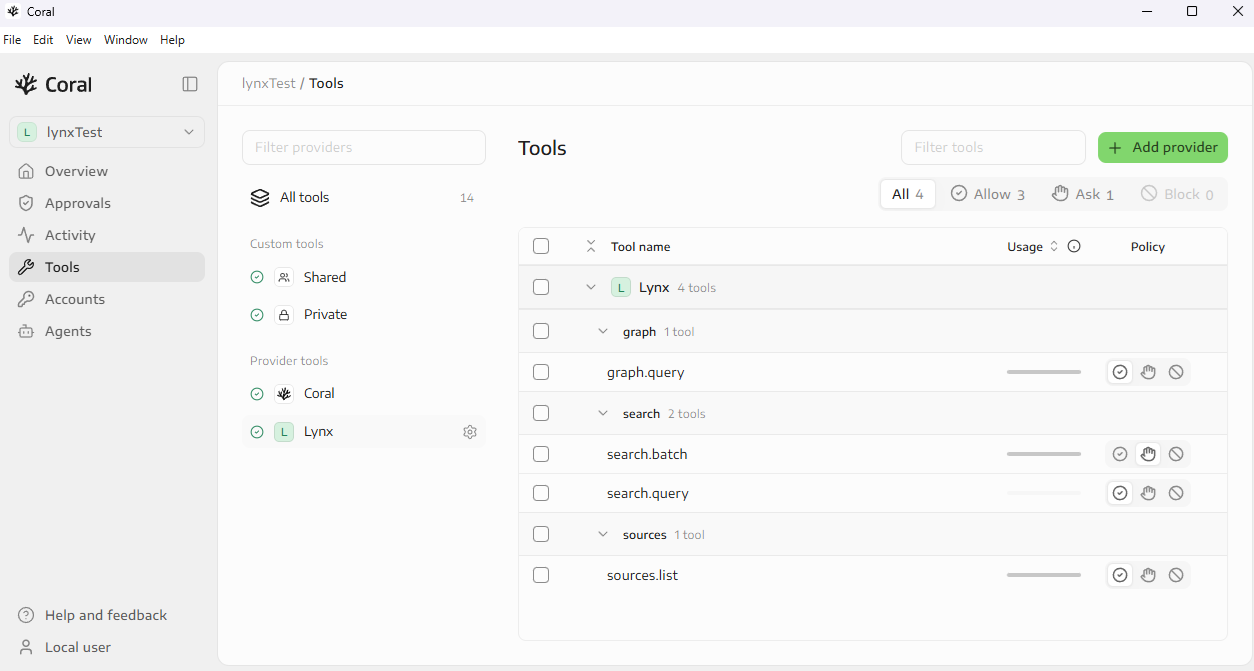
Point Coral at /api/v1/openapi.json and it exposes four typed tools automatically.
Documentation
| LynxManager | The web UI step by step, with pictures of the current version |
| Full guide | Configuration, codebase / webdoc / PDF sources, retrieval internals, tool profiles, hooks, air-gapped setup |
| Outline mode | Signatures instead of bodies: 2.4× smaller output, measured data & chart |
| Coral | Code search and code graph as typed tools in Coral 1.x |
| DuckDB / Steampipe | Code search and code graph as SQL tables |
| Agent rules snippet | Short pointer for AGENTS.md / CLAUDE.md |
| MCP recipes | Combining Lynx with GitHub, Sentry and Jira MCP servers |
| GitHub Action | Automated PR impact analysis on every pull request |
| config.example.json | Annotated v2 configuration reference |
Status & License
Developed independently; issues and PRs are welcome (see ROADMAP.md). Licensed under Apache 2.0.







