Listed from the MCP registry; nobody on Odel publishes it.
Yanked. Package apolo-cad was yanked by its publisher.



Apolo CAD
Agent-native parametric 3D CAD: model machines, validate them and emit shop drawings
Runs on your machine from its package; the steps are below.
What it does
- Reads
- Writes
- High impact
At most: moves money, runs code or commands, deletes data, or sends messages for you.
What it costs
FreeOdel charges nothing per call. The publisher may charge for its own service.
Runs locally over stdio
This server isn't hosted — your MCP client launches it from a package registry. Use one of the commands below, or drop the config into your client (e.g. Claude Desktop).
Run
uvx apolo-cad
MCP client config
{
  "mcpServers": {
    "apolo-cad": {
      "command": "uvx",
      "args": [
        "apolo-cad"
      ]
    }
  }
}English · Español
Genix Apolo CAD
A parametric 3D CAD for industrial machinery, built to be driven by an AI agent.
The agent designs like an engineer over MCP and hands back finished deliverables:
a validated 3D model, shop drawings, a calculation report, a costed BOM and an assembly manual.





What it is
Apolo is a headless parametric CAD (OpenCascade through build123d) with a FastAPI server and a three.js web viewer. Every operation is a command against one HTTP API, and the AI agent, the web UI and the MCP server are equal clients of that API.
The goal is not button parity with SolidWorks or Inventor. Those tools are built around a person clicking; Apolo is built around an agent that has to reach the same result a competent engineering office delivers:
- a 3D model that can be fabricated and holds itself up (fastening, load path, clearances, gravity checked, not assumed);
- shop drawings, a calculation report that cites its standards, a costed BOM and quotation, and a step-by-step assembly manual;
- since V8, the machine's control panel, PLC program and pneumatics, tested in a virtual commissioning run before anything is built.
The agent works with engineering judgment by default: what is removable gets bolted, guards are supported and fastened, and a design is not called done while something floats, collides or lacks declared fastening.
See it
 |  |
| 500 L agitator tank — AISI 304, gearmotor, pitched-blade impeller, interlocked inspection hatch and a control panel with PLC, drive and safety relay. Passes the release gate. | 200 L paddle mixer — pneumatic discharge gate (FRL, 5/2 valve, cylinder), lid and container interlocks, control panel with PLC. |
 |  |
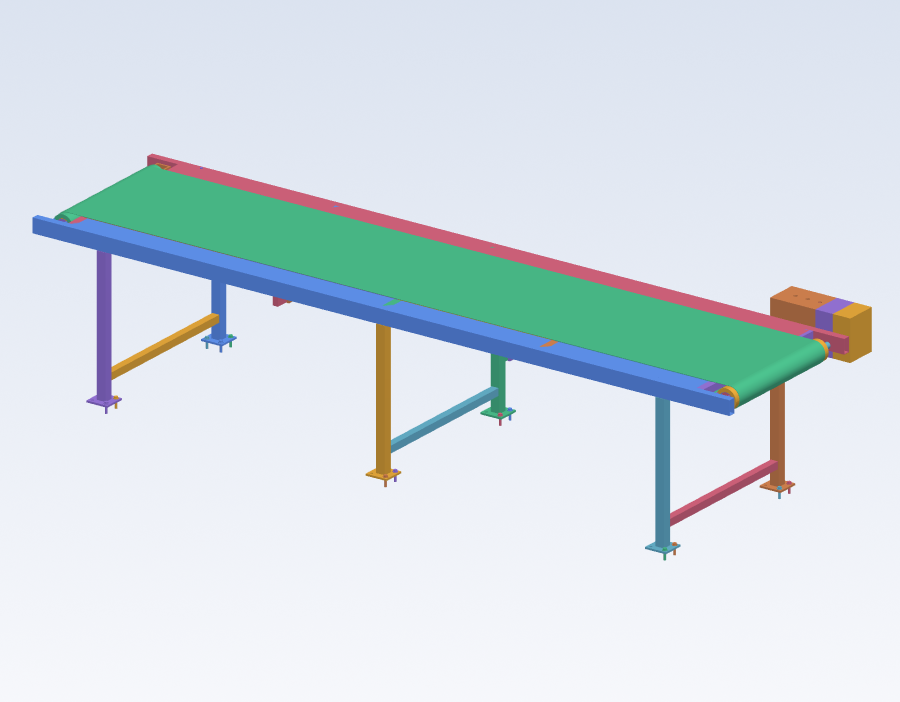
| 4 m parcel belt conveyor — the reference project of the benchmark, 100 % parametric. | Bifold folding door — wood and glass; the same engine outside machinery. |
 |
Motion and physics. A two-level box lift (shown without its enclosure) runs its named
motion study: the platform hangs from two roller chains anchored at both ends, and the chains
follow it in every pose. Studies are scanned for collisions along the whole travel; MuJoCo
simulates gravity, drop tests and powered joints, belts and sensors.
Every image on this page is rendered by Apolo itself, with the same engine the agent uses to look at its own work ( render_view, motion_gif, drawing).
|
The control panel, in 3D

The agent declares the circuit (devices with terminals, wires, conductors) and layout_tablero
builds the panel: enclosure, DIN rails, wire ducts, devices, and the door with its operators.
Apolo runs an electrical rule check (short circuits, crossed voltages, unprotected motors, earthing),
adds the panel to the BOM and costing, and the PLC program runs against the real terminals.
What you get from one model

| Deliverable | What it contains |
|---|---|
| Drawing set (PDF, DXF; DWG with ODA) | Assembly sheet with parts list and balloons, one sheet per part with hole callouts, ISO 286 fits, datums and GD&T, ISO 2768-mK, ISO 1302 roughness, ISO 2553 weld symbols, cut list, hardware schedule, installation sheet with anchor loads |
| Calculation report (A4 PDF) | Design basis, formula, substitution and safety factor for each check, each one citing its standard (CEMA, ISO, DIN, EN, AISC), FEA results with mesh convergence |
| BOM, costing and quotation | Bill of materials (mechanical, electrical and pneumatic), cut list, nesting, a quotation where every cost line declares its source |
| Assembly manual | Steps ordered by load path, from the floor up, with tightening torque and wrench size per step |
| Pneumatic schematic | ISO 1219 sheet generated from the declared air circuit (example) |
| Validation | Interference, gravity and stability, tolerance stack-up (worst case and RSS), linear static FEA, and two gates: delivery_check (green / amber / red) and the stricter publication_gate |
Quick start
pip install "apolo-cad[physics,fea]"   # extras: MuJoCo physics, linear static FEA
apolo --open                            # API + web UI on http://127.0.0.1:8000
Python 3.11–3.13; CI runs on Linux and Windows. Your projects are stored in ~/.apolo/
(APOLO_HOME changes it). apolo-cad[sketch] forces the PlaneGCS sketch solver where no wheel
is published; otherwise the sketcher falls back to SciPy.
Connect an agent over MCP
Keep apolo running and register the stdio server in any MCP client (Claude Code, Claude
Desktop, …):
{
  "mcpServers": {
    "apolo-cad": {
      "command": "apolo-mcp",
      "env": { "APOLO_URL": "http://127.0.0.1:8000" }
    }
  }
}
The server is also listed in the official MCP registry as io.github.mariorojasmz/apolo-cad.
Then ask in plain language:
"Design a 4 m × 600 mm belt conveyor for 1–15 kg parcels, with a hollow-shaft gearmotor and a control panel with an emergency stop. Check that nothing collides or falls, and give me the drawing set and the calculation report."
The agent works in a loop: it models with run_batch (atomic batches: one regeneration,
one undo step, with an optional contract that rolls the whole batch back if a clearance or
interference assertion fails), looks with render_view and measure, validates with
check_interference, gravity_test, engineering_check and delivery_check, and
documents with drawing_set, calc_report, quotation and assembly_manual.
The write core is small (run_command, run_batch, edit_command, edit_batch, undo/redo)
and covers the whole command registry; the rest of the 92 tools read, measure, simulate and
produce documents. Everything the agent does is a command in the log: editable, undoable and
visible live in the browser.
How it works
   AI agent (MCP) ──┐        ┌── web UI (React + three.js)      equal clients
                    ▼        ▼                                  of one HTTP API
               core/apolo/api      FastAPI · REST + WebSocket · jobs
                    │
   doc        document = command log (event-sourced, undo/redo, KB-sized .apolo files)
   commands   command registry + JSON Schemas: UI, dialogs and agent tools from one source
   kernel     build123d / OpenCascade: B-rep, rendering, measurement, picking
   library    standards-based catalog, BOM, costing, engineering rules
   assembly   joints, mates, constraints, connectivity
   drawing    HLR drawings, drawing sets, calculation report, manual
   physics    MuJoCo: gravity, drop test, dynamics          fea   gmsh + scikit-fem
   plc        Structured Text compiled to safe Python       cosim electrical + PLC + mechanics
- The document is a command log. Geometry is never stored: opening a file replays its log, so files are KB-sized and every past command stays editable.
- Schema-driven. A command added to the registry appears in the toolbar, the dialogs, the properties panel and the agent's tools without further code.
- Expressions everywhere. Any numeric field accepts
"=expression"over project variables; changing a variable regenerates the model. - Declarative selectors for edges and faces (direction, face, length, proximity) instead of fragile topological names.
- Machine templates are super-commands (
create_belt_conveyor,create_roller_conveyor,create_hoist_chain,create_pneumatic_cylinder,layout_tablero, …): they inherit parametric editing, undo, BOM and agent exposure. - A 469-reference catalog built from standard dimensions (ISO, DIN, EN, ASTM): bearings, profiles, fasteners, gearmotors, electrical and pneumatic devices.
The living machine (V8)
The current roadmap gives each machine its real control system:
- Electrical model: devices with terminals, wires and conductors; ERC; electrical BOM and costing.
- 3D control panel: rails, ducts, devices and door, wire lengths, duct fill, heat dissipation (IEC 60890) and cable glands.
- PLC: the program is written in Structured Text (IEC 61131-3) and compiled to a safe, deterministic scan with a watchdog.
- Co-simulation: the supply feeds the panel, the PLC reads sensors and drives contactors and drives, the motors move the MuJoCo physics, and each test scenario comes out green or red. In the viewer you press the panel's buttons and watch the machine respond.
- Pneumatics: FRL, valves, cylinders and hoses; the cylinder pushes with its force, speed set by flow and its air consumption; ISO 1219 schematic.
Status
V1–V7 are closed: modeling, assemblies, drawings, deliverables, robustness and performance. V8, the living machine, is in progress: the electrical model, physics, co-simulation and the live viewer are done; the 3D panel, pneumatics and the hoisting chain are being completed. Details in the roadmap.
Maturity is measured by deliverables, not features: the same machine's package from Apolo is scored against a package finished by hand, with a public rubric (benchmark).
Before a machine is delivered, a second agent reviews it blind, with a shop-floor checklist (reviewer prompt); every confirmed defect becomes a rule.
Out of scope on purpose: CAM, contact or non-linear FEA, multi-user cloud and generative design.
From source
python -m venv .venv
.venv\Scripts\python -m pip install -e "core[dev,physics,fea]"
cd ui ; npm ci ; npm run build ; cd ..
.\start-apolo.ps1                                   # API + UI on http://127.0.0.1:8000
.venv\Scripts\python -m pytest tests -q -n auto    # 6641 tests
The repo ships a .mcp.json for the source checkout. The web UI also has an optional built-in
chat, off by default (APOLO_CHAT=1 and ANTHROPIC_API_KEY).
Contributing
Contributions are welcome. Read CONTRIBUTING.md first: what gets accepted, how to run the tests and the build, and the commit style. On your first pull request you'll be asked to sign the Contributor License Agreement once, through CLA Assistant. To report a security problem, follow SECURITY.md.
License
MIT © 2026 Mario Rojas.
Built on free software: OpenCascade (LGPL),
build123d (Apache-2.0),
FastAPI (MIT), three.js (MIT),
MuJoCo (Apache-2.0), gmsh (GPL, optional fea
extra) and scikit-fem (BSD).