Listed from the MCP registry; nobody on Odel publishes it.

Groundrule
Your repository's engineering standards for coding agents: rules per file, CI check, rule proposals.
Runs on your machine from its package; the steps are below.
What it does
- Reads
- Writes
- High impact
At most: only reads or looks up information.
What it costs
FreeOdel charges nothing per call. The publisher may charge for its own service.
Runs locally over stdio
This server isn't hosted — your MCP client launches it from a package registry. Use one of the commands below, or drop the config into your client (e.g. Claude Desktop).
Run
npx -y @groundrule/cli
MCP client config
{
  "mcpServers": {
    "groundrule": {
      "command": "npx",
      "args": [
        "-y",
        "@groundrule/cli"
      ]
    }
  }
}



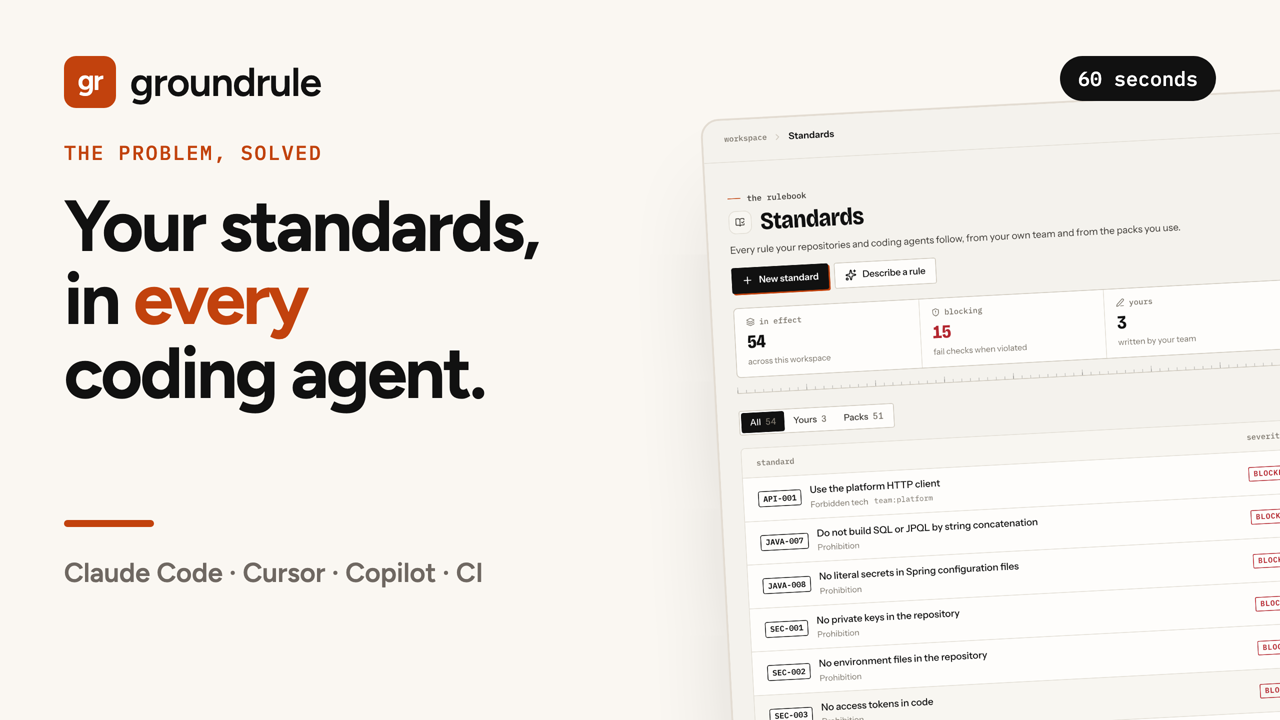
Your engineering standards, taught to every coding agent and checked on every PR.
Write a standard once, as a small YAML file in git. Groundrule:
- teaches your coding agents. It generates
AGENTS.md,CLAUDE.md, Cursor rules, and Copilot instructions containing only the standards that apply, without touching what you wrote by hand. An MCP server and hooks let Claude Code, Codex, Cursor and Copilot follow action policies before each tool call and check their own changes before they finish. - checks the code. It runs locally and in CI against your changes or the whole repository, with deterministic checks (files, patterns, dependencies, imports, layout, metrics, change sets), Semgrep, and optional AI checks on the Groundrule platform.
- tells you why. Every finding names the standard, shows the evidence, says how to fix it, and labels whether it came from a deterministic check or AI.
Everything in this repository works offline and without an account. The Groundrule platform adds a shared rulebook, staged rollout, hosted checks and a compliance report on top of it.
Status: 0.x. Groundrule checks its own repositories with it. The document format is
groundrule.dev/v1alpha1and may still change before 1.0; changes are announced in Discussions.
See it in 60 seconds
Quick start
One command, no account, nothing leaves your machine:
npx @groundrule/cli
In a repository with no Groundrule configuration it takes a first look: it detects your stack, runs the checks over the whole repository and shows what they find today, worst first, without writing anything. Then it asks one question and sets the repository up: .groundrule/config.yaml, the agent files (AGENTS.md, CLAUDE.md, Cursor, Copilot), and the hooks. A new repository starts from the essentials: a short set of rules that are all checked (secrets, SQL built from strings, unsafe deserialization, unverified tokens, and a few per language). groundrule scan then shows the rest of the catalog and which rules already pass, and groundrule packs lists the full packs to add.
 groundrule · a first look at orders-api

   Stack   typescript
   Rules   14 rules from essentials apply here
           every one is checked on every change

 What the checks find in this repository today

 ✕ SEC-015  Use parameterized queries, never string-built SQL
   BLOCKER · deterministic (regex)
   src/orders.ts:7
     SQL built by interpolating into a template literal; pass values as bound parameters
   → Move every value out of the query text and pass it as a bound parameter.

 5 findings in 4 rules. This is code that already exists: it is listed, and it never blocks.
 Once set up, only what a change introduces is checked.

 Set it up now? [Y/n]
After that, groundrule check checks what you changed:
npx @groundrule/cli check # your uncommitted changes; --all audits everything
The steps are also separate commands (init, sync, hooks) when you want one at a time, and groundrule start --yes sets up without asking, for scripts.
 groundrule check · 11 standards · 2 files changed

 ✕ TS-003  No eval or new Function
   BLOCKER · deterministic (regex)
   src/app.ts:3
     eval or new Function in application code
     3: return eval(input);
   → Parse the input instead: JSON.parse, a schema, or a lookup table of allowed operations.
   → groundrule explain TS-003

 Failed  ✓ 7 passed  ✕ 1 failed  ◇ 2 guidance, not checked  · 0.1s
A standard
apiVersion: groundrule.dev/v1alpha1
kind: Standard
metadata:
  id: DEP-008
  title: Use the platform HTTP client
  type: forbidden-tech
  owner: team:platform
spec:
  severity: warning
  requirement: Backend services must use @acme/http-client for outbound HTTP calls.
  examples:
    forbidden: ["import axios from 'axios'"]
  checks:
    - evaluator: dependencies
      forbid: [axios, got, node-fetch]
      allowInstead: ["@acme/http-client"]
More in examples/foundation.
Commands
| Command | What it does |
|---|---|
groundrule / groundrule start [--yes] [--no-hooks] | In a new repository: a first look at what the checks find today, then set everything up with one question |
groundrule init | Create .groundrule/config.yaml with packs for your stack |
groundrule sync [--check] [--upload] | Write (or verify) coding-agent instructions; --upload reports what the repository delivers to agents |
groundrule check [--base <ref>] [--all] | Check changes, a branch, or everything. -f json|sarif|markdown, --summary <file> |
groundrule standards | List the standards in effect |
groundrule keys generate | Create a signing key pair for check results (RFC 0008) |
groundrule verify <run.json> --key <public.pem> | Check a run's signature offline |
groundrule explain <ID> | Why a standard exists, examples, how to comply, exceptions |
groundrule doctor | Check configuration, tools, and agent files |
groundrule packs | List bundled packs |
groundrule scan [--json] [--upload] | Observe this repository against the whole catalog: stack, agent files, tools, and how every rule would do today. Changes nothing |
groundrule propose "<rule>" | Propose a rule for your team to review on the platform. --why, --example, --file path[:line] |
groundrule mcp | Serve your standards to coding agents over MCP, let them check their changes and propose rules (see below) |
groundrule hooks [--agents <list>] [--remove] | Have Claude Code, Codex, Cursor, or Copilot follow action policies before each tool call and run the check when they finish a task (see below) |
groundrule login | Sign in to your organization on the Groundrule platform (browser approval) |
groundrule whoami / logout | Show or remove (and revoke) your saved sign-in |
Exit codes: 0 passed, 1 failed, 2 configuration or usage error.
Using the Groundrule platform (optional)
Everything above works offline. If your organization manages its standards on the Groundrule platform, connect a repository instead of listing packs:
npx @groundrule/cli login               # approve this computer in your browser
npx @groundrule/cli init --org acme     # writes platform: { org: acme } to .groundrule/config.yaml
npx @groundrule/cli sync                # your organization's rules, with every customization
groundrule scan --upload shares a scan with your organization so it can see which rules fit each repository. It also imports what you already have as proposals: instructions from AGENTS.md, CLAUDE.md, Cursor, and Copilot files; ESLint, Biome, Ruff, golangci-lint, Checkstyle, PMD, and tsconfig settings that match catalog rules; CODEOWNERS; and the architecture the code already keeps, as proposed boundary rules with the files that would fail each today (RFC 0011; use --no-import to leave these out). Reports contain counts and at most three one-line, redacted snippets per rule (none for security rules, none at all with --no-snippets); --json shows exactly what would be sent. When uploading, the scan also tests your organization's own rules that have checks, drafts included, so you see their impact before publishing them.
groundrule check --upload sends the result to your organization as a compliance record (RFC 0007): which rules were in effect (as a digest anyone with the same rules can recompute), each rule's version, rollout stage and whether it could fail the change, the exceptions that applied, and which coding agents the change's commits declare, from Co-Authored-By trailers and bot authors (counts only; never commit messages or email addresses). Agent counts are a declaration, not proof; leave them out with --no-authorship.
With a signing key in CI (groundrule keys generate, then the private key as GROUNDRULE_SIGNING_KEY), every uploaded run is signed with Ed25519 (RFC 0008); groundrule verify proves later, offline, that a run wasn't altered. The signature covers everything but code snippets. In GitHub Actions, --sigstore signs with the job's own identity instead of a key (RFC 0009, needs id-token: write; opt-in, since the identity and the result's hash go to Sigstore's public log).
What each command takes from the platform depends on the rule's rollout stage: sync writes rules at Teach, Advise, and Enforce into your agent files; check runs Enforce rules as set and Advise rules as warnings. Rules your repository defines in .groundrule/standards/ still apply. In CI, set GROUNDRULE_TOKEN to a token from Settings → API tokens. Sign-ins are saved in ~/.config/groundrule/credentials.json, readable only by you.
Coding agents (MCP)
groundrule mcp is a Model Context Protocol server (stdio) with four tools:
list_standards: the rules in effect in the repository, so the agent follows them. Works offline.rules_for: the rules that name the files the agent is about to change (by path or language), blocking first, with how to comply (ADR 0010). The server's instructions tell the agent to call it before editing a file; rules that apply everywhere stay in the agent file. Works offline.check: the same check CI runs, on the agent's uncommitted changes (or since abaseref, orallfiles). It lists only what the change introduced, with where and how to fix it, so the agent fixes it before it finishes. Works offline. In a repository connected to its workspace, the counts per rule are reported to the workspace (see below).propose_rule: when you correct your agent and say (or agree) that it should apply to everyone, it proposes the rule to your organization's review inbox, with where it came up. Nothing changes until a reviewer accepts it. Needs a connected repository andgroundrule login.
Add it to your agent once per repository or user:
claude mcp add groundrule -- npx -y @groundrule/cli mcp # Claude Code
{ "mcpServers": { "groundrule": { "command": "npx", "args": ["-y", "@groundrule/cli", "mcp"] } } }
The JSON form goes in .cursor/mcp.json for Cursor, .vscode/mcp.json for VS Code (as servers), or your agent's MCP settings. Proposals carry the rule, your reason, and a file and line if given; nothing else from the repository is sent.
Claude Code plugin
One install gives a developer the MCP server, both hooks and a skill, without changing the repository. Inside Claude Code:
/plugin marketplace add Metricall-AI-Lab/groundrule-oss
/plugin install groundrule@groundrule
It runs the CLI at an exact pinned version (plugin/). groundrule hooks below does the same for a whole team by committing the hooks to the repository; use one or the other. Anthropic's plugin directory lists a smaller bundle with the skill and two commands only (plugin-skill/), because the directory accepts hooks and local MCP servers only from organizations it has verified.
Hooks: before each action, and when the agent finishes
groundrule hooks adds two hooks to the agent's project settings. A before-tool hook decides what the agent is about to do against your action policies, and a stop hook runs the check every time the agent finishes a task, whether or not it remembered to:
npx @groundrule/cli hooks # Claude Code, plus Codex, Cursor and Copilot if the repository uses them
| Agent | File | Before an action | When the check fails |
|---|---|---|---|
| Claude Code | .claude/settings.json | allow, ask or deny, with the reason; the rules for a file ride along before an edit (ADR 0010) | The agent is stopped from finishing and told what to fix |
| Codex | .codex/hooks.json | allow or deny (ask is delivered as deny, with the reason); each developer trusts the hooks once with /hooks | The same |
| Cursor | .cursor/hooks.json | shell commands, MCP calls and file reads (ask on a read is deny) | What to fix is sent as a follow-up message |
| Copilot (CLI and cloud agent) | .github/hooks/groundrule.json | allow, ask or deny (the cloud agent treats ask as deny) | The agent takes another turn with what to fix |
Existing settings and hooks are kept. Without an action policy the before-tool hook answers nothing, and without a Groundrule configuration neither hook does anything. The stop hook asks once per turn, so an agent that can't fix something isn't kept going forever. Commit the files so every developer's agent runs them; --remove takes the hooks out again.
What agents may do (action policies)
A standard says what the code must be. An action policy (RFC 0017) says what the agent may do: which shell commands, edits, reads, fetches and MCP calls it may run on its own (allow), which a person confirms first (ask, the default), and which are refused (deny). It lives next to your standards, with the same identity, scope, owner, exceptions and rollout stages:
apiVersion: groundrule.dev/v1alpha1
kind: ActionPolicy
metadata:
  id: ACT-001
  title: Never force-push
spec:
  severity: blocker
  effect: deny
  requirement: Never force-push. Ask the developer, or push to a new branch.
  when:
    actions: [shell]
    commands: ["git push --force*", "git push -f*"]
The before-tool hook decides it in the agent's own permission flow, on your computer, in milliseconds, and the reason names the policy and what to do instead. A matching exception in .groundrule/exceptions.yaml lifts it; a wrong decision never holds up the agent, because any problem means no decision. groundrule:packs/agent-actions ships ten policies to start from: force-pushes, history rewrites, hook bypass, piping downloads into a shell, publishing, infrastructure changes, elevated privileges, deleting outside the repository, secret files and CI workflows. Agent files get a section "What you may not do alone", so an agent without the hook knows too.
What the workspace learns. In a repository with platform: in its config, when this computer is signed in, the hook and the MCP check tool send the workspace a report after the agent has its answer (RFC 0012): the agent, which rules found something and how many times, how many files and rules were checked, and whether the agent was stopped. Never a path, a line, a snippet, or anything the agent or you wrote. It is sent with a two-second timeout and every failure is ignored, so it can't slow the agent or change the check. The workspace uses it to show how much is caught before a commit exists. platform.reports: none turns it off; groundrule doctor says which applies. Offline repositories send nothing.
Checks
| Evaluator | Source | Use it for |
|---|---|---|
files | deterministic | Required or forbidden files (CODEOWNERS, .env) |
regex | deterministic | Forbidden or required patterns in code |
dependencies | deterministic | Forbidden packages (npm, Maven, Gradle, pip, Go, Cargo) |
change-set | deterministic | Rules about a change ("entity changes need a migration") |
semgrep | static analysis | Semgrep rules you already have |
llm | AI | A question about the change, answered by Groundrule's hosted checks (RFC 0013); advisory, never fails a change. Reported as not run locally and in CI |
Packs
groundrule:packs/essentials is where a new repository starts: about a dozen rules per repository, drawn from the packs below, every one with a check. Extending a full pack later adds to it without clashing. groundrule packs lists the bundled packs (security, TypeScript/Node, React, Python, Java/Spring, Go, Docker, Kubernetes, Terraform, GitHub Actions, HTTP APIs, testing, AI agent hygiene, and what agents may do). Your organization's own packs work the same way: github:your-org/engineering-standards//packs/backend@v1.
GitHub
Metricall-AI-Lab/groundrule-action@v1 checks every pull request, writes a job summary, and uploads findings to code scanning. Source in action/.
Development
pnpm install
pnpm check
See CONTRIBUTING.md. Groundrule checks itself: see .groundrule/.
License
Apache-2.0. "Groundrule" is a trademark; see GOVERNANCE.md.







