Listed from the MCP registry; nobody on Odel publishes it.
Is this yours? Claim it
Agent402.Tools: payments and trust for AI agents
Payment and trust layer for agentic commerce (Agentic Finance): pay and verify over x402 and MPP
One address for any MCP client. No sign-in needed on this server.

What it does
6 read2 act9 other
Grouped by tool name. At most: moves money, runs code or commands, deletes data, or sends messages for you.
What it costs
FreeOdel charges nothing per call. The publisher may charge for its own service.
Tools
17 · grouped by tool name · checked 16 Nov 2026Read · 6Look things up
- catalog.search
- catalog.find
- web.search
- market.quote
- memory.read
- server.describe
Act · 2Change something
- memory.write
- decide.execute
Other · 9Neither hinted nor named
- catalog.call
- payment.info
- web.answer
- web.news
- browser.render
- audio.transcribe
- decide.plan
- demand.request
- decide.feedback
Agent402: the payment and trust layer for agentic commerce
Live at agent402.tools.
Agent402 is the payment and trust layer for agentic commerce: agents find, pay for and verify paid calls to Agent402, across x402 and MPP, with signed receipts on successful direct calls.
- Every rail on one server: x402 across chains with facilitator fallbacks, MPP with Tempo and card, and proof of work for the pure-CPU tools.
- In the money path: an x402 payment settles after a successful answer and an error cancels it, a hang-up before the answer can be forgiven, a charged failure is booked and repaid against the chain record, and a settled paid answer on the direct routes carries a signed receipt (a streamed one as a final event-stream comment line, or as a trailer when the request sends
TE: trailers); a tool bought through a referral link carries none. - The outside market too: a crawled index of x402 sellers and a router that buys from the proven ones.
- Open source and self-hostable, with
agent402-tollboothfor sites that charge agents per request andagent402-client, the buyer SDK.
500+ ready tools on the same rails, plus metered models and finished reports, and reports by card too. The applied layer of Agentic Finance. MCP-native.
Operated by Havok Holdings LLC · Live · Why pay here · Receipts · Status · Security · Company
Try it in 30 seconds: claude mcp add agent402 -- npx -y agent402-mcp@0.17.1, or paste https://agent402.tools/mcp into any MCP client. The free tier needs no wallet. Verified setup blocks for Cursor, VS Code, Windsurf, Cline, Roo Code, Codex CLI, Gemini CLI, Continue, ElizaOS, Paperclip, HarnessRouter and AgentCore: agent402.tools/guides/agent-hosts (shortlinks agent402.sh/<host>, e.g. agent402.sh/cursor).
Who pays: agents pay per call (from $0.001; models metered under a quoted ceiling and settled at actual usage); people buy finished reports ($2 to $5) and monitors ($5 a month) by card; sites charge crawlers with the tollbooth.









Receipts and verification
- Every settled x402 answer carries
PAYMENT-RESPONSE(success,transaction,network,payer), and every MPP answerPayment-Receipt(reference). Look the x402transactionup on itsnetworkto see the transfer to thepayTothe 402 named. /.well-known/agent402-conformance.jsonlists, per payment rail, settlement after the answer, idempotent re-sends, the replay guard, refunds of a charged failure and the receipt, computed from the serving code.- A server run with a receipt signing key (
RECEIPT_SIGNING_KEY) also signs every settled paid answer on the direct routes (a tool bought through a referral link carries none; its transaction on chain is its record):Agent402-Receipt, a compact JWS (EdDSA, Ed25519) over the route, the request, the answer's sha256, the price, the rail, the payer and the settlement, checked against/.well-known/agent402-receipt-key.jsonor withverifyReceiptin agent402-client. A one-piece answer carries it as a header; a streamed answer ends with a: agent402-receipt <receipt>server-sent comment line, which event-stream parsers skip, over every byte streamed before it (and anAgent402-Receipttrailer when the client sendsTE: trailers), checked withverifyStreamedReceipt. Every streamed paid answer's head also namesX-Agent402-Receipt-Url, whereGET /api/receipt/<token>with the token that header names (free, for 30 days) answers the same receipt once the answer finished, so a client that reads neither the comment line nor a trailer still gets it. A prepaid credits call names the key's id and its debit; a card-bought report carries one over the checkout and the report's text, on its page and in its email; the hosted MCP connector passes a paid result's receipt in_meta["tools.agent402/receipt"]. ThesignedReceiptcell of each conformance row reads true only while that server signs; without the key, the receipt is the settlement's own record. POST /api/attestbinds a paid call's response digest to its settlement on Base;POST /api/receiptsreturns the paying wallet's settled calls with each transaction and digest.- /trust#verify walks one call end to end;
/api/index?seller=<host>shows an outside seller's crawl history, paywall probe and router verdict.
What Agent402 is
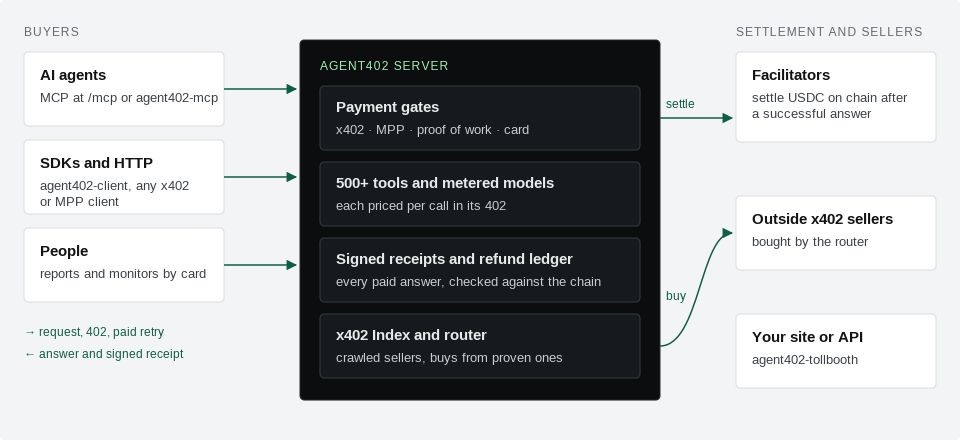
Agentic Finance is software agents paying and getting paid on their own: discovering a service, paying per request from a wallet over open protocols (x402, MPP), receiving a verifiable receipt, and earning per request in return. Agent402 is its applied layer - explainer: agent402.tools/agentic-finance · glossary.
Selling an x402 API? List it on the index for free at
/sell(POST /api/index/register: self-serve, no signup, 0% take). The router sends buyers to a seller once its routes show settled payments from several independent buyers; calls priced at $0.05 or less on Base (up to $0.25 a day per seller and $5.00 a day in all) or $0.01 or less on Solana can be tried before that, marked unproven on the buyer's receipt. Charging crawlers on your own site instead?agent402-tollboothputs a 402 gate in front of it.What makes it different: Agent402 is open-source and self-hostable - and a single integration gives a buyer three free primitives over the whole x402 ecosystem:
- Find -
/api/find?q={task}resolves a task description to the best-matching tools (route, price, schema, ready example).- Route -
POST /api/routeis the neutral Smart Order Router: rank tools across every x402 seller crawled (auto-discovered from the x402 Bazaar on the Coinbase Developer Platform), health-aware, withinclude=externalto exclude us. The response returns the top N and carriesmatchedfor how many scored.- Leaderboard -
GET /api/leaderboardis the public on-chain ranking of x402 sellers by Base USDC settled volume - calls served, totalUsd, unique buyers per seller. It returns the top N, never the whole board (25 by default, 50 the ceiling;totalSellerscarries the full count). Pipeline: Bazaar →eth_getLogs→ per-call ceiling → aggregate bypayTo. The snapshot refreshes every 12 hours.Plus the catalog - 500+ strong: search/answer as the MCP front door, then 500+ tools and curated skill packs (multi-tool workflows callable as MCP prompts) - all runnable yourself, plus
agent402-tollbooth- an open pay-per-crawl gate for the other side of x402.Two doors, two price lists. Agents pay per call in USDC (x402 / MPP) or free via proof-of-work, and a finished report costs $0.60 to $2.00 that way ($0.05 for the IPO digest). People pay by card: the same reports at agent402.tools/reports (company dossier, 13F fund report, insider flow, market brief, deep research, FDA recall, domain audit) are $2 to $5, monitors that re-run on change at /monitors are $5 a month, and a prepaid credits key pays per successful call on Agent402's own services (
Authorization: Bearer a402_…; /credits says whether packs are on sale). The card price includes payment processing. An agent paying per call pays the lower tool price for the same report.Two payment wires, one URL. Every paid endpoint accepts x402 (
PAYMENT-SIGNATURE, USDC on 13 chains or USDG on Robinhood Chain) and MPP (Machine Payments Protocol, the IETF-trackPaymentHTTP auth scheme co-authored by Tempo and Stripe): the same 402 carries both, anmppxclient pays out of the box, and MPP settles on Base and Celo (USDC), natively on Tempo (in a dollar token the 402 names, via Tempo's relay), or by card over MPP (Stripestripe/charge, offered on routes priced $0.50 and up when the operator configures it). The MPP marketplace lists every MPP seller we can verify live. Details: MPP on Agent402 · live MPP settlements.
Framework adapters (drop-in tools for the major agent stacks - auto-payment underneath):









500+ strong - live web search and cited answers as the MCP front door, then ready-to-use web tools and multi-tool skill packs for your AI agent, from one server. Every one priced per call and settled on-chain. Browser
rendering, web search, PDFs, images, OCR, live financial/crypto/macro data, SEC EDGAR, deterministic stats, forecasting, and options/bond pricing (Black-Scholes, YTM), compression, and 150+ pure-CPU utilities. Run it yourself for free in 30 seconds (MCP or
plain HTTP, no API keys, no signup - the free tier and x402/MPP payments never
need a key; only a prepaid credits key is a bearer key), connect
it to Claude/ChatGPT/any MCP client, and add your own tools in a few lines.
No language model writes a utility tool's answer, and every tool CI can run
without a third-party key is re-tested against its own example before every release. The model-backed
surfaces are explicit and priced as such: the /v1 gateway (metered under a
quoted ceiling, or flat tiers) and the finished report products (/v1/research, /v1/dossier, ... below).
Optionally, the same server can charge per call over the x402 protocol (USDC on Base, Solana, Polygon, Arbitrum One, Monad, Celo, Avalanche C-Chain, Sei, OP Mainnet, Arc, Ink, Stellar & Algorand, plus USDG on Robinhood Chain - 14 chains) - so the instance you self-host for free can also be a hosted, monetized one. Free mode is one setting (
FREE_MODE=true); a paid instance needs a payout wallet.
🟢 Hosted demo: agent402.tools · 📖 Wiki · 📦 npm · 🔌 MCP Registry · 🧩 Hosted MCP connector (https://agent402.tools/mcp)
Run it yourself in 30 seconds
Pick whichever fits. They are all free and need no wallet:
1. Zero install - add the hosted connector to Claude (claude.ai → Settings → Connectors → Add custom connector):
https://agent402.tools/mcp
The pure-CPU tools run free there. A wallet-only tool is payable in the same call over x402 or MPP, from an MCP client that holds a wallet (MCP Connector).
2. One command - run the MCP server locally (the pure-CPU tools work with no key; it pays the tiny proof-of-work for you):
npx -y agent402-mcp@0.17.1
# in Claude Code:  claude mcp add agent402 -- npx -y agent402-mcp@0.17.1
3. Clone and host the whole thing (all 500+ tools as an HTTP API + MCP, free mode, no payments):
git clone https://github.com/MikeyPetrillo/Agent402 && cd Agent402
npm install
FREE_MODE=true npm start          # → http://localhost:3000  (HTTP API + /mcp)
# try a tool over HTTP - no auth in free mode
curl -s -X POST localhost:3000/api/hash -H 'content-type: application/json' \
  -d '{"text":"hello world","algo":"sha256"}'
4. Deploy to Railway (full self-hosted instance, built from the repo's Dockerfile):

The button creates the service from this repository; it adds no database or cache. Set FREE_MODE=true to serve every tool free, or the paid-mode variables in Self-Hosting: without one or the other the server exits at boot. The seller index crawls on a production boot (the image sets NODE_ENV=production; a FREE_MODE boot needs X402_INDEX_CRAWL=on). Redis and Postgres are optional and you add them yourself: REDIS_URL enables the upstream response cache (X-Cache: hit|miss), and DATABASE_URL enables the public /api/analytics dashboard.
Every environment variable the server reads, with its purpose and default, is in the generated
configuration reference; .env.example is a commented starting file.
Pay per call from a wallet
Every paid route answers 402 with both an x402 offer and MPP challenges, so either client pays it. No API key, no signup: the wallet is the account.
MPP (a dollar token on Tempo, listed first in the 402, or USDC on Base or Celo) with mppx:
import { Mppx, tempo, evm } from "mppx/client";
import { privateKeyToAccount } from "viem/accounts";
const account = privateKeyToAccount(process.env.AGENT_KEY);
// The evm method signs for the tokens you list: USDC on Base and on Celo.
const methods = [tempo.charge({ account }), evm.charge({ account, currencies: [evm.assets.base.USDC, evm.assets.celo.USDC] })];
const res = await Mppx.create({ methods }).fetch("https://agent402.tools/api/uuid");
x402 (USDC on Base and other chains) with @x402/fetch:
import { wrapFetchWithPayment } from "@x402/fetch"; import { x402Client } from "@x402/core/client"; import { registerExactEvmScheme } from "@x402/evm/exact/client";
const client = new x402Client(); registerExactEvmScheme(client, { signer: (await import("viem/accounts")).privateKeyToAccount(process.env.AGENT_KEY) });
const res = await wrapFetchWithPayment(fetch, client)("https://agent402.tools/api/uuid");
On Base, an x402 exact payment is a signature (EIP-3009): the facilitator submits it and pays the gas, so the paying wallet needs only USDC, no ETH.
More: Paying with MPP · Paying with x402.
What's in the catalog (500+ tools)
Every tool earns its place: priced to market and settled on-chain, and every tool CI can run without a third-party key is tested against its own example on every CI run. CI holds a 400-entry catalog floor and verifies the “500+” claim against the running catalog (
scripts/sync-count.js --check). The catalog grows only when a tool is worth calling.
| Examples | |
|---|---|
| Browser & web | render (headless Chromium, executes JS), screenshot, extract (article→markdown), meta |
| Live search & answers | search (real web index), search-lite (a quick 5-result sample), answer (web answer with citations), search-news/search-images/search-videos variants, search-suggest, multi-search |
| PDFs & media | pdf-to-markdown, pdf-merge, pdf-extract-pages, pdf-rotate, images-to-pdf, audio-convert, audio-normalize (EBU R128, real ffmpeg) |
| Images | image-resize, image-convert, image-thumbnail, barcode-decode (jimp/zxing, pure-CPU) |
| OCR | image-ocr (text out of any image - pure-CPU, no model) |
| Geo | geo-distance (haversine, pure-CPU), place-lookup (place names worldwide), geo-lookup (US county and state), sun-times |
| Weather | weather-current, weather-daily, weather-hourly, weather-history, weather-air-quality by coordinates or place name; weather-probability, weather-market-brackets, weather-market-board (ensemble probabilities); weather-window, weather-thresholds; free calculators heat-index-calc, aqi-calc, degree-days-calc, wmo-weather-code |
| Live data | fx-rate (ECB), barcode-lookup (Open Food Facts), gov-data (data.gov), weather-forecast/weather-alerts, earthquakes (USGS) |
| Calendars & business days | public-holidays, bank-holidays, school-holidays, next-holidays, long-weekends (with bridge days), country-business-days (check, add, count, region-aware), business-day-planner (first common business day across countries); settlement-calendar (ACH, Fedwire, SEPA, SEPA Instant, CHAPS settlement dates from each rail's published operating days); market-calendar (open, close and holidays for NYSE, the London Stock Exchange, Xetra, JPX and HKEX; calendar facts only, no market data, not affiliated with the exchanges). Holiday data by Nager.Date, used under a sponsorship held for this service; a commercial self-host needs its own sponsorship |
| Finance & crypto | crypto-price/crypto-market/crypto-history/crypto-trending/crypto-global (CoinGecko) |
| Crypto derivatives | perp-markets, perp-funding, perp-funding-screener, perp-basis, perp-open-interest, perp-klines, perp-orderbook (live perpetuals: mark/oracle price, funding, OI, candles, depth) - $0.001 to $0.003 a call, no exchange account |
| DeFi, venues & stablecoins (computed answers) | lending-rates (Aave v3 and Compound v3 supply and borrow rates read from the contracts), funding-screener (one coin's funding across every listed venue), stablecoin-depeg-watch (USD stablecoins off peg now, over 24 hours and 7 days), exchange-spread (each venue's deviation from a coin's cross-venue median price), dex-pool-health, dex-volume-board, defi-screener, chain-board - $0.005 a call |
| Solana token intel | sol-token-pairs, sol-token-search, sol-trending, sol-price - markets and prices for any mint |
| Crypto market coverage | crypto-indicators (RSI, MACD, moving averages, computed here), crypto-market-pulse, coin-profile, coin-history, coin-ohlc, coin-market-chart-range, coin-categories, coin-price-by-contract (price by token ADDRESS, no coin id needed), global-defi, exchanges, exchange-tickers, exchange-rates, coin-search - plus tokenized real-world assets from the same CoinGecko key: rwa-list, rwa-markets, rwa-asset, rwa-issuers, rwa-issuer (tokenized stocks, ETFs and commodities with onchain market data and the issuers behind them) |
| Indexed chain data | asset-transfers (filtered transfer history), token-balances, token-allowance, tx-receipt (decoded transfers), block-receipts, token-price-history - indexed reads across the major EVM chains, no node and no key of your own |
| Site crawling | site-map (enumerate a site's URLs) and site-crawl (breadth-first crawl to clean markdown, robots-respecting, hard page/depth/time budgets) - the deterministic pair behind any "read this whole site" task |
| Macro (US agencies + more) | us-macro-series (90 common series IDs read from the agencies that publish them: BLS, BEA, the Treasury, the Federal Reserve Board and the New York Fed), yield curve, treasury, fiscal, Fed funds, CPI, unemployment, Sahm rule, ECB FX, World Bank |
| SEC EDGAR | ticker→CIK, filing list, 10-K/10-Q text, XBRL frames, insider transactions, 13F holdings, IPO calendar, full-text search |
| Finished reports (cited) | research/research-pro/research-max (grounded deep research), market-brief, dossier/dossier-max (company due diligence), fund-report/fund-report-max (13F portfolio), domain-audit/domain-audit-pro (graded security + deliverability), recall-report (FDA), insider-report (Form 4 flow), token-risk/token-risk-pro (on-chain contract risk), filing-report (latest SEC filing), token-brief (Solana mint risk evidence, available while its data source answers), ticker-pack (dossier + insider flow + holders), ipo-report (S-1 + 424B4 digest, deterministic) - $0.60 to $2.00 per report over x402 / MPP ($0.05 for the IPO digest), or $2 to $5 by card at /reports; see the /v1 table below |
| Network truth | dns, dns-lookup, tls-cert, whois, http-check, robots-check, email-validate, ip-info |
| Crypto & payments | usdc-balance, tx-status, gas-estimate, ens-resolve, x402-quote, x402-verify, transfer-authorization - non-custodial, multi-chain (Base/Polygon/Arbitrum/OP Mainnet/Ethereum) |
| Agent memory | wallet-keyed KV + TTL, atomic counters, cross-wallet grants, hash-chained audit log, similarity recall |
| Stats & forecasting | stats-summary, correlation, linear-regression, moving-average, outliers; forecast-naive, forecast-ses, forecast-holt, forecast-holt-winters + forecast-eval (MAPE/RMSE backtest) |
| Finance math | black-scholes (option pricing + greeks), bond-price/bond-ytm, cagr, sharpe-ratio, annuity, npv/irr, compound-interest, loan-payment/amortization, break-even, effective-annual-rate (pure-CPU, deterministic) |
| Compression | gzip/gunzip, brotli-compress/brotli-decompress, compress-compare (algorithm shootout, pure-CPU via node:zlib) |
| HTML extraction | html-select (CSS query), html-table, html-strip, html-links, html-meta - deterministic counterpart to extract |
| Network ops | dns-lookup, dns-propagation, spf-check/dmarc-check/dkim-lookup, email-deliverability; cert-transparency, http-headers (security audit), tech-stack, asn-info (IP geo) |
| Chain reads | block-number, chain-info, block-info, contract-code, erc721-owner, event-logs - keyless JSON-RPC reads with multi-endpoint failover on Ethereum/Base/Polygon/Arbitrum/OP Mainnet (event-logs reads Base), from $0.001 |
| SQL policy | sql-guard ($0.004 - pass/warn/block verdict with named risks on a SQL statement, plus an Ed25519-signed check result when a signing key is configured), sql-cert-verify ($0.001 - verifies that signed result against the exact statement) |
| x402 seller intelligence | Three rungs on the same question, cheapest first. seller-trust (GET /api/x402/seller-trust, $0.005) - the router's gate field by field: indexed, manifest parses, chains advertised, settled calls observed, would we spend buyer money there. seller-dossier (POST /api/seller-dossier, $0.05) - the assembled record: every price with its provenance, advertised wallets against the wallets actually paid, settlement evidence per source, the dispatch verdict per chain with its reason, and what each route delivered when our router called it, paid calls and the unpaid non-answers it refused to resell alike. seller-payability (POST /api/seller-payability, $0.10) - buys one real call right now and reports every leg, including whether the accept's EIP-712 domain matches the token it names. The first two are offline reads of what we already know; the third spends USDC to find out |
| 150+ pure-CPU utilities | hashing, JWT, base58, JSON⇄CSV/YAML, token-count, text-chunk, json-validate, text stats, cron math, validators, unit conversions across 13 categories (one parametric tool) |
Full schemas live in /openapi.json; a
machine-readable catalog is at /api/pricing
and /llms.txt. Don't know which tool you need?
/api/find?q=<task> resolves
a task description to the right tool - route, price, schema, and a ready example -
so an agent skips the token-heavy "search around to find a tool" step.
LLM gateway (/v1) - chat, embeddings, rerank, images, speech & finished reports, pay per call
Call a model: the metered route is the default. POST /v1/metered/chat/completions
(and the Anthropic Messages and OpenAI Responses twins, /v1/metered/messages and
/v1/metered/responses) serves third-party models with no API key, no signup and no
account, paid per call in USDC over x402 or MPP (a prepaid credits key also works, see
For humans). The 402 quotes this exact request from
its own body (the input estimated from its tokens with headroom, plus your
max_tokens, at the model's list price plus a fee). On x402, Tempo and credits,
settlement never exceeds that quote: an exact payer pays the quote, and an upto
payer (where the 402 offers it) or a credits key settles what the answer used; a card
payment adds the processor fee. Set a client timeout of at least 120 s: the answer is
generated and the payment settled before the response is sent, which takes a few seconds
on most calls and longer for long answers, and a client that disconnects after the
payment settles is charged without the answer (the charge is recorded as owed and
reviewed for a refund).
The gateway is an Agent402 service: it prices each call before it runs (a flat tier price, or a quote from the request on the metered routes), routes auto chat calls to a model chosen for the task, falls back to the next model on a chat tier when one fails, and signs a receipt for each settled paid answer.
curl -i -X POST https://agent402.tools/v1/metered/chat/completions -H 'content-type: application/json' \
  -d '{"model":"anthropic/claude-haiku-4.5","messages":[{"role":"user","content":"Summarize x402 in one line"}],"max_tokens":200}'
# unpaid: HTTP 402 quoting this body; an x402 or MPP client pays the quote and resends
The flat tiers below stay as the predictable-price option: point any OpenAI SDK at
base_url = https://agent402.tools/v1 (or /v1/nano, /v1/pro, /v1/premium) for one
price per call whatever the length.
| Endpoint | Price | Serves |
|---|---|---|
POST /v1/metered/chat/completions | from $0.001 | the default - every explicit model the flat chat tiers serve, quoted per request from the body (200k chars in on every model and more on a larger context window, 8,192 tokens out) |
POST /v1/nano/chat/completions | $0.003 | nano models - priced for high-frequency agent loops |
POST /v1/auto/chat/completions | $0.01 | no model needed - deterministic eval-ranked routing (code / reasoning / long / general), optional quality: fast | balanced | best at the same price, decision disclosed via agent402_router |
POST /v1/chat/completions | $0.02 | budget/mid models (gpt-6-luna by default, claude haiku, gemini flash, deepseek, llama…) |
POST /v1/pro/chat/completions | $0.10 | mid-frontier (gpt-6.1 terra by default, gpt-6 sol and 6.2 sol, claude sonnet, gemini pro and 4 argon, carbon and neon, grok) |
POST /v1/premium/chat/completions | $0.50 | frontier (claude opus 5.5 by default, gpt-5.6 sol and terra, gpt-6.2 astra, claude fable 5.1 and 5.2, gemini 4 argon) |
POST /v1/grounded/chat/completions | $0.03 | the auto router plus a live web search on every call - answers carry OpenAI-wire url_citation annotations; never cached |
POST /v1/{nano,auto,pro,premium}/messages, POST /v1/messages | tier price | the Anthropic Messages wire on every tier (same allowlist, caps and failover as the chat route); effort (low to max) is the depth control on Claude 4.7+, older Claude takes thinking.budget_tokens |
POST /v1/{nano,auto,pro,premium}/responses, POST /v1/responses | tier price | the OpenAI Responses wire on every tier (function tools only, no server state) |
POST /v1/{nano,auto,pro,premium,metered}/gemini, POST /v1/gemini | tier price | the Gemini generateContent wire on every tier (contents, systemInstruction, generationConfig, function declarations); also answers /v1beta/models/<model>:generateContent |
POST /v1/embeddings | $0.002 | OpenAI embeddings, batch up to 64 inputs - an identical repeat from the payer that paid for it is free (deterministic output, cache default-on; scope below) |
POST /v1/rerank | $0.002 | Cohere-compatible rerank ({query, documents[], top_n}), up to 50 documents, cache default-on (scope below) |
POST /v1/images/generations | $0.08 | image generation (FLUX.2 Pro, 1024x1024 PNG) - OpenAI images wire, inline base64 out |
POST /v1/images/fast | $0.02 | budget text-to-image, same OpenAI images wire, about two seconds a picture |
POST /v1/images/pro | $0.05 | higher-fidelity text-to-image, one picture a call |
POST /v1/images/edits | $0.02 | edit an image with a prompt, OpenAI images.edit wire: one to four PNG or JPEG references in, one JPEG out |
POST /v1/videos/generations | $0.20 | text-to-video: one silent 4-second 720p clip, MP4 inline base64, 16:9 or 9:16 |
POST /v1/audio/transcriptions | $0.03 | speech-to-text, OpenAI transcription wire: multipart file in, transcript out, recordings up to four minutes |
POST /v1/pro/audio/transcriptions | $0.10 | the same model for recordings up to ten minutes |
POST /v1/audio/speech | $0.06 | text-to-speech, OpenAI audio.speech.create() wire - up to 2,000 chars in, raw mp3 (default) or pcm bytes out, five-model failover chain |
Streaming (stream: true), full tools/function-calling passthrough, an opt-in
prompt cache on the chat tiers (cache: true → a byte-identical repeat within
10 minutes is free to the payer that paid for it, on a fresh payment of its own: an
x402 v2 exact payment signed by the paying wallet's own key, a verified Tempo sender,
or the same credits key; the repeat's payment is not charged, except a Tempo transfer
sent before the call, which is final when sent; other payers and payment methods,
including Solana, Stellar, Algorand, Permit2/upto, x402 v1 and contract wallets, are
charged on each call; the same rule covers the embeddings and rerank caches), upstream failover chains that end in a canary-proven model, and a
free GET /v1/models listing every model with
its tier and caps. A real-money canary buys the core surfaces daily (the chat
tiers, the messages and responses wires, embeddings, rerank, image generation
and speech) - streaming, routing disclosure, and both cache behaviors included.
Finished report products live on the same /v1 prefix: one paid call returns
a complete, cited report (JSON, with a sources appendix) rather than a raw model
turn. Every report is grounded in primary data the server fetches itself (EDGAR
filings, openFDA, DNS/TLS probes, on-chain reads, a live web search) before
synthesis; ipo-report is fully deterministic (no model at all):
| Endpoint | Price | Report |
|---|---|---|
POST /v1/research · /v1/research/pro · /v1/research/max | $0.60 · $0.85 · $1.10 | deep research report ({query}) - grounded multi-search, rerank, cited synthesis |
POST /v1/research/market-brief | $0.85 | market / competitor brief ({query}) |
POST /v1/dossier · /v1/dossier/max | $0.85 · $1.10 | company due-diligence dossier ({ticker}) - filings, insider flow, web |
POST /v1/fund · /v1/fund/max | $0.60 · $0.85 | fund portfolio report from the latest 13F ({manager}) - bought/sold last quarter |
POST /v1/domain-audit · /v1/domain-audit/pro | $0.60 · $0.85 | graded domain security + deliverability audit ({domain}) |
POST /v1/recall-report | $0.60 | FDA recall report, drug/food/device ({query}) |
POST /v1/insider-report | $0.60 | insider flow report from parsed Form 4 filings ({ticker}) |
POST /v1/filing-report | $0.85 | latest SEC filing read and summarized with the facts that moved ({ticker}) |
POST /v1/token-brief | $0.60 | Solana token on-chain facts from on-chain and market data ({mint}), never a verdict, available while its data source answers |
POST /v1/ticker-pack | $2.00 | one ticker in one report: dossier, insider flow and holders |
POST /v1/linkedin-article | $1.10 | a publish-ready professional article package from a topic, formatted for posting on LinkedIn (not affiliated with LinkedIn), ({topic}): cited research, headline options, the body, a companion post and images at the platform's sizes |
POST /v1/token-risk · /v1/token-risk/pro | $0.60 · $0.85 | token and contract risk report from on-chain evidence ({address, chain}) |
POST /v1/ipo-report | $0.05 | IPO pipeline digest, S-1 + 424B4 from EDGAR full-text search ({days, keyword}), deterministic |
Reports are wallet-only (x402 / MPP / prepaid credits, never proof-of-work) and take a few minutes to generate. The same reports are sold to people by card at agent402.tools/reports for $2 to $5 depending on depth. The card price includes payment processing; an agent paying per call over x402 or MPP pays the lower tool price for the same report.
Two companion tools close the loop: POST /api/route/execute ($0.01, with
execute-plus $0.05, execute-mid $0.12, execute-max $0.55 and execute-pro $3.30 tiers for pricier tools) resolves a task description to the
best tool and runs it in one paid call, including, with include:"external",
tools sold by other x402 sellers (it routes on proven on-chain settled
volume, with one exception - a Base or Solana seller with no history yet is
tried only after every proven candidate, under a small per-call ceiling (on Base,
also a daily cap per seller), and flagged unproven on the receipt - buys the result from them on the chain you paid
on - Base, Solana, Algorand or Tempo - and sells it to you; see the
Smart Order Router guide), and
POST /api/my-usage ($0.005) returns the paying wallet's own purchase
history - no wallet parameter; the x402 payment is the identity, so nobody can
read another wallet's profile.
For humans: reports and monitors
The same catalog has a card-paying front door (Stripe Checkout; the operator
enables it with STRIPE_SECRET_KEY, otherwise these pages simply do not mount):
| Page | What you get |
|---|---|
| agent402.tools/reports | Buy any finished report from the table above by card (POST /api/buy) for $2 to $5 (the deepest tiers and the ticker pack sit at the top of that range; current prices on the page), delivered at /r/<session> - no wallet, no account. The card price includes payment processing; an agent paying per call pays the lower tool price for the same report. A report is generated only against a Stripe-verified paid session, once; a failed generation is refunded automatically. |
| agent402.tools/monitors | $5/month subscriptions that re-run a report when something changes and email you (up to 4 full reports in any 30 days; a change past that arrives as an alert email): domain security monitor (free daily re-probe, full paid re-run on a security change, a certificate inside 14 days of expiry, or every 30 days), SEC filing watch (new filing), Solana token facts watch (changed on-chain facts, available while its data source answers), fund 13F watch (new filing), FDA recall watch (new recall number), insider flow watch (new Form 4), research question watch (your question researched again about once a week), IPO pipeline watch (weekly digest). Reports land at /m/<id>; manage or cancel through the Stripe Customer Portal at /monitors/manage. |
| agent402.tools/credits | Prepaid credits: a prepayment for Agent402's own services, for business and developer use (the page says whether packs are on sale). Send a key (a402_…) as Authorization: Bearer a402_… on a priced route and the call is paid from the key - debited only on a successful response, integer micro-dollars so sub-cent prices are exact; credits never expire and carry no fees, and are not transferable or redeemable for cash. GET /api/credits/balance (same header) reads the balance; a 402 with {reason, balanceUsd, topup} means insufficient. Identity-bound tools (/api/memory*, my-usage) refuse credits because the payment is the identity there; pay those over an x402 rail. Routes that buy from an outside seller with our wallet (the route-execute tiers, seller-payability, /api/decide/execute and the flight routes) take a wallet payment only (x402, or MPP on a chain). |
A credits key is understood by the SDKs: agent402-mcp reads
AGENT402_CREDITS_KEY and agent402-client takes { creditsKey }.
Decide - describe the job, get the plan
POST /api/decide turns a task description into a call-ready plan: which tools, from this
catalog and from outside x402 sellers whose 402 was verified in the last week, in what order, with
fallbacks, inputs that validate against each tool's schema, and cost and latency estimates.
Priced by depth: quick (one best tool), plan (steps and fallbacks) and full (plus a compiled
prompt), from $0.003 to $0.03 per decision over x402 or MPP.
curl -X POST https://agent402.tools/api/decide \
  -H "Content-Type: application/json" \
  -d '{"task":"Check whether wallet 0xd8dA...6045 is on a sanctions list, then list its recent token transfers on Base","depth":"plan"}'
Self-hosting: Decide runs as its own service (npm run start:decide, services/decide, with its own
Postgres). The main server serves /api/decide only when DECIDE_SERVICE_URL (the service's address)
and DECIDE_INTERNAL_TOKEN (a shared secret of 24 characters or more) are both set; without them the
route answers 404. Every variable is in the configuration reference.
- Neutral ranking. One formula scores every candidate (fit, observed reliability, price,
schema quality, freshness) with no term for who sells the tool, and every step says whether
the tool is ours (
firstParty). - The fee comes back. A decision paid with a wallet returns its fee as a 24-hour credit toward
POST /api/decide/execute, which runs the plan: our tools directly, outside steps bought from the seller and resold at the seller's price plus a disclosed 5% markup. Spend stops at the budget, fallbacks are tried in order, and a run where no step succeeds is not charged on x402. Because it can buy from outside sellers, execute is paid from a wallet (x402, or MPP on a chain). - On MCP the same pair is
decide.plananddecide.execute;decide.feedback(free) records whether a step worked. Page: agent402.tools/decide.
Skill packs - 80+ multi-tool workflows
For jobs that span several tools - "audit a domain", "diagnose deliverability",
"work up a time-series", "peel an opaque blob" - Agent402 ships curated
skill packs: ordered, typed sequences of tool calls with a Claude-ready
prompt template. Callable as MCP prompts (prompts/list → prompts/get { name, arguments })
or plain HTTP at GET /api/skill-packs/{slug}/prompt (every slug is listed in the
free JSON index at /api/skill-packs.json).
A task-shaped query to catalog.search (the hosted connector's search tool; the older search_tools name still works as an alias) returns the matching pack alongside individual tools.
| Featured pack | Chains | Use it for |
|---|---|---|
security-audit | cert-transparency · dns-lookup · spf-check · dmarc-check · http-headers · tls-cert · tech-stack | Domain security posture |
trend-analysis | us-macro-series · stats-summary · moving-average · linear-regression · outliers · correlation · forecast-eval | Quant workup on any time series |
structured-scrape | extract · render · html-select · html-table · html-strip · html-links · html-meta | Deterministic scraping decision tree |
decode-blob | jwt-decode · gunzip · brotli-decompress · base64 · hex · json-format · hash | Identify and peel any opaque string |
forecasting-bake-off | us-macro-series · forecast-eval · forecast-naive · forecast-ses · forecast-holt · forecast-holt-winters | Rank 4 forecasters by RMSE, pick the winner |
document-intel | pdf-info · pdf-to-markdown · pdf-extract-pages · image-ocr · barcode-decode · pdf-merge · images-to-pdf | PDF/OCR/barcode pipeline |
status-snapshot | dns-lookup · http-check · http-headers · tls-cert · robots-check | One-shot service-health sweep |
All 80+ packs at /skills · JSON index at /api/skill-packs.json ·
on MCP the packs appear under prompts/list so any MCP-aware client picks them up automatically.
x402 Index - Find · Route · Leaderboard
Agent402 is also the open routing + ranking layer for the whole x402
ecosystem: it crawls public x402 sellers (the local catalog + an
auto-discovered set from the x402 Bazaar (Coinbase Developer Platform),
refreshed hourly) and exposes them through three free surfaces - same logic as
/api/find: discovery primitives shouldn't cost money.
| Surface | What |
|---|---|
GET /api/find?q={task} | Resolve a task to the best-matching tools (route, price, schema, ready example) |
POST /api/route | Smart Order Router: { query, top, include } → ranked tools across sellers (match score, then health, then price; a judgment model then moves the listing that actually does the task to the top, cheapest among equally good ones, reported in judged). include=external excludes Agent402 itself |
GET /api/leaderboard | On-chain ranking of x402 sellers by Base USDC settled volume (callsSettled, totalUsd, uniqueBuyers per seller). Top N only - 25 default, 50 ceiling, totalSellers for the full count. Pipeline: Bazaar → eth_getLogs → per-call ceiling → aggregate. The snapshot refreshes every 12 hours |
/marketplace | Public HTML dashboard: every seller, tool count, network, last-fetched, rolling health |
GET /api/index | The seller index as JSON (totals, per-seller health/routable flags). Paginated - one page of 250 max, complete: false and a Link header with rel="next" while more remain, sellerCount for the total. One origin, unpaged and with its crawl history: ?seller=<host> |
/stellar · /algorand | Per-chain marketplace pages: sellers and tools settling on that rail specifically |
# "I need an OCR tool - find me the cheapest healthy one anywhere on x402"
curl -X POST https://agent402.tools/api/route \
  -H 'content-type: application/json' \
  -d '{"query":"ocr image to text","top":5}'

# "Who are the most-used x402 sellers right now? (on-chain proof, not self-reports)"
curl 'https://agent402.tools/api/leaderboard?top=25&include=external'
Dispatch is labeled, never implied: every /api/route row and /api/index
seller carries routerDispatchEligible and routerDispatchReason (crawl_failed,
network_unknown, settlement_required, settlement_checked_at_pay_time,
eligible, ...); executeVia appears only on a row the router will pay right
now (executeViaCallableNow: true), otherwise the tier moves to
executeViaWhenEligible. routable is crawl readiness, never a promise to pay.
A manifest-priced route is also read live once and then weekly, so the chains
its 402 actually offers reach the row even when the seller's manifest lags.
Health-aware: sellers whose last few crawls errored are excluded from the router (a buyer routed to a dead seller wastes money). Healthier sellers also break ties at equal match score and price, so flaky-but-cheap sellers lose to reliable ones. Brand-new sellers (no history yet) get the benefit of the doubt.
Judged fit: the lexical score rewards a listing whose name repeats the task's words, so one seller's twenty narrow routes could out-rank a general tool that does the job. A judgment model now reads a shortlist - at most two rows per seller, plus the best matches from the local catalog - and moves the listing that actually does the task to the top; when several do it equally well, the cheapest wins. It never adds a seller the settlement gate did not admit, it can say "none of these" (route-execute then refuses before anything is paid), and it fails open to the lexical order. The tools themselves still run no model; this is only how the router chooses.
Operators get 3-rail attribution on the dashboard (/api/stats,
/__operator, token-gated - it answers 404 without the operator token): USDC vs. proof-of-work vs.
heartbeat-probe traffic are counted separately - and the heartbeat rail is gated
on a POW_SECRET-signed token (not a spoofable User-Agent), so the operator
view reflects real external demand.
For API sellers: /sell is the front door -
list an existing x402-speaking API on the index for free with
POST /api/index/register (health-routed, 0%
take, self-serve, no signup), or install agent402-tollbooth to
put a pay-per-crawl gate in front of a site that isn't x402-native yet.
From code, the agent402-client npm package wraps all of this -
find() a tool, then call() it, paying automatically (a built-in proof-of-work
for free tools, your x402 wallet for paid ones), with caching and idempotent
retries:
npm install agent402-client
import { Agent402 } from "agent402-client";
import { privateKeyToAccount } from "viem/accounts";
const a = new Agent402();                       // free tier (proof-of-work)
const out = await a.call("hash", { text: "hello world", algo: "sha256" });

// a prepaid credits key pays wallet-only tools on Agent402's own services
const b = new Agent402({ creditsKey: "a402_..." });

// a signer that deposited USDC into Circle Gateway pays the batched accept
// where a 402 offers one (no gas per call); off by default
const c = new Agent402({ gateway: { signer: privateKeyToAccount(process.env.AGENT_KEY) } });
agent402-client has no dependencies: install viem for privateKeyToAccount, or pass any EIP-712 signer with address and signTypedData.
Live payments view (services/live)
A separate, read-only service that draws x402 payments on Base and MPP payments on Tempo as they settle. It reads public chain RPCs and public discovery listings, holds the last hour in memory, and fans out to browsers over one server-sent event stream; it shares no process, database or key with the API. Hosted at https://live.agent402.tools.
Run it locally (Node 24+, no dependencies):
cd services/live
PORT=8090 node server.js      # then open http://localhost:8090
node test.js                  # offline tests
Optional settings: LIVE_BASE_RPCS and LIVE_TEMPO_RPCS (comma-separated RPC URLs), LIVE_INCLUDE_UNLISTED=1 (also count Base payments to wallets no discovery listing names), LIVE_INTERNAL_PAYERS (payer wallets to label as test traffic), LIVE_MAX_PAYMENT_USD (default 50), LIVE_REFERRAL_ROUTERS (comma-separated split-contract addresses a referral network pays sellers through; a settlement to one is drawn as a payment to the seller it paid in that transaction; none by default).
Plug into your agent framework (zero-dep adapters)
If you're already on one of the stacks below - OpenAI, Anthropic, the Vercel AI SDK, LangChain (JS or Python), LlamaIndex, Strands, Google ADK, or the OpenAI Agents SDK - skip the wiring: there's a drop-in package that turns the Agent402 catalog into native tool objects for your framework, with payment handled underneath (proof-of-work for free tools, x402+USDC when you pass an @x402/fetch):
| Stack | npm | Returns |
|---|---|---|
| OpenAI function-calling (chat.completions / Assistants v2 / Responses) | agent402-function-calling | tools[] for tools: param |
Anthropic Messages API (tool_use) | agent402-messages-tools | tools[] for tools: param |
Vercel AI SDK (streamText / generateText) | agent402-stream-tools | Record<name, tool()> |
| LangChain JS / LangGraph | agent402-structured-tools | DynamicStructuredTool[] |
| LlamaIndex TS | agent402-function-tools | FunctionTool[] |
| Strands Agents | agent402-agent-loop-tools | StrandsTool[] for new Agent({ tools }) |
| Google ADK (Agent Development Kit) | agent402-dev-kit-tools | FunctionTool[] for ADK agents |
| OpenAI Agents SDK | agent402-runner-tools | Agent tools for @openai/agents |
| Coinbase AgentKit (CDP, Privy, ZeroDev, viem wallets) | agent402-action-provider | an ActionProvider for AgentKit.from({ actionProviders }) |
| LangChain Python / CrewAI | agent402-structured-tools (PyPI) | StructuredTool[] from Agent402Toolkit.get_tools() - four meta-tools (find / route / call / about), not one per slug |
Renamed packages (same API; each earlier name's last release forwards to its new name): agent402-openai-tools is now agent402-function-calling, agent402-anthropic-tools is now agent402-messages-tools, agent402-ai-sdk is now agent402-stream-tools, agent402-langchain is now agent402-structured-tools (npm and PyPI), agent402-llamaindex is now agent402-function-tools, agent402-google-adk is now agent402-dev-kit-tools, agent402-strands is now agent402-agent-loop-tools, agent402-agentkit is now agent402-action-provider, agent402-openai-agents is now agent402-runner-tools, elizaos-plugin-agent402 is now agent402-actions-plugin, agent402-openclaw is now agent402-model-provider.
// e.g. OpenAI - every adapter has the same surface.
import OpenAI from "openai";
import { agent402Tools } from "agent402-function-calling";

const openai = new OpenAI();
const { tools, execute } = await agent402Tools({ slugs: ["extract", "hash", "render"] });
const res = await openai.chat.completions.create({ model: "gpt-6-luna", tools, messages: [...] });
// when the model returns a tool call: await execute(call.function.name, JSON.parse(call.function.arguments));
Already a Claude/MCP user? agent402-mcp is still the better path - paste https://agent402.tools/mcp into your client. The adapters are for direct API integrations where MCP isn't available. Sources: adapters/.
OpenClaw agents: drop in skills/openclaw/agent402/SKILL.md - teaches an OpenClaw agent to find, pay (x402 USDC on Base, twelve other chains accepted, or free proof-of-work), and call any of the 500+ tools and packs.
Add your own tool (~15 lines)
A tool is just an object in a kit array. Drop this into any file in
src/tools/ (e.g. append to AGENT_TOOLS in src/tools/agent-kit.js)
and it's live - routed, schema-published, MCP-exposed, and covered by the
"every tool answers its own example" CI check:
{
  route: "POST /api/reverse",
  name: "Reverse text",
  slug: "reverse",
  category: "text",
  price: "$0.001",                       // free via proof-of-work once listed in src/free-tier.js
  description: "Reverse a string. Example: {\"text\":\"abc\"} → {\"reversed\":\"cba\"}",
  discovery: {
    inputSchema: { properties: { text: { type: "string" } }, required: ["text"] },
    example: { text: "abc" },            // CI calls this and checks it works
  },
  handler: (input) => {
    if (typeof input.text !== "string") { const e = new Error('"text" required'); e.statusCode = 400; throw e; }
    return { reversed: [...input.text].reverse().join("") };
  },
}
That's the whole contract: handler(input) returns a JSON-serializable object
(or throws an Error with .statusCode for a 4xx). A new tool is wallet-only;
a pure-CPU tool joins the free proof-of-work tier when its slug is added to
FREE_TIER_SLUGS in src/free-tier.js. See CONTRIBUTING.md for the full walkthrough.
Optional: charge per call with x402
The same server can require payment per call - useful if you host a public
instance. Payments are the default posture: a bare npm start fails closed,
exiting unless WALLET_ADDRESS is set - running without payments is the
explicit opt-in (FREE_MODE=true npm start). To charge, set WALLET_ADDRESS
- CDP facilitator keys (free at portal.cdp.coinbase.com)
and agents pay in USDC on Base (or Solana, Polygon, Arbitrum One, Monad, Celo, Avalanche C-Chain, Sei, OP Mainnet, Arc, Ink, Stellar,
Algorand - or USDG on Robinhood Chain via
PAYMENT_NETWORKS=…,robinhood+ROBINHOOD_FACILITATOR_URL) via standard x402 clients:
Every 402 is valid under @x402/core's own schemas (at most five tags, CI-checked
on all routes) and carries a typed output schema twice: in the bazaar discovery
extension and as accepts[0].outputSchema on the first accept, so a client that
reads the spec's field sees the response shape before paying.
Optional: GATEWAY_NANOPAYMENTS=on adds a Circle Gateway batched accept on Arc
and Base beside the plain one (same price, same payTo; buyers who deposited
USDC into Gateway sign per call with no gas, and Gateway settles off chain into
your Gateway balance, withdrawn with scripts/gateway-withdraw.js). Off by
default; see the wiki's Self-Hosting page. Buyers pay it from agent402-client
with the gateway option (wiki: Circle Gateway).
import { wrapFetchWithPayment } from "@x402/fetch";
import { x402Client } from "@x402/core/client";
import { registerExactEvmScheme } from "@x402/evm/exact/client";
import { privateKeyToAccount } from "viem/accounts";

const client = new x402Client();
registerExactEvmScheme(client, { signer: privateKeyToAccount(KEY) });
const payFetch = wrapFetchWithPayment(fetch, client);
const res = await payFetch("https://agent402.tools/api/extract", {
  method: "POST", headers: { "Content-Type": "application/json" },
  body: JSON.stringify({ url: "https://agent402.tools/guides/x402-in-5-minutes" }),
});
MPP dual-stack. The paywall also speaks MPP (Machine Payments Protocol -
the IETF-track Payment HTTP auth scheme from tempoxyz/mpp):
the same 402 carries a WWW-Authenticate: Payment challenge, Authorization: Payment credentials settle, and settled responses return a Payment-Receipt.
MPP has two methods here: evm settles identically to x402 (EIP-3009 USDC,
same facilitator, same price); tempo settles natively via
Tempo's own relay (TIP-1034/TIP-20, no x402 facilitator
involved) - a genuinely separate settlement path, set TEMPO_API_KEY to
enable it. An mppx client works out
of the box for either method; set MPP_SECRET_KEY to enable the shim on your
own instance. Same URL either way - the buyer's client picks the dialect.
Agents without a wallet still use every pure-CPU tool by solving a single-use sha256 proof-of-work (a fraction of a second on a laptop; the MCP servers do it automatically). Details: wiki: Paying with x402 · Paying with MPP · Paying with Compute.
Why pay here - seven things that are different
Every claim links to the surface that proves it (the live version, a section of the docs: agent402.tools/docs#why).
- Pay for what the model used, with the ceiling quoted first. The metered gateway (
POST /v1/metered/chat/completions) quotes each 402 from the request's own body; a wallet payinguptosettles actual usage under that ceiling, provider discounts such as prompt-cache reads pass through, and every settled x402 or MPP response carries a receipt; a JSON answer bought with an EVM wallet can be attested on Base by that wallet (POST /api/attest). - A failed x402 call is not charged, and the response proves it. Some calls are paid before they run; a failed one can be retried free with the same payment, or is refunded. Settlement runs after the handler and an error status cancels it, so a failed call is answered with no payment receipt, or with a receipt marked
success:false, and is not charged. A call paid before it ran answerscharged: true. One exception, on the EVM chains: a transfer that lands after a timed-out settle, a disconnect during settle, or a settle the facilitator answered as pending whose receipt was not read in time, is booked as a refund owed and repaid after on-chain proof. Not so for a receipt whose errorReason is settlement_unconfirmed (a settle that ended without showing whether the transfer was sent): the transfer may still land, so do not sign a new authorization for that call before the expiry the answer names (authorizationValidBefore, lastValidRound or expirationLedger), or, when it names none, before the paying wallet shows whether the transfer landed, and follow the answer's retry (watch-transaction: watch the named transaction; check-wallet: check the paying wallet). A receipt whose errorReason is settled_refund_owed was charged: its transfer landed after an earlier attempt with the same payment and is booked as owed to the paying wallet, repaid after on-chain proof (refundStatusUrl shows where it stands), and a new authorization makes the call. A retry carrying the sameIdempotency-Keyand the same payment credential replays the paid answer instead of paying again, and a request re-sent with the same signed EVM payment is answered from its first answer even without a key (X-Replayed-Answer: 1); a settled receipt on an error response is detected by our own alarm and recorded as a debt in a refund ledger, never written off silently. - One key buys everything. The same wallet pays for five LLM tiers on four wires (OpenAI chat, OpenAI Responses, Anthropic Messages, Gemini generateContent), embeddings, rerank, images, video, speech, transcription, grounded answers with citations, 500+ tools and finished reports, and an EVM wallet also keys its own memory.
- No wallet required. Proof-of-work pays for the pure-CPU tools, cards over MPP pay routes priced at $0.50 or more, and card checkout sells the finished reports, beside USDC or USDG on fourteen chains and native MPP on Tempo.
- Finished work, ready to use. Dossiers, insider flow, 13F holdings, filing reports, IPO digests, domain audits, token risk, deep research, market briefs, recall watch and a professional article package, grounded in live sources, most with a downloadable data appendix; monitors check for free on a schedule and re-run the paid report when the facts change, up to 4 full reports in any 30 days.
- We source from other sellers.
POST /api/route/executeresolves a task to the best seller across the ecosystem, buys the result from that seller with our wallet and sells it to you under one receipt. Sellers are routable on proven on-chain settlement, with one bounded exception for a zero-history Base or Solana seller under a small per-call ceiling. - Everything is checkable. Uptime observed by two probes outside production (
/status), a real-money canary through every on-chain rail daily, transactions published by rail and wire (/revenue), open source and self-hostable. The deterministic tools run no model; the ones that do are named (the /v1 tiers, the report products, the image, speech, transcription, embedding and AI-answer tools, the Decide planner, and the judgment model that can pick among the router's shortlisted candidates). The operator is identified on-chain: Agent402 is agent 94639 in the ERC-8004 Identity Registry on Base, resolving to/.well-known/agent-registration.json, with an A2A agent card at/.well-known/agent-card.json. Some calls are paid before they run; a failed one can be retried free with the same payment, or is refunded.
Why it's solid
- Everything is tested - CI calls every tool that needs no third-party key
with its own documented example and blocks the release on any failure; the
key-gated and model-backed tools are covered by input probes and a daily paid
canary instead, because CI holds no third-party keys. Two independent probes outside
production watch the live instance (one every 5 minutes, on separate infra from
the other), and what they observe is public at
/status- where a day with no observation reads "no data", never uptime, because an outage is exactly when a probe cannot report. - Hardened - connect-time SSRF guard on every URL tool (DNS-rebind safe), proof-of-work that's signed/single-use/slug-scoped, per-IP