
OpenNodes
Discover verified AI inference nodes, get the best node+model per task, pre-price chains.
Runs on your machine from its package; the steps are below.
What it does
- Reads
- Writes
- High impact
Not assessed yet.
What it costs
FreeOdel charges nothing per call. The publisher may charge for its own service.
Runs locally over stdio
This server isn't hosted — your MCP client launches it from a package registry. Use one of the commands below, or drop the config into your client (e.g. Claude Desktop).
Run
npx -y @opennodes/cli
MCP client config
{
  "mcpServers": {
    "opennodes": {
      "command": "npx",
      "args": [
        "-y",
        "@opennodes/cli"
      ]
    }
  }
}OpenNodes Protocol (ONP) — Draft 0.1
An open standard for discovering, invoking, and paying AI inference endpoints ("AI Nodes") across vendors — from frontier labs to a university GPU cluster — with bridges to MCP and WebMCP.
Status: Draft 0.1 (working proposal, 2026-08-20) — not affiliated with any standards body yet. Home: opennodes.io
The one-sentence pitch
MCP standardized how AI applications reach tools; the OpenAI API shape standardized how they invoke models; x402 standardized how machines pay each other — but nothing standardizes how a client finds an inference endpoint it doesn't already know about: what model it serves, how big it is, what hardware backs it, how well it benchmarks, what it costs per token, and whether it's up. ONP fills exactly that gap and composes the rest from existing standards.
Documents
Start here
- 00 — Project overview — the concept, architecture, implementation status, completed development stages, and next steps in one document.
Research (why this standard, and why now)
- 01 — Protocol & standards landscape — MCP + Registry, WebMCP, A2A, AGNTCY, ANP, NANDA, OpenAI-compatible APIs, DIDs/VCs, x402, UCAN, model cards, MLPerf; full gap analysis.
- 02 — Market landscape & demand evidence — OpenRouter, HF Inference Providers, gateways, DePIN/decentralized compute, OS-level AI runtimes, payment rails; viability assessment.
- 04 — Universal AI client landscape — AI browsers, branded assistants, neutral/BYOK clients, multi-homing data, distribution economics; assessment of the "primary access point" client idea.
Specification suite
- ONP-1 — Overview, terminology, architecture, conformance
- ONP-2 — The Node Card — self-description document at
/.well-known/open-node.json - ONP-3 — Registry & Discovery API — registration, verification, search, health, ranking, federation
- ONP-4 — Invocation profiles — bindings for text, image/diffusion, embeddings, agents
- ONP-5 — Settlement — price advertisement, payment schemes (x402 / prepaid / free), signed usage receipts
- ONP-6 — Bridging — connecting discovered nodes to MCP servers, WebMCP sites, and conventional web data
Development requirements
- REQ-001 — Discovery Service (registry) — MVP registry: registration, admission battery, search, estimation, MCP surface; acceptance criteria.
- REQ-002 — Test client — CLI + OpenAI-compatible gateway + MCP modes; compatibility matrix (Cursor, VS Code, Open WebUI…).
- REQ-003 — Node Kit — reverse-proxy wrapper turning vLLM/Ollama/TGI into a conforming node: card generation, receipts, registration, self-test.
Install (published packages)
npx @opennodes/cli mcp --print-config   # discovery + advisor tools for Cursor / VS Code / Claude Desktop
npx @opennodes/cli gateway --port 4141  # OpenAI-compatible gateway with onp/auto routing; base URL http://127.0.0.1:4141/v1
npx @opennodes/registry                 # run a registry: web app + API + MCP on http://127.0.0.1:4300
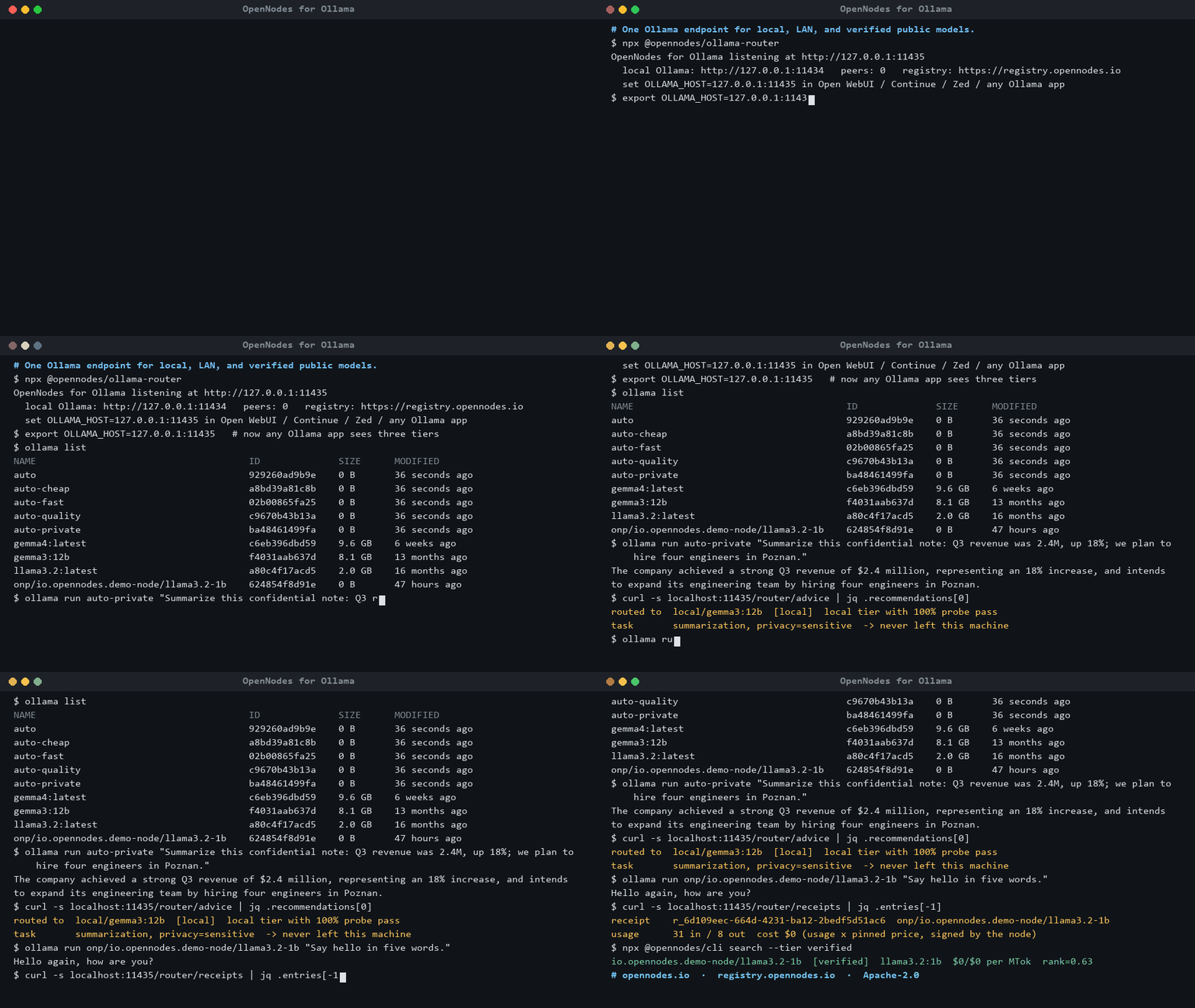
npx @opennodes/ollama-router            # OpenNodes for Ollama: one Ollama endpoint over local + LAN + verified public models
pipx install onp-node                   # Node Kit: turn a vLLM / Ollama / TGI deployment into a conforming node
npm: @opennodes/core · @opennodes/cli · @opennodes/registry · @opennodes/ollama-router — PyPI: onp-node
OpenNodes for Ollama (impl/packages/ollama-router): point Open WebUI, Continue, Zed, or the ollama CLI at OLLAMA_HOST=127.0.0.1:11435 and one model list spans your local Ollama, other machines on your LAN (plain Ollama servers or Node Kit nodes, auto-discovered via mDNS), and verified public nodes from the registry — with auto, auto-cheap, auto-fast, auto-quality, and auto-private (never leaves the LAN) routed by the advisor, pinned prices, budget caps, and signed receipts for public calls.
Implementation
- schemas/open-node.schema.json — normative JSON Schema for the Node Card (Phase 0 deliverable).
- impl/ — reference stack source (registry + fixture node +
onpCLI/gateway);npm install && npm testinimpl/. - node-kit/ — Python Node Kit (REQ-003): wraps any OpenAI-compatible engine (vLLM/Ollama/TGI) into a conforming node; cross-language e2e against the JS registry.
Ecosystem
Clients and products consuming ONP — independent of the standard, listed here for discovery:
-
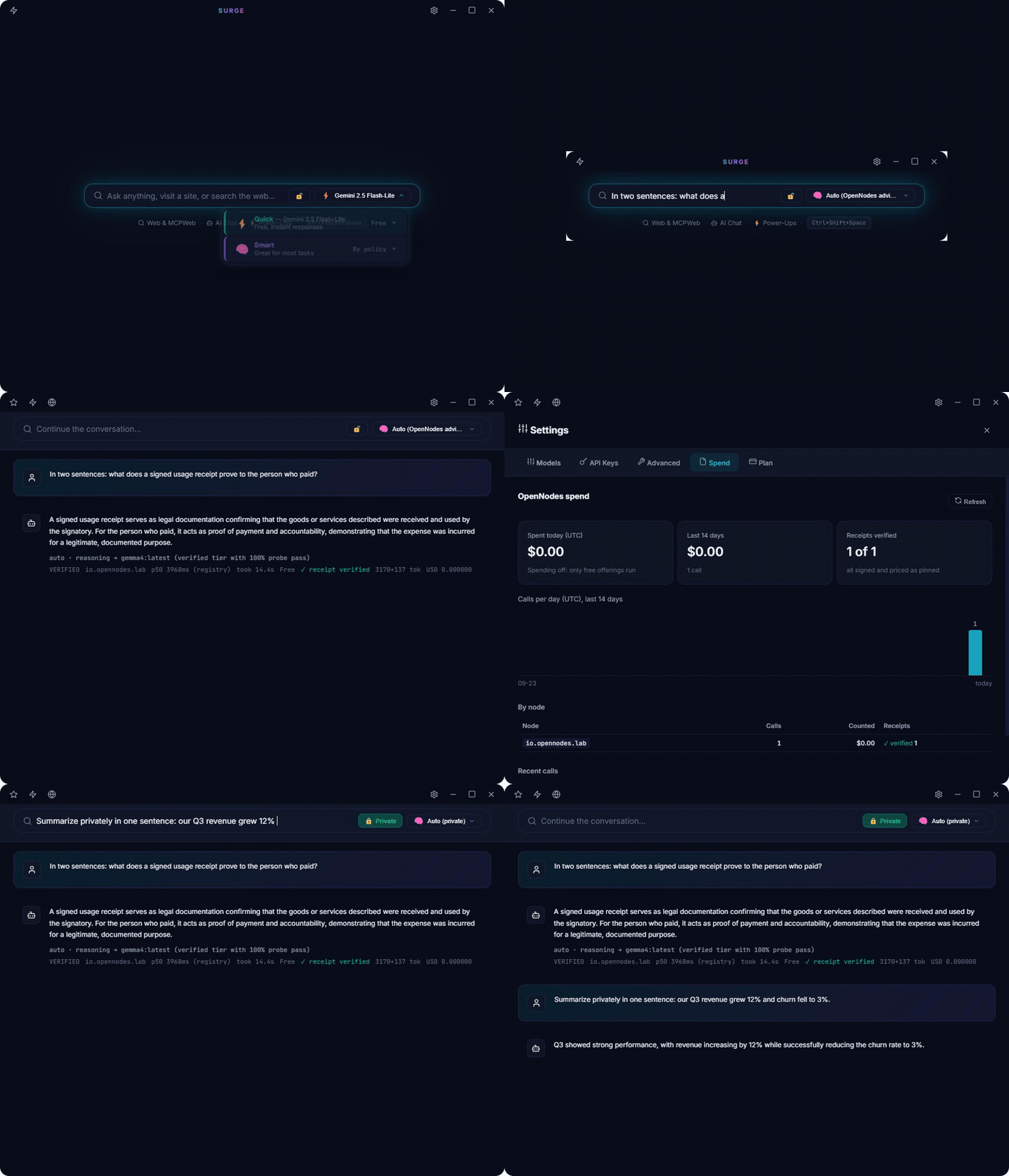
Surge (desktop client, pre-release — Windows installer; macOS and Linux build from source) — a desktop "browser for MCP" and the reference OpenNodes client: the model picker is fed live from the registry (trust tier, measured latency, price), Auto runs the advisor on your machine to pick a node per prompt, and every call is pinned to the node's card revision and comes back with a signed receipt Surge verifies. A spend policy is on from first launch, a dashboard keeps the ledger, and one click switches to private mode (local Ollama and LAN only). The first client to span both discovery layers (models via ONP, tools via MCP).
-
Your client here — ONP is an open standard; any client can implement discovery via ONP-3 and invocation via ONP-4. Open a PR to be listed.
Design principles
- Standardize the gap, reuse the rest. ONP defines only the Node Card, the Registry API, and thin profiles binding existing standards together. Invocation is OpenAI-compatible; payment is x402/prepaid; identity is domain-based with optional DIDs; tool access is MCP.
- Registry as a protocol, not a place. Like the MCP Registry, ONP specifies an OpenAPI interface any registry can implement. Anyone can run a registry; clients can query several; a root "meta-registry" is a bootstrap convenience, not an architectural requirement.
- Metadata is claims + attestations. Nodes self-report; registries and third-party attesters verify (liveness probes, conformance tests, benchmark attestations as Verifiable Credentials). Rank is computed by registries from declared, transparent components — ONP standardizes the signal format, not the ranking formula.
- Curated trust tiers, permissionless entry. Anyone can publish a Node Card and register (Community tier). Paid production traffic concentrates in Verified/Attested tiers — this is the lesson of Bittensor/Akash vs. OpenRouter/HF.
- The client is the orchestrator. Multi-node scenarios, MCP bridging, and WebMCP access are client-side composition over standard primitives — ONP specifies the primitives and a portable scenario format, not an orchestration runtime.





