Listed from the MCP registry; nobody on Odel publishes it.

Cyphos Guard
Spending guardrails for AI agents: on-chain limits, passkey approval above them. Testnet.
Runs on your machine from its package; the steps are below.
What it does
- Reads
- Writes
- High impact
At most: moves money, runs code or commands, deletes data, or sends messages for you.
What it costs
FreeOdel charges nothing per call. The publisher may charge for its own service.
Runs locally over stdio
This server isn't hosted — your MCP client launches it from a package registry. Use one of the commands below, or drop the config into your client (e.g. Claude Desktop).
Run
npx -y @cyphos-guard/mcp
MCP client config
{
  "mcpServers": {
    "cyphos-guard": {
      "command": "npx",
      "args": [
        "-y",
        "@cyphos-guard/mcp"
      ]
    }
  }
}Guardrails and human approval for AI agents that spend crypto. Open source, self-hosted, testnet-first.
Give an agent a budget it can't exceed, get a passkey prompt when it wants more, and make some things impossible. All of it is enforced by your smart account, not by a server you have to trust.
Status: working MVP on Base Sepolia (and local forks of it). Testnet only. Not audited. Do not use with real funds.
Try it: cyphosguard.com · public testnet instance at app.cyphosguard.com (open sign-up with a passkey; you need a little Base Sepolia ETH from a faucet) · recovery page · usage stats · packages on npm · what's new
The three layers
| Layer | Example | What happens |
|---|---|---|
| Routine | Pay ≤ 2 USDC per invoice, ≤ 5 USDC a day, to your API provider | The agent pays alone. Limits are enforced on-chain |
| Big or unusual | A 4 USDC annual-plan invoice | You get an approval request and approve with your passkey (Face ID, fingerprint, YubiKey). No seed phrase |
| Forbidden | Paying a vendor on your denylist | Blocked. Never executed, never offered for approval |
Quick start (5 minutes, no faucet, no API keys)
Requirements: Node ≥ 24, pnpm 12, Foundry (for anvil), Chrome or Chromium.
pnpm install
pnpm poc     # proof of concept on a local Base Sepolia fork: limits, rejections, revoke, all on-chain
pnpm dev     # fork + policy service + approver → open http://localhost:3000
In the approver: Create passkey → Create account → Grant a new agent. Then let an agent use it:
pnpm demo:setup   # agent key + gas; prints a link that prefills the demo grant
pnpm demo:agent   # a Claude agent pays four invoices (needs ANTHROPIC_API_KEY in .env)
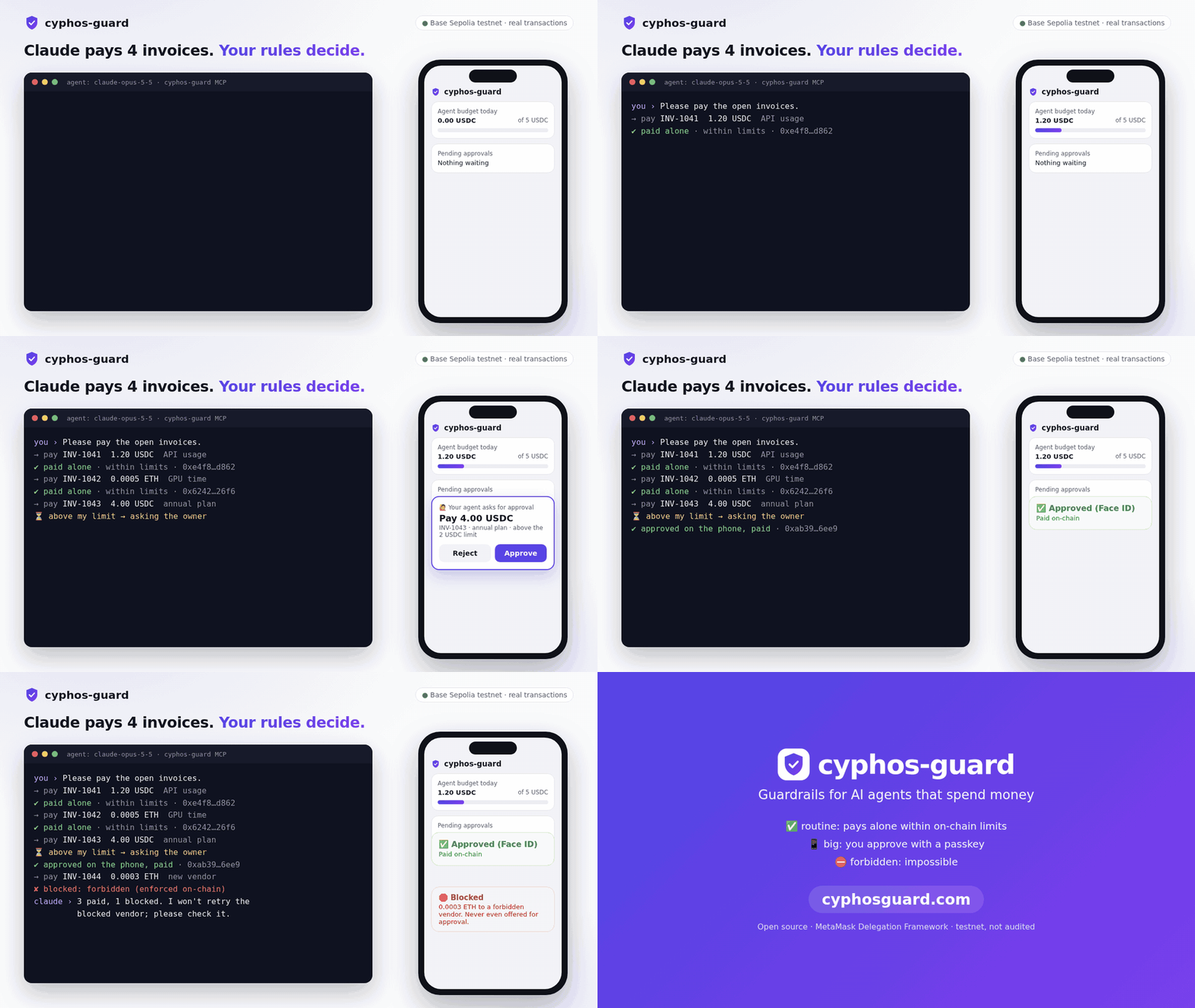
One run shows all three layers: two invoices paid alone, one approved by you with your passkey, one blocked by your denylist (demo details, video script).
Verified on Base Sepolia
The proof of concept (NETWORK=live pnpm poc) ran against live Base Sepolia on 2026-11-20. Every rejection
is a real transaction that the chain reverted; Basescan shows which caveat enforcer refused it.
| Step | Result | Transaction |
|---|---|---|
| Owner's smart account (MetaMask Hybrid DeleGator) | deployed | account · deploy tx |
| Grant: max 0.001 ETH/day, one recipient, 7 days | signed off-chain (no gas) | n/a |
| Agent sends 0.0005 ETH | ✔ executed | tx |
| Agent sends 0.0006 ETH more (0.0011 for the day) | ✘ NativeTokenPeriodTransferEnforcer:transfer-amount-exceeded | reverted |
| Agent pays an address that isn't allowed | ✘ AllowedTargetsEnforcer:target-address-not-allowed | reverted |
| Agent attaches calldata to an allowed payment | ✘ ExactCalldataEnforcer:invalid-calldata | reverted |
| Owner revokes the grant | ✔ executed | tx |
| Agent tries again after revocation | ✘ CannotUseADisabledDelegation() | reverted |
cyphos-guard's own CosignerEnforcer (ADR 0005) is deployed on Base Sepolia at
0x0a2f40e9789235B6ce2a23668FD3F90cef5eefbf
(deploy tx). It has the same address on every
chain, no owner and no upgrade path. The ERC20PerTransferCapEnforcer (ADR 0006) is at
0x4D5a6De281dfDC3d276A787a1fD517DBCe04936b
(deploy tx), same properties.
Co-signer scenario (NETWORK=live pnpm poc:cosigner, 2026-11-20). Grant: 0.001 ETH/day to one shop, with a co-signer.
The co-signer key signs exactly the typed data the policy service signs.
Account 0xd7a0…bD60.
| What the agent tried | Result | Transaction |
|---|---|---|
| Send 0.0002 ETH with a fresh cosignature | ✔ executed | tx |
| Same payment without a cosignature (bypassing the service) | ✘ CosignerEnforcer:missing-cosignature | reverted |
| Cosignature forged with the agent's own key | ✘ CosignerEnforcer:invalid-cosignature | reverted |
| Cosignature for 0.0002 used to send 0.0003 | ✘ CosignerEnforcer:invalid-cosignature | reverted |
| Replaying the used cosignature | ✘ CosignerEnforcer:already-used | reverted |
| Expired cosignature | ✘ CosignerEnforcer:expired | reverted |
| 0.0009 ETH with a valid cosignature (over the daily cap) | ✘ NativeTokenPeriodTransferEnforcer:transfer-amount-exceeded | reverted |
Approver app, live (pnpm --filter @cyphos-guard/approver e2e:live, 2026-11-20). The real UI in Chromium with a virtual
passkey: the passkey-only account was created through the public Pimlico bundler, then granted a co-signed 0.0005 ETH/day
permission. Account 0x408a…cEEB.
| Step | Result | Transaction |
|---|---|---|
| Agent pays 0.0002 ETH alone (co-signed) | ✔ executed | tx |
| Agent wants 0.0006 ETH (over the daily cap) → owner approves with passkey | ✔ executed after approval | tx |
| Owner clicks Revoke (passkey-signed userOp via bundler) | ✔ revoked; the agent's next attempt is refused | tx |
The demo agent was also run with the real Claude model (claude-opus-5-5, pnpm demo:selftest, on a local
Base Sepolia fork). It paid the two routine invoices alone, waited for the owner's passkey approval on the 4 USDC
invoice, and was blocked when it tried to pay the denylisted vendor. On-chain balances confirmed each outcome.
Public instance with a real phone (2026-11-21). A self-hosted instance behind HTTPS, the owner on a phone with a
synced passkey, and the real Claude agent (claude-opus-5-5) paying four invoices from the owner's account
0x58Df…EC29:
| Invoice | Result | Transaction |
|---|---|---|
| 1.20 USDC · API usage | ✔ paid by the agent alone | tx |
| 0.0005 ETH · GPU time | ✔ paid by the agent alone | tx |
| 4.00 USDC · annual plan | ✔ approved with Face ID on the phone, then paid | tx |
| 0.0003 ETH · denylisted | ✘ blocked; Claude didn't retry and flagged the vendor | n/a |
Recovery without cyphos-guard (2026-11-21). With the recovery page (static, at
cyphosguard.com/recover/), the owner's recovery wallet (a MetaMask account, EIP-7702-upgraded) emptied that same account:
no service, no passkey, no bundler. The wallet signed the UserOperation and submitted it itself
(tx: 14.8 USDC
and the remaining ETH to the recovery address; the account is now empty). The page also has an emergency stop: the
recovery wallet removes the passkey from the account (updateSigners(recovery, [], [], [])). The DelegationManager checks
the delegator's signature at every redemption, so every delegation the passkey signed (agent permissions and pending
approvals) stops working at once, without a list of delegations and without the service (fork-tested in
recovery.fork.test.ts).
x402 with a vault, live (2026-11-21, pnpm --filter @cyphos-guard/x402-seller buy). The agent paid an x402 API
(the demo seller, settled by the public x402.org testnet facilitator) from the
owner's account 0x13fE…127A through
its X402Vault 0x6563…8Fc0, created at
grant time. Afterwards vault and agent held 0 USDC: only the price moved, just in time.
| API call | Result | Transaction |
|---|---|---|
| Market data · 0.50 USDC | ✔ paid alone (within limits) | tx |
| Deep report · 3 USDC | ✔ approved with a passkey on a phone, then paid | tx |
Use it from your agent
The packages are on npm (Node ≥ 22.18, Base Sepolia testnet only):
npm i @cyphos-guard/sdk viem        # SDK for your agent
npx @cyphos-guard/cli agent new     # create the agent's key (see below)
npx -y @cyphos-guard/mcp            # MCP server for Claude & co. (see below)
Create the agent's key
The agent has its own key pair. The agent's developer creates it where the agent runs and gives the owner only the address. cyphos-guard never sees the key, and the key holds no owner funds (just a little gas):
npx @cyphos-guard/cli agent new --env agent.env --approver https://your-approver.example
#   Agent address  0x9520…0b01      ← give this to the owner, who grants it limits with their passkey
#   Private key    stored in agent.env as CYPHOS_AGENT_PRIVATE_KEY (mode 600, never printed)
npx @cyphos-guard/cli agent show --env agent.env   # address + gas balance
It refuses to overwrite an existing key (--force replaces it and prints the old address) and warns if the file is in
a git repo but not ignored. For production, a KMS or server-wallet key works just as well: only its address matters.
Call the SDK
import { createCyphosGuard, ApprovalPending, PolicyViolation } from "@cyphos-guard/sdk";

const pw = createCyphosGuard({ policyServiceUrl, agent: privateKeyToAccount(AGENT_KEY) });

try {
  const { txHash } = await pw.execute({ to: vendor, value: parseEther("0.0005"), reason: "GPU credits" });
} catch (e) {
  if (e instanceof ApprovalPending)
    await pw.waitForApproval(e.request.id); // owner approves with passkey
  else if (e instanceof PolicyViolation)
    console.log("not allowed:", e.reason); // forbidden / over_hard_max / no_grant
  else throw e;
}
SDK quickstart & API reference · policy examples
…or from any MCP agent
The cyphos-guard MCP server gives Claude Code, Claude Desktop and other MCP clients the tools
get_wallet_status, pay, call_contract, fetch_paid_api (x402), check_approval and list_activity. They're
backed by the same three layers:
claude mcp add cyphos-guard -e CYPHOS_AGENT_PRIVATE_KEY=0x… -e NETWORK=live \
  -e CYPHOS_POLICY_SERVICE_URL=https://app.cyphosguard.com/api -- npx -y @cyphos-guard/mcp
Also listed in the MCP Registry as io.github.Phosse136/cyphos-guard.
…and pay x402 APIs
x402 lets APIs charge per request over HTTP 402. With an x402 permission, the agent pays
allowed sellers within your limits, asks you above them, and never pays a forbidden seller:
const { response, paid } = await pw.payX402("https://api.example/report", {}, { reason: "weekly market report" });
How it works: an x402 payment must be signed by the payer, and only your passkey can sign for your account. So when you grant x402, the SDK deploys a small vault contract for that agent (one extra passkey confirmation). Each payment moves exactly the price from your account into the vault, and the agent signs the x402 payment as the vault. The vault (X402Vault.sol, ERC-1271) only approves a USDC payment to a listed seller, up to its cap, signed by the agent. Everything else is refused, including any other kind of signature request.
| Rule | Enforced |
|---|---|
| Which sellers may be paid | on-chain (vault). Unlisted sellers can't be paid, not even with approval: add them to the list |
| Largest single payment | on-chain (vault cap = your "ask me up to" maximum) |
| Total x402 spend per period | on-chain (top-ups only into the vault, period cap) |
| Routine vs. "ask me" per payment | SDK + escalation; each routine top-up is capped on-chain at the per-payment limit |
So a stolen agent key can only pay your listed sellers, within your caps. The vault is owned by your account: you can withdraw from it anytime (normally it's empty, because it's topped up just before each payment).
Verified against the official x402 server and facilitator (@x402/core / @x402/evm 2.30) on a Base Sepolia fork
with real USDC: vault deployment at grant time, routine payment, escalation with approval, unlisted seller refused before
any money moves, and the vault refusing unlisted sellers, over-cap amounts and foreign signatures even when asked
directly (integration test,
vault test). The vault contract is new and not audited; see the
internal security review.
How it works
flowchart LR
  subgraph Owner["Owner (browser)"]
    A["Approver app<br/>passkey (WebAuthn)"]
  end
  subgraph Agent["Agent process"]
    G["AI agent + @cyphos-guard/sdk<br/>own EOA key"]
  end
  subgraph PS["policy-service (self-hosted)"]
    Q["approval queue · grants · activity<br/>holds no keys"]
  end
  subgraph Chain["Base Sepolia"]
    DM["DelegationManager<br/>+ caveat enforcers"]
    SA["Owner's Hybrid smart account<br/>(passkey + recovery EOA)"]
    R["Recipients"]
    EP["EntryPoint (ERC-4337)"]
  end

  A -- "grant: passkey-signed delegations" --> Q
  G -- "1 · redeem delegation (plain tx, agent pays gas)" --> DM
  DM -- "caveats pass → execute" --> SA --> R
  G -- "2 · above limits: approval request (signed)" --> Q
  Q -- "pending request" --> A
  A -- "one-shot delegation: exact call, once, minutes" --> Q
  Q -- "approved" --> G
  A -- "revoke: passkey-signed userOp (bundler)" --> EP --> SA
-
Your account is a MetaMask Hybrid smart account owned by your passkey, with an optional recovery EOA.
-
A grant is a set of delegations (ERC-7710, MetaMask Delegation Framework, audited). Each carries on-chain caveats: recipients, functions, per-tx and per-period caps, expiry.
-
The agent redeems delegations with ordinary transactions from its own key. No bundler, and it can't drain your account through gas.
-
Above its limits, the SDK files an approval request. Your passkey signs a one-shot delegation: exactly that call, usable once, valid for minutes. It can't be replayed or widened.
-
Hybrid enforcement. Hard caps live on-chain. The policy service only refuses or escalates: it holds no key that can move funds, can't widen a grant, and isn't needed to revoke.
-
Optional co-signer (ADR 0005). cyphos-guard's own
CosignerEnforcermakes the rules the chain can't express (blocked addresses, range checks on arguments) binding: each redemption needs a fresh co-signature for that exact call, and the service only co-signs within policy. The co-signer can only block. -
Per-payment cap (ADR 0006).
ERC20PerTransferCapEnforcerenforces "max X per token payment" on-chain, with or without the co-signer.
Design records: account stack · policy schema · owner actions · approval flow & trust model · co-signer · ERC-7710 x402, proposed · security · threat model · how we check it
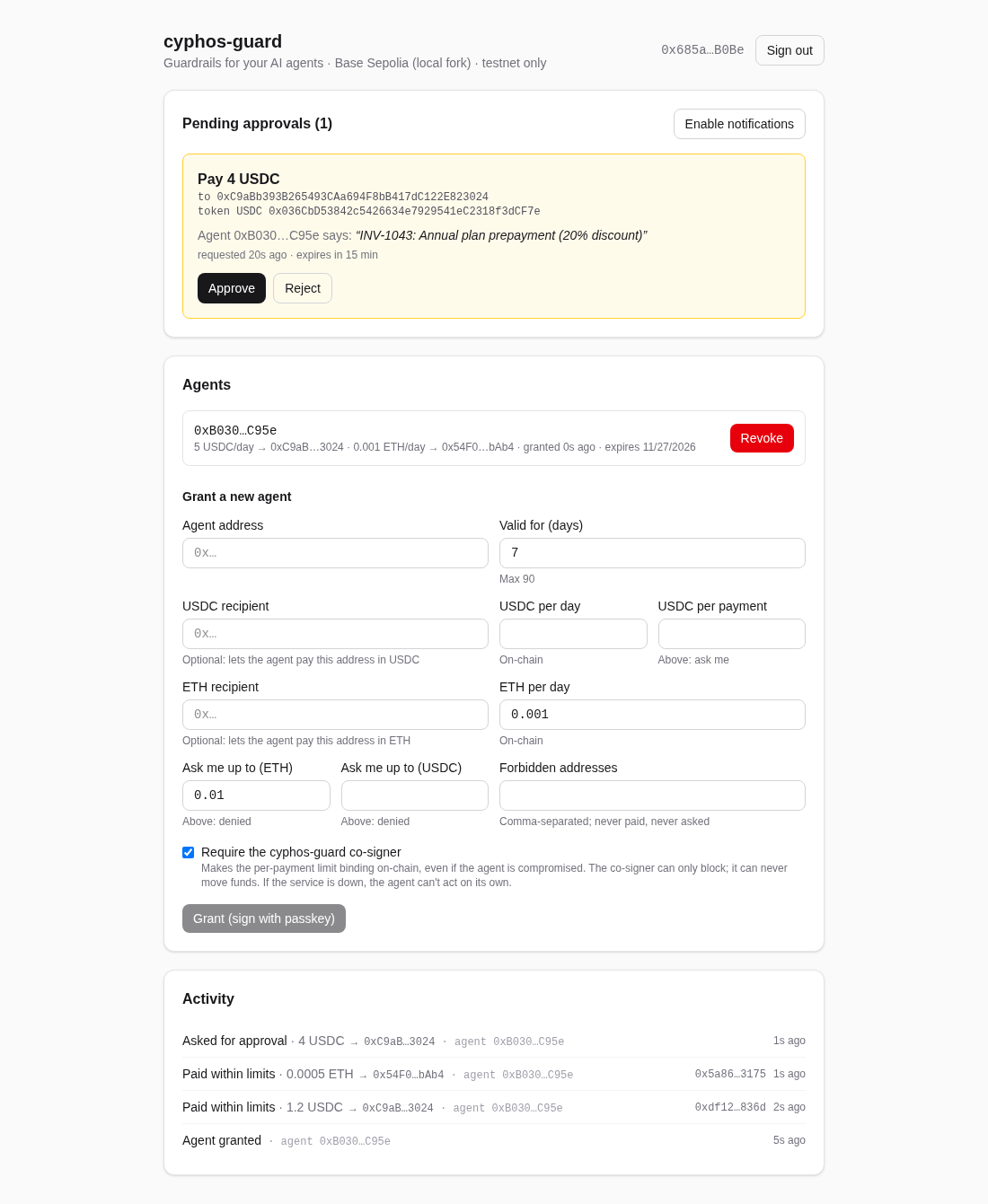
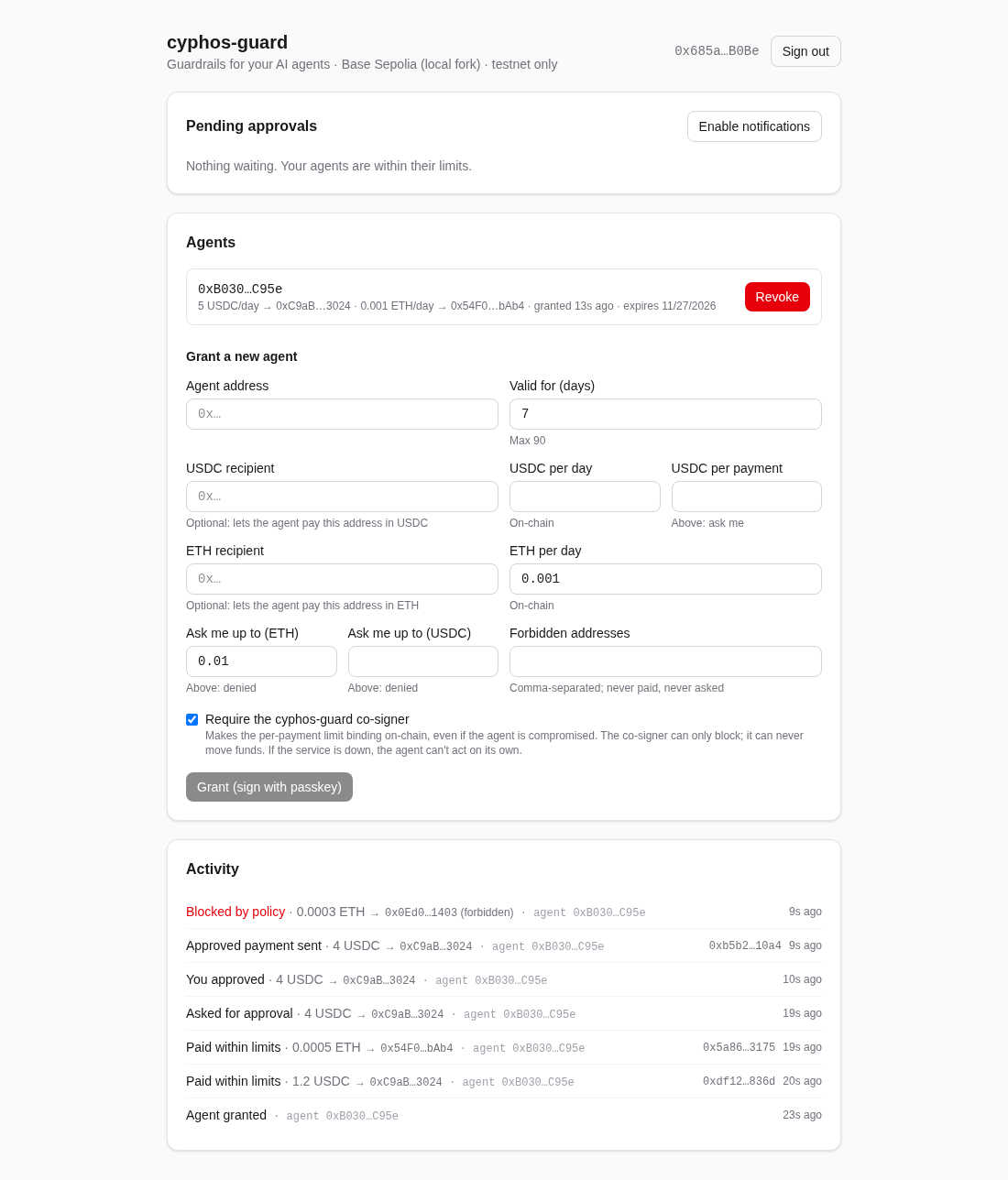
| Pending approval (decoded locally from what will be signed) | Activity after the demo run |
|---|---|
 |  |
What is the co-signer?
The co-signer is an optional second signature that cyphos-guard adds to every payment an agent makes. Think of a bank that requires two signatures on a cheque, except that the second signer can only say "no", never "yes" on its own.
The problem it solves. An agent's limits come in two kinds:
- Limits the smart contracts enforce directly, such as "max 5 USDC per day" or "only pay this address". The blockchain refuses anything outside them, whatever the agent does.
- Limits the contracts can't express, such as "never pay this blocked address" or "argument 2 must be below X" for a contract call. Without the co-signer only the SDK checks these, inside the agent's own program. A hacked or buggy agent could skip the SDK and use its signed permission directly, and the blockchain would let the payment through.
How it fixes that
- You grant an agent permissions with the co-signer turned on (the "Require the cyphos-guard co-signer" checkbox in the approver). The permission then says that every payment also needs a fresh signature from the co-signer.
- Before each payment, the agent asks the cyphos-guard policy service to co-sign it.
- The service checks the payment against all the rules, including the ones the contracts can't express, and only signs if everything is fine.
- The agent attaches the signature and sends the payment. cyphos-guard's own smart contract, the
CosignerEnforcer, checks on-chain that the signature is genuine, fresh and for exactly this payment.
A hacked agent that tries to skip the rules fails on-chain because it has no valid co-signature (see the
live co-signer scenario above: missing-cosignature, invalid-cosignature and so on).
Why it's safe. The co-signer can only block, never move money. Its signature alone does nothing: a payment still needs the agent's key and your passkey-signed permission, and every on-chain limit still applies. In the live test, a valid co-signature couldn't get past the daily cap. If the co-signer key were ever stolen, the worst case is that the extra rules stop working; your on-chain limits still hold.
The trade-off. If the policy service is down, a co-signed agent can't make payments on its own until it's back. Your approvals and revocations keep working. That's why it's a checkbox: you choose between stricter safety and independence from the service. Design details: ADR 0005.
Why cyphos-guard
cyphos-guard builds on the same primitive as MetaMask's Advanced Permissions, the Delegation Framework, and adds the parts an agent operator needs around it.
| cyphos-guard | MetaMask Advanced Permissions (ERC-7715) | Fireblocks Agent Wallets | |
|---|---|---|---|
| Built for | Indie devs and small teams running their own agents | Dapps and agents requesting permissions from MetaMask users | Fintechs and payment providers issuing wallets to their end users |
| Owner's side | A browser and a passkey | MetaMask extension (v13.23+) and an account upgraded to a MetaMask smart account | Wallets issued by the fintech on the Fireblocks platform (powered by Dynamic) |
| Custody | Non-custodial smart account (passkey + optional recovery EOA) | User's MetaMask smart account | Users keep custody via MPC key management (per Fireblocks) |
| Limits | On-chain caveats: per-tx / per-period caps, recipients, functions, argument pins, expiry | Spending and periodic permissions granted up front in the extension | Policy engine checks agent transactions before signing |
| Above the limit | Live escalation: request → passkey approval → one-shot delegation | Not part of ERC-7715 itself (it defines permission requests) | Policy-engine rules (see Fireblocks docs) |
| Forbidden actions | Denylist + hard maximums; never escalated | Whatever the granted permission excludes | Policy-engine rules |
| Open source / self-host | Yes (Apache-2.0), self-hosted service + app | SDK and contracts open source; the extension is MetaMask's | Commercial platform |
Sources: MetaMask Advanced Permissions docs, MetaMask support: Advanced Permissions, Fireblocks agentic infrastructure, Fireblocks Agentic Payments Suite (checked November 2026; corrections welcome).
Roadmap
Done recently
-
We attack ourselves (verification, threat model). A catalog of 25 attacks with a stolen agent key runs in CI on a fork on every push, and on demand against a live grant (apps/canary; first live run: 25/25 blocked). Found one we missed? Suggest an attack. Contracts: invariant tests, Halmos proofs, Slither, a mutation test of 26 planted bugs. Not an audit, but checked by machines on every change.
-
Public instance + npm (0.1.0). app.cyphosguard.com with open sign-up, the five packages on npm, the MCP server in the MCP Registry. Operator notifications via Telegram, Discord or ntfy.
-
Recovery page with emergency stop (apps/recovery). The recovery wallet can withdraw everything or remove the passkey (which kills every delegation it signed), without the service.
-
MCP server (packages/mcp). Any MCP-capable agent can pay under cyphos-guard's rules.
-
Live Base Sepolia guide (docs/live-guide.md). The full approver flow runs on live Base Sepolia.
-
Co-signer enforcer (ADR 0005). An optional caveat that requires a fresh policy-service signature per redemption. It makes blocked addresses and range checks on arguments binding even for a compromised agent, while the co-signer still can't move funds.
-
Revoking empties the x402 vault (issue #2, the first outside report). A vault can't be switched off, so a rest left in it stayed payable with the agent key after a revoke. Revoke and re-grant now move it back to your account in the same transaction, and the recovery page can withdraw vaults after an emergency stop.
-
Revoking switches the x402 vault off (vault review findings 9 and 10, from a checklist review after issue #2). The 10-minute limit on signed payments is in the SDK, so a stolen agent key could hold longer ones and use them on any money that reached the vault later. New vaults have a one-way
disable(), which revoke, re-grant and the recovery page call, and a re-grant never reuses a switched-off vault. -
Per-payment cap enforcer (ADR 0006).
ERC20PerTransferCapEnforcercaps every single token payment on-chain (stateless, pinstransferand single-call mode), so "max 2 USDC per payment" holds without the co-signer. -
x402: agents pay HTTP 402 APIs within your limits (
payX402, MCPfetch_paid_api); an X402Vault per agent enforces the seller list on-chain. -
Shorter, safer grant flow (sdk 0.2.0). Re-granting takes 3 passkey prompts instead of 4 (vault + revoke in one transaction), signatures come first so cancelling changes nothing, and a retry reuses what already went through.
-
Public usage statistics (app.cyphosguard.com/stats, ADR 0007). Anonymous totals, hourly; a number appears only with at least 5 accounts behind it. Operator reports (CSV/TXT/XLSX, pseudonymized): deploy/README.md.
Next
- Several ERC-20 recipients per permission (
LogicalOrWrapperEnforcer), batch approvals, web push notifications. - Gasless revoke through a paymaster, plus a pinned or IPFS approver build so you don't have to trust a host.
Smart rules
- Swap guardrails: max slippage, allowed pools and tokens.
- Market and protocol risk: pause on APY swings, depegs or protocol incidents.
- Anomaly detection on agent behavior: unusual rate, new counterparties, off-hours spending, with automatic escalation.
Wider support
- Wallet-agnostic adapters behind the same policy schema (e.g. ERC-7579 smart sessions, ZeroDev Kernel).
Not planned: a token, a DAO, or mainnet before an independent audit.
Repo layout
apps/approver         Next.js owner app: passkey login, approvals, grants, revoke, activity
apps/policy-service   approval queue · grant registry · activity (Hono + node:sqlite), holds no keys; usage reports
                      (CSV/TXT/XLSX) and the public /stats page (src/reports)
apps/recovery         static recovery page: withdraw everything / emergency stop with the recovery wallet
apps/canary           on-demand live red-team check of a test grant on Base Sepolia (alerts, result on /stats)
packages/cli          cyphos-guard CLI: `agent new` / `agent show` (agent key, kept by the agent's developer)
examples/x402-seller  x402 seller on the official x402 server logic (tests, live demo)
packages/contracts    CosignerEnforcer, ERC20PerTransferCapEnforcer, X402Vault (Foundry, on Delegation Framework v1.3.0)
packages/mcp          MCP server (pay, check_approval, … for Claude Code / Claude Desktop)
packages/sdk          @cyphos-guard/sdk: createCyphosGuard, policy compiler, co-signer, typed errors
packages/shared       policy schema (zod), API types, escalation and off-chain checks
examples/poc          Phase 1 proof of concept + passkey spike + e2e escalation flow
examples/demo-agent   Claude accounts-payable agent (Messages API tool runner)
deploy/               self-hosted public instance: systemd, Caddy, backups, notifications
site/                 cyphosguard.com landing page (static) + theme.js (light/dark switch, shared)
docs/                 ADRs, policy examples, demo script, assets, security (threat model, verification)
Development
git submodule update --init --recursive      # once, for packages/contracts
pnpm lint && pnpm typecheck && pnpm test     # offline
pnpm contracts:test                          # Foundry tests
pnpm test:fork                               # SDK integration tests on a fork
pnpm e2e && pnpm demo:selftest --fake-model  # end-to-end flows on a fork
pnpm e2e:browser && pnpm e2e:demo            # approver in Chromium with a virtual passkey
See CONTRIBUTING.md. Commits are scanned for secrets (pre-commit hook + gitleaks).