PipRail
Budget-bound x402 payment wallet for AI agents — pays HTTP 402 URLs, capped locally. No backend.
Runs on your machine from its package; the steps are below.
What it does
- Reads
- Writes
- High impact
At most: moves money, runs code or commands, deletes data, or sends messages for you.
What it costs
FreeOdel charges nothing per call. The publisher may charge for its own service.
Runs locally over stdio
This server isn't hosted — your MCP client launches it from a package registry. Use one of the commands below, or drop the config into your client (e.g. Claude Desktop).
Run
npx -y @piprail/mcp
MCP client config
{
  "mcpServers": {
    "piprail": {
      "command": "npx",
      "args": [
        "-y",
        "@piprail/mcp"
      ]
    }
  }
}








Let any HTTP endpoint charge for itself, and any agent pay for itself — across every major chain, in a couple of lines.
Website · Documentation · npm
PipRail implements the open x402 "402 Payment Required" standard with no backend, no database, no account, no API key, and no fee. Payments settle straight into your wallet, verified locally against your own RPC — across every major EVM chain plus Solana, TON, Tron, NEAR, Sui, Aptos, Algorand, Stellar & the XRP Ledger. Self-custodial throughout.
How a payment moves
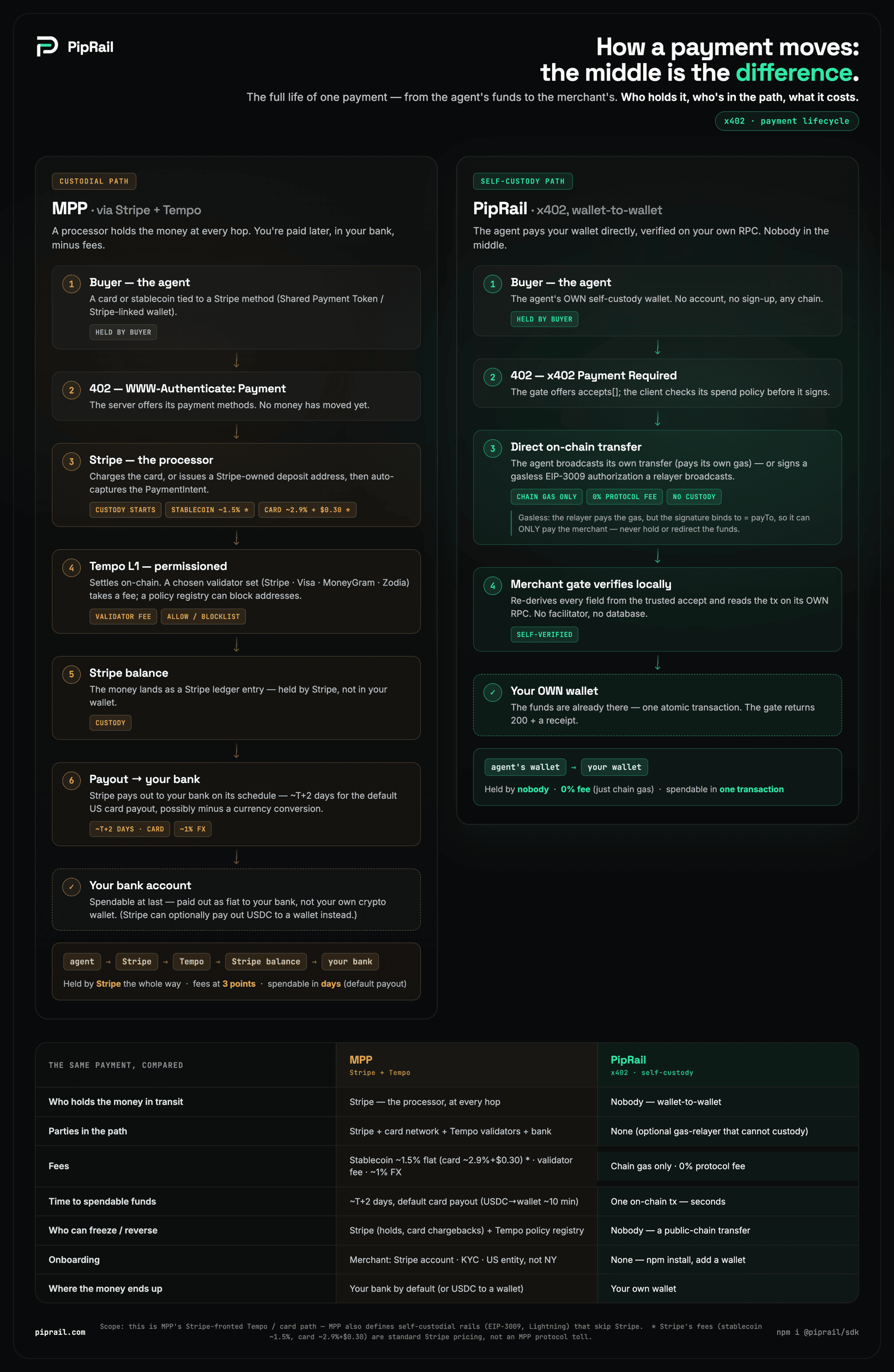
The middle is the difference. A traditional processor holds the money in transit, takes days to release it, and can freeze or reverse it. PipRail removes the middle entirely — the agent pays the merchant's wallet directly, the merchant verifies it locally against their own RPC, and it settles in one transaction at 0% fee, self-custodial end to end. See it on piprail.com →
📊 The pitch deck
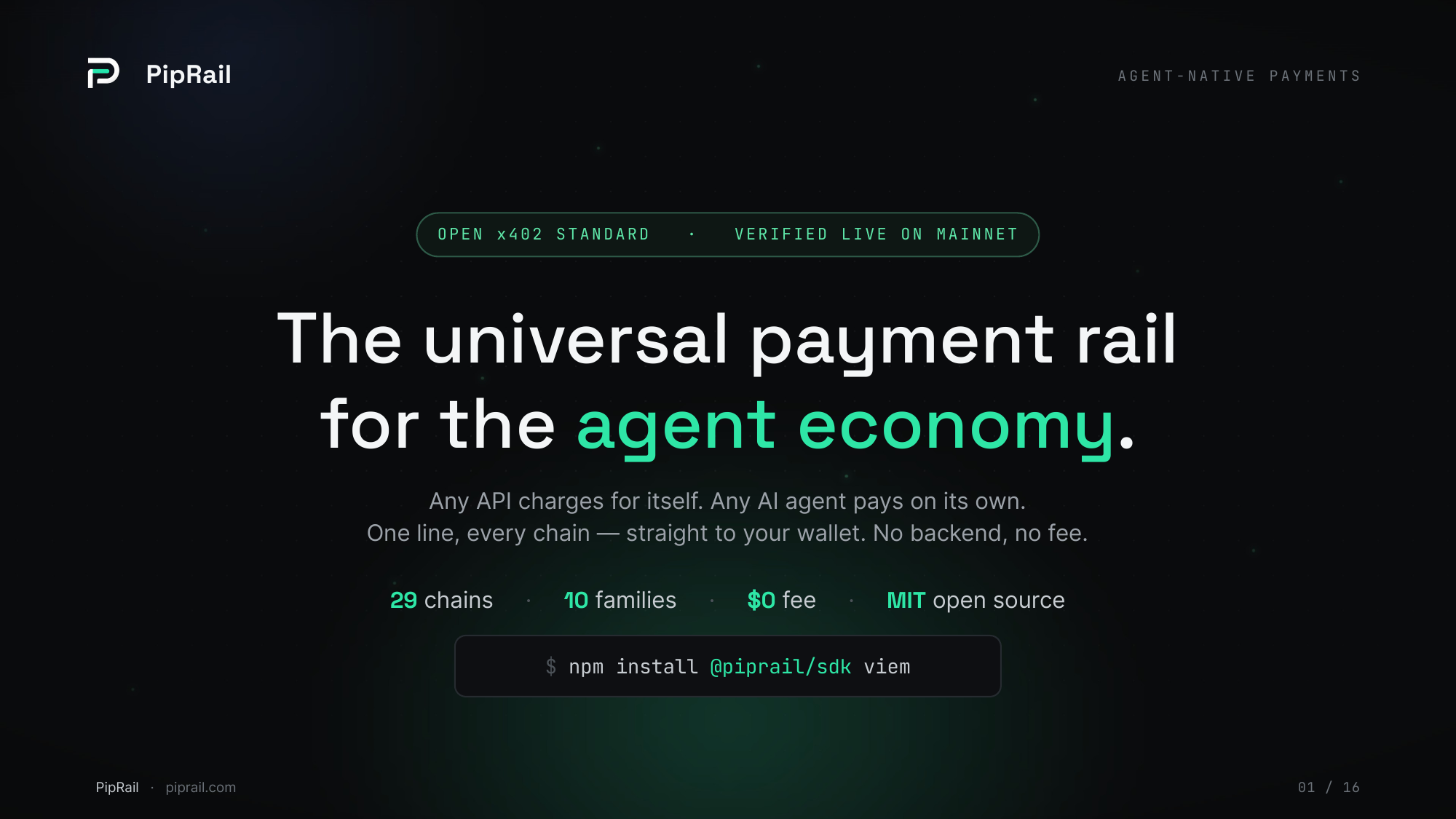
▶︎ Open the full deck — PDF ◀︎
Opens right here in your browser — no download, GitHub renders it inline. 16 slides · every stat sourced in the speaker notes.
The whole thesis in one read: why agent payments are happening now, why chain & token fragmentation is the enemy, and how a single chain: parameter turns PipRail into the universal adapter. The payment path is 0% forever — the moat and the distribution; value accrues to the layer around the free rail, never the rail itself.
What's inside — the 16-slide arc
| # | Slide | # | Slide |
|---|---|---|---|
| 1 | Hero — the universal payment rail for the agent economy | 9 | The MCP — give your agent a budget-bound wallet |
| 2 | Why now — money is moving on-chain | 10 | Open · dual-rail · gasless |
| 3 | The new buyer — autonomous agents | 11 | MPP vs PipRail — count the middlemen |
| 4 | The standard — x402, "402 Payment Required" | 12 | Discovery + integrations |
| 5 | The problem — chain & token fragmentation | 13 | Why PipRail wins — the moat |
| 6 | The reveal — the universal adapter | 14 | Traction |
| 7 | How it works — 402 → pay → verify → 200 | 15 | Business model — open core, 0% rail |
| 8 | Two sides, one SDK — accept and pay | 16 | The ask |
Source .pptx (fully editable, brand fonts embedded) lives in .claude/skills/branding/design/deck/. The root PipRail-deck.pdf is regenerated from it — don't hand-edit the PDF.
📖 Full documentation → docs.piprail.com
The single, searchable source of truth — every function, option, chain, and example. This README is just the front door.
What's here
@piprail/sdk | The TypeScript SDK — accept & make x402 payments. The product. Optionally swaps tokens where an open, keyless route exists (no fee, no API key, never automatic). |
@piprail/mcp | An MCP server giving any AI agent a budget-bound wallet (io.github.piprail/mcp). |
@piprail/create | npm create @piprail — scaffolds a runnable, mainnet-by-default x402 merchant in one command. Paste a public address; no key, no backend. |
integrations/ | First-party agent-framework integrations — OpenClaw, Hermes, elizaOS (@piprail/elizaos-plugin), n8n (@piprail/n8n-nodes-piprail) & Mastra. Each wraps @piprail/sdk or @piprail/mcp; nothing new to build. |
site/ · docs/ · examples/ | piprail.com · the docs.piprail.com source · runnable demos. |
Quick taste
npm install @piprail/sdk viem
import { requirePayment } from '@piprail/sdk'

app.get('/report',
  requirePayment({ chain: 'base', token: 'USDC', amount: '0.05', payTo: '0xYourWallet…' }),
  (_req, res) => res.json({ report: 'TOP SECRET' }),
)
That route now costs 0.05 USDC on Base, paid straight to your wallet. Point an agent at it and it pays itself — name any chain with a single chain: parameter. The full quickstart, every chain, the MCP server, spend controls, and the error model are in the docs.
Documentation & links
- docs.piprail.com — the complete manual (source of truth)
- MCP server · Discovery · Supported chains
- Integrations — drop PipRail into agent frameworks: OpenClaw, Hermes, elizaOS, n8n & Mastra (more coming)
- Runnable examples — merchant + agent demos, a live Anvil end-to-end, and the
why-402teardown - Releasing (tag-driven CI) · Contributing (DCO)
Spread the word
PipRail is free, open-source, and has no backend to sell you — so word of mouth is how it grows. If it saved you from building a payments backend, the best way to give back is to help other developers (and their agents) find it:
- ⭐ Star PipRail on GitHub — the #1 way to help others discover it
- 𝕏 Follow @piprailhq — new chains, ship logs, and agent-payment tips
- 🌐 piprail.com · 📖 docs.piprail.com
License & trademark
Code: MIT — use it, fork it, ship it, commercially or otherwise.
Name & brand: PipRail™, the logo, and the @piprail npm scope are trademarks of the PipRail project — MIT covers the code, not the name. Build on it freely; just don't call a fork "PipRail" or imply it's official. See TRADEMARK.md.