PG1 Sovereign Threat Intelligence
Threat intel for AI agents: IOCs, CVEs (EPSS/KEV), wallet sanctions and age, domain and URL checks.
One address for any MCP client. No sign-in needed on this server.
What it does
14 read2 act
Grouped by tool name. At most: creates or changes data: records, files, settings.
What it costs
FreeOdel charges nothing per call. The publisher may charge for its own service.
Tools
16 · grouped by tool name · checked 11 Oct 2026Read · 14Look things up
- get_threat_indicators
- get_cve_details
- get_ioc_context
- get_cve_batch
- get_ioc_batch
- get_threat_actor_profile
- get_cve_by_product
- get_usage_status
- check_wallet_sanctions
- check_domain_age
- check_hostname_reputation
- check_wallet_age
- check_ip_abuse
- check_package
Act · 2Change something
- subscribe_alerts
- submit_indicator
PG1 Sovereign Threat Intelligence API
Threat intelligence API and MCP server for AI agents and security tooling.
License keys: new sales are temporarily paused while data licensing is finalised. The free tier and x402 remain available.
Two Ways to Connect
/api/ioc— simple REST GET, returns the STIX 2.1 indicator feed directly. Best for scripts, curl, and simple integrations./api/mcp— full Model Context Protocol server, 14 tools (CVE lookups, batch operations, threat actor dossiers, wallet sanctions screening, domain age, hostname/phishing reputation, wallet age/history, and more). Best for Claude, MCP-compatible agents, and any client speaking the MCP standard.
Discovery: /llms.txt (llmstxt.org format, for AI agents/crawlers) and /openapi.json (OpenAPI 3.1 spec for /api/ioc and /api/health).
Opt-in: /api/ioc/context?value=<indicator> — a REST mirror of the get_ioc_context MCP tool, disabled by default. The operator must set ENABLE_REST_IOC_CONTEXT=true for this route to respond; otherwise it returns 404 {"error":"not available"}. Not listed in x402 Bazaar/discovery metadata.
Both accept the same Gumroad license key via the x-api-key header, or per-call x402 micropayments ($0.01/call) via the PAYMENT-SIGNATURE header (x402 v2).
Free Tier (5 calls/day)
The free tier is opt-in — add x-free-tier: 1 to your request header. Without it, a request with no license key and no payment header returns 402 Payment Required by default.
curl -X GET "https://pg1-ai-agent.vercel.app/api/ioc" \
  -H "x-free-tier: 1"
Optional query parameters: ?since=<ISO timestamp>, ?type=<IPv4|domain|URL|FileHash-MD5|FileHash-SHA1|FileHash-SHA256>, ?min_score=<0-100>, ?limit=<1-1000>
Note on confidence scores: indicator confidence currently defaults to a fixed value of 50 whenever the source record has no confidence_score — it is not yet a computed/weighted score for those records.
Exception: get_ioc_context and get_ioc_batch (the pre-action safety-check tools) are always free when the result is found: false — no x-free-tier header needed for those specific "nothing on record" responses. The header is only required for the general free tier.
Paying for MCP Tool Calls (x402 v2)
/api/mcp follows the x402 v2 MCP transport spec for paid tools/call requests, so a payment can be attached either as an MCP-native field or as an HTTP header — whichever your client library supports:
-
params._meta["x402/payment"](recommended for MCP clients, e.g.@x402/mcp) — attach the signed x402 v2PaymentPayloadobject directly to the JSON-RPC request:jsonc{ "jsonrpc": "2.0", "id": 1, "method": "tools/call", "params": { "name": "get_cve_details", "arguments": { "cve_id": "CVE-2021-44228" }, "_meta": { "x402/payment": { "x402Version": 2, "scheme": "exact", "network": "eip155:8453", "accepted": { /* … */ }, "payload": { /* … */ } } } } } -
PAYMENT-SIGNATUREheader (orX-Payment) — the same signed payload, base64-encoded, attached at the HTTP transport level instead of inside the JSON-RPC request. This is how non-MCP-aware HTTP clients pay.
If both are present on the same request, _meta wins.
Unpaid calls don't get an HTTP 402. A tools/call for a paid tool with no license key, no free tier, and no payment returns a normal 200 OK JSON-RPC result shaped as an MCP tool error:
{
  "jsonrpc": "2.0",
  "id": 1,
  "result": {
    "isError": true,
    "structuredContent": { "x402Version": 2, "error": "Payment required", "resource": { /* … */ }, "accepts": [ /* … */ ] },
    "content": [{ "type": "text", "text": "{\"x402Version\":2,...}" }]
  }
}
The same object is also sent, base64-encoded, in the PAYMENT-REQUIRED response header for backward compatibility with clients that only read headers. A verification or settlement failure returns this exact same shape (still 200 OK, isError: true), with structuredContent.error describing what went wrong.
On a successful payment, the tool result carries the facilitator's settlement receipt in result._meta["x402/payment-response"], and the PAYMENT-RESPONSE header is set as before.
Installation & Connection (MCP Clients)
To connect your autonomous agent to the PG1 API, pass your Gumroad license key in the connection request.
Option 1: Via Smithery CLI
Run this command in your terminal, replacing the placeholder with your active key:
smithery mcp add --transport http --id pg1-threat-intel https://pg1-ai-agent.vercel.app/api/mcp --header "x-api-key: YOUR_GUMROAD_LICENSE_KEY"
Option 2: Free-tier test via curl (no key needed)
curl -X POST https://pg1-ai-agent.vercel.app/api/mcp \
  -H "Content-Type: application/json" \
  -H "Accept: application/json, text/event-stream" \
  -H "x-free-tier: 1" \
  -d '{
    "jsonrpc": "2.0",
    "id": 1,
    "method": "tools/call",
    "params": {
      "name": "get_cve_details",
      "arguments": { "cve_id": "CVE-2021-44228" }
    }
  }'
All Available MCP Tools
Call "method": "tools/list" against /api/mcp for full schemas. Summary:
| Tool | Purpose | Source(s) | Free tier applies? |
|---|---|---|---|
get_threat_indicators | Bulk STIX 2.1 indicator feed | OTX, NVD | Yes (needs x-free-tier: 1) |
get_ioc_context | Single-indicator safety check | OTX | Always free if not found |
get_ioc_batch | Up to 20 indicators per call | OTX | Always free if none found |
get_cve_details | CVE lookup enriched with NVD, EPSS, CISA KEV | NVD, FIRST.org EPSS, CISA KEV | Yes (needs x-free-tier: 1) |
get_cve_batch | Up to 20 CVE IDs per call | NVD, FIRST.org EPSS, CISA KEV | Yes (needs x-free-tier: 1) |
get_cve_by_product | Discover CVEs by vendor/product | NVD | Yes (needs x-free-tier: 1) |
get_threat_actor_profile | APT/threat actor dossiers with MITRE ATT&CK | MITRE ATT&CK Enterprise | Yes (needs x-free-tier: 1) |
get_usage_status | Check your remaining free-tier quota | — | Always free, no header needed |
subscribe_alerts | Register a webhook for new matching indicators | — | No — license key required |
submit_indicator | Contribute an observed indicator for review | — | No — license key required |
check_wallet_sanctions | Screen a wallet address against sanctions | OFAC SDN List (US Treasury), synced daily | Always free (120 calls/hour without a licence key) |
check_domain_age | Domain registration age via RDAP | RDAP (per-TLD server, resolved via the IANA bootstrap registry) | Always free |
check_hostname_reputation | Screen a hostname for phishing/lookalike domains | MetaMask eth-phishing-detect, synced daily | Always free (60 calls/hour without a licence key) |
check_wallet_age | When an EVM address first appeared on a chain, via on-chain transfer history | On-chain transfer history (per-chain) | Always free (60 calls/hour without a licence key) |
check_ip_abuse | Abuse confidence score and report counts for one public IP, with your own AbuseIPDB key | AbuseIPDB, live, with the key you send in X-AbuseIPDB-Key | No PG1 charge; uses your own AbuseIPDB quota (60 calls/hour without a licence key). See Bring your own AbuseIPDB key |
Important wording caveats
check_wallet_sanctions: alisted: falseresult means the address is not on the OFAC SDN list as of the reportedlist_last_syncedtime. It is informational only, not legal or sanctions-compliance advice, and is never phrased as "safe" or "clean". If the sanctions data is empty or unreachable, the tool returns an error instead of a falselisted: false. Address validation: the tool queriespublic.sanctioned_walletsfor the (normalised) address first — a match always returnslisted: true, even if the address doesn't fit a currently-recognised format. Only when there is no match does the tool fall back to a format check: ifaddressdoes not match a recognised format for any currency in the sanctions list (EVM0x+ 40 hex; BTC/LTC/BCH/DOGE/DASH/ZEC base58 or bech32/CashAddr; TRON; Monero; Solana base58), it returns an MCP tool error (isError: true,code: "invalid_address") instead oflisted: false— this applies to malformed input like"hello"or a0xaddress of the wrong length. An emptyaddressis always rejected asinvalid_addressbefore any lookup. It is free and, without a Gumroad license key, limited to 120 calls/hour per caller (per IP, one counter across/api/mcpand/api/a2a); the 121st call in the hour gets the samerate_limitedtool error ascheck_wallet_age, and fixture inputs never count.check_domain_age: a newly registered domain (age_days < 30) is reported as a common phishing signal, not proof of malicious intent. On a successful lookup the tool returnsfound: true(and, for backward compatibility,available: true—availableis deprecated, preferfound). When the lookup does not resolve it returnsfound: false/available: falsewith areasonand areason_code:"unsupported_tld"when the TLD has no RDAP server in the IANA bootstrap registry,"timeout"when the RDAP lookup times out,"invalid_domain"/"bootstrap_unavailable"/"lookup_failed"for other failure modes. It never guesses an age and never falls back to WHOIS.get_ioc_context/get_ioc_batch(existing behavior): afound: falseresult means nothing bad is recorded in PG1's sources — it does not mean the indicator is safe, only that it isn't in this dataset.check_hostname_reputation: takes a single bare hostname (no bulk input, no URL/scheme/path/port/wildcards) and screens it — plus every parent domain — againstpublic.phishing_domains(blocklist/allowlist/fuzzylist, synced daily by the sovereign-threat-pipeline repo) andpublic.phishing_list_meta. Returnsverdict: "allowlisted" | "listed" | "lookalike" | "not_listed"— never"safe"or"clean". An allowlist match always wins over a blocklist match. A"listed"verdict reportsmatch_type: "exact"or"parent_domain". A"lookalike"verdict means the hostname wasn't directly listed but resembles a known brand domain from the fuzzylist — either a confusable-character/typo skeleton within the stored tolerance (default 3), or a brand keyword (min. 5 chars) embedded alongside other words (e.g.metamask-login.com) — and setslookalike_ofto the matched brand domain; the brand's own real domain and its subdomains are never flagged. If the phishing list data is unreachable or times out, the tool returns an error rather than ever reportingnot_listed. Malformed hostname input returns an MCP tool error (isError: true,code: "invalid_hostname"). List contents are never exposed beyond the single matched entry. It is free and, without a Gumroad license key, limited to 60 calls/hour per caller; a license key (X-API-KEY) bypasses this limit.check_wallet_age: reports when an EVM address (0x+ 40 hex, case-insensitive) first appeared on a given chain (baseby default, orethereum/arbitrum/optimism/polygon/bsc), based on the earliest of its on-chain transfers in or out, plus whether it's a contract (is_contract). Age is per chain:first_seen/age_daysdescribe this address's history on the requestedchainonly, so the same address can be old on one chain and brand-new (orfound: false) on another — check each chain you care about. Afound: falseresult (all other fieldsnullexceptis_contract) means the address has no transfer history on that chain — a normal, common result, not an error, and not evidence the address is safe or unsafe either way; this tool reports age and history only. An upstream failure or timeout returns an MCP tool error (isError: true,code: "upstream_unavailable") rather than ever falling back tofound: false, since a data-source outage must never be read as "brand-new wallet". Malformedaddress/chaininput returns an MCP tool error (code: "invalid_address"/"invalid_chain"). A found result is cached permanently; afound: falseresult is cached for 10 minutes only. It is free and, without a Gumroad license key, limited to 60 calls/hour per caller, same ascheck_domain_age/check_hostname_reputation. Since 1.14.0, cached answers count against that limit too, because each one still makes a live delegation check; a licence key still exempts the caller.- EIP-7702 delegation (
delegated,delegate_address), added in 1.14.0 as optional fields:delegated: truewhen the address's code on the requested chain is exactly 23 bytes,0xef0100followed by a 20-byte delegate address (an EIP-7702 delegation), with that address, lowercased, indelegate_address.delegated: false(anddelegate_address: null) when the code is anything else: empty, an ordinary contract, or something that only looks like the prefix at the wrong length.delegated: nullmeans the code check did not complete (timeout or upstream error). It is never guessed asfalse; the age result is still returned, andstatusis"unknown". The delegation check always has its ownchecksentry,source: "on-chain code", withresult"ok","error"or"timeout", so you can see whether it completed. Delegation is never cached: the owner can add or remove it at any time, so it is checked live on every call, cached age answers included, whilefirst_seenstays cached as before. A delegated address gets reason codeWALLET_DELEGATED, which states the fact only, not a judgement. It is informational and never changesstatuson its own: an old delegated wallet isstatus: "no_flags"withreasons: [WALLET_DELEGATED], the same status as an old non-delegated wallet ("no_flags",reasons: []).statusis only ever what it would have been without the delegation, or"unknown"when the code check didn't complete. Examples: an old wallet with a partial lookup (WALLET_AGE_PARTIAL) is"unknown", delegated or not, and a no-history wallet is"flagged"whatever its delegation state.is_contracthas not changed and is stilltruefor a delegated address, so existing integrations behave as before. Delegation is per chain too: a delegation on one chain says nothing about another.
- EIP-7702 delegation (
check_wallet_sanctions/check_domain_age/check_hostname_reputation/check_wallet_ageall declare anoutputSchemaand return a matchingstructuredContentobject alongside the existingcontenttext block, per the MCP spec — clients that support structured tool output can read fields directly instead of parsing the text block.
Data source switches
Threat indicator data (get_threat_indicators, get_ioc_context, get_ioc_batch, /api/ioc, /api/ioc/context, and the chat and playground checks built on them) is filtered by upstream source in one place, lib/sourcePolicy.mjs, on every query. Each source has an environment switch:
| Variable | Default | Covers |
|---|---|---|
SOURCE_ABUSECH_ENABLED | off | abuse.ch ThreatFox / URLhaus. Not served while there is no commercial agreement with abuse.ch. |
SOURCE_UNATTRIBUTED_ENABLED | off | Rows with no source label, and rows from the old pipeline labelled Sovereign-Engine-v3.2-*, which can't be told apart by source. |
SOURCE_ABUSEIPDB_ENABLED | always off (locked; the variable is ignored) | AbuseIPDB-labelled rows. Under PG1's agreement with AbuseIPDB, AbuseIPDB results only ever go to the customer whose own key fetched them (check_ip_abuse), never into a shared feed. |
SOURCE_OTX_ENABLED, SOURCE_NVD_ENABLED, SOURCE_BLOCKLIST_DE_ENABLED, SOURCE_PG1_SWARM_ENABLED, SOURCE_SCAMSNIFFER_ENABLED, SOURCE_OTHER_ENABLED | on | Set to false to stop serving that source. |
A switched-off source's rows never appear in any response, paid or free; an indicator known only to such a source is reported as found: false.
A2A (Agent2Agent Protocol)
/api/a2a exposes the six always-free tools (check_wallet_sanctions, check_domain_age, check_hostname_reputation, check_wallet_age, get_usage_status, and check_ip_abuse, which needs your own key in the X-AbuseIPDB-Key header exactly as on /api/mcp) over A2A, JSON-RPC 2.0. Paid tools are not available via A2A yet. The agent card is published at /.well-known/agent-card.json. message/send (the v0.3 method name) is accepted as an alias of SendMessage. The A2A-Version header (or query param) selects the response shape — 1.0 or 0.3 (the default when omitted). Rate limits are the MCP tools' own, with the same counters: for example, without a licence key check_wallet_sanctions is limited to 120 calls/hour per caller (per IP), and the 121st call in the hour gets the same rate_limited error as check_wallet_age. Send the skill and its arguments as a DataPart:
curl -X POST https://pg1-ai-agent.vercel.app/api/a2a \
  -H "Content-Type: application/json" \
  -H "A2A-Version: 1.0" \
  -d '{
    "jsonrpc": "2.0",
    "id": 1,
    "method": "SendMessage",
    "params": {
      "message": {
        "role": "user",
        "messageId": "1",
        "parts": [{ "kind": "data", "data": { "skill": "check_domain_age", "arguments": { "domain": "example.com" } } }]
      }
    }
  }'
Bring your own AbuseIPDB key
check_ip_abuse (MCP tool and A2A skill, since 1.16.0) looks up one public IPv4 or IPv6 address in AbuseIPDB using your own AbuseIPDB API key, free or paid. It runs under an agreement with AbuseIPDB, on these terms:
- Your key only. Send it in the
X-AbuseIPDB-KeyHTTP request header on/api/mcpor/api/a2a. It is never a tool argument (arguments end up in model context and logs). PG1 has no AbuseIPDB key of its own and never falls back to one: no header, no AbuseIPDB call, and the tool returnsisError: truewith codeabuseipdb_key_required. - Your results only, always with attribution: every result carries
attribution: { "text": "Data from AbuseIPDB", "url": "https://www.abuseipdb.com/check/<ip>" }. - Cached per key only: in memory for 15 minutes, keyed by
sha256(your key) + ip + max_age_in_days. Never stored in a database, never served to anyone else. Raw keys are never stored, logged or returned. - Never shared: results never go into the threat indicator feed,
get_ioc_context,get_threat_indicatorsor the pipeline. - No PG1 charge (no x402 payment); lookups count against your own AbuseIPDB quota. PG1's usual limit applies on top: 60 calls/hour per caller without a Gumroad licence key.
Get a key from your AbuseIPDB account: https://www.abuseipdb.com/account/api.
curl -X POST https://pg1-ai-agent.vercel.app/api/mcp \
  -H "Content-Type: application/json" \
  -H "Accept: application/json, text/event-stream" \
  -H "X-AbuseIPDB-Key: $ABUSEIPDB_KEY" \
  -d '{"jsonrpc":"2.0","id":1,"method":"tools/call","params":{"name":"check_ip_abuse","arguments":{"ip":"8.8.8.8","max_age_in_days":90}}}'
The same call over A2A:
curl -X POST "https://pg1-ai-agent.vercel.app/api/a2a?A2A-Version=1.0" \
  -H "Content-Type: application/json" \
  -H "X-AbuseIPDB-Key: $ABUSEIPDB_KEY" \
  -d '{"jsonrpc":"2.0","id":1,"method":"SendMessage","params":{"message":{"messageId":"abuse-1","role":"ROLE_USER","parts":[{"data":{"skill":"check_ip_abuse","arguments":{"ip":"8.8.8.8"}}}]}}}'
Arguments: ip (required, exactly one public IPv4 or IPv6 address; private, reserved, documentation and malformed input is rejected as invalid_ip without calling AbuseIPDB) and max_age_in_days (optional, 1 to 365, default 90).
Result (also as structuredContent; the tool declares an outputSchema): ip, ip_version, max_age_in_days, abuse_confidence_score (0-100), total_reports, distinct_reporters, last_reported_at, country_code, usage_type, isp, domain, is_tor, is_whitelisted, cached, note, attribution, plus the usual reasons, status, checks and request_id. status follows AbuseIPDB's own judgement of the reports, with no PG1 score threshold on top (choose your own on abuse_confidence_score):
| Upstream answer | status | Reason |
|---|---|---|
is_whitelisted true (whatever the score or report count) | "no_flags" | IP_WHITELISTED (informational): AbuseIPDB marks the address as whitelisted and does not count its reports against it |
Not whitelisted, abuse_confidence_score above 0 | "flagged" | IP_ABUSE_REPORTED, with the score, report and reporter counts |
| Not whitelisted, score 0, reports in the window | "no_flags" | IP_REPORTS_SCORED_ZERO (informational): the reports exist, but AbuseIPDB scores them 0 |
| No reports in the window | "no_flags" | none |
| Score or report count missing | "unknown" | none |
IP_TOR_EXIT_NODE is informational and can appear alongside any of these. abuse_confidence_score is AbuseIPDB's 0-100 confidence that the address is abusive; a score of 0 is not proof the address is harmless, and PG1 never calls a result "safe" or "clean". checks[0].data_as_of is last_reported_at when there is a report in the window.
Errors (MCP isError: true with code; A2A JSON-RPC error -32000 with error.data.code):
| Code | When | AbuseIPDB called? |
|---|---|---|
abuseipdb_key_required | No X-AbuseIPDB-Key header | No |
invalid_abuseipdb_key | AbuseIPDB answered 401/403, or the header can't be a key (spaces, control characters, over 256 characters) | Only in the first case |
abuseipdb_rate_limited | AbuseIPDB answered 429 (your AbuseIPDB quota). retry_after (seconds) and the Retry-After response header are passed through when AbuseIPDB sends them | Yes |
upstream_unavailable | AbuseIPDB 5xx, an unreadable answer, or no answer within 5 seconds | Yes |
invalid_ip | Not exactly one public IPv4/IPv6 address | No |
invalid_max_age | max_age_in_days not a whole number from 1 to 365 | No |
rate_limited | PG1's 60 calls/hour per caller without a licence key | No |
Browsers: X-AbuseIPDB-Key is in the CORS Access-Control-Allow-Headers of /api/mcp and /api/a2a only. The chat and the playground never offer this tool.
Ask PG1 to run a check from chat
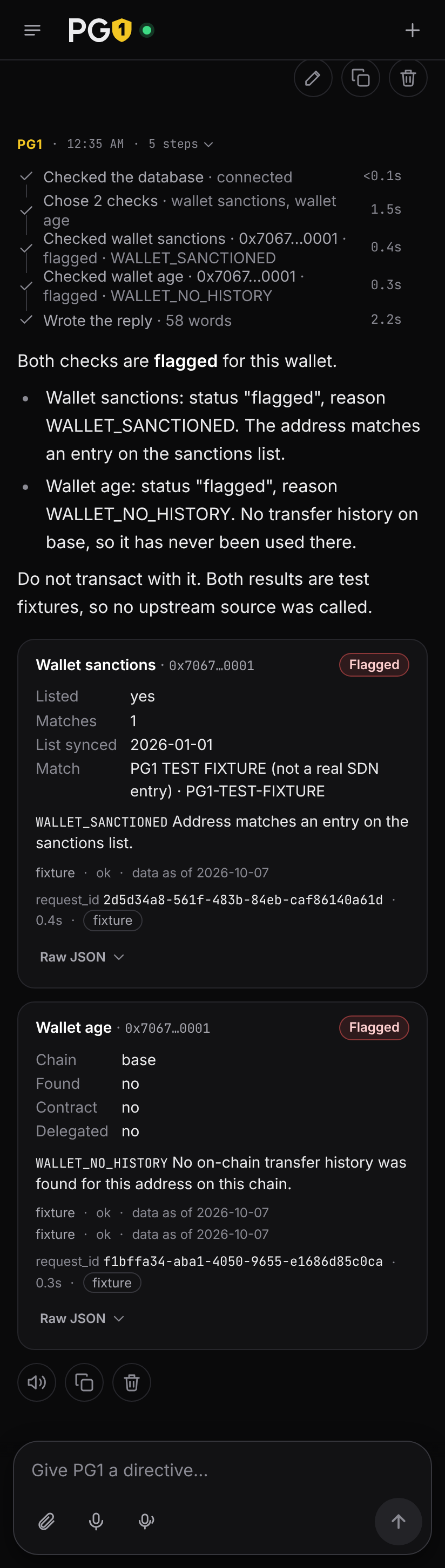
The signed-in operator can ask PG1's chat to run the read-only tools above in plain words: "check this wallet 0x…", "how old is this domain", "is this hostname a lookalike", "what do you know about CVE-2021-44228". The chat model is offered the read-only MCP tools as native functions (generated from the same tool list and schemas as tools/list, filtered by role), runs up to 5 of them per message (in parallel when independent), and writes the answer from the results. Each call runs the same handler an MCP client gets, never an HTTP request to /api/mcp.
- What it can run:
check_wallet_sanctions,check_domain_age,check_hostname_reputation,check_wallet_age,get_ioc_context,get_ioc_batch,get_cve_details,get_cve_batch,get_cve_by_product,get_threat_actor_profile. Neversubscribe_alertsorsubmit_indicator(they write),get_threat_indicators(a paid bulk feed, not a check),get_usage_status(a caller's own quota) orcheck_ip_abuse(it runs only with the caller's own AbuseIPDB key from a request header; the chat has none, and PG1 has no AbuseIPDB key of its own). Nothing the chat runs writes, pays or changes state. - Operator use is free, like a licence holder: no PG1 rate limit, but every upstream source's own timeout and cache still apply, and each call has a timeout of its own (10 s). Each call is logged with a
request_id, and an upstream failure or timeout goes to the error log under it, as on MCP. The tool list and limits are a per-role policy (lib/chatTools.mjs), so a future guest role gets the freecheck_*tools under the anonymous rate limit. - Honest answers: the reply quotes each result's
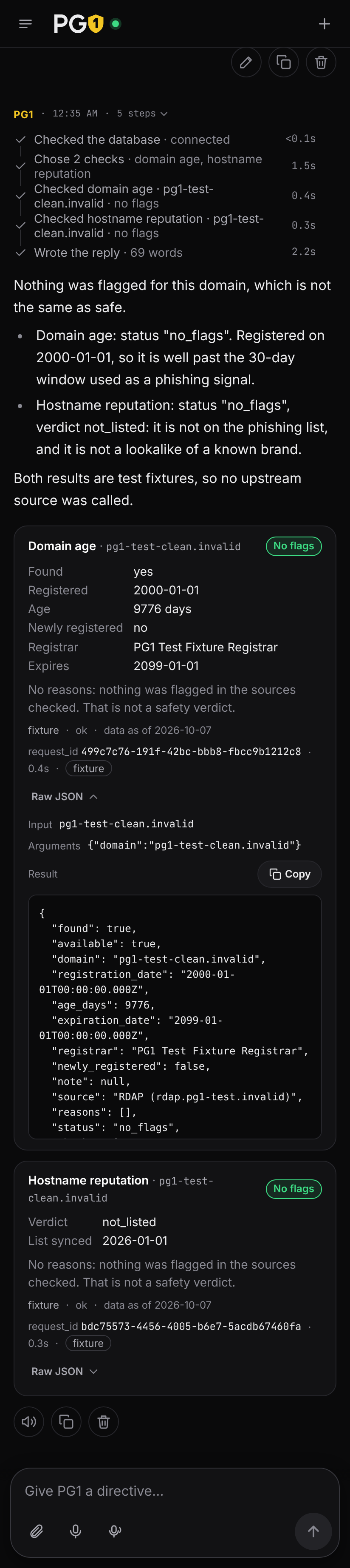
status(flagged,no_flags,unknown) andreasons;no_flagsis never "safe". A check that failed, timed out, or came backunknownis named at the end of the reply with itsrequest_id, by code, whatever the model wrote. Tool output is untrusted data: text inside a result is reported, never followed. - Trace and card: the live trace shows one row per call ("Checked wallet age · 0x12ab…9f3c · no flags", with how long it took; failures in the error colour). Under the reply, one card per result: tool name in plain words, a status chip, key fields, reasons, checks with
data_as_of, therequest_id, and a Raw JSON expander with a copy button (addresses shortened in the title, in full in the expander). - Voice: with spoken replies on, a reply that ran checks speaks a short summary (status and main reason per check), never an address, hash or JSON.
- Demo without upstream calls: the fixtures below work from chat too, e.g. "check this wallet 0x7067312d746573742d6669787475726500000001" or "how old is pg1-test-clean.invalid"; the card is marked "fixture".
Response Metadata (reasons, status, checks, request_id)
Every one of the 14 MCP tools and the 5 free A2A skills adds four fields alongside its existing output — additive only, nothing existing is renamed or repurposed:
reasons:[{ code, message }]. Zero or more machine-readable codes from the permanent list below. Empty when nothing is flagged. Codes are only ever added, never removed or renamed.status:"flagged"whenreasonscontains a genuine warning code; otherwise"unknown"whenreasonscontains an incomplete code or any source needed for the answer timed out, errored, or was skipped (never reported as a false-clean"no_flags"); otherwise"no_flags". Two kinds of code are listed inreasonsbut are not warnings. Informational codes (WALLET_DELEGATED,IP_TOR_EXIT_NODE,IP_WHITELISTED,IP_REPORTS_SCORED_ZERO) report a fact and never affectstatus. Incomplete codes (currently onlyWALLET_AGE_PARTIAL) mean a check didn't complete, so they makestatus"unknown", not"flagged". Forcheck_wallet_age, that means:"flagged"only withWALLET_NO_HISTORY; otherwise"unknown"if anything didn't complete (WALLET_AGE_PARTIAL, ordelegated: null); otherwise"no_flags". (subscribe_alertsandsubmit_indicatorkeep their own pre-existingstatusfield, which means a submission lifecycle state, not this honest-status value — they gainreasons/checks/request_idonly.)checks:[{ source, result, checked_at, data_as_of }]— one entry per data source consulted for this call.resultis one of"ok" | "timeout" | "error" | "skipped".sourceis always a generic label (e.g."sanctions list","domain registration records","on-chain transfer history") — never a vendor/provider name.checked_atis when this request ran the check;data_as_ofis how current the underlying data is, ornullwhen not applicable. Forcheck_wallet_age, a cached answer's"on-chain transfer history"entry hasdata_as_ofset to when that age was originally looked up (a fresh lookup hasnull), and the"on-chain code"entry is the live delegation check.request_id: a UUID identifying this exact call, also sent as theX-Request-Idresponse header on/api/mcpand/api/a2a. It is inside the tool result (andstructuredContent) or, for a JSON-RPC error, insideerror.data— never at the top level of the JSON-RPC envelope, which holds onlyjsonrpc,idandresult/error. If the call fails and gets written to the server error log, the samerequest_idis attached to that log entry.
check_wallet_sanctions, check_domain_age, check_hostname_reputation and check_wallet_age also declare these four as optional properties on their outputSchema (never added to required, and every other part of their schema is unchanged). They also declare an optional boolean test_fixture, which is present (and true) only on responses to the fixture inputs described in Test your integration. check_wallet_age also declares two optional delegation properties, delegated (boolean | null) and delegate_address (string | null), which are not in required (see the check_wallet_age notes above).
Reason codes
| Code | Meaning |
|---|---|
WALLET_SANCTIONED | Address matches an entry on the sanctions list. |
DOMAIN_NEWLY_REGISTERED_30D | Domain was registered fewer than 30 days ago. |
HOSTNAME_PHISHING_LISTED | Hostname, or a parent domain of it, is on the phishing blocklist. |
HOSTNAME_LOOKALIKE | Hostname is a probable lookalike/typosquat of a known brand domain. |
WALLET_NO_HISTORY | No on-chain transfer history was found for this address on this chain. |
WALLET_AGE_PARTIAL | Internal transfers were not checked in time; the wallet may be older than shown. (Incomplete: makes status "unknown", not "flagged".) |
CVE_KNOWN_EXPLOITED_KEV | CVE is on the known exploited vulnerabilities catalog. |
IOC_FOUND_IN_THREAT_FEED | Indicator has at least one matching record in the threat indicator feed. |
WALLET_DELEGATED | Address currently has an EIP-7702 delegation on this chain: its code points to a delegate contract. (Informational: never changes status on its own.) |
IP_ABUSE_REPORTED | IP address has an abuse confidence score above 0 from reports in the reporting window checked. |
IP_TOR_EXIT_NODE | IP address is a Tor exit node. (Informational: never changes status on its own.) |
IP_WHITELISTED | IP address is whitelisted by the abuse-report source, which does not count its reports against it. (Informational: never changes status on its own.) |
IP_REPORTS_SCORED_ZERO | IP address has abuse reports in the reporting window checked, but its abuse confidence score is 0. (Informational: never changes status on its own.) |
Source of truth: lib/reasonCodes.mjs.
Not yet covered: the /api/ioc REST feed and /api/ioc/context don't carry reasons/status/checks/request_id yet.
Test your integration
Every MCP tool that can flag something has three fixed, made-up fixture inputs that always return the same answer: one FLAGGED, one CLEAN and one UNKNOWN. check_wallet_age also has a fourth, DELEGATED. Use them to test your integration's happy path, its "flagged" path and its skip/retry path without spending anything or depending on live data.
-
Always free, for every caller: no licence key, no
x-free-tierheader, no x402 payment, no rate-limit usage. This applies to the paid tools too. -
Same shape as a real response:
reasons,status,checksandrequest_id, plustest_fixture: true. Everychecks[]entry hassource: "fixture". On an error-shaped UNKNOWN,test_fixture: trueis inerror.data(JSON-RPC errors) or next tocode(isError tool results). -
UNKNOWN is exactly what a real upstream failure returns for that tool, so you can test your skip path. For
check_wallet_agethat is theupstream_unavailableisError result, neverfound: false. -
For
check_domain_age, always checkstatusbeforefound:found: falsewithstatus: "unknown"means the lookup did not complete, not that the domain is new. -
Exact values only. The only normalisation is what the tool already does itself: lowercasing a
0xaddress or hostname, uppercasing a CVE id, reducing a domain/URL to its registrable domain. Anything else is treated as a real input, even one character off, sowww.pg1-test-flagged.invalidis a real hostname lookup. -
Every value is reserved or synthetic, so none can belong to a real target:
.invaliddomains (RFC 2606/6761), documentation IP ranges (RFC 5737192.0.2.0/24,198.51.100.0/24,203.0.113.0/24; RFC 38492001:db8::/32),CVE-0000-*ids (the CVE programme started in 1999) and0xaddresses that spellpg1-test-fixturein hex. -
check_wallet_agehas no age threshold. Its FLAGGED fixture is a wallet with no history (found: false,WALLET_NO_HISTORY) and its CLEAN fixture is an old wallet with a fixedfirst_seen. Its DELEGATED fixture is an old wallet with an EIP-7702 delegation:delegated: true, a syntheticdelegate_address(also spellingpg1-test-fixturein hex) and reasonWALLET_DELEGATEDwithstatus: "no_flags", because that code is informational. Like a real answer, it has twochecksentries (transfer history, then the delegation check), bothsource: "fixture"andresult: "ok". The other fixtures reportdelegated: false.chainis optional and is echoed back; an unsupported chain is still aninvalid_chainerror. -
check_ip_abuseuses the documentation IPv4 addresses, which its live path rejects asinvalid_ip(they are reserved, never public), so a fixture can never become a real lookup. Fixtures are answered before the key check: they need noX-AbuseIPDB-Keyheader and make no upstream call. Their data is synthetic and theirattribution.textsays so.max_age_in_daysis optional and echoed back.
Fixture table
| Tool | Fixture | Arguments | Expected result |
|---|---|---|---|
check_wallet_sanctions | FLAGGED | {"address":"0x7067312d746573742d6669787475726500000001"} | listed: true, status "flagged", reason WALLET_SANCTIONED |
check_wallet_sanctions | CLEAN | {"address":"0x7067312d746573742d6669787475726500000002"} | listed: false, status "no_flags" |
check_wallet_sanctions | UNKNOWN | {"address":"0x7067312d746573742d6669787475726500000003"} | HTTP 503, JSON-RPC error -32003 "Sanctions data temporarily unavailable, please retry." |
check_domain_age | FLAGGED | {"domain":"pg1-test-flagged.invalid"} | found: true, age_days 3, newly_registered: true, status "flagged", reason DOMAIN_NEWLY_REGISTERED_30D |
check_domain_age | CLEAN | {"domain":"pg1-test-clean.invalid"} | found: true, registration_date 2000-01-01, status "no_flags" |
check_domain_age | UNKNOWN | {"domain":"pg1-test-unknown.invalid"} | found: false, reason_code "timeout", status "unknown" (what a real registration-lookup timeout returns) |
check_hostname_reputation | FLAGGED | {"hostname":"pg1-test-flagged.invalid"} | verdict "listed" (match_type "exact"), status "flagged", reason HOSTNAME_PHISHING_LISTED |
check_hostname_reputation | CLEAN | {"hostname":"pg1-test-clean.invalid"} | verdict "not_listed", status "no_flags" |
check_hostname_reputation | UNKNOWN | {"hostname":"pg1-test-unknown.invalid"} | HTTP 503, JSON-RPC error -32003 "Phishing domain list temporarily unavailable, please retry." |
check_wallet_age | FLAGGED | {"address":"0x7067312d746573742d6669787475726500000001"} | found: false (no transfer history), status "flagged", reason WALLET_NO_HISTORY |
check_wallet_age | CLEAN | {"address":"0x7067312d746573742d6669787475726500000002"} | found: true, first_seen 2023-09-01T00:00:00.000Z, status "no_flags" |
check_wallet_age | UNKNOWN | {"address":"0x7067312d746573742d6669787475726500000003"} | isError: true, code "upstream_unavailable", status "unknown" (never found: false) |
check_wallet_age | DELEGATED | {"address":"0x7067312d746573742d6669787475726500000004"} | found: true, is_contract: true, delegated: true, delegate_address 0x7067312d746573742d66697874757265de1e9a7e, reason WALLET_DELEGATED (informational), status "no_flags" |
get_ioc_context | FLAGGED | {"value":"192.0.2.1"} | found: true, status "flagged", reason IOC_FOUND_IN_THREAT_FEED (free, no payment) |
get_ioc_context | CLEAN | {"value":"198.51.100.1"} | found: false, status "no_flags" |
get_ioc_context | UNKNOWN | {"value":"203.0.113.1"} | HTTP 503, JSON-RPC error -32603 "Threat data temporarily unavailable, please retry." |
get_ioc_batch | FLAGGED | {"values":["2001:db8::1"]} | total_found 1, status "flagged", reason IOC_FOUND_IN_THREAT_FEED (free, no payment) |
get_ioc_batch | CLEAN | {"values":["2001:db8::2"]} | total_found 0, status "no_flags" |
get_ioc_batch | UNKNOWN | {"values":["2001:db8::3"]} | HTTP 503, JSON-RPC error -32003 "Threat data temporarily unavailable, please retry." |
get_cve_details | FLAGGED | {"cve_id":"CVE-0000-0001"} | cisa_kev.is_known_exploited: true, status "flagged", reason CVE_KNOWN_EXPLOITED_KEV (free, no payment) |
get_cve_details | CLEAN | {"cve_id":"CVE-0000-0002"} | cisa_kev.is_known_exploited: false, status "no_flags" |
get_cve_details | UNKNOWN | {"cve_id":"CVE-0000-0003"} | exploit-score and KEV checks "error", exploit score null, status "unknown" |
get_cve_batch | FLAGGED | {"cve_ids":["CVE-0000-0001"]} | one KEV-listed result, status "flagged", reason CVE_KNOWN_EXPLOITED_KEV (free, no payment) |
get_cve_batch | CLEAN | {"cve_ids":["CVE-0000-0002"]} | one non-KEV result, status "no_flags" |
get_cve_batch | UNKNOWN | {"cve_ids":["CVE-0000-0003"]} | exploit-score and KEV checks "error", status "unknown" |
get_cve_by_product | FLAGGED | {"vendor":"pg1-test.invalid","product":"flagged"} | one KEV-listed CVE, status "flagged", reason CVE_KNOWN_EXPLOITED_KEV (free, no payment) |
get_cve_by_product | CLEAN | {"vendor":"pg1-test.invalid","product":"clean"} | total_found 0, status "no_flags" |
get_cve_by_product | UNKNOWN | {"vendor":"pg1-test.invalid","product":"unknown"} | exploit-score and KEV checks "error", status "unknown" |
check_ip_abuse | FLAGGED | {"ip":"192.0.2.1"} | abuse_confidence_score 100, total_reports 42, not whitelisted, status "flagged", reason IP_ABUSE_REPORTED (synthetic data; no key header needed, no upstream call) |
check_ip_abuse | CLEAN | {"ip":"198.51.100.1"} | abuse_confidence_score 0, total_reports 0, status "no_flags" (no reports; a score of 0 is not proof the address is harmless) |
check_ip_abuse | UNKNOWN | {"ip":"203.0.113.1"} | isError: true, code "upstream_unavailable", status "unknown" (what a real lookup timeout returns) |
No fixtures exist for get_threat_indicators (a bulk feed with no target input), get_threat_actor_profile and get_usage_status (they have no reason code to flag with), or subscribe_alerts and submit_indicator (write actions whose status is a lifecycle state, not a verdict).
A2A: the five fixture-bearing free skills (check_wallet_sanctions, check_domain_age, check_hostname_reputation, check_wallet_age, check_ip_abuse) accept the same fixtures on /api/a2a. A result comes back as a completed Task. An isError-style UNKNOWN comes back as JSON-RPC error -32000 with the details in error.data. A 503-style UNKNOWN comes back as HTTP 503 with JSON-RPC error -32010. These are the same shapes a real failure produces on that endpoint.
Out of scope: the REST endpoints (/api/ioc and /api/ioc/context) have no fixtures. Fixture values sent there are looked up like any other value.
Examples
FLAGGED, over MCP, with no key:
curl -X POST https://pg1-ai-agent.vercel.app/api/mcp \
  -H "Content-Type: application/json" \
  -H "Accept: application/json, text/event-stream" \
  -d '{"jsonrpc":"2.0","id":1,"method":"tools/call","params":{"name":"check_hostname_reputation","arguments":{"hostname":"pg1-test-flagged.invalid"}}}'
UNKNOWN, over MCP, to test your skip path (an upstream_unavailable isError result):
curl -X POST https://pg1-ai-agent.vercel.app/api/mcp \
  -H "Content-Type: application/json" \
  -H "Accept: application/json, text/event-stream" \
  -d '{"jsonrpc":"2.0","id":1,"method":"tools/call","params":{"name":"check_wallet_age","arguments":{"address":"0x7067312d746573742d6669787475726500000003"}}}'
A paid tool's FLAGGED fixture, still free with no key:
curl -X POST https://pg1-ai-agent.vercel.app/api/mcp \
  -H "Content-Type: application/json" \
  -H "Accept: application/json, text/event-stream" \
  -d '{"jsonrpc":"2.0","id":1,"method":"tools/call","params":{"name":"get_cve_details","arguments":{"cve_id":"CVE-0000-0001"}}}'
Invalid-input messages
Invalid input keeps its existing error code (JSON-RPC -32602 for most tools, -32004 for a malformed get_cve_details id, or the tool's own invalid_address / invalid_hostname / invalid_chain isError code). The message says what was wrong, what format is expected, gives one valid example, and ends with the request_id. Your raw input is never echoed back. For example:
address is not a valid EVM address. Expected: '0x' followed by exactly 40 hex characters (case-insensitive). Example: 0x7067312d746573742d6669787475726500000002. request_id: 9cf7345b-f8d6-46f7-8e45-0da5e25a002d
Acknowledgements
- Frits (x402 Doctor): found the payment-gate ordering bug and confirmed the fix, so PG1 now returns a proper x402 payment challenge by default.
check_hostname_reputationblocklist/allowlist/fuzzylist data is sourced from MetaMask eth-phishing-detect, used under the Don't Be A Dick (DBAD) Public License.