Brightspace
D2L Brightspace MCP server: grades, due dates, assignments, announcements and files. Any school.
Runs on your machine from its package; the steps are below.
What it does
- Reads
- Writes
- High impact
At most: only reads or looks up information.
What it costs
FreeOdel charges nothing per call. The publisher may charge for its own service.
Runs locally over stdio
This server isn't hosted — your MCP client launches it from a package registry. Use one of the commands below, or drop the config into your client (e.g. Claude Desktop).
Run
npx -y brightspace-mcp-server
MCP client config
{
  "mcpServers": {
    "brightspace": {
      "command": "npx",
      "args": [
        "-y",
        "brightspace-mcp-server"
      ]
    }
  }
}Brightspace MCP Server





By Rohan Muppa, ECE @ Purdue
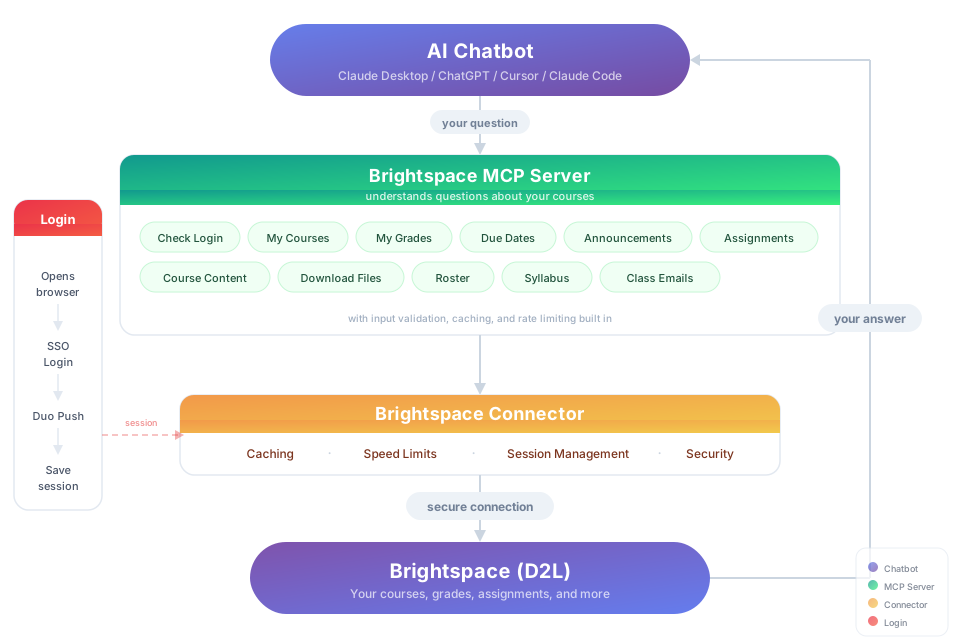
Lets your AI see your Brightspace classes, so you can just ask:
"What's due this week?" · "Am I passing all my classes?" · "Summarize today's announcements" · "Turn my lecture slides into flashcards"
Works with Claude Desktop, Claude Code, Cursor, ChatGPT Desktop, Windsurf, and any other app that supports MCP (the standard way to plug tools into an AI). It only reads your courses — it never submits, edits, or deletes anything.
Get started in 3 steps
-
Install Node.js (version 20 or newer) if you don't have it. Download, run the installer, done.
-
Open a terminal and run the setup:
bashnpx -y brightspace-mcp-server@latest setupIt asks for your school's Brightspace address, your username and password, and how you normally do two-factor sign-in (phone approval, authenticator code, or a browser window). Your password goes into your computer's own password store (Keychain on Mac, Credential Manager on Windows), never into a file. At the end it connects itself to Claude Desktop, Cursor, Antigravity, Codex, or Claude Code if you have them. If one of them already has a
brightspaceentry pointing somewhere else (an old local build, a fork), setup shows you that entry and asks before replacing it.On a Mac: when Keychain asks whether
nodemay use the saved Brightspace password, choose Always Allow, not just Allow. That lets later sign-ins (theauthcommand and questions from your AI app) read it without asking again. -
Restart your AI app and ask it something — the first question signs you in. If your phone asks you to approve a sign-in, approve it and ask again.
At one of these schools, add the flag and skip typing the address: --purdue, --suny, --western, --tudelft, --cuny, --leiden, --mcgill, --ngeeann, --javeriana.
Rather have the AI install it for you? Paste this into Claude Code, Cursor, Windsurf, Copilot, or Codex:
Install brightspace-mcp-server for me by following
https://github.com/RohanMuppa/brightspace-mcp-server/blob/main/LLMs.md
(use --purdue at Purdue, --suny at SUNY, --tudelft at TU Delft, --cuny at CUNY, --leiden at Leiden, --mcgill at McGill, --ngeeann at Ngee Ann Polytechnic, or --javeriana at Javeriana Cali).
Using a different AI app? Add the command npx -y brightspace-mcp-server@latest to its MCP settings (on Windows: cmd /c npx -y brightspace-mcp-server@latest). Exact steps for each app: docs/troubleshooting.md.
Does my school work?
If your school uses D2L Brightspace, yes. These have automatic sign-in built in:
| School | Sign-in | Flag |
|---|---|---|
| Purdue | Microsoft (phone approval, authenticator code, or browser) | --purdue |
| SUNY | Shared site with a campus picker | --suny |
| Western University | Microsoft | --western |
| TU Delft | NetID (no two-factor) | --tudelft |
| CUNY | CUNY Login, authenticator code each time | --cuny |
| Leiden University | SURFconext → Microsoft | --leiden |
| McGill University | Microsoft Entra | --mcgill |
| Javeriana Cali | OneGate (password + authenticator code) | --javeriana |
| Ngee Ann Polytechnic | Microsoft Entra | --ngeeann |
| Any other D2L school | Paste your Brightspace address; if the login page isn't recognized, a browser window opens so you can sign in by hand | none |
School-specific quirks: docs/sign-in.md.
Things to ask
| About | Try |
|---|---|
| Grades | "Am I passing all my classes?" · "Compare my grades across courses" · "Is there feedback on my midterm?" (quiz-scored grades link to the quiz, since quiz feedback, including feedback only viewable in LockDown Browser, isn't readable through the API) |
| Due dates | "What's due in the next 48 hours?" · "Build me a study schedule for the week" |
| Assignments and rubrics | "What does the lab 4 spec actually ask for?" · "Why did I lose points on the analysis criterion?" |
| Quizzes and exams | "Which quizzes close this week?" · "Is there a midterm in the gradebook that isn't on my assignments list?" |
| Announcements | "Did any professor post something important today?" · "Read the file attached to today's announcement" |
| Course content | "Find the midterm review slides" · "Download every PDF from Module 5" · "Search this course for office hours" · or just read a file inline instead of saving it |
| Syllabus | "What's the late policy in ECE 264's syllabus?" (if the course keeps its syllabus in an external tool such as Simple Syllabus, you get the link to open instead) |
| People | "Who are the TAs for ECE 264?" · "Who is in my project group?" |
| Discussions | "Summarize the latest posts in the final project thread" |
| Lecture videos | "What did the professor say about pinch-off in Tuesday's recording?" (Kaltura, including BoilerCast LTI links, and YouTube) |
| Calendar | "When is my midterm?" · "Is lab cancelled on Thursday?" |
| For instructors and TAs | "Which students haven't submitted Lab 4 yet?" · "What feedback did I leave on this student's homework?" · "Download that student's submitted PDF" (students see a clear "instructor access required" note) |
Prompts
Apps with a prompt picker (like Claude Desktop) also offer four ready-made prompts, so you can start from one click instead of typing a question:
| Prompt | Arguments | What it asks for |
|---|---|---|
weekly_briefing | — | A 7-day rollup of what's due, what's new, and what changed in your grades, across every course |
grade_audit | courseId (optional) | Analyzes grades for one course, or all of them, and flags missing or low-scoring items |
study_planner | daysAhead (optional, default 7) | Plans study time from upcoming due dates and calendar events |
course_summary | courseId (required) | Syllabus, content outline, assignments, and grades for one course |
Settings you might want
All optional, set in your AI app's MCP env config or your shell. The full list is in LLMs.md.
| Setting | What it does |
|---|---|
D2L_REMEMBER_MFA=true | Tick Microsoft's "Don't ask again" box so later sign-ins skip the second factor (off by default; not for shared computers). setup asks this and saves it as rememberMfa in config.json; the env var overrides it |
D2L_PASSWORDLESS=true | Sign in with Microsoft Entra's passwordless phone approval, so no password is saved on the computer (off by default; Entra schools only). Every sign-in, including automatic ones, then waits for you to approve on your phone, so it suits interactive use, not unattended or scheduled jobs. setup asks this and saves it as passwordless in config.json; the env var overrides it (details) |
D2L_TOTP_SECRET | An authenticator setup key, so a Microsoft Entra "enter a code" challenge is answered on this computer instead of on your phone (off by default). Prefer setup, which keeps the key in your OS keychain; this variable is for CI and containers with no keychain and is weaker, because anything that can read the process environment gets your second factor (details) |
D2L_HEADLESS=false | Show the browser window during sign-in, for MFA methods that need a click |
D2L_DUO_PASSCODE=1 | On Duo, type a passcode instead of waiting for a push |
D2L_SESSION_COOKIE / D2L_ACCESS_TOKEN | Skip the browser entirely with a pasted cookie or token (how) |
D2L_INCLUDE_COURSES / D2L_EXCLUDE_COURSES | Limit which courses the AI sees, by course id |
D2L_ACTIVE_ONLY=false | Include courses whose enrollment has ended |
D2L_NO_UPDATE_CHECK=1 | Turn off the new-version notice |
D2L_DEV_MODE=true | Write a local, content-free log of tool calls and sign-in events, for debugging session problems (how) |
When it asks you to sign in
There's no separate login — asking a question signs you in, and it stays signed in on its own most days. When your school wants two-factor again, the number to approve shows up right in the answer; approve it on your phone and the assistant keeps checking on its own — each check waits up to 45 seconds and the original question completes as soon as the sign-in does, without you having to say you've approved it. If your AI client shows tool progress messages, the number appears while the question is still running instead. If it ever gets stuck, run this in a terminal:
npx -y brightspace-mcp-server@latest auth
On a Mac, sign-in first reads your saved password from Keychain. If you picked a one-time Allow at the Keychain prompt, a later sign-in from your AI app or another terminal can fail or hang waiting for an approval nobody sees; pick Always Allow instead. That permission only lets the local Brightspace server read its own saved sign-in password, nothing else in your Keychain.
If your school asks for a 6-digit code rather than a phone approval, setup can save the
authenticator setup key (not a code) you got when you enrolled the app. From then on automatic
sign-ins generate the code on this computer and finish without you, which is what unattended and
scheduled use needs. It is optional and off unless you paste a key. The tradeoff is real: the key
sits beside your password, so on this computer your two factors become one. It still stops
anyone who only has your password, and it changes nothing for your other devices. Full enrollment
steps: docs/sign-in.md.
To sign out early (on a shared computer, say), run npx -y brightspace-mcp-server@latest auth --logout. It deletes this computer's saved Brightspace session, so the next question does a full sign-in. Your saved password, authenticator key, and settings are kept. An AI app that is already running can keep answering until its current access token expires; restart the app to drop it right away. It only clears this computer; it does not sign you out of Microsoft or Brightspace anywhere else. If a sign-in is in progress, it refuses and deletes nothing.
How often you're asked is up to your school, not this tool. Everything else about sign-in — Duo, authenticator codes, visible-browser mode, and running without a browser at all (Docker, WSL, hardware keys) — is in docs/sign-in.md.
Something not working?
- Run
npx -y brightspace-mcp-server@latest doctorfirst — it checks your Node version, saved setup, credential store, Brightspace connectivity, saved sign-in, and installed version, and tells you exactly what to fix. Authentication failed: The native credential store is locked or unavailable.Your password store is locked or hasn't let this server read the saved password. Unlock it (on a Mac, log in or unlock Keychain Access), then runnpx -y brightspace-mcp-server@latest authagain, orsetupif that still fails, and choose Always Allow when Keychain asks.- It works in the terminal but not in the app: the app starts it separately and may not see your password store yet — see docs/troubleshooting.md.
- Which version do I have? Ask your AI "which version of the Brightspace server am I running?"
- Still stuck? Open an issue and paste what the terminal printed.
For developers
Tool reference, response fields, and environment variables: LLMs.md. What's safe to build against: STABILITY.md. Licensed under the MIT License.