Runs on your machine from its package; the steps are below.
What it does
- Reads
- Writes
- High impact
At most: moves money, runs code or commands, deletes data, or sends messages for you.
What it costs
FreeOdel charges nothing per call. The publisher may charge for its own service.
Runs locally over stdio
This server isn't hosted — your MCP client launches it from a package registry. Use one of the commands below, or drop the config into your client (e.g. Claude Desktop).
Distributed as an MCP bundle (`https://github.com/sandraschi/yahboom-mcp/releases/download/v2.5.0b1/yahboom-mcp-v2.5.0b1.mcpb`) — download it and import the bundle in your MCP client.
Yahboom Raspbot v2 (Boomy) — MCP Server, Webapp & Documentation





📖 Installation Guide — quick start, manual setup, and troubleshooting











Download for Windows:
yahboom-mcp-2.5.0-setup.exe— installer with webapp + embedded backend, one shortcut. The installer is unsigned: SmartScreen will warn — click More info > Run anyway. Claude Desktop users can instead install the MCP bundle (one-liner below).
Quick Start
Claude Desktop only (MCPB bundle):
irm https://github.com/sandraschi/yahboom-mcp/releases/latest/download/install.ps1 | iex
Every other client (Cursor, Windsurf, OpenCode, Claude Code) — stdio via uvx:
{
  "mcpServers": {
    "yahboom-mcp": {
      "command": "uvx",
      "args": ["--from", "git+https://github.com/sandraschi/yahboom-mcp", "yahboom-mcp", "--mode", "stdio"],
      "env": { "YAHBOOM_IP": "192.168.1.11" }
    }
  }
}
Developers from source:
git clone https://github.com/sandraschi/yahboom-mcp
cd yahboom-mcp
just
This opens an interactive dashboard showing all available commands. Run just bootstrap to install dependencies, then just serve or just dev to start.
Manual Setup
If you don't have just installed:
Overview
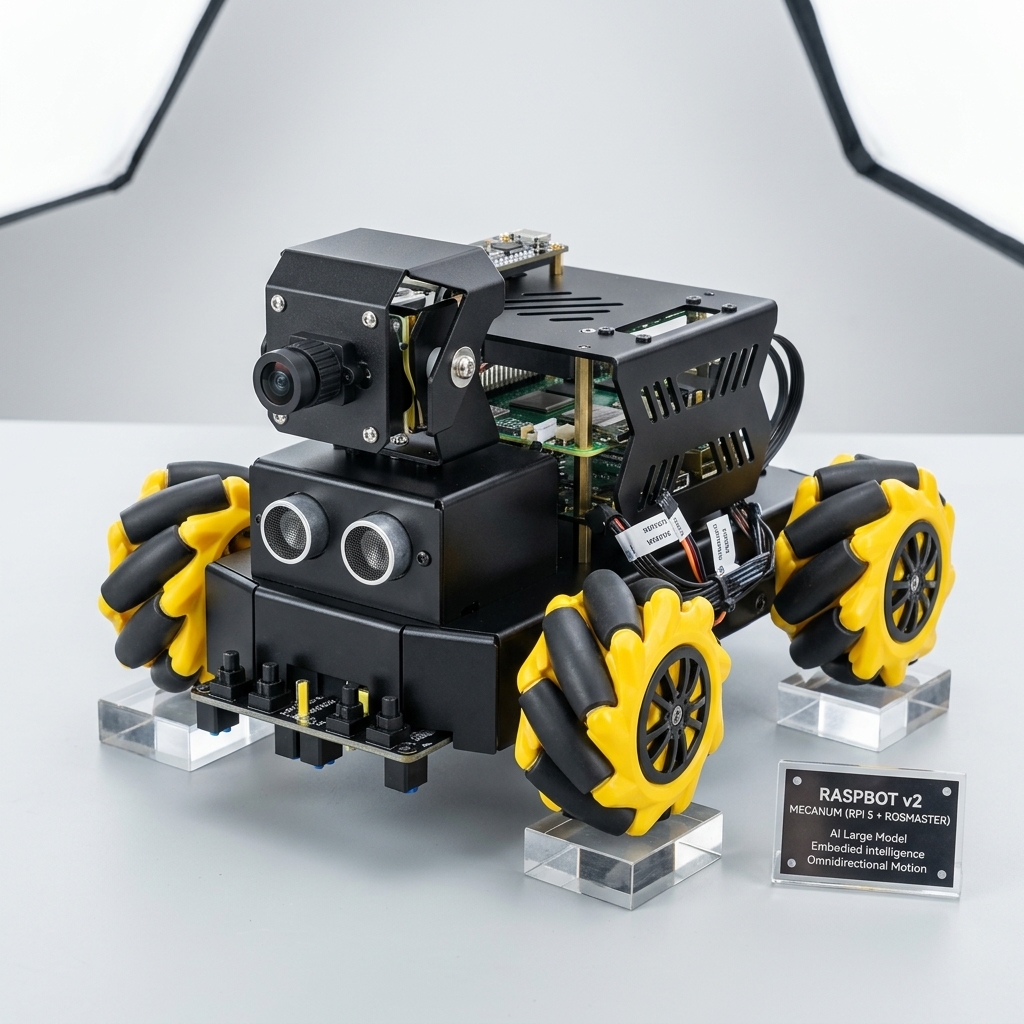
Boomy is a Yahboom Raspbot v2 (Mecanum Version) robot car. Weighing in at approximately 1.0 kg and costing roughly $300 (fully loaded with a Raspberry Pi 5 16GB), it provides a unified platform for testing sensor integration, ROS 2 orchestration, and agentic (AI-driven) robotics. It's also great fun for kids of all ages.
The Manufacturer: Yahboom
Yahboom is a prominent player in the Chinese robotics and STEM education industry. They offer a diverse range of hardware platforms:
- Market Range: From entry-level $50 DIY kits to advanced $2,000+ STEM robots with precision mechanical arms.
- Industry Position: They specialize in accessible hardware for education and prototyping, positioned below enterprise-grade platforms such as Unitree or Noetix.
- Developer Ecosystem: Yahboom maintains a strong commitment to a FOSS (Free and Open Source Software) stack and provides active GitHub support for developers.
🏗️ Hardware Architecture
Boomy utilizes a "Double-Stack" controller model to bridge real-time physical reliability with high-level cognitive tasks:
- Rosmaster (ESP32 / Micro-ROS): Small-form-factor hardware controller for low-latency motor control, ultrasonic pinging, and line-sensor processing.
- Raspberry Pi 5 (Optional / Gateway): The main brain for standalone operation.
🚀 The "Zero-Host" Swarm Config
For scaled deployments, Boomy can operate in a Pi-less Swarm mode:
- Setup: Remove the Raspberry Pi; replace with a WiFi-to-Ethernet/UART bridge ($15).
- Control: Centralized orchestration via a remote Mothership (PC with RTX 4090).
- Scaling: Deploy 3+ units for the price of a single Pi-hosted robot.
🕹️ Interface Separation
This project clearly distinguishes between human-operable controls and machine-optimized interfaces:
- Human Interface: A browser-based Web Dashboard (React/Vite) designed for manual telemetry observation, peripheral control (lights, OLED), and human-robot interaction.
- Machine Interface: A standards-compliant MCP Server (Model Context Protocol) designed for AI agents and MCP clients to programmatic control Boomy as a tool within a larger fleet.
Fleet Crossconnects (Companions)
yahboom-mcp works completely standalone. You can optionally connect it with companion servers in the sandraschi fleet to unlock extended features:
| Companion Server | Feature Unlocked | Status | Setup |
|---|---|---|---|
speech-mcp | spoken-feedback, voice-synthesis | Optional | Install Guide |
reaper-mcp | audio-playback, soundboard-fx | Optional | Install Guide |
virtualdj-mcp | deck-control, music-playback | Optional | Install Guide |
Self-Contained Companions: Fleet companions operate independently. Installing companions does not trigger transitive dependency chains.
📂 Documentation Pillars
| Pillar | Focus | Key Topics |
|---|---|---|
| Autonomous Missions | v2.4.0 — Ollama → ROS | Natural-language goals → LLM planning → ROS execution; vision detection (SSD MobileNet v2); ultrasonic obstacle avoidance; "find our dog" walkthrough. |
| Startup & bringup | Start here (robot + Goliath) | ROS 2 vs rosbridge_suite (software) vs USB controller tier under the Pi; boot order; Docker/systemd on the Pi; what the webapp can restart; dashboard vs diagnostics. |
| Agent missions & MCP | LLM → Pi missions | yahboom_agent_mission (MCP) and POST /api/v1/agent/mission (HTTP); MissionPlanV1; env vars; boomy_mission_executor; Nav2 and /boomy/detections_json; troubleshooting vs yahboom_agentic_workflow. |
| Rosmaster Architecture | Dual-bus analysis | I2C (0x2b) for motors/sensors, UART for IMU/battery; register map; container layout; micro-ROS analysis. |
| Stack health probe | health.stack | TTL SSH/TCP probes, YAHBOOM_ROS2_CONTAINER, lifecycle (never started vs exited vs restart loop), optional docker logs preview (redacted). |
| Setup & Installation | Dev install | uv, modes, baseline env vars. |
| Software & Logic | Architecture | System design, ROS 2 node graphs, and state management. |
| Hardware & Pinouts | Physical Layer | Wiring diagrams, I2C addresses, and sensor technical specs. |
| Raspbot v2 hardware stack | Boomy chassis | Chassis, mecanum, motors, lightstrip, PTZ, camera, IMU, ultrasonic, line/cliff, expansion board vs rosbridge software, Pi ports, I2C, battery, switch. |
| ROS 2 Bridge | Connectivity | Bridge architecture, topic map, state cache, env vars, known bugs. |
| Voice & Audio | Sound System | CSK4002 module protocol, espeak-ng TTS, chatrobot architecture, audio soundboard with 17 built-in effects. |
| Multi-Robot Integration | Ecosystem | Federated fleet standards and cross-robot communication protocols. |
| Configuration | Reference | Env vars, ports, transport modes, LLM providers. |
| Development | Reference | Dev setup, layout, test commands, five-gate. |
| Tools | Reference | MCP tools, yahboom_tool operations, REST endpoints. |
| Troubleshooting | Reference | Common issues and fixes. |
| Onboarding | First-time setup | Hardware bring-up for Boomy (robot power, IP, sanity checks). |
Webapp status surfaces
- Dashboard (
/dashboard) — First page: basic robot link (gateway, target IP, ROS · SSH · video) and operator hints when the Raspbot is off or Goliath has no AP/Ethernet path. - Diagnostic Hub (
/diagnostics) — Detail: ROS topic explorer, node list, resync / hard reset, SSH shell, stack health table (samestackpayload as the dashboard when available). - Server logs (
/logs) — Live yahboom-mcp log stream (SSE) on Goliath.
Historical status logs and legacy research are preserved in the docs/archive/ directory.
Stack
| Layer | Tech |
|---|---|
| MCP | FastMCP 3.4 (Unified Gateway: stdio + HTTP/SSE) |
| Backend | FastAPI + uvicorn, Pydantic v2, structlog |
| Robot link | roslibpy (rosbridge) / direct ESP32 TCP / mock bridge, paramiko SSH |
| Vision/audio | OpenCV, faster-whisper, edge-tts, pytapo |
| Frontend | React 19 + Vite 5 + TailwindCSS 3 + Lucide + Framer Motion + Zustand + Three.js |
| Package managers | uv (Python), bun (webapp) |
| Desktop | Tauri 2 + NSIS (PyInstaller sidecar backend) |
| Quality | ruff + pyright + pytest (+coverage) / tsc + Biome / Playwright |
| LLM | Ollama (:11434) + LM Studio (:1234) auto-discovery, Gemini mission planning |
🛡️ Industrial Quality Stack
This project adheres to SOTA 2026 industrial standards for high-fidelity agentic orchestration:
- Python (Core): Ruff for linting and formatting. Zero-tolerance for
printstatements in core handlers (T201). - Webapp (UI): Biome for sub-millisecond linting.
- MCP: FastMCP 3.4 with Unified Gateway, portmanteau tools, skills, and agentic sampling.
- LLM Providers: Auto-discovery of Ollama (
:11434) and LM Studio (:1234). GPU metrics via nvidia-smi. - Automation: Justfile recipes for all fleet operations (
just lint,just fix,just dev).