Listed from the MCP registry; nobody on Odel publishes it.

AdversaryGate
Fail-closed merge gate an agent calls before saying done: MERGE, BLOCK or INCONCLUSIVE.
Runs on your machine from its package; the steps are below.
What it does
- Reads
- Writes
- High impact
At most: moves money, runs code or commands, deletes data, or sends messages for you.
What it costs
FreeOdel charges nothing per call. The publisher may charge for its own service.
Runs locally over stdio
This server isn't hosted — your MCP client launches it from a package registry. Use one of the commands below, or drop the config into your client (e.g. Claude Desktop).
Run
uvx adversary-gate-mcp
MCP client config
{
  "mcpServers": {
    "adversarygate": {
      "command": "uvx",
      "args": [
        "adversary-gate-mcp"
      ]
    }
  }
}



High AI usage ≠ high confidence. The cost of an agentic coding pipeline is not the model's intelligence — it is the pipeline's self-deception.
A fail-closed verification gate for patches written by AI coding agents. It runs your tests on the baseline and on the patch, mutation-tests only the lines the patch wrote, and answers MERGE, BLOCK or INCONCLUSIVE — where uncertainty is a first-class result instead of a silent approval. CLI, GitHub Action and MCP server.
Python only, for now. It measures Python/pytest repositories; on other stacks it runs your suite via --test-command but answers INCONCLUSIVE, never MERGE — see Language support.
pip install adversary-gate
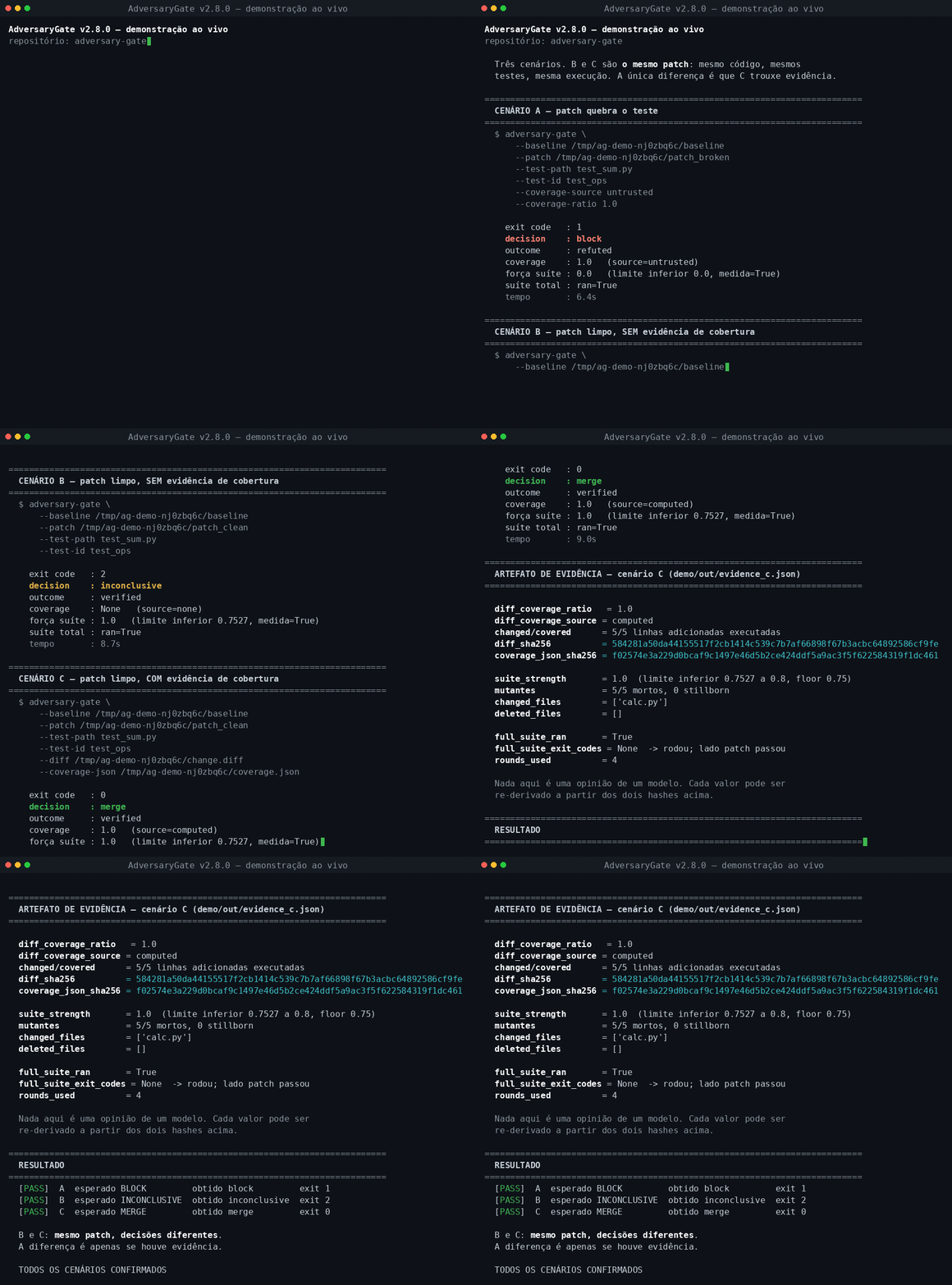
🎬 Watch it decide (60 seconds)
B and C are the same patch. Same code, same tests, same execution. The only difference is that C brought evidence (--diff + --coverage-json); B brought none.
| Patch | Coverage evidence | Decision | Exit | |
|---|---|---|---|---|
| A | breaks the test | declared untrusted | BLOCK | 1 |
| B | clean | none — never measured | INCONCLUSIVE | 2 |
| C | clean | measured, both artefacts SHA-256'd | MERGE | 0 |
That middle row is the whole product. An unproduced measurement is not a measurement, so it cannot clear a floor — and a number nobody can re-derive is an opinion with a false precision label.
python3 demo/demo.py          # runs the three scenarios; exits non-zero if one regresses
python3 demo/render_gif.py    # rebuilds demo/demo.gif from the captured frames
demo/demo.py is an acceptance test, not a screenshot: it builds the fixtures, runs the real CLI as a subprocess, reads the real exit codes, and fails if any of the three decisions changes. Its evidence artefacts are checked in under demo/out/.
INCONCLUSIVEis not an error. It is the gate saying "I did not measure that", and it is exit 2 so CI treats it as "do not merge yet", not as "pass". See Howdiff_coveragegets its value for the one-step path fromINCONCLUSIVEtoMERGE.
🎯 Why
Agents write fluent, plausible code, and naive pipelines that collapse infrastructure errors into "pass" approve patches whose tests are broken, never ran, or were rewritten to agree with the bug. Switching models does not fix that; deterministic verification does. AdversaryGate puts no LLM in the verifier: the same harness judges every patch, whichever model wrote it, and when it did not measure something it says so instead of showing a green check.
🚀 Quick Start (CLI & GitHub Action)
On GitHub, start with the Action: one input,
base-sha, and it derives the baseline, the diff and the coverage report itself.
The CLI below runs the same gate anywhere else.
First run, in one minute
From the root of a git repository with the agent's change in the working tree,
not committed yet (new files tracked: git add -N them), with
pip install adversary-gate coverage.
Before you paste:
BASEis the commit the agent started from. Your default branch may bemaster, notmain(git's default withoutinit.defaultBranch). If the agent already committed its change, use the commit before it:main~1ormaster~1.- Run the lines one at a time. The block does not stop on an error: with no
baseline the gate exits 3, writes no answer, and the
pythonline then fails on an empty file. Stop at a git or coverage error and fix it; the gate's own exit 1 or 2 is its answer, not a failure. If you stop midway, run the last line (git worktree remove) before you start again.
BASE=main                                         # or master: the commit before the agent's change
W=$(mktemp -d)
git worktree add -q --detach "$W/before" "$BASE"  # the baseline, exactly as committed
git diff --no-ext-diff --no-renames "$BASE" > "$W/changes.diff"  # baseline -> your working tree
coverage run -m pytest -q; coverage json -q -o "$W/coverage.json"  # ';' not '&&': a failing test is the gate's to judge
adversary-gate --baseline "$W/before" --patch . \
  --claim tests/test_shop.py::test_discount_never_negative \
  --diff "$W/changes.diff" --coverage-json "$W/coverage.json" > "$W/answer.json"
echo "exit $?"                                    # 0 MERGE, 1 BLOCK, 2 INCONCLUSIVE, 3 usage error (no answer written)
python -c "import json,sys; a=json.load(open(sys.argv[1])); print(a['decision'], '-', a['reason']); print(json.dumps(a.get('next_steps'), indent=1))" "$W/answer.json"
git worktree remove --force "$W/before"
--claim: replace it with the test that proves your fix (path::test).--detachis there becausegit worktree addrefuses a branch that is already checked out, andmainusually is.- The sandbox: where bubblewrap (
bwrap) is installed and can start, the tests run inside it; where it is not (macOS, Android/Termux, some containers), they run without one, with the same network and files as you. Nothing is printed about it; the answer says which ran inexecution.sandboxandexecution.sandbox_note.
On a correct one-line fix the first answer is usually exit 2 with
every claim held and the fix is proven, but suite strength's lower bound is ....
To measure the tests, the gate makes mutants: small deliberate breaks of the
changed lines, each of which a good test should fail on. A one-line change gives
one to three of them, and the floor (by default, a cautious lower bound of 0.75
on the share the tests kill) takes at least 5. Then one of two things:
- Every mutant killed (
1/1,3/3): the reason ends withthe change is too small to measure at this floor ...; see next_steps. The fix is proven; a person has to review the change (the Action'ssmall-change: reviewpasses the step with a warning for that, so keep a required review on the branch). - A mutant survived (
0/3,2/3): your test runs the line but does not check what the break changed.next_stepsnames the line. For a fix toreturn max(0, price - price * pct / 100),assert discount(100, 150) >= 0kills none of the three;== 0kills two (price * pct * 100is negative too, andmaxhides it); addingassert discount(100, 10) == 90kills all three. It has to be in a test you name with--claim: only those face the mutants, so the same assertion in another test of the suite does not count. Name more than one with--claim(see Which tests?).
Neither is a failure of the fix. See Small changes.
Command-Line Usage
adversary-gate \
  --baseline /path/to/before \
  --patch /path/to/after \
  --test-path tests/test_auth.py \
  --test-id test_token_expiry \
  --diff changes.diff \
  --coverage-json coverage.json \
  --model "${AGENT_MODEL_NAME}" \
  --evidence-log evidence.jsonl \
  --report
--model (which model wrote the patch) and --report (the metrics report on
stderr) are optional.
Produce the two artefacts in your own pipeline, for example:
git diff --no-ext-diff --no-renames baseline...patch > changes.diff
coverage json -o coverage.json          # after: coverage run -m pytest
Which tests? Name several, or let coverage say
One run verifies any number of claims, and the decision is over all of them
(one REFUTED blocks; one UNVERIFIED makes it INCONCLUSIVE):
adversary-gate ... --test-path tests/test_auth.py --test-id test_expiry --test-id test_refresh
adversary-gate ... --claim tests/test_auth.py::test_expiry --claim tests/test_api.py::TestLogin::test_ok
Or name none, and let the gate verify the tests that executed a changed source line — read from coverage.py's per-test contexts, not guessed:
printf '[run]\ndynamic_context = test_function\n' > contexts.coveragerc
coverage run --rcfile=contexts.coveragerc -m pytest
coverage json --show-contexts -o coverage.json
adversary-gate --baseline before --patch after \
      --diff changes.diff --coverage-json coverage.json --discover-claims
A test file the patch rewrote is still picked, and judged with the
baseline's copy of it (the baseline oracle, above); it is named under
discovery (rewritten_test_files_judged_by_baseline), next to anything that
could not be resolved to a node id, and the cap
(--max-claims, default 10) with how many it cut. From 3.0.9 a cut test is not left unjudged: with the full suite off (--full-suite-path ""), a patch whose kept claims would merge is INCONCLUSIVE instead, and the reason says to raise the cap or run the suite. A report recorded without
contexts is a usage error (exit 3), not "no tests".
Your project's interpreter, its limits, its environment
adversary-gate ... --python .venv/bin/python \
      --timeout 120 --cpu-seconds 60 --memory 2G \
      --pass-env PATH --env PYTEST_DISABLE_PLUGIN_AUTOLOAD=1
| Flag | Default | |
|---|---|---|
--python | the gate's own | the interpreter pytest runs on — the one your dependencies are in |
--timeout | 30 | wall-clock seconds per claim or mutant run; none removes it |
--cpu-seconds | 10 | CPU seconds per claim or mutant run; none removes it |
--full-suite-timeout | 900 | wall-clock seconds for the collateral full-suite run |
--full-suite-cpu-seconds | none | CPU seconds for the collateral full-suite run |
--full-suite-memory | 4G; none on Android | address space for the collateral full-suite run |
--memory | 512M; none on Android | address space per run (K/M/G); use none for the JVM and Node, which cannot start under one |
--pass-env NAME | — | copy a variable into the runs (they start from a minimal environment) |
--env NAME=VALUE | — | set one |
--serial-sides | off | run the baseline and patch sides of a check one after the other instead of together, and the full suite after the claims and mutants instead of alongside the claims; forces --mutation-workers 1 (small machines; tests that share a fixed /tmp path or a port). The mutants never run beside the suite either way (AG-043) |
--mutation-workers N | 1 | mutants at once, each on its own copy of the tree. Only for claims that share nothing outside the repository: two runs that meet on the same /tmp path, port or test database make one of them fail, and a failing run counts as a killed mutant (AG-043). Not with --census-min-mutants |
The same choices apply to every run — claims, mutants and the collateral suite —
except time and memory: the whole suite gets its own limits, because ones sized
for a single test killed every suite of real size on both sides (out of time, or
pytest dying with MemoryError under 512M of address space): never a MERGE (two failing
sides are unverifiable), but the regression the suite would have caught came
back INCONCLUSIVE instead of BLOCK (AG-033). The output records them under execution, with the names of the
variables and never their values. A run the memory limit killed (MemoryError,
Fatal process out of memory, Could not reserve enough space…) is reported as
the harness dying, not as a failing test: it says nothing about the patch.
Not a pytest suite, or running a patch you have not seen?
# 1. run your own command instead of pytest (any language, any runner)
adversary-gate --baseline before --patch after \
      --test-path run_tests.sh --test-command "./run_tests.sh"

# 2. every run is wrapped in bubblewrap by default wherever it can run
#    (no network, private PID and /tmp, read-only system, only the repo
#    writable); --sandbox bwrap refuses to start without it
adversary-gate ... --sandbox bwrap

# 3. both together -- the usual shape for a patch from someone else
adversary-gate ... --test-command "make check" --sandbox bwrap \
      --require-network-isolation
--test-command needs no --test-id (there are no node IDs to name), and it
feeds the collateral full-suite run too unless you pass --full-suite-command.
The default, --sandbox auto, uses bubblewrap
wherever it can run the project's interpreter and says in the answer when it
could not; --sandbox bwrap refuses to start without it; --sandbox none
turns it off for tests that need the network. Inside it the tests get no
network, their own process, IPC and hostname namespaces, a private /tmp and
no capabilities (--cap-drop ALL). There is no seccomp filter and the kernel is
the host's: it contains a buggy patch, not a hostile one. See
Execution boundary
for exactly what it does and does not contain.
Exit Codes for CI Integration:
0—MERGE: Every claim executed cleanly and cleared coverage & suite strength floors.1—BLOCK: Regressions or collateral suite failures detected.2—INCONCLUSIVE: Infrastructure error, missing test, missing coverage evidence, or weak suite (blocks merge).3—USAGE_ERROR: Bad arguments, malformed JSON, or a coverage claim that was not declared as untrusted.
GitHub Action Integration (action.yml)
One ref in. base-sha derives the baseline, the diff and the coverage
report itself, so a first run is not INCONCLUSIVE for want of evidence (a
change too small to measure still can be: see
Small changes):
name: Verification Gate

on: [pull_request]

jobs:
  verify-agent-patch:
    runs-on: ubuntu-latest
    steps:
      # base-sha is a commit in history: this is not optional.
      - uses: actions/checkout@v4
        with:
          fetch-depth: 0

      # Your Python, your dependencies -- the tests run here.
      - uses: actions/setup-python@v5
        with:
          python-version: '3.11'
      - run: pip install -r requirements.txt pytest coverage

      - name: Run AdversaryGate
        uses: Sanflow10/adversary-gate@v3
        with:
          base-sha: ${{ github.event.pull_request.base.sha }}
          evidence-log: 'evidence.jsonl'
No test is named: the Action records coverage per test and verifies the tests
that executed the lines the pull request changed. Name them yourself with
claims (one path::test per line) or test-path + test-id (one id per
line); either one turns discovery off unless discover-claims: 'true'.
Any non-zero exit fails the step, and that is the safe default. BLOCK
(1), INCONCLUSIVE (2) and a usage or harness error (3/4) all turn the check
red. Do not add continue-on-error and stop there: that lets a BLOCK through
along with everything else. If some pull requests are INCONCLUSIVE by nature
(a change to C++ or SQL, which the gate runs but cannot measure), keep the step
from failing and branch on the exit-code output instead (2.13.0 and later):
      - name: Run AdversaryGate
        id: gate
        uses: Sanflow10/adversary-gate@v3
        continue-on-error: true
        with:
          base-sha: ${{ github.event.pull_request.base.sha }}

      - name: Act on the decision
        if: always()
        env:
          EXIT_CODE: ${{ steps.gate.outputs.exit-code }}
        run: |
          case "$EXIT_CODE" in
            0) echo "MERGE" ;;
            2) echo "::warning::INCONCLUSIVE: the gate could not measure this change; a human decides" ;;
            1) echo "::error::BLOCK"; exit 1 ;;
            *) echo "::error::the gate did not finish (exit '${EXIT_CODE}')"; exit 1 ;;
          esac
Branch on exit-code, not on decision: a run that printed no verdict (exit
3/4) still reports decision: inconclusive, and an empty exit-code means the
Action stopped before the gate ran. Let 2 pass only where you know the gate
cannot measure the change, for example with paths: on a separate workflow;
everywhere else, leave the default.
It runs your tests on your Python. The gate itself lives in a private venv
on its own 3.12, and your job's python is the same before and after the step.
The tests run on the first python/python3 on PATH that can import pytest —
the one your setup-python step put there — or on the interpreter you name with
python:. When there is none, they run on the gate's own and the run says so.
timeout, cpu-seconds, memory, pass-env and env are the CLI flags
above.
Which ref?
v3.0.18is the newest release, and the Release workflow that publishes it also moves the floatingv3tag, which follows every 3.x release. Versions before 3.0.4 are unsupported.@mainfollowsmainand picks up whatever lands next. For anything that matters, pin the full commit SHA instead (uses: Sanflow10/adversary-gate@<full-sha>), which cannot be moved under you.
What that does, and where each piece comes from:
| Artefact | Derived from |
|---|---|
baseline | <base-sha>'s tree through a private index (read-tree + checkout-index) — every file as committed, no worktree leftovers; not git archive, which applies the repository's export attributes (AG-044) |
diff | git diff --no-ext-diff --no-renames --no-textconv <base-sha>...HEAD, with --text for the .py files; on git 2.40 and later, without the .gitattributes the pull request may carry |
coverage-json | coverage-command, run in the checkout under the gate's own boundary: the sandbox input, the minimal environment plus pass-env/env, and one fresh writable directory outside the repository (until 3.0.7 it ran as a bare shell step with the job's whole environment) |
patch | the checkout itself |
If the ref is not in your local history the Action stops with exit 4 and
tells you fetch-depth: 0 rather than measuring against a baseline it
invented. coverage-command defaults to coverage run -m pytest + coverage json
(with per-test contexts when claims are discovered), and coverage in it is
coverage.py on your interpreter — installed beside it, not into it, when it
is missing. Override it to point at your own suite, or pass coverage-json to
supply the artefact yourself.
Everything it derived is plain git and coverage.py you could run by hand. When
you would rather assemble it yourself — a monorepo, a generated diff, coverage
from a non-coverage.py tool — pass the paths explicitly instead:
      - name: Collect coverage evidence
        run: |
          git diff --no-ext-diff --no-renames ${{ github.event.pull_request.base.sha }}...HEAD > changes.diff
          python -m pip install pytest coverage
          coverage run -m pytest
          coverage json -o coverage.json

      - name: Run AdversaryGate
        uses: Sanflow10/adversary-gate@v3
        with:
          baseline: './baseline'
          patch: './patch'
          test-path: 'tests/test_token_expiry.py'
          test-id: 'test_token_expiry'
          diff: 'changes.diff'
          coverage-json: 'coverage.json'
          coverage-floor: '0.80'
          suite-strength-floor: '0.75'
          model: '${{ matrix.model }}'
          evidence-log: 'evidence.jsonl'
Without diff + coverage-json (and without base-sha to derive them) the Action reports INCONCLUSIVE, because there is no coverage evidence to clear the floor with. If you deliberately want to assert the number instead, set coverage-ratio and coverage-source: 'untrusted'.
📦 Installation
pip install adversary-gate
PyPI gets each release from a signed tag through Trusted Publishing, and every
file carries a PyPI provenance attestation. Versions before 3.0.4 are
unsupported: each lacks fail-open fixes (a patch reaching MERGE it should
not) that came after it. To pin the version:
pip install adversary-gate==3.0.18
The same build is attached to the GitHub Release, at a plain public URL — no PyPI, no GitHub login:
# The tag carries the "v", the filename does not.
pip install https://github.com/Sanflow10/adversary-gate/releases/download/v3.0.18/adversary_gate-3.0.18-py3-none-any.whl
Or follow main instead of a release:
pip install git+https://github.com/Sanflow10/adversary-gate.git   # from the repository
PYTHONPATH=src python3 -m adversary_gate --help                   # from a clone, nothing installed
| Route | Follows | Needs |
|---|---|---|
pip install adversary-gate (PyPI) | the latest release, attested | network |
| GitHub Release wheel | the same release | nothing but pip |
uses: Sanflow10/adversary-gate@v3 | the latest 3.x release | GitHub Actions |
pip install git+https://…adversary-gate.git | main | network |
PYTHONPATH=src python3 -m adversary_gate | main, from a clone | nothing |
How a release is built, signed and published, and what changed in that process: Releasing.
🤖 Coding agents: Hermes (MCP) and Jev (triage)
Two integrations, one rule: nothing an integration says can make the gate more lenient.
An agent that cannot grade itself — MCP server (Hermes, any MCP client)
pip install "adversary-gate[mcp]"          # in an environment the agent cannot write to
# or, without installing anything:  uvx adversary-gate-mcp  (the same server, as its own PyPI package)
adversary-gate-mcp                         # stdio MCP server
adversary-gate-mcp --print-hermes-skill    # SKILL.md for ~/.hermes/skills/adversary-gate/
adversary-gate-mcp --print-hermes-config   # the mcp_servers block for ~/.hermes/config.yaml
Tools: verify_repo(repo, claims?, pytest_args?, base_ref?) and gate_policy(). verify_repo judges the repository's working tree — committed or not, untracked files included — against a baseline: it writes the baseline commit's tree into a scratch directory, every file as committed (not with git archive, which applies the repository's export attributes — AG-044), writes the diff, runs coverage.py with per-test contexts (data file in a scratch directory, nothing written into the repo), discovers the claims when none are named, and runs the gate. The answer carries decision, mergeable, fix_proven, every claim's oracle, and the full artefact.
The agent says what to judge; the operator says how strictly, and against what. The tool arguments name evidence only. Everything that decides the answer comes from the server's environment, set in the agent's MCP config by whoever runs it:
| Variable | Why the agent may not set it |
|---|---|
ADVERSARY_GATE_POLICY | gate flags (--sandbox bwrap, --triage jev, which sends the diff out of the machine, see below; floors). An agent that can pass --coverage-floor 0 grades itself. Evidence flags here are refused, and so is a flag not spelled out in full (3.0.18). |
ADVERSARY_GATE_BASE_REF | the baseline is the oracle: an agent could commit a rewritten test and name that commit as the base. Unpinned, the agent's base_ref (default HEAD) must already be on a remote-tracking branch — a commit the agent made locally is refused with inconclusive and nothing runs (3.0.11; before, any commit was taken) — and be a remote tip or the point where HEAD left one (3.0.18). That narrows which commits an agent can name; it does not make the choice the operator's, so pin the baseline when it matters; the answer says "baseline_chosen_by": "agent". An agent that can push, write .git/refs/remotes or move HEAD itself gets past that check. Pin a commit id or a remote-tracking ref (origin/main): a pin on a local branch, a tag or HEAD moves when the agent commits or tags, so it is refused with inconclusive unless ADVERSARY_GATE_ALLOW_LOCAL_PIN=1 says the agent cannot write the repository (3.0.18). Pinning names the baseline; it is not a defence against an agent that can write the repository's .git (its refs, objects or configuration) — run such an agent where it cannot, as with any code that runs with your privileges. |
ADVERSARY_GATE_PYTHON | the interpreter's site-packages are harness too — a plugin installed there runs inside pytest. Use one the agent cannot write to. |
ADVERSARY_GATE_REQUIRE_PINNED_BASE | 1 makes the pin above mandatory: without ADVERSARY_GATE_BASE_REF, verify_repo answers inconclusive and runs nothing, rather than judge against a baseline the agent named. Off by default, so servers that rely on base_ref keep working; gate_policy reports it as baseline_pin_required. |
pytest_args accepts test paths only; an option (-p evil) is refused. The shipped Hermes skill tells the agent to call the gate before saying "done", to fix code rather than tests on block, to never report inconclusive as success, and to promote a self-written skill only on merge.
Risk triage with Jev (TypeSafe AI) — advice that can only tighten
export TYPESAFE_API_KEY=sk-...
adversary-gate ... --diff change.diff --triage jev     # --triage-threshold 0.70 by default
Jev is a decision model: text and a schema in, a typed answer with a probability out. Its makers describe it as calibrated and answering in about 100 ms; neither is measured here. The gate asks it one choice (low / medium / high risk) and one yes/no (does this change a contract callers rely on?). A confident high raises this run's floors — strength confidence to 0.95, coverage floor to 0.90 — so a 5-of-5 mutant score that merges an ordinary change is INCONCLUSIVE for a risky one. A low, a medium, an unconfident high, an error or a timeout change nothing; there is no path from Jev's answer to a more lenient decision, which is what makes it safe to feed it text the patch's author wrote. The answer is recorded in execution.triage either way.
- The diff leaves the machine, truncated to 64 KiB. That is why it is opt-in. It is the whole diff: removed lines as well as added ones, and, through the MCP server, every untracked file git does not ignore (a
.envleft outside.gitignoreincluded). Nothing is filtered for secrets. TypeSafe's terms for what it keeps are in its data processing addendum. - The endpoint must be
https, or plainhttptolocalhost,127.0.0.1or::1for a local test server; a URL with a user, a password or a fragment is refused (3.0.18). The key goes in the same request. - The request names a model:
jev-latestunlessTYPESAFE_MODELor--triage-modelsays otherwise.execution.triagerecords the model asked for and the one that answered. Until 3.0.18 no model was sent, and the API, which requires one, refused every request: triage recorded an error and changed nothing. - Experimental. Jev is early-access (launched 2026-09-15). The client follows TypeSafe's published request/response shape and is tested against a local server speaking it, not against the live API from this repository.
📚 Read more
| Document | What it is |
|---|---|
| 🧮 How it decides | the fail-closed model, decision matrix, diff_coverage and suite_strength, why a one-line fix is INCONCLUSIVE, exit-code taxonomy, provenance |
| 🌐 Language support | what happens on a repository that is not Python/pytest |
| 🛡️ Execution boundary | read before running it on untrusted code: --sandbox bwrap and its limits |
| ⏱️ Performance & compatibility | timings, supported Pythons, deprecations |
| 📦 Releasing | how a release is signed, published and verified |
| 📄 CHANGELOG | what changed in each version |
| 🔐 SECURITY | report a fail-open. A wrong MERGE is the whole failure mode, so a bug here is a security bug |
| 📋 Findings register | every finding against the gate itself, reproduced by real exit code before being fixed — and what is still open |
🏢 Using AdversaryGate at your company
- Running it unmodified on your own code is free, in CI or on a laptop. The AGPL asks nothing of you for that.
- If you modify it and offer the modified gate to others — including as a network service — you must publish your changes under the AGPL.
- If you ship a modified copy, the NOTICE adds the terms that section 7 of the AGPL allows: keep the NOTICE and the attribution, mark the copy as modified, do not present it as AdversaryGate, and do not use the names Sanflow or Sanflow10 to promote it.
- If your legal team cannot accept the AGPL, a commercial license is available: write to sanflow086@gmail.com.
Rolling it out
- Advisory first. Run the Action on pull requests with
continue-on-error: truefor a few weeks, which lets every answer through, aBLOCKincluded, and read theBLOCKandINCONCLUSIVEreasons. Most first answers are a small change or an uncovered line, not a bad patch, andnext_stepssays which. - Keep the policy where the agent cannot write it. The floors and flags
live in the workflow file; protect it (CODEOWNERS, branch protection). An
agent that can edit them, or pass
--coverage-floor 0, grades itself. - Then make it required, and route
INCONCLUSIVEto a person rather than to a red X (small-change: reviewfor changes too small to measure).
This is a summary, not legal advice; the LICENSE and NOTICE are what apply.
📄 License
Copyright © 2026 Sanflow (Sanflow10).
Releases from 3.0.0 on are distributed under the GNU Affero General Public License v3.0 (AGPL-3.0-only), with the additional terms that section 7 of that license allows — see NOTICE. The 2.x line, up to and including 2.14.2, was published under the MIT License, and copies obtained under it keep that license. Versions before 3.0.4 are no longer distributed. From 3.0.4 on, every release stays published; one superseded by a security fix is yanked on PyPI, so pip skips it unless it is pinned exactly, and then warns.







