
MCP Event Intelligence
MCP-native CEP for durable agents: event-time patterns, semantic predicates, derived events.
Runs on your machine from its package; the steps are below.
What it does
- Reads
- Writes
- High impact
At most: only reads or looks up information.
What it costs
FreeOdel charges nothing per call. The publisher may charge for its own service.
Runs locally over stdio
This server isn't hosted — your MCP client launches it from a package registry. Use one of the commands below, or drop the config into your client (e.g. Claude Desktop).
Run
npx -y mcp-event-intelligence
MCP client config
{
  "mcpServers": {
    "mcp-event-intelligence": {
      "command": "npx",
      "args": [
        "-y",
        "mcp-event-intelligence"
      ]
    }
  }
}Durable temporal event intelligence for sleeping agents.




MCP Event Intelligence is an experimental event runtime for agents that need to react to future conditions over multiple event sources without keeping an LLM or agent loop alive.
The primary integration model is embedded and host-owned: the agent host keeps its existing MCP clients, transports, OAuth sessions and provider credentials. Event Intelligence receives a reference to the host's MCP registry, discovers the already-connected clients automatically, and uses only the Events-capable ones.
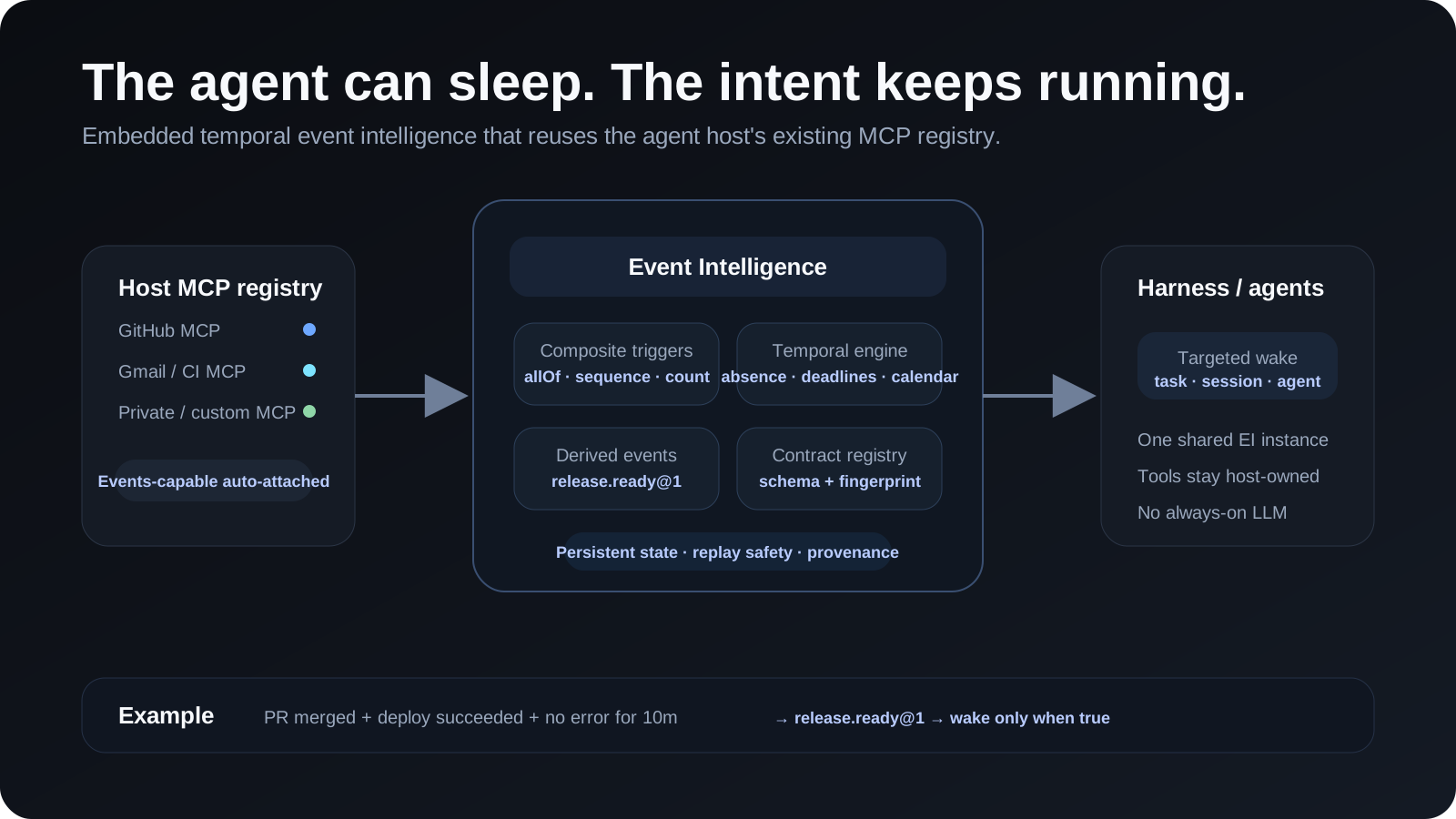
An agent can express an intent such as:
When this PR is merged, the production deploy succeeds, and no error is observed for 10 minutes, wake this task and review the release.
Event Intelligence persists the future condition independently of the model, waits for the world to satisfy it, and wakes the host only when the condition has an activation target. Conditions may also exist without an agent continuation; higher-level facts are composed separately through derived-event triggers.
Embed it in an existing agent host
Install from npm:
npm install mcp-event-intelligence
Published package: npm · Official MCP Registry
For most runtimes, start with the runtime-neutral integration surface:
import {
  createEmbeddedRuntimeIntegration,
  createEventSourceRegistry,
} from 'mcp-event-intelligence/embedded';

const ei = await createEmbeddedRuntimeIntegration({
  dataDir: './data/event-intelligence',

  // The host owns transports, auth and connection lifecycle.
  eventSources: createEventSourceRegistry({
    list: () => runtime.events.connections(),
    subscribe: (refresh) => runtime.events.onConnectionsChanged(refresh),
  }),

  // EI emits an activation. The host decides what "resume" means.
  activation: {
    resolveTarget: (target) => runtime.resolveContinuation(target),
    hasReceipt: (receiptId) => runtime.hasWakeReceipt(receiptId),
    deliver: ({ activation, target, receiptId }) =>
      runtime.resumeFromEvent({ activation, target, receiptId }),
  },

  // Optional. Runtimes without an agent-tool surface can omit tooling entirely.
  tooling: {
    resolveContext: (ctx) => ({
      target: runtime.currentContinuation(ctx),
      actor: runtime.currentActor(ctx),
      owner: runtime.currentOwner(ctx),
    }),

    // Host-owned control. EI does not reduce authorization/approval/interrupt
    // semantics to a boolean.
    control: (request) => runtime.policy.control(request),

    // Optional host-owned result projection. Large results may be externalized
    // behind a runtime-specific reference instead of entering model context.
    projectResult: (request) => runtime.results.project(request),
  },
});
The continuation target is intentionally opaque to EI apart from
{ runtime, kind, id }. A host may map it to a Turn, Execution, thread,
graph checkpoint, workflow, Case, or any other durable continuation primitive.
The returned tools are neutral descriptors with EI-neutral capability metadata:
for (const tool of ei.toolCatalog.all) {
  // The host translates this descriptor into its own tool/capability system.
  runtime.tools.register(tool);
}
The embedded catalog includes source discovery plus the complete durable trigger
lifecycle: trigger_create, trigger_list, trigger_inspect,
trigger_pause, trigger_resume, trigger_update and
trigger_delete. Trigger reads are owner-scoped through the identity returned
by resolveContext(); durable mutations still pass through the host's
control() boundary.
EI intentionally ships no per-runtime adapter matrix such as
toOpenAI(), toAnthropic(), toMuffin() or toArtemis().
There are too many runtimes, and adding one runtime must never require changing
EI core. The host consumes the same neutral contract and performs the final
translation at its own boundary.
Tool exposure is also host-owned. toolCatalog.list({ capabilityIds }) can
project only the capabilities the host has decided to expose. EI supplies
metadata such as read vs durable mutation; it does not decide the host's RBAC,
risk tiers, approval flow or interrupt UX.
For durable mutations, tooling.control() returns either:
{ action: 'execute', execution?: ... }— proceed, optionally attaching host policy/approval provenance; or{ action: 'return', result: ... }— stop and return an opaque host-owned outcome. That outcome may mean denied, approval required, interrupted, deferred, or anything else the host runtime supports.
EI never interprets the second case. This keeps authorization, human approval and interrupt semantics entirely outside the event engine.
Result handling follows the same boundary. projectResult() may keep a small
value inline or replace it with a host-owned reference. EI does not become a
blob store, artifact system or model-context manager.
The package contains no named-runtime dispatch such as
if (runtime === "muffin"), "artemis", "openai" or "anthropic".
A new runtime should require only host-boundary code outside EI core.
The lower-level host API remains available when a runtime needs direct control:
Pass the harness-level MCP registry once — not every MCP one by one:
import {
  createEventIntelligenceHost,
  createMcpRegistryAdapter,
} from 'mcp-event-intelligence/host';

const ei = await createEventIntelligenceHost({
  dataDir: './data',
  mcpRegistry: createMcpRegistryAdapter({
    listConnections: () => host.mcp.listConnections(),
    subscribe: (refresh) => host.mcp.onConnectionsChanged(refresh),
  }),
  wake: async (packet, activation) => {
    const receipt = await host.resume(packet.target, {
      packet,
      activation,
    });
    return { runtimeReceiptId: receipt.id };
  },
});
Event Intelligence enumerates the host registry automatically. GitHub, Gmail, private/company MCPs and future connections do not need to be configured again inside EI. Tools-only MCPs remain available to the agent and are ignored by the Events layer; Events-capable MCPs are attached automatically.
Agent-first trigger flow
Agents do not need a second DSL or a model-specific planner. The public authoring path is:
event_sources_list
        ↓
trigger_language_describe   (only when grammar discovery is useful)
        ↓
trigger_plan
        ↓
Pattern AST definition
        ↓
trigger_create
planTrigger() is deterministic: it resolves live event sources, fills serverId, validates subscription arguments and predicate/pattern field paths against advertised schemas, and returns the canonical trigger definition plus the required connection IDs.
For a simple condition, omitting pattern produces an allOf Pattern over the declared events:
const plan = await ei.planTrigger({
  events: [{
    id: 'invoice',
    event: 'erpnext.sales_invoice.submitted',
    where: [
      { path: 'grand_total', op: 'gt', value: 10000 },
    ],
  }],
  withinMs: 60 * 60 * 1000,
  target: {
    runtime: 'agent',
    kind: 'conversation',
    id: 'chat-42',
  },
  continuation: {
    instruction:
      'Check the submitted invoice for anomalies and report back in this conversation.',
  },
});
For advanced CEP, author the same canonical pattern directly:
const language = ei.describeTriggerLanguage({ category: 'pattern' });

const plan = await ei.planTrigger({
  events: [
    { id: 'order', event: 'erpnext.sales_order.created' },
    { id: 'failure', event: 'payments.failed' },
    { id: 'ticket', event: 'support.ticket.created' },
  ],
  withinMs: 30 * 60 * 1000,
  pattern: {
    version: '2',
    partitionBy: [{
      key: 'customer',
      fields: [
        { ref: 'order', path: 'customer' },
        { ref: 'failure', path: 'customer' },
        { ref: 'ticket', path: 'customer' },
      ],
    }],
    root: {
      kind: 'aggregate',
      function: 'sum',
      ref: 'order',
      path: 'grand_total',
      op: 'gte',
      value: 10000,
      child: {
        kind: 'sequence',
        contiguity: 'followedBy',
        children: [
          { kind: 'event', ref: 'order' },
          {
            kind: 'repeat',
            child: { kind: 'event', ref: 'failure' },
            min: 2,
            max: 5,
            mode: 'greedy',
          },
          {
            kind: 'optional',
            child: { kind: 'event', ref: 'ticket' },
            mode: 'greedy',
          },
        ],
      },
    },
  },
  target: {
    runtime: 'agent',
    kind: 'conversation',
    id: 'chat-42',
  },
  continuation: {
    instruction: 'Review this customer payment-risk pattern.',
  },
});
Pattern AST is the single canonical trigger execution model. It covers nested boolean and sequence patterns, contiguity, repeat/optional quantifiers, bounded negative patterns, calendar/absence/debounce/rate/distinct semantics, event-time windows, cross-event comparisons and arithmetic, aggregates, state transitions, partitioning, match-selection policy and deterministic derived measures.
The wire schema currently identifies this grammar as version: "2"; that is a schema version, not a second execution architecture.
The runtime is deterministic first. A first-class semantic node is available only when structural data cannot express the condition reliably. It is vendor-neutral and calls the configured SemanticEvaluator; the bundled TypeSafe Jev adapter is optional when TYPESAFE_API_KEY is present. Semantic calls are explicit, bounded, timed out, cacheable and audit-recorded; ordinary CEP execution requires no model API.
The persisted continuation answers a separate question from the trigger condition: what should the agent do after the future condition becomes true? A trigger can instead set conditionOnly: true and persist only the condition state, with no runtime target or continuation.
The wire wake remains deliberately small and reference-only. Embedded hosts also receive an Activation Envelope as the second wake argument. The same envelope can be reconstructed later:
const activation = await ei.hydrateWake(wakeId);
The envelope contains the configured continuation, canonical Pattern, match state, and matched evidence. Event payloads are labeled as untrusted external signals and are included only according to the trigger's continuation.contextPolicy.
Shared hosts, tenant isolation and storage
One EI host can serve many tenants/workspaces without sharing trigger state. Give each host-owned MCP connection a scopeId and give tenant-facing code only the corresponding scoped view:
const tenant = await ei.scope('tenant-acme');

await tenant.triggerControl.createTrigger({
  definition,
  connectionIds: ['acme-erp'],
  actor,
  owner,
});

const acmeConnections = await tenant.mcpStatus();
The default reference store physically namespaces non-default scopes under separate persistent store partitions. Trigger IDs, match IDs, cursors, event sources, deadlines, derived events and wake delivery state are therefore resolved inside a scope rather than filtered out of a global result after the fact. The root host object is the trusted operator/control-plane capability; tenant code should receive a scoped view.
Storage is injectable:
const ei = await createEventIntelligenceHost({
  store: myEventIntelligenceStore,
  mcpRegistry,
  wake,
});
PersistentEventStore remains the zero-dependency single-process default. For horizontally scaled workers, use the optional PostgreSQL adapter:
import pg from 'pg';
import {
  PostgresEventStore,
} from 'mcp-event-intelligence/storage/postgres';

const store = new PostgresEventStore({
  pool: new pg.Pool({ connectionString: process.env.DATABASE_URL }),
  ownsPool: true,
});
Run shared deployments with EVENT_INTELLIGENCE_REQUIRE_SHARED_STORE=true and a globally unique EVENT_INTELLIGENCE_WORKER_ID. The PostgreSQL path provides database-authoritative scope isolation, distributed-atomic wake claims and trigger/version/partition leases, plus shared retry/dead-letter and crash-recovery state. The bundled JSONL store remains reference-grade rather than pretending to provide multi-replica safety. See Storage and shared state.
Add Events to an MCP provider
Providers can expose the experimental Events boundary without reimplementing the generic JSON-RPC glue:
import { createMcpEventsProvider } from 'mcp-event-intelligence/provider';

const events = createMcpEventsProvider({
  events: [
    {
      descriptor: {
        name: 'erpnext.sales_invoice.submitted',
        description: 'A submitted Sales Invoice was observed.',
        delivery: ['poll'],
        inputSchema: { type: 'object' },
        payloadSchema: {
          type: 'object',
          required: ['name', 'company', 'grand_total'],
          properties: {
            name: { type: 'string' },
            company: { type: 'string' },
            grand_total: { type: 'number' },
          },
        },
      },
      poll: async ({ cursor, maxEvents, context }) => {
        return providerRuntime.pollInvoices({ cursor, maxEvents, context });
      },
    },
  ],
});
The package owns the current draft Events extension identifier/settings, events/list, events/poll, common validation and response shapes. The embedding MCP server advertises capabilities.extensions["io.modelcontextprotocol/events"]; the provider owns domain event definitions, authentication, data queries, occurrence IDs and opaque cursor semantics.
This adapter tracks the current experimental MCP Events draft. It is not a claim of finalized MCP Events conformance. The v0.4 compatibility snapshot follows the io.modelcontextprotocol/events extension-negotiation direction in experimental-ext-triggers-events PR #7 and the discovery/poll contract exercised by conformance PR #521 as of 2026-09-25.
An ERPNext-shaped provider factory is also exported:
import {
  createErpNextEventsProvider,
} from 'mcp-event-intelligence/provider/erpnext';

const events = createErpNextEventsProvider({
  pollSalesInvoices: ({ cursor, maxEvents }) =>
    erp.pollSubmittedInvoices({ cursor, maxEvents }),
  pollSalesOrders: ({ cursor, maxEvents }) =>
    erp.pollCreatedSalesOrders({ cursor, maxEvents }),
});
This helper owns the MCP Events descriptors, schemas and response validation for
erpnext.sales_invoice.submitted and erpnext.sales_order.created. It is
not a credential-owning ERPNext connector: the host/provider must supply the
actual data-access functions. That separation is intentional so Event
Intelligence never duplicates provider authentication.
The production proof that the abstraction works against a real ERP data layer
lives in sarooo17/world-capability-mcp: its ERP Events implementation uses
createMcpEventsProvider with authenticated ERPNext/Frappe record queries,
tenant/company filters, opaque replay-safe cursors, pagination/hasMore,
timezone normalization and deterministic occurrence IDs. The local factory in
this package should therefore be read as a typed convenience API, not as the
production ERP connector itself.
What v0.7 implements
Host-owned event sources
- automatic discovery from the host's existing MCP registry;
- reuse of already-connected MCP clients without duplicate credentials;
- direct MCP extension negotiation through
capabilities.extensions["io.modelcontextprotocol/events"]; - paginated
events/listdiscovery; - durable EventSubscription identity over
(connection, event name, arguments); events/pollwith server-directednextPollMs, nullable cursors and bounded page draining;- host-owned push and webhook delivery adapters feeding the same EventOccurrence pipeline;
- persistent opaque cursors and per-subscription delivery state;
- shared upstream subscriptions fan out to every active trigger using the same
(connection, event, arguments)tuple; - per-scope source/cursor isolation for shared hosts;
- single-flight polling per connection plus bounded
hasMorebatch draining; - automatic event-source registration;
- dynamic attach/detach of host MCP clients;
- provider-native compatibility adapters such as GitHub webhooks.
Composite and temporal triggers
allOf,anyOf,sequence,count;- deterministic same-value correlation;
- optional semantic correlation;
absence,not,unless,after,until;debounce,threshold,rate,distinct;- calendar-aware conditions with IANA timezones;
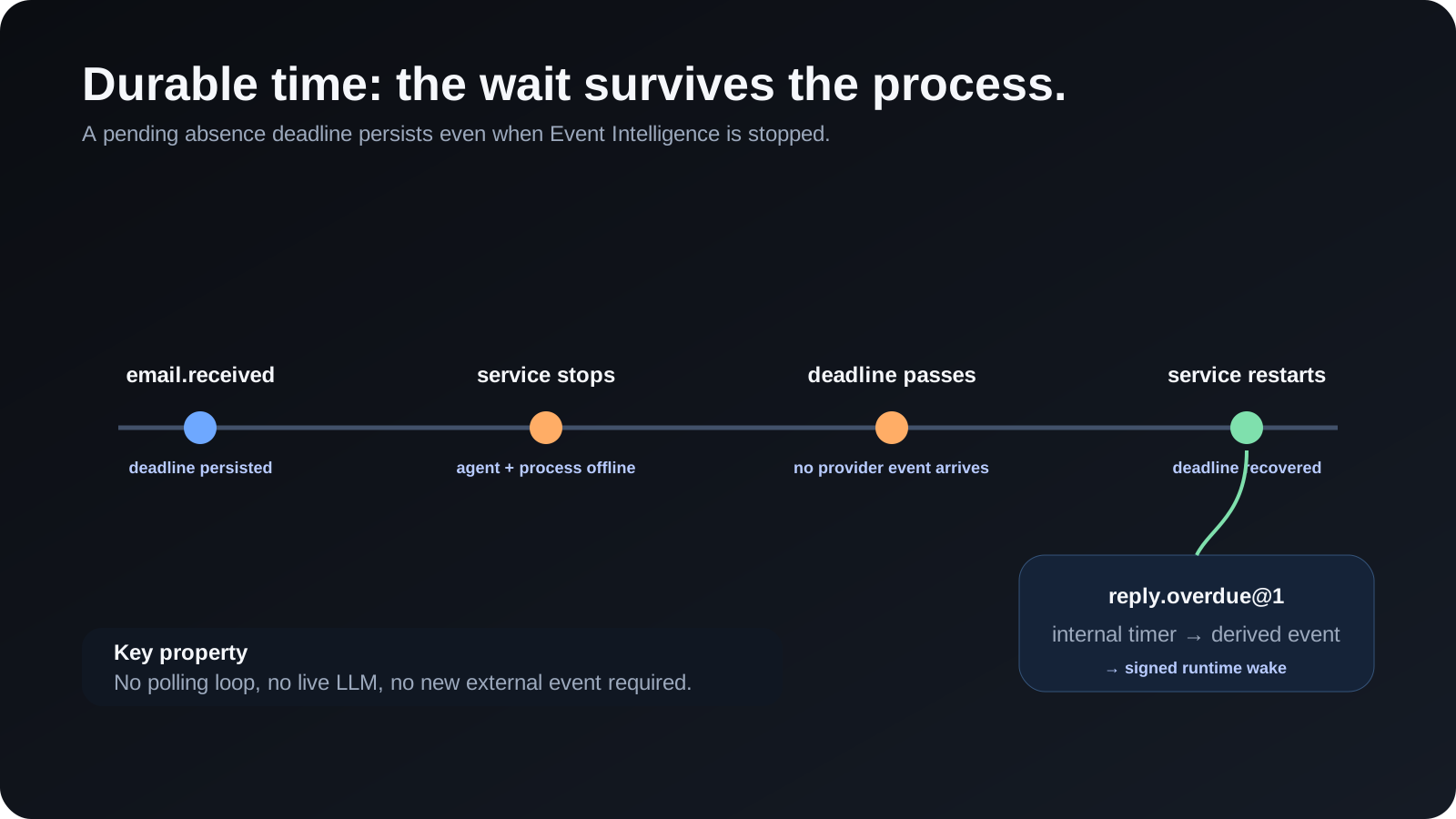
- durable deadlines that continue even when no new provider event arrives.
Event sources vs subscriptions
events/list discovers an EventSource descriptor. A durable EventSubscription is a separate runtime object identified by the host connection, event name and canonical subscription arguments. Each subscription owns its cursor/delivery state independently.
This keeps MCP-side filtering separate from Event Intelligence conditions: arguments are validated against the provider's inputSchema; trigger where predicates are evaluated by EI against delivered payloads. Two triggers may therefore subscribe to the same event name with different arguments without sharing cursors.
Poll, push and webhook are treated only as delivery mechanisms. All three normalize into the same EventOccurrence ingestion path before correlation, temporal reasoning, derived events or wake logic.
Agent-authored continuations
- event-source discovery;
- agent-friendly deterministic trigger planning/compilation;
- MCP subscription
argumentsvalidated against each sourceinputSchema, kept distinct from EI payload predicates; - structured predicates including
eq,neq,contains,startsWith,endsWith,regex,in,notIn,between,exists,isNull,type,gt,gte,lt,lte; - persisted continuation contracts separated from trigger conditions;
- Activation Envelope hydration with matched event evidence;
- embedded wake callbacks receive
(packet, activation); - deterministic validation against real source schemas and advertised fields;
- approval-gated persistent mutations;
- one-shot, cooldown, max-firings, expiry, leases, update and delete.
Derived events and composition
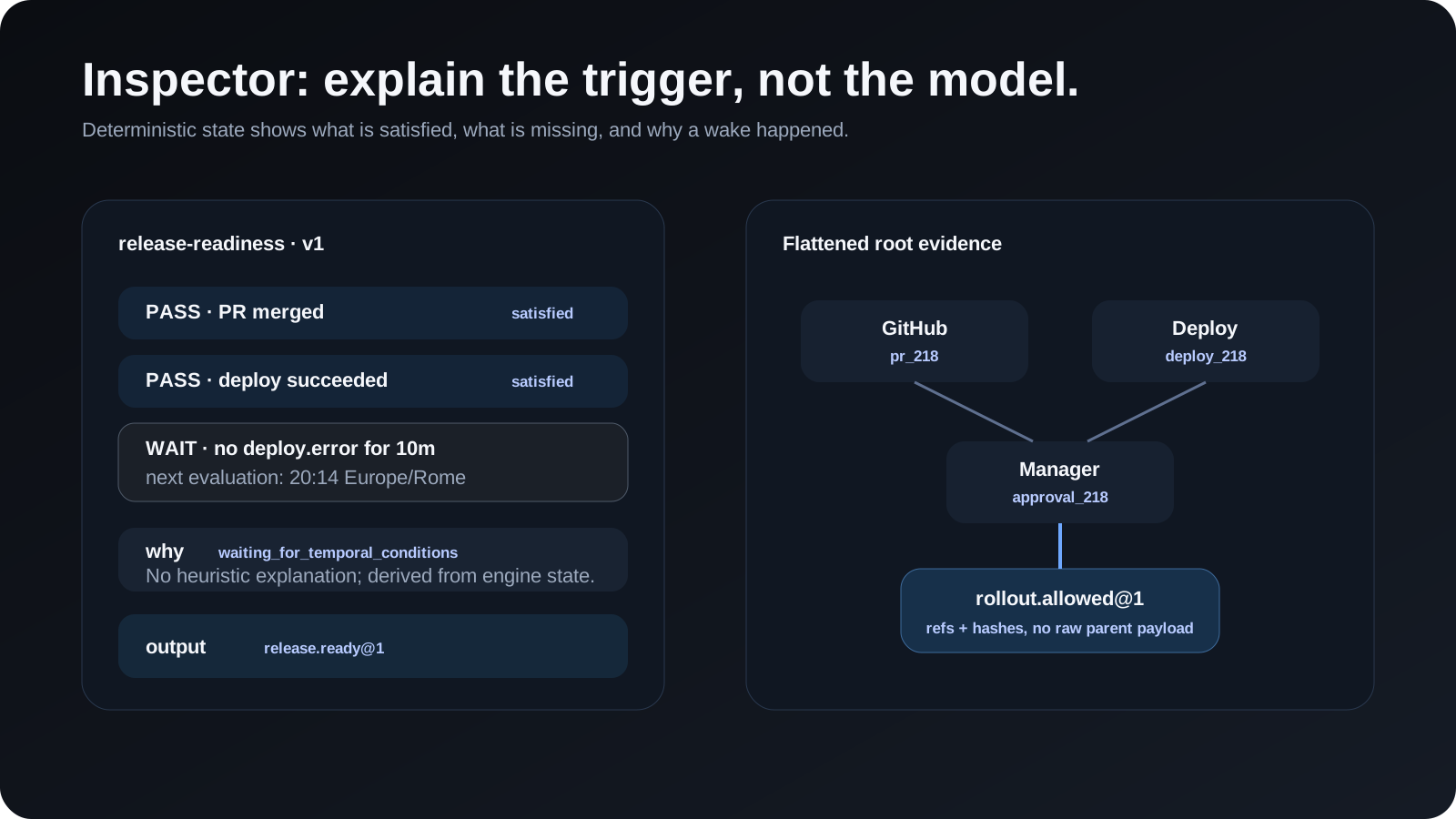
Triggers can emit immutable higher-level events instead of waking an agent:
pr.merged + deploy.succeeded
              ↓
        release.ready@1
              +
       manager.approved
              ↓
       rollout.allowed@1
              ↓
          runtime wake
Derived events preserve refs-only lineage to their direct parents and flattened root evidence.
Versioned contracts
Derived event names are versioned contracts such as release.ready@1.
- first producer establishes the canonical schema;
- compatible producers may join the same contract version;
- incompatible schemas fail before trigger persistence;
- multiple versions may coexist;
- ambiguous unversioned consumers fail closed;
- every occurrence carries a schema fingerprint.
Host or callback wake
An embedded harness can provide one in-process wake dispatcher that routes by target.runtime, target.kind and target.id; runtime-specific handlers remain available as a lower-level option. A standalone deployment can instead use signed HMAC callbacks. Both paths return a stable runtimeReceiptId.
Runtime delivery is durable: a stable wake ID gets a persisted delivery record, a worker claims it with a lease, transient failures are retried with bounded exponential backoff, expired claims can be recovered after restart, and only an exhausted retry budget enters dead-letter. This prevents two workers sharing an atomic store from intentionally owning the same delivery at the same time. The runtime should still treat the stable wake ID as an idempotency key because no system can make an arbitrary external side effect transactionally exactly-once without cooperation from the receiver.
Why this exists
MCP Events is concerned with the event transport/subscription boundary. Event Intelligence explores the layer above transport:
- how an agent declares a future condition;
- how multi-event state survives while the agent sleeps;
- how absence/time becomes an event;
- how higher-level facts are derived without invoking a model;
- how those facts can be safely composed;
- how a host resumes an agent effectively once in the validated scenarios.
This project does not propose a replacement for MCP Events and does not claim to be an official MCP extension.
AI and API keys
Event Intelligence has one optional AI boundary: explicit semantic evaluation.
- Pattern AST exposes a vendor-neutral
semanticnode as the only semantic condition form. TYPESAFE_API_KEYenables the bundled TypeSafe Jev evaluator when a trigger explicitly requests semantic evaluation.- embedded hosts may inject a compatible
semanticEvaluatorinstead. - deterministic predicates, patterns, windows, aggregations, state changes, deadlines and derived measures never require an AI evaluator.
- there is no bundled OpenAI planner and no OpenAI API dependency.
The agent/harness is already responsible for natural-language reasoning. It can use trigger_plan / planTrigger() to compile common requests deterministically against discovered source schemas, or submit a canonical trigger definition directly for advanced cases. Deterministic correlation, temporal logic, persistence, derived events and wake delivery require no model API.
Full-system acceptance
The v0.6 acceptance suite verifies:
- host-owned MCP client → extension discovery → durable subscription → poll/push/webhook occurrence → composite match → in-process wake;
- provider-neutral events → composite match → derived event → derived composition → signed runtime wake;
- contract schema evolution and ambiguity rejection;
- refs-only root provenance;
- replay without duplicate derived events or wakes;
- process shutdown while a temporal deadline is pending;
- restart on the same datastore after the deadline;
- wake recovery without a new provider event;
- retry-state recovery after process restart and lease-based concurrent-worker exclusion;
- shared-host tenant isolation with identical trigger IDs in different scopes;
- bounded/single-flight provider polling;
- provider-generalization coverage with ERPNext-shaped invoice/order events;
- hash-linked audit verification.
A separate live regression also verified real GitHub webhook ingress into the MCP EventOccurrence / composite fan-in path.
Reference/debug service
The HTTP service remains useful for local development, conformance work and provider-native regression tests. It is not the primary integration model and does not replace the embedded host-owned package path above.
Requirements
- Node.js 22+
- no external database for the reference setup
git clone https://github.com/sarooo17/event-intelligence.git
cd event-intelligence
npm ci
npm run check

export SERVICE_AUTH_TOKEN="$(openssl rand -hex 32)"
npm start
Then:
curl http://127.0.0.1:3000/readyz
The standalone service supports manual/provider-native event ingress. It does not own arbitrary MCP connections; host-owned MCP reuse belongs to the package integration above.
Docker
docker build -t mcp-event-intelligence:0.6.1 .

docker run --rm \
  -p 3000:3000 \
  -v mcp-event-intelligence-data:/data \
  -e SERVICE_AUTH_TOKEN="$(openssl rand -hex 32)" \
  mcp-event-intelligence:0.6.1
Optional MCP control plane
The package also exposes a standard MCP stdio control plane through the official TypeScript SDK v2:
npx mcp-event-intelligence mcp
Read/non-mutating tools are exposed by default, including event_sources_list, trigger_plan, inspection, simulation, wake_hydrate, contracts and runtime status. trigger_create accepts either a raw canonical definition or the same agent-friendly plan shape; EI compiles the latter before applying the normal mutation controls.
Persistent trigger mutations are only registered when the operator explicitly enables MCP_WRITE_ENABLED=true, and each mutation still requires a confirmationId. The MCP server is a control-plane adapter; it is not a gateway through which the host's other MCP servers must be reconnected.
See docs/QUICKSTART.md and docs/MCP-REGISTRY.md.
Configuration
Standalone/core environment variables:
| Variable | Required | Purpose |
|---|---|---|
SERVICE_AUTH_TOKEN | yes for protected HTTP APIs | bearer token for control-plane endpoints |
DATA_DIR | no | persistent JSONL directory, default ./data |
PORT | no | HTTP port, default 3000 |
ENVIRONMENT_ID | no | environment boundary |
RUNTIME_WAKE_TARGETS_JSON | no | signed standalone runtime callbacks |
GITHUB_WEBHOOK_SECRET | no | verify GitHub webhook ingress |
TYPESAFE_API_KEY | no | bundled TypeSafe Jev semantic evaluator |
WAKE_DELIVERY_MAX_ATTEMPTS | no | maximum wake delivery attempts, default 5 |
WAKE_DELIVERY_LEASE_MS | no | claim lease duration, default 30000 |
WAKE_RETRY_BASE_DELAY_MS | no | first retry delay, default 1000 |
WAKE_RETRY_MAX_DELAY_MS | no | retry backoff cap, default 60000 |
WAKE_RETRY_TICK_MS | no | retry scheduler tick, default 1000 |
Embedded hosts pass one MCP registry adapter. Event Intelligence discovers already-connected clients from that registry; provider MCP connection settings are not duplicated inside EI.
Architecture
The detailed execution model, clocks, lifecycle, persistence and trust boundaries are documented in docs/ARCHITECTURE.md.
Important semantics
Event-time vs processing-time
Normal event windows use event occurredAt; MCP ingress also preserves host receivedAt when available. Delivery order does not define event order.
Out-of-order events are matched against compatible event-time windows. A late event may re-anchor a partial match to an earlier occurredAt only when the complete event-time span still fits withinMs; otherwise it starts a separate partial window and cannot create a false sequence.
Triggers may set eventTime.allowedLatenessMs (default 0). EI maintains an event-time watermark per trigger/correlation stream: old partial windows are retained until their expiry falls behind maxObservedEventTime - allowedLatenessMs. An event older than the watermark can still complete a retained compatible partial, but cannot seed a new stale window.
Absence/deadline progression uses Event Intelligence processing time. This separation is explicit and tested.
Effectively-once runtime activation
The implementation does not claim theoretical distributed exactly-once delivery.
It uses stable wake IDs, persisted delivery state, atomic claim leases, bounded retries, runtime receipts and replay handling to provide effectively-once runtime activation in the validated reference scenarios.
Derived event vs current state
A derived event says what became true at a point in history.
Event Intelligence intentionally does not implement a mutable current-state/facts database.
Security
Read SECURITY.md and docs/SECURITY-MODEL.md.
In embedded mode, the host retains MCP authorization and credentials; Event Intelligence discovers only the client objects exposed through the host-provided MCP registry. Tenant-facing callers should receive only host.scope(scopeId). The reference JSONL store is scope-partitioned and single-process; distributed custom stores must preserve scope isolation and atomic wake claims.
MCP compatibility status
There are two separate MCP boundaries:
- event ingress: host-owned, already-connected MCP clients exposing the experimental
io.modelcontextprotocol/eventsextension, plus provider-native adapters; poll is native in the reference provider adapter, while push/webhook receivers remain host-owned delivery adapters; - control plane: optional standard MCP stdio server built on the official TypeScript SDK v2 and targeting protocol revision 2026-07-28.
Registry identity:
io.github.sarooo17/event-intelligence
server.json is validated with the official mcp-publisher validate command in CI. MCP Events itself remains experimental and may change as the Triggers & Events work evolves.
Project status
v0.6.x reference implementation / experimental.
The architecture is implemented and exercised end-to-end. Storage is now injectable and scoped, while the bundled JSONL backend remains a single-process reference implementation. Remaining work is primarily production database adapters/HA validation, scale benchmarks and upstream feedback.
Example
See the release-gate example for a composed future-condition flow using durable time, derived events and targeted wake.
Contributing
See CONTRIBUTING.md.
Contributions are especially useful around host adapters, MCP Events compatibility, temporal semantics, production persistence, security review and reproducible provider integrations.
License
Apache License 2.0. See LICENSE.
Disclaimer
This is an independent open-source project. It is not an official Model Context Protocol specification and is not affiliated with or endorsed by the MCP maintainers.