Listed from the MCP registry; nobody on Odel publishes it.
Is this yours? Claim it
twelveswaras
Identify the raaga in Carnatic or Hindustani music; look up 70 raagas' scales and notes.
One address for any MCP client. No sign-in needed on this server.
What it does
2 read2 other
Grouped by tool name.
What it costs
FreeOdel charges nothing per call. The publisher may charge for its own service.
Tools
4 · grouped by tool name · checked 13 Nov 2026Read · 2Look things up
- find_raaga
- list_raagas
Other · 2Neither hinted nor named
- raagas_with_notes
- identify_raaga
An open-source "Shazam for raagas": play it a clip of Carnatic or Hindustani music and it names the raaga, shows the tonic (Sa) it heard, and helps you learn to hear that raaga yourself.










Live: twelveswaras.com. The recognizer runs first-party on Cloudflare (Worker + container), with no third-party embed.
Status: live and recognizing 70 raagas (40 Carnatic, 30 Hindustani) from one dual-tradition model. Hindustani is a preview: it has no real-world benchmark yet. The opt-in contribute-to-the-commons loop is live for both traditions. twelveswaras is non-commercial and open source, stewarded in the neutral
twelveswarasGitHub organisation, not owned by any company.
Contents
- What it does
- Features
- Use it from an AI assistant (MCP)
- Run it locally / command line
- Open data
- How it works
- Accuracy
- Project layout
- Development
- Deploy
- Contributing
- Citing this work
- Licensing
- Acknowledgements
What it does
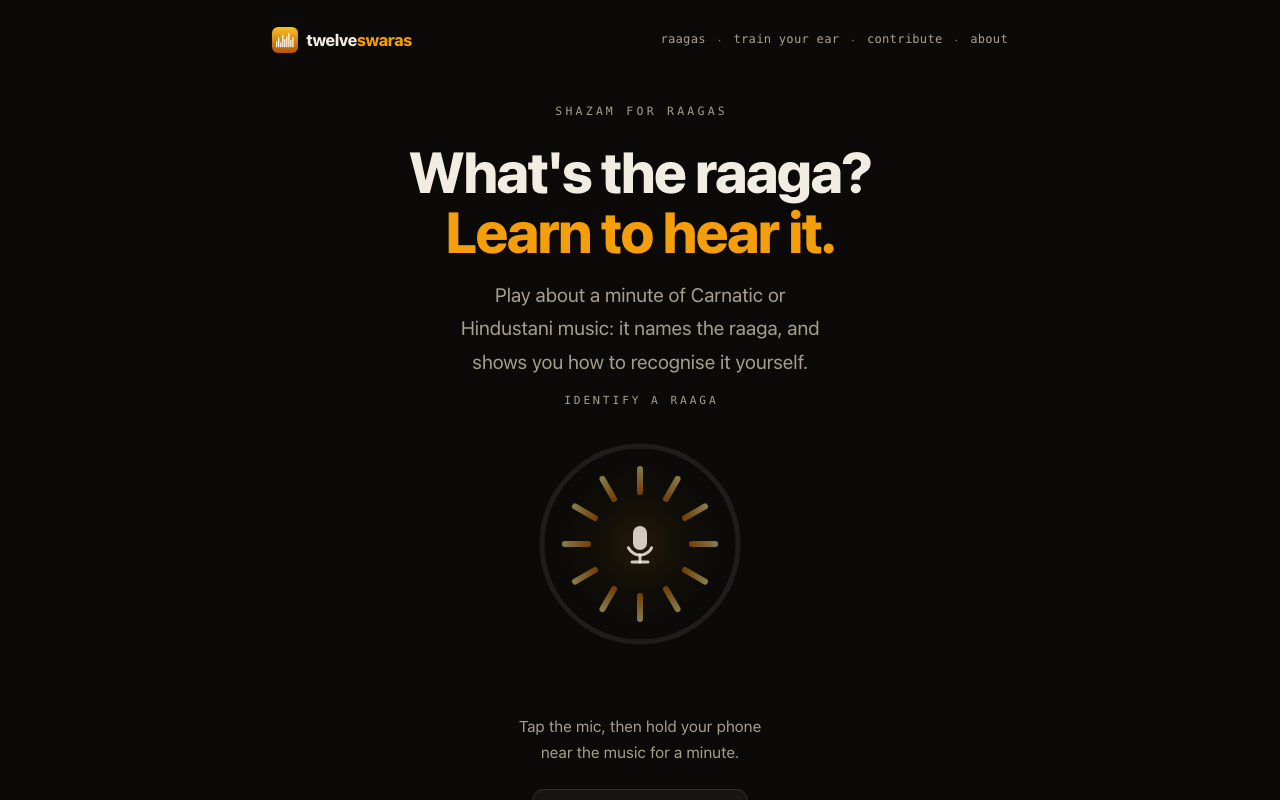
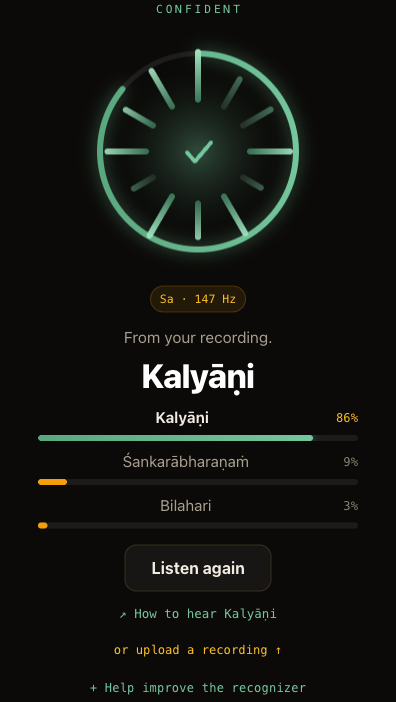
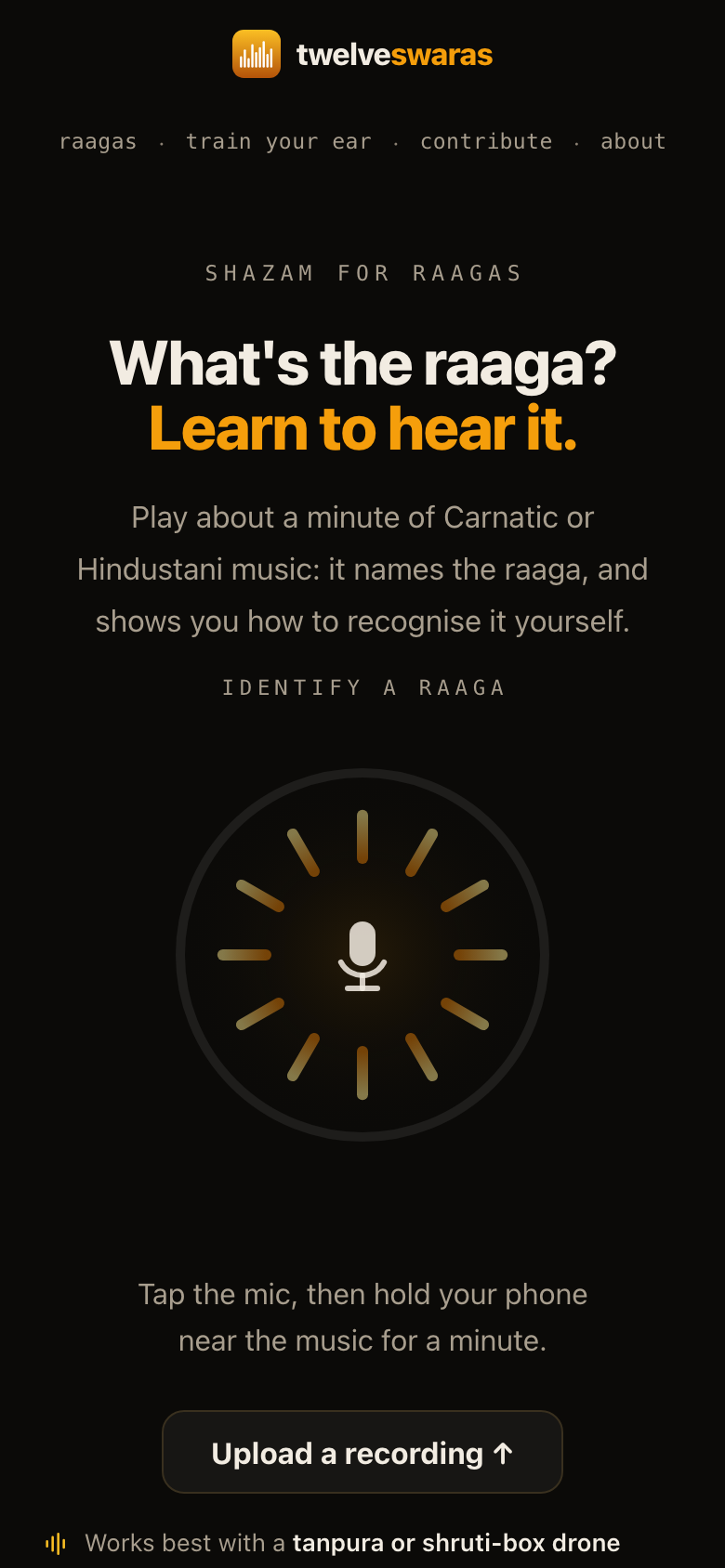
Play about a minute of Carnatic or Hindustani music to twelveswaras.com, from the microphone or an uploaded recording. It shows the top three raagas with calibrated confidence and the tonic (Sa) it detected, and links to that raaga's page so you can learn to hear it. Below a confidence threshold it says "not sure" and invites you to teach it the raaga instead.
Why "twelveswaras"? The twelve swaras are the twelve note-positions of the octave, the shared alphabet of both Carnatic and Hindustani music. The name, schema and pipeline are tradition-neutral on purpose: Carnatic came first, but nothing locks the project to one tradition.
How it differs from Shazam. Shazam does audio fingerprinting: it matches a specific recording. twelveswaras does audio classification: it infers the musical structure (the raaga) of any performance, including one it has never heard. That is a Music Information Retrieval problem, not a lookup.
Features
- Recognizer: 70 raagas (40 Carnatic, 30 Hindustani) from one model, with the top three, the tonic, and an honest "not sure" below a confidence threshold. On a live listen it shows no raaga name for the first minute, because answers before then are right only about half the time.
- Raaga Explorer (
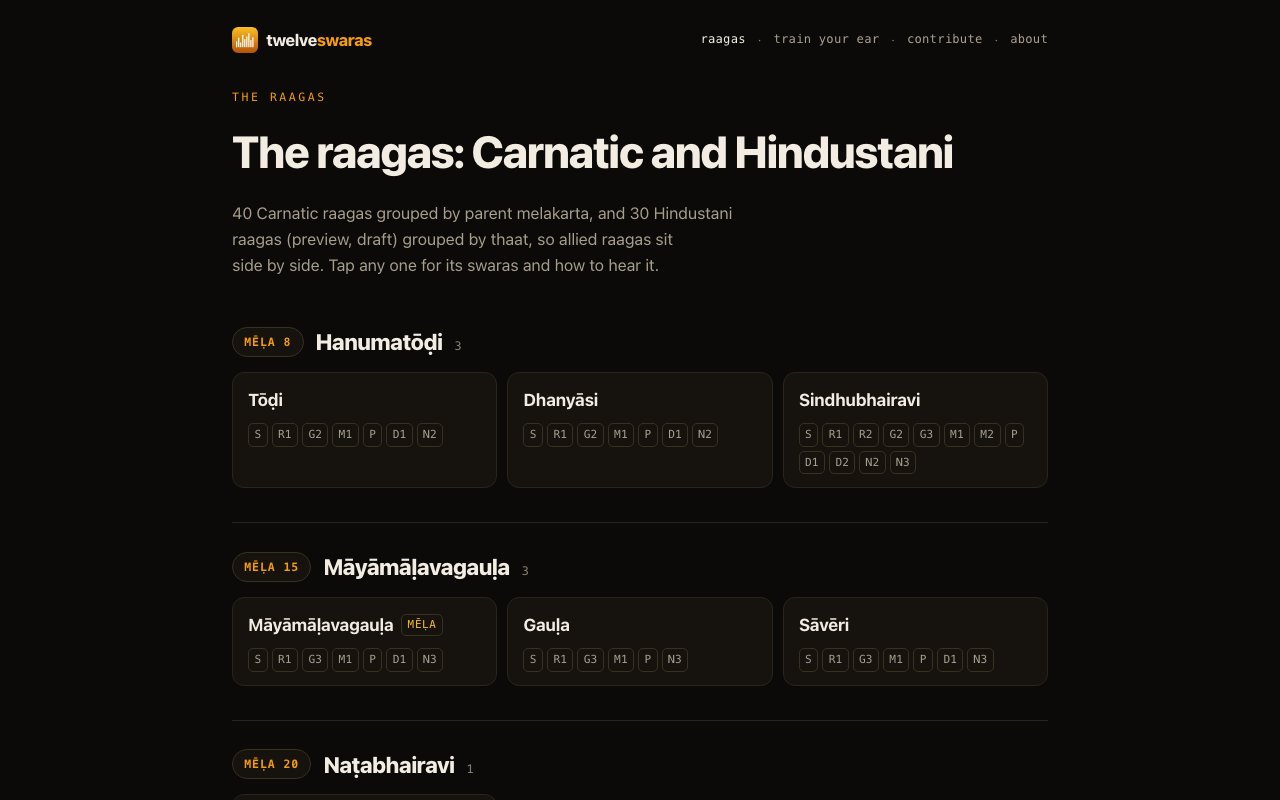
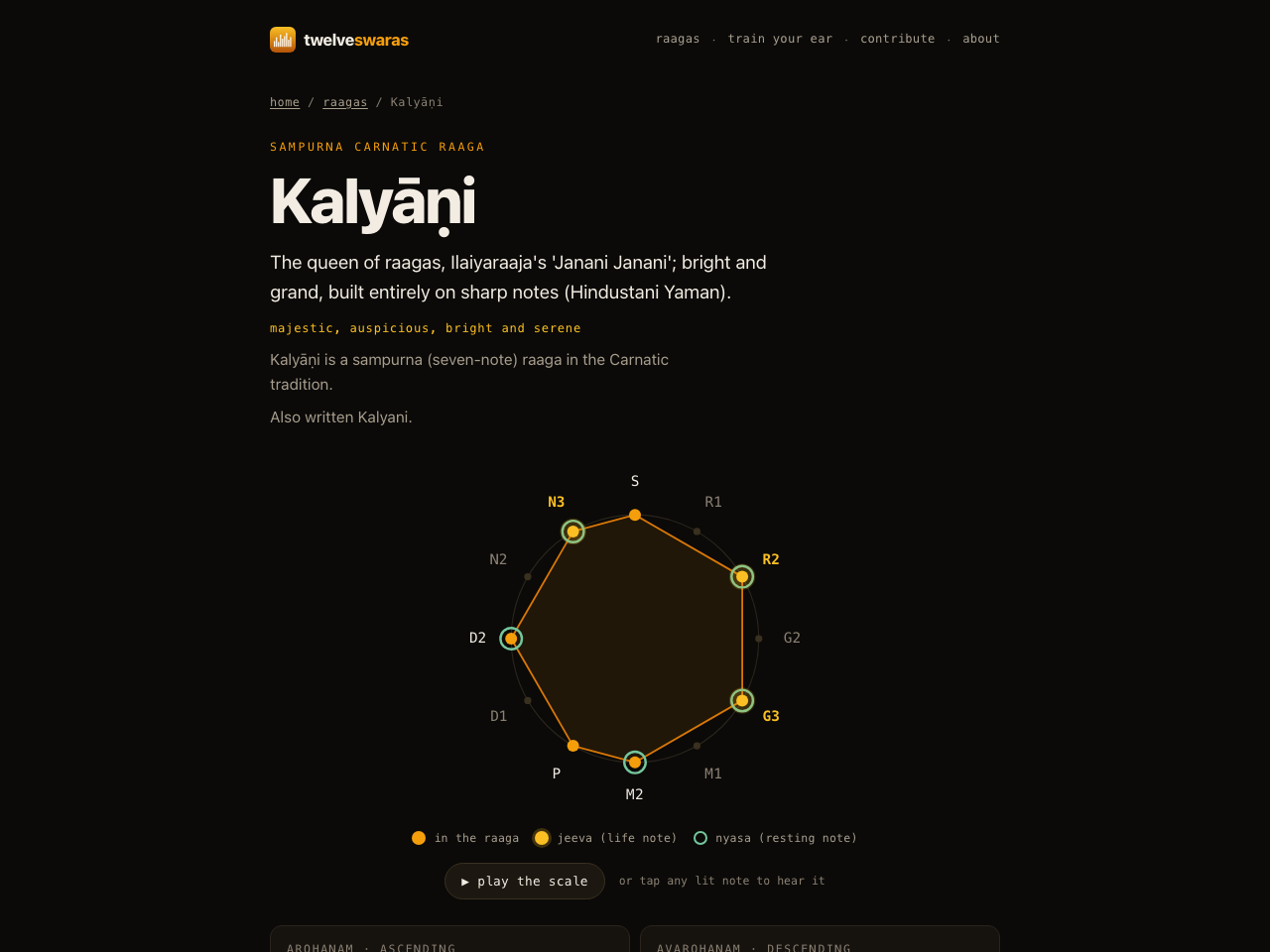
/raaga/): a page per raaga, the 40 Carnatic raagas grouped by parent melakarta and the 30 Hindustani raagas by thaat, so allied raagas sit side by side. Each page has a playable swara wheel, the scale, and how to hear it. - Train your ear (
/listen/): an ear-training game for Carnatic raagas that runs in the browser: hear a scale, guess the raaga. - Contribute to the commons (
/contribute/): donate a clip after identifying it, or record one directly. Rights-gated, anonymous by default, and the audio stays private unless you release it under CC-BY-4.0. - MCP server at
https://twelveswaras.com/mcpfor AI assistants. - Open data and model weights under CC-BY-4.0.
Use it from an AI assistant (MCP)
twelveswaras is a remote MCP server at https://twelveswaras.com/mcp (Streamable HTTP, no
sign-in). Add it as a remote or custom connector in Claude, ChatGPT, Cursor or any MCP client. It is
published in the official
MCP Registry
as io.github.sathya-sankaran/twelveswaras (the entry is server.json). AI apps send
their own name when they connect. We count MCP sessions by app (Claude, Cursor, …) and keep nothing else.
| Tool | What it does |
|---|---|
find_raaga | Look a raaga up by any spelling (Mohanam, Mōhanaṁ, Bhoop, "kalyani ragam"). Returns its scale, parent, notes, key notes, songs, what it is confused with, and its page. |
raagas_with_notes | The raagas that use a set of notes, in Carnatic labels (S R2 G3 P D2) or Hindustani letters (S R G P D). |
list_raagas | The 70 raagas (40 Carnatic, 30 Hindustani), with their parent and page. |
identify_raaga | The raaga in a recording at a public http(s) URL (mp3, wav, m4a, ogg, webm; up to 25 MB): the top three with confidence, the tonic, and each raaga's page. The recording is not stored. |
find_raaga, raagas_with_notes and list_raagas take an optional tradition (carnatic or
hindustani). To see the tool list from a shell:
curl -s https://twelveswaras.com/mcp \
  -H 'content-type: application/json' \
  -H 'accept: application/json, text/event-stream' \
  -d '{"jsonrpc":"2.0","id":1,"method":"tools/list"}'
No key is needed. If you call it from your own code, please send a User-Agent that names your
app (for example my-app/1.0). We read it only to tell apps, AI tools and crawlers apart, so our
counts of how each mode is used stay honest. We don't store it, and we don't track who you are.
The server is cloudflare/worker/src/mcp.js.
Run it locally / command line
The npm package twelveswaras is a command line and a local MCP server in one (Node 18+, no
dependencies). It names the raaga in a recording on your own machine, which the hosted
identify_raaga cannot (it needs a public URL):
npx -y twelveswaras identify concert.m4a              # top three, confidence, tonic, each raaga's page
npx -y twelveswaras identify concert.m4a --from 2:30  # skip applause or talk (needs ffmpeg)
npx -y twelveswaras raaga mohanam
npx -y twelveswaras notes "S R2 G3 P D2"
npx -y twelveswaras list --tradition hindustani
npx -y twelveswaras identify concert.m4a --format md | npx -y mdshare-mcp upload -   # or --share
With no arguments it runs as a stdio MCP server with the same four tools, where identify_raaga
also takes path, a file on this machine. For a desktop client:
{ "mcpServers": { "twelveswaras": { "command": "npx", "args": ["-y", "twelveswaras"] } } }
See cli/README.md.
Open data
Both files are CC-BY-4.0. Credit them as "twelveswaras (twelveswaras.com), CC-BY-4.0".
| URL | What it holds |
|---|---|
/data/raaga-reference.json | The facts on the raaga pages for all 70 raagas: scales, parents and note sets (positions count semitones from Sa, 0 to 11). |
/data/raagas.json | The 40 Carnatic raagas from the app's production guide, with the model's note sets. Records with reviewed=false are provisional. |
The scales, parents and note sets were checked against published sources; the corrections and their
sources are in raaga_corrections.json. They have not been reviewed by a
musician, so corrections are welcome (see Contributing).
How it works
Fully automatic, with no input beyond the audio. METHODOLOGY.md has the full
detail and citations.
- Predominant-melody pitch from the audio (Essentia
PredominantPitchMelodia). - Tonic (Sa) from the tanpura drone (Essentia
TonicIndianArtMusic, the Salamon, Gulati and Serra multipitch method), from up to 300 s of audio: Sa accuracy keeps rising with listening time. Tonic-normalization, hearing everything relative to Sa, is the key step the Harvard reference thesis skipped. - Feature: a tonic-normalized, windowed Time-Delayed Melody Surface (TDMS), a 2-D histogram
of
(pitch(t), pitch(t+delay))that captures gamaka (the movement between notes), not just which notes occur. - Classifier: XGBoost over the surfaces, window-aggregated.
- Swara chains: a second-order Markov chain per raaga over the sung swaras captures the order of notes (phrases, zig-zag movement) that TDMS cannot see. Its evidence is fused with the classifier's, then temperature-calibrated, so a shown "70%" is right about 70% of the time.
The request path: the site (Cloudflare Pages) calls the Worker at /api/*, which calls the headless
recognizer (a Cloudflare Container running Essentia and XGBoost), with D1 for result metadata and R2
for opt-in clips.
Accuracy
- Studio benchmark (frozen, 129 tracks): top-1 0.830 (chance 0.025), after surface augmentation and a junk gate that drops non-melodic windows.
- Real-world benchmark (80 clips, the number that matters): top-1 0.713, top-3 0.800. Before the swara chains it was 0.537 / 0.762; before the tonic was heard up to 300 s, 0.688 / 0.787.
- Hindustani (preview): the unified model cross-validates at about 0.88 top-1 on clean studio audio, with cross-tradition confusion of about 3%, and Carnatic held steady when Hindustani was added. That is the studio ceiling only; a real-world Hindustani benchmark is still pending.
The gap between studio and real-world audio is the whole problem, and closing it is what the data
commons is for. The full progression is in benchmark/leaderboard.md.
Needs a drone. Concert and TV audio works; solo voice with no drone is unreliable. Known
limitations are listed in METHODOLOGY.md.
Project layout
| Path | What it is |
|---|---|
raaga_id/ | The core library: pitch extraction, features (TDMS), model, training, calibration, evaluation. |
apps/ | Entry points: identify (the local demo) and usage_log (the old Hugging Face usage logger, superseded by D1). |
space/ | Source of the recognizer API (api.py), bundled into the Cloudflare container by cloudflare/recognizer/assemble.sh. |
cloudflare/ | The Worker API and MCP server (worker/), the recognizer container (recognizer/), the D1 schema, and DEPLOY.md. |
site/ | The static website, including site/data/ (the open data). |
tools/ | Training, cross-validation, real-world evaluation, page and data builders, clip fetchers. |
pipeline/ | Commons jobs: pull_commons, import_shaale (licensed bulk import), and the planned retrain. |
benchmark/ | The frozen evaluation set, the leaderboard and the real-world clips. |
tests/ | The Python test suite. |
e2e/ | Browser tests (Playwright) against the site, with the recognizer API stubbed. |
raagas*.json, raaga_guide*.json, raaga_profiles.json, raaga_corrections.json | The raaga reference data the site and the open data are built from. |
cli/ | The npm package twelveswaras: the command line and the local MCP server. |
server.json | The MCP Registry entry (the hosted server and the npm package). |
Development
The project uses two conda environments, because the audio-to-pitch path (Essentia) needs
numpy < 2 while training uses numpy 2.x.
# 1. Training, features, benchmark and the tests
conda env create -f environment.yml
conda activate twelveswaras

# 2. Inference and the local demo (the audio -> raaga path, with Essentia)
conda env create -f environment-inference.yml
conda activate twelveswaras-infer
python -m apps.identify
On Linux (for example the recognizer container), install from requirements.txt instead of
environment.yml.
Tests
CI (.github/workflows/ci.yml) runs all three suites on every pull
request and every push to main.
# Python suite, from the twelveswaras env at the repo root
pytest tests/ -q

# Worker and MCP unit tests (Node 20, no dependencies, no network)
cd cloudflare/worker && node --test

# The command line (cli/), same: no dependencies, no network
cd cli && node --test

# Browser tests: the static site served from site/, the recognizer API stubbed
cd e2e
npm ci
npx playwright install chromium
npx playwright test
CI also fails on any em-dash (U+2014) in a tracked Markdown file, checks that CITATION.cff parses,
and checks the site's JSON-LD. It also runs ruff check . (pinned to the version in ci.yml), so run
it before you push.
Deploy
A merge to main deploys site/ to Cloudflare Pages from CI, once the Python, lint and browser
checks pass. The Worker, D1, R2 and the recognizer container are deployed with Wrangler; the steps
are in cloudflare/DEPLOY.md.
Contributing
For most people the most valuable contribution is not code: contribute an audio clip at
twelveswaras.com after identifying a raaga, especially an in-the-wild
recording (a concert, radio, TV, your own practice with a drone). It grows the openly licensed data
commons and improves the model. Contributing is anonymous by default, with an optional public
credit in CONTRIBUTORS.md.
Musicians can review the raaga reference (open an issue or edit the JSON), and everyone can report
issues or send code. See CONTRIBUTING.md, the
CODE_OF_CONDUCT.md and GOVERNANCE.md. Report security
issues privately as described in SECURITY.md, not in a public issue.
The project follows People's Digital Goods and Infrastructure (PDGI) principles:
people before digital, rights-centric, commons-oriented, transparent. PDGI.md is a
public scorecard of how each one is implemented and where it still falls short.
Roadmap. Deepen the commons before widening it: more in-the-wild audio of the current 70 raagas (about 12 varied recordings per raaga is the floor for learning one); new raagas are trained in only once they reach that, always quarantined from the 70. Next, fold contributed clips into a retrain and publish the CC-BY contributor dataset. Then quality: allied-raaga disambiguation, an out-of-distribution detector for confident-but-wrong cases, a real-world Hindustani benchmark, and an expert-annotation tier. The dataset audio is now available for research use; training on features computed from it the way the site computes them did not help (see the benchmark leaderboard), and published results for pretrained music models on raagas are weak, so a better pitch tracker is the audio-based method still worth a trial.
Citing this work
If you use twelveswaras in research, please cite it. CITATION.cff holds the
machine-readable metadata (GitHub shows a "Cite this repository" button from it) and lists the
datasets and prior work the model builds on. Releases are archived on Zenodo:
10.5281/zenodo.24096813 always resolves to the latest
version, and each version has its own DOI on that page (1.0.0 is
10.5281/zenodo.24096814). Please cite the version you used.
Sankaran, S. (2026). twelveswaras: an open-source raaga recognizer for Carnatic and Hindustani music [Computer software]. Zenodo. https://doi.org/10.5281/zenodo.24096813
@software{sankaran_twelveswaras,
  author    = {Sankaran, Sathya},
  title     = {twelveswaras: an open-source raaga recognizer for Carnatic and Hindustani music},
  year      = {2026},
  publisher = {Zenodo},
  doi       = {10.5281/zenodo.24096813},
  url       = {https://doi.org/10.5281/zenodo.24096813}
}
For a specific version, add its version number and use that version's DOI from the Zenodo page. Other styles (Harvard, MLA, Chicago and more) are on the Zenodo page and behind GitHub's "Cite this repository" button.
Licensing
- Code: MIT (
LICENSE). - The running recognizer: AGPL-3.0. It uses Essentia (AGPL-3.0) for pitch and tonic detection, so the recognizer service as a whole is covered by the AGPL: if you run a modified copy for others over a network, you must offer them its source. The MIT files in this repository stay MIT on their own.
- Model weights: CC-BY-4.0, downloadable (with SHA-256 checksums) from the
v1.0.0 release. The model is
trained on the Raga Recognition Dataset features (CC-BY-4.0); credit both those authors and
twelveswaras (see
CITATION.cff). - Reference data (
/data/raaga-reference.json,/data/raagas.json): CC-BY-4.0. - Reference swara profiles (
raaga_profiles.json, the learner panel): CC-BY-4.0, built from the same Raga Recognition Dataset features. - Contributor dataset (the commons): CC-BY-4.0, kept separate from non-commercial source data (such as Saraga, CC-BY-NC-SA) so it stays cleanly reusable.
Code contributions are made under MIT and data contributions under CC-BY-4.0.
Acknowledgements
Built on openly available research corpora, with attribution required by their licences:
- Indian Art Music Raga Recognition Dataset (CompMusic / MTG-UPF; Gulati et al.): the current model is trained on its pitch and tonic features, CC-BY-4.0 (Zenodo); the audio is separate and access-restricted. Its Carnatic (CMD) set backs the 40 Carnatic raagas and its Hindustani (HMD) set the 30 Hindustani raagas.
- Saraga Carnatic (CompMusic / MTG-UPF): CC-BY-NC-SA. Its annotated tonics are the ground truth
for the tonic benchmark (
tools/tonic_bench); earlier seed models trained on it. Nothing derived from it is in the live model. - Community and partner contributions (the data commons): opt-in recordings, CC-BY-4.0 when
contributors release them publicly. Some are shared under a train-only licence (for example
recordings from Shaale): they may be used to train and evaluate models, but
the audio stays private and is never redistributed. They are not in the current model. Credited
in
CONTRIBUTORS.md.
Built with Essentia (AGPL), librosa and XGBoost. gradio is used only
by the local demo (apps/identify), not by the deployed recognizer.
Prior work it builds on:
- S. Gulati et al., Time-Delayed Melody Surfaces for Rāga Recognition (ISMIR 2016): the TDMS feature at the heart of the model.
- S. Gulati, Computational Approaches for Melodic Description in Indian Art Music Corpora (PhD thesis, UPF 2016): the definitive reference, for the tonic and melody methods.
- H. Narayanan, Classifying Ragams in Carnatic Music with Machine Learning (Harvard, 2024), the
"Shazam for ragas" reference implementation. twelveswaras improves on it with tonic-normalization
and TDMS, and adopts its data-augmentation idea (see
METHODOLOGY.md). - Madhusudhan and Beigi, DEEPSRGM: a sequence-model benchmark target.
The full bibliography is in METHODOLOGY.md.