Listed from the MCP registry; nobody on Odel publishes it.

ZShield MCP
Capped, allow-listed shielded Zcash payments for AI agents.
Runs on your machine from its package; the steps are below.
What it does
- Reads
- Writes
- High impact
At most: moves money, runs code or commands, deletes data, or sends messages for you.
What it costs
FreeOdel charges nothing per call. The publisher may charge for its own service.
Runs locally over stdio
This server isn't hosted — your MCP client launches it from a package registry. Use one of the commands below, or drop the config into your client (e.g. Claude Desktop).
Run
npx -y zshield-mcp
MCP client config
{
  "mcpServers": {
    "zshield-mcp": {
      "command": "npx",
      "args": [
        "-y",
        "zshield-mcp"
      ]
    }
  }
}
zshield-mcp
Shielded Zcash payments for AI agents, with human-defined spending controls.
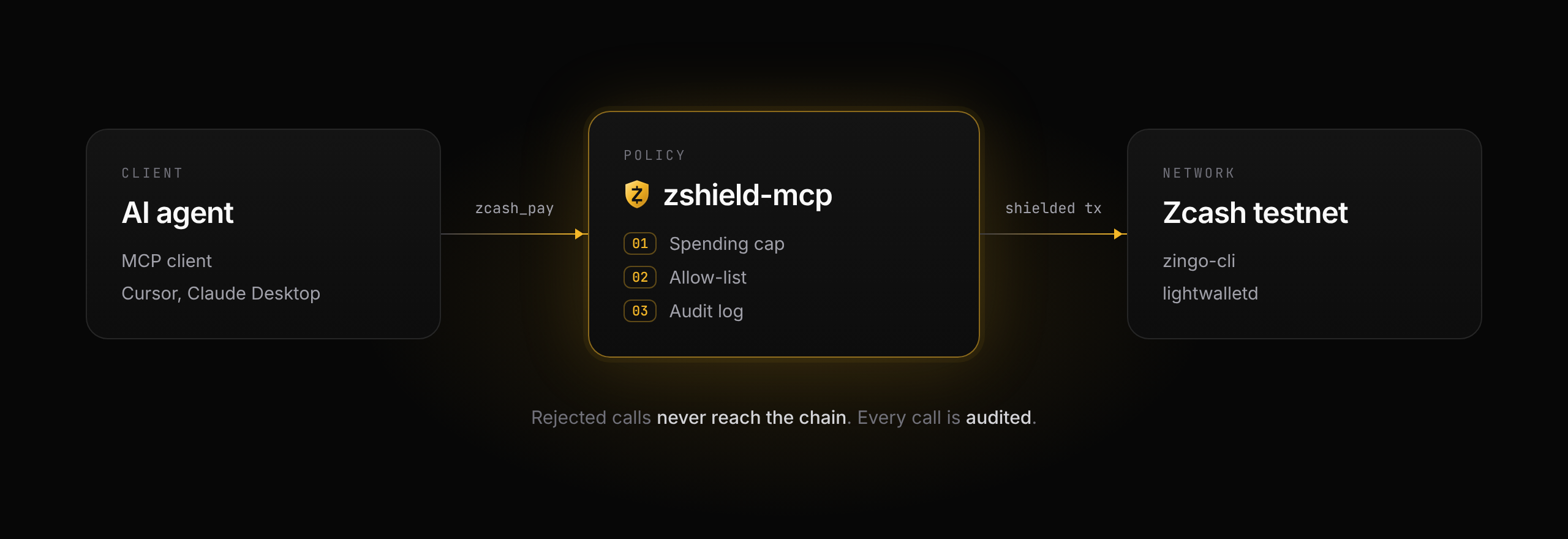
ZShield is an open-source MCP server that lets agents request shielded ZEC payments without exposing wallet spending keys to the model. Every payment is checked against a spending cap and recipient allow-list. Payments have durable idempotency and audit records; wallet reads never move funds.
Supports a local mock wallet, real Zcash testnet payments via zingo-cli, and integrations with zkool_graphql and Ironclad FROST wallets. Mainnet is opt-in and requires additional operator controls.
Status: Mainnet has not been validated for production financial use. Read production readiness before using a funded wallet.
Quickstart
Try it locally (Node.js 20+, no funds required):
git clone https://github.com/Steeve-Crypto/zshield-mcp.git
cd zshield-mcp
npm install
npm run build
npm run demo:mock
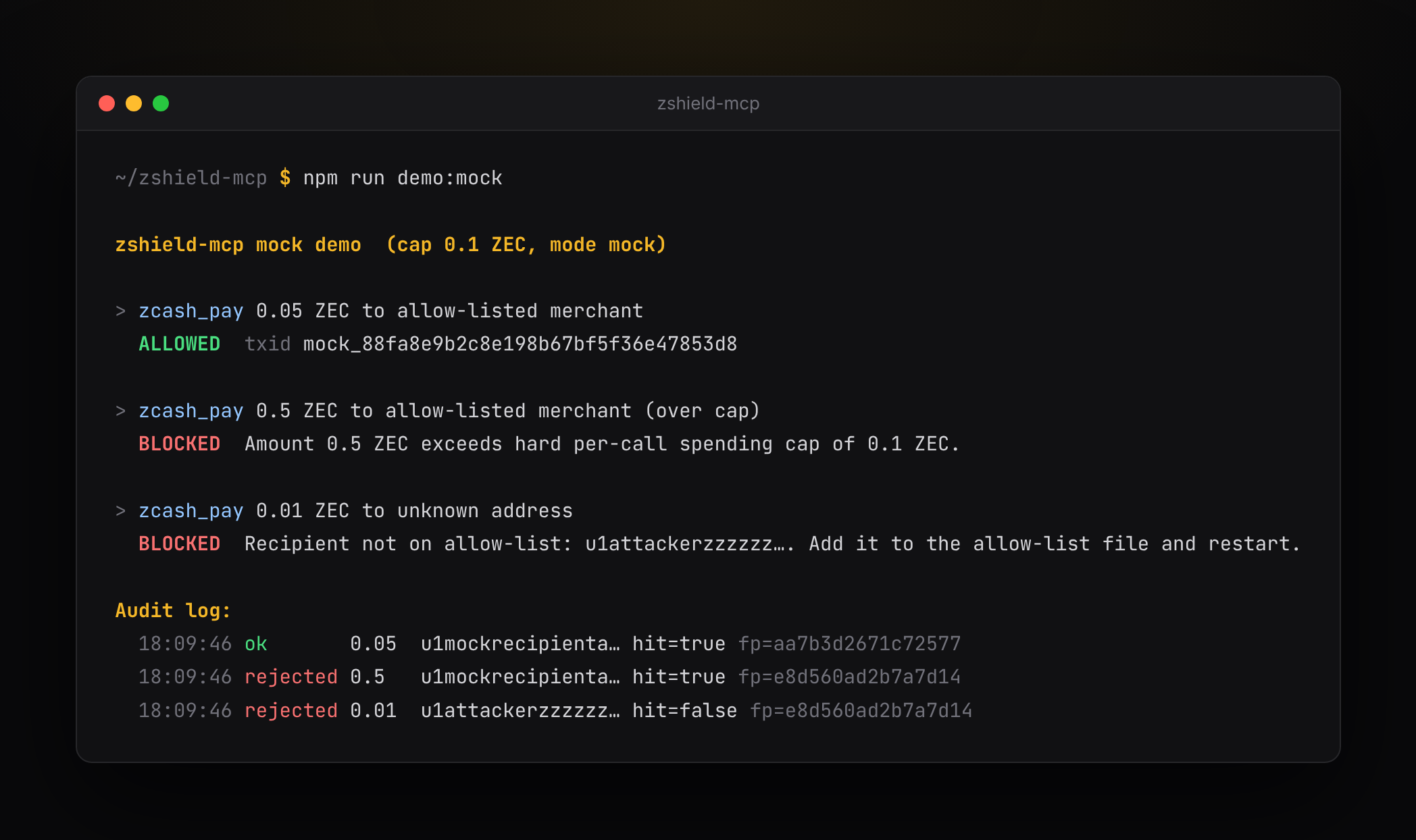
Connect an MCP client using the published package. This example runs in mock mode, so it does not send real ZEC:
{
  "mcpServers": {
    "zshield": {
      "command": "npx",
      "args": ["-y", "zshield-mcp"],
      "env": {
        "CHAIN_MODE": "mock",
        "SPENDING_CAP_ZEC": "0.01",
        "ALLOWLIST_PATH": "/absolute/path/to/recipients.json",
        "AUDIT_DIR": "/absolute/path/to/audits"
      }
    }
  }
}
Copy the example recipient allow-list to the path you configured. For real testnet payments, install and fund a testnet zingo-cli wallet, set CHAIN_MODE=testnet, and configure ZINGO_BIN, ZINGO_DATA_DIR, and VIEW_KEY_FINGERPRINT_SALT. Use operator controls and the security model before enabling live payments.
Tools
| Tool | What it does |
|---|---|
zcash_pay | Requests an allow-listed shielded payment within the spending cap |
zcash_balance | Reads wallet balances |
zcash_receive_address | Reads the wallet's receiving address |
zcash_history | Lists recent wallet transactions |
zcash_payment_status | Checks a payment by call, operation, or idempotency key |
Live zcash_pay calls require amount_zec, recipient, and a unique idempotency_key; memo is optional. An agent can also read zshield://policy to see the active spending policy. Payment requests can be refused; an uncertain send must be checked with zcash_payment_status rather than retried with a new key.
Payment controls
- Spending limit:
SPENDING_CAP_ZECcaps each call. - Recipient allow-list:
ALLOWLIST_PATHrestricts destinations. - Audit trail:
AUDIT_DIRstores payment and rejection evidence. - Safe retries: Durable payment state and idempotency keys guard against duplicate sends.
- Operator protections: Mainnet requires extra controls, including a cumulative budget and approvals.
The server cannot protect a wallet from a compromised host or an operator who grants an agent unrestricted filesystem or process access. Review the security model for the trust boundaries.
Wallet integrations
| Mode | Use |
|---|---|
mock | Local demos and tests; no real transactions |
testnet | Real testnet transfers with zingo-cli |
zkool | A configured zkool_graphql wallet service |
ironclad | Ironclad FROST co-signer integration |
mainnet | Explicit opt-in via zingo-cli; requires operator controls |
For advanced configuration and operational requirements, see operator controls, reliability design, and production readiness.
Testnet proof
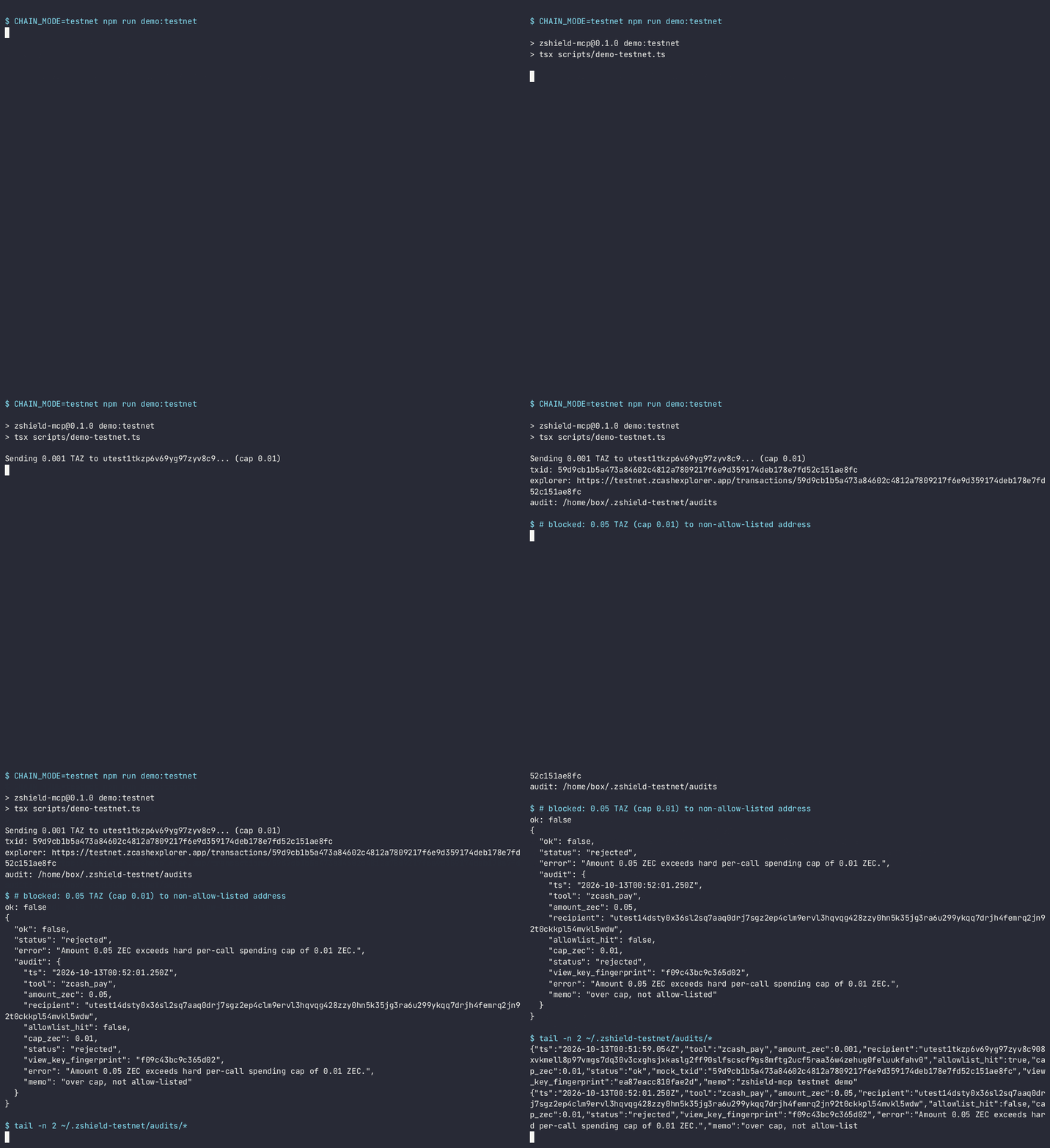
ZShield has completed real shielded testnet payments. The animation below shows a testnet run; it is not a mainnet demonstration.
Development
npm test
npm run typecheck
npm run build
Further documentation: security · audit logs · payment reliability · operator controls · release readiness