Listed from the MCP registry; nobody on Odel publishes it.

CodeInspectus
Local-first MCP security scanner and CLI for AI-generated applications.
Runs on your machine from its package; the steps are below.
What it does
- Reads
- Writes
- High impact
At most: moves money, runs code or commands, deletes data, or sends messages for you.
What it costs
FreeOdel charges nothing per call. The publisher may charge for its own service.
Runs locally over stdio
This server isn't hosted — your MCP client launches it from a package registry. Use one of the commands below, or drop the config into your client (e.g. Claude Desktop).
Run
npx -y codeinspectus
MCP client config
{
  "mcpServers": {
    "codeinspectus": {
      "command": "npx",
      "args": [
        "-y",
        "codeinspectus"
      ]
    }
  }
}CodeInspectus, by Synvoya









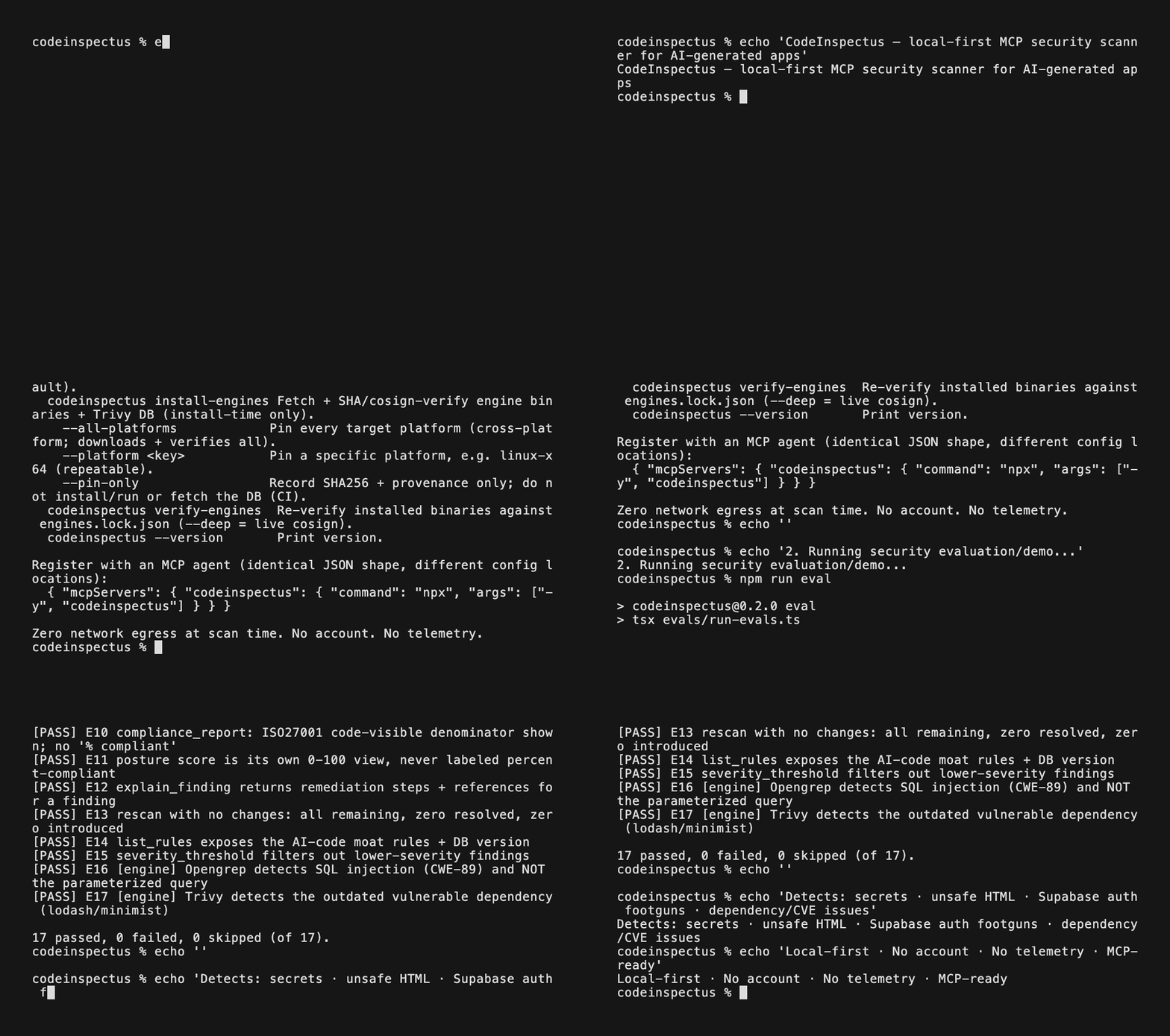
A local-first, privacy-preserving security MCP server and CLI. Any AI coding agent (Claude Code, Cursor, Codex, Windsurf, Cline, Aider) can invoke CodeInspectus to scan AI-generated / "vibe-coded" code for real vulnerabilities, map findings to compliance frameworks as honest code-level coverage, and drive a scan → fix → rescan loop — fully on your machine, with no account and zero network egress at scan time.
Reproduce the V2.1 proof: the codeinspectus@2.1.0 package scans an immutable public Rich
commit, finds one high-confidence GitHub Actions expression-injection pattern, applies GitHub's
documented intermediate-env remediation in a temporary clone, confirms it as 1 resolved,
0 remaining, 0 introduced, 0 not rechecked, then creates and verifies sealed evidence for both
states. Run the reproduction script or read the
scanner-derived case study. The recorded
pre-publication run used the exact V2.1 tarball; the script defaults to npm after publication.
The case uses the ai scanner class to isolate stable native behavior; use a normal full scan for
broad repository coverage.
If CodeInspectus is useful, star the repository so other AI-app builders can find it.
CodeInspectus runs five engines behind one normalized, CWE-keyed schema: four best-in-class open-source engines, plus the Synvoya engine, our own, which carries the AI-code-specific checks and recent advisories that generic scanners miss:
- Opengrep — SAST / OWASP Top 10 (SARIF)
- Gitleaks — secrets
- Trivy — dependency CVEs (SCA), IaC misconfig, secrets, SBOM, and licence findings when you opt in (
include_licenses: true/--licenses; off by default) - osv-scanner (Google) — offline dependency matching against OSV.dev data, including
OpenSSF malicious-package (
MAL-) advisories. It runs only on the OSV databases you approved for the ecosystems your repository uses - Synvoya engine (ours) — an offline gap-advisory layer for what those engines miss:
declared Node.js, PHP, Python, Ruby, Go, .NET and Java versions (version-manager pins, manifests,
CI setup steps, image tags), end-of-life lines, exploited products such as Adobe Commerce and
WordPress core, malicious package versions, vendored and CDN-loaded JavaScript libraries (checked
by osv-scanner through a per-scan SBOM), Magento editions, the declared Go toolchain, and GitHub
Actions advisories. It reads only what the repository declares, ships inside the package with
SHA-256 integrity checks, and folds into an upstream finding rather than duplicating it. Synvoya also
provides the PHP and Node.js Opengrep rule packs (
syn-php-*,syn-node-*). See docs/SYNVOYA.md - CodeInspectus Pub — first-party, exact-version Dart/Flutter dependency matching and
CycloneDX/SPDX inventory from
pubspec.lock, backed by a bundled offline OSV Pub snapshot - CodeInspectus native checks — client-side secret/bundle exposure, Supabase
RLS / inverted-auth (the CVE-2025-48757 class), prompt-injection sinks,
model-produced tool arguments reaching Node, Python, or narrowly supported Go, Java, C#, PHP, Rust, and Ruby shell sinks without a visible guard,
general model output reaching JavaScript
eval/Functionor import-proven shell-string APIs, conventional Next.js and import-proven Express admin API handlers missing visible authentication or server-side authorization, Supabase Edge Functions with explicit anonymous deployment but no request authentication or privileged-operation authorization, client-writableuser_metadataauthorization, and unsanitized model/user output rendered viadangerouslySetInnerHTML(XSS / LLM05), plus explicit API-boundary leaks, raw request-to-database writes, sensitive logging, and evidence-gated security-header/CSP/Referrer-Policy/Permissions-Policy/session-cookie/Supabase-CAPTCHA configuration checks. Separate first-party packs cover six narrow Flutter/Dart source failure modes and eight bounded Android/iOS repository-configuration failures, plus four React Native and two Expo framework-specific mobile failures. A bounded Python AI/API pack covers ten narrow Django, Flask, FastAPI, Starlette, Jinja, OpenAI, Anthropic, LangChain, and OS-command source failures. Separate Go, Java, and C# AI packs each contribute one exact official OpenAI SDK tool-argument-to-shell rule; the PHP pack contributes one equivalent rule for the community-maintainedopenai-php/clientecosystem, and the Rust pack contributes one bounded rule for the community-maintainedasync-openaiecosystem. A Ruby pack contributes one equivalent rule for the exact officialopenaigem. A Firebase configuration pack contributes three literal public-write rules for Firestore, Cloud Storage, and Realtime Database. A GitHub Actions pack contributes two workflow rules for direct untrusted-context shell interpolation and exactpull_request_targetcheckout-and-execute chains.
The shipped manifest contains 122 curated detections: 70 first-party native rule
IDs (27 JavaScript/TypeScript, 6 Flutter/Dart, 4 Android, 4 iOS, 4 React Native, and
2 Expo, plus 10 Python AI/API, 1 Go AI, 1 Java AI, 1 C# AI, 1 PHP AI, 1 Rust AI, 1 Ruby AI,
3 Firebase configuration, 2 GitHub Actions workflow, and 2 JavaScript baseline SAST rules), 16 Opengrep-owned
SAST rules, 19 Synvoya PHP Opengrep rules (syn-php-*), 12 Synvoya Node.js Opengrep rules
(syn-node-*), and 5 custom Gitleaks rules. Four rules that failed the 4.1 fresh-set precision gate are
experimental: not reported, not counted, and named in their pack's limitations or the experimental folder
(precision). All 18
ci-baseline-* Opengrep YAML rules remain physically active:
the two native-owned rules reconcile exact results and fall back to Opengrep on mismatch or
native unavailability. Opengrep, Gitleaks, Trivy, and osv-scanner are optional, managed, additive engines.
CodeInspectus explains each engine's coverage, license, platform-specific size, and required action before asking permission. After approval it downloads the official, SHA-pinned engine binaries, stores them outside the npm package, and calls them as local subprocesses. It does not fork them.
Why CodeInspectus?
AI-generated apps often ship with security mistakes that generic scanners miss: exposed client-side secrets, weak Supabase auth patterns, unsafe HTML rendering, prompt-injection sinks, and risky AI/vector-store integrations.
CodeInspectus combines proven local scanners with AI-app-specific rules, then exposes the workflow through an MCP server so coding agents can scan, explain, and help fix issues before shipping.
Install
Prerequisite: Node.js ≥22. Node 24 LTS is recommended. No separate engine or Cosign
installation is required. CodeInspectus can bootstrap a SHA-pinned Cosign verifier inside
~/.codeinspectus/ after approval; signature verification remains fail-closed.
On Linux, the current upstream Opengrep assets require glibc. Alpine/musl remains supported for
native CodeInspectus rules, Gitleaks, and Trivy, but setup marks Opengrep unavailable before any
download and reports aggregate scan coverage as partial when it is selected.
The official @contentauth/c2pa-node validator is an optional peer because its upstream package
downloads a platform-native binding during its own lifecycle script. Normal CodeInspectus installs
do not install that peer. Install it explicitly alongside CodeInspectus when local C2PA validation
is required; otherwise candidate assets report partial content_provenance coverage.
One command sets everything up:
npx codeinspectus init
init finds the AI assistants on this machine (Claude Code, Codex, Cursor, VS Code, Windsurf, Cline),
then shows one screen with every change: each assistant and the exact command it runs or file it
edits, each of the four open-source engines (Opengrep, Gitleaks, Trivy, OSV-Scanner) with its size and
licence, and the OSV databases the current project's lockfiles need, with their sizes. Nothing is
written or downloaded before you say yes (--yes without a terminal; --dry-run only shows the
screen). A single download over 100 MB (on a first install the Cosign verifier, about 140–200 MB depending on
platform, and the Trivy DB, about 140 MB; the OSV npm database, about 220 MB) is marked on that screen and gets a second question (a no installs everything else); with --yes it
needs --large. Claude Code is registered with claude mcp add-json --scope user and VS Code with
code --add-mcp; other assistants' config files are merged, never replaced. A file that is not plain
JSON (comments, trailing commas) is left untouched and the manual step is printed, an existing
different codeinspectus entry is left alone, and the first change to a file keeps a copy at
<file>.codeinspectus-backup. Nothing from a config file (such as tokens in an env block) is ever
printed. Running it again reports "already registered" and downloads nothing
new. Options: --path <repo> (which project's lockfiles choose the OSV databases; default: the current
folder unless it is your home folder or the filesystem root),
--clients claude,codex, --skip-engines, --json. After a release, npx codeinspectus@latest init --update
fetches new engine pins and refreshes your installed databases (npx may otherwise run a cached copy).
To choose engines yourself, or to register an assistant by hand (see Client registration), use the commands below.
# Interactive: inspect coverage, licenses, and sizes; then approve all or choose components.
npx codeinspectus setup

# Automation after an operator has reviewed the plan:
npx codeinspectus setup --status
npx codeinspectus setup --all
npx codeinspectus setup --select opengrep,gitleaks

# osv-scanner: install it and download only the OSV databases this repository needs
# (--path reads lockfile names to pick ecosystems; --osv-ecosystems names them explicitly).
npx codeinspectus setup --select osv-scanner --path /absolute/path/to/repository
npx codeinspectus setup --select osv-scanner --osv-ecosystems npm,PyPI
On a terminal, a first bare npx codeinspectus run opens this guided setup (its first line points
to npx codeinspectus init). MCP clients continue
to start over piped stdio and expose codeinspectus_setup: agents must request a plan, show it,
ask permission, then call install with confirm_downloads=true. Declined choices are saved so
users are not repeatedly prompted; setup --reset clears them.
Setup first checks local state without network access. It downloads only missing,
mismatched, or newly pinned binaries, verifies them against the immutable lockfile shipped in the
npm package, and atomically installs them under ~/.codeinspectus/. It refreshes the offline
Trivy vulnerability DB only when it is missing, lacks rescan provenance, or is more than seven
days old. Rule-only CodeInspectus upgrades therefore download nothing. After setup, scans
perform zero network I/O.
osv-scanner's vulnerability data is one OSV database per package ecosystem. Setup downloads a
database only after you approve it, only for the ecosystems your repository's lockfiles name
(--path, or the path the MCP setup tool takes) or the ones you list with --osv-ecosystems, and
only from osv-vulnerabilities.storage.googleapis.com. The allow-list is language ecosystems: npm,
PyPI, Packagist, Go, crates.io, RubyGems, Maven, NuGet, and Pub, plus the small "GitHub Actions" database
(about 100 KB, offered when the repository has workflows) that Synvoya's Actions matcher reads. Distribution
ecosystems are never downloaded. The npm database is over 200 MB zipped, so setup shows each size before you approve.
OSV publishes no signature for these files; integrity is TLS to that one host plus a SHA-256
CodeInspectus records at install time. Setup (unless you declined osv-scanner) and a bare
repair-engines (while osv-scanner is installed) also refresh an OSV database you already
installed once it is more than seven days old or has lost its install record; neither adds an
ecosystem you did not approve. To add a database later:
npx codeinspectus repair-engines osv-scanner --osv-ecosystems PyPI.
Every scan and codeinspectus_list_rules response includes structured engine_setup state:
ready, repair_required, db_refresh_recommended, or unsupported_platform. MCP agents are
instructed to explain non-ready state and obtain approval through codeinspectus_setup. There is
no silent npm postinstall download. repair-engines remains available for advanced/manual use;
the older install-engines command remains a compatibility alias.
If a Trivy DB was installed before 0.3.2, scan output tells your agent that CVE rescan
tracking is not yet enabled. The agent should run setup (codeinspectus_setup, or npx codeinspectus setup)
once; this re-fetches the DB through the verified install path and records its provenance.
Until then, vanished CVEs conservatively report not_rechecked; current scan findings
remain complete and unaffected.
Re-verify your pinned binaries any time:
npx codeinspectus verify-engines
Keeping databases fresh
Once a day, starting 24 hours after the newest database download (the Trivy DB or an OSV database),
scan, rescan and list-rules results over MCP carry a database_update question that your agent relays: update now, not now (asks again in 24 hours), or not for a week (asks again in 7 days).
Nothing touches the network before you say yes, and only public update sources are used: the OSV bucket,
the Trivy DB through the pinned Trivy binary, and the npm registry (to report, never install, a newer
CodeInspectus carrying newer Synvoya advisories and rules). OSV publishes no deltas, so each OSV database
is re-downloaded in full; a database over 100 MB (the Trivy DB, about 140 MB, and the OSV npm export,
about 220 MB) needs a second confirmation (over MCP your agent asks you separately for it). An update refreshes databases only: if Trivy or osv-scanner
needs repair, run setup first. A failed download keeps the old database, and the question comes back in about an hour. There is no prompt on a fresh install, and CLI and CI scans never prompt.
From a terminal, run the same update yourself:
npx codeinspectus update          # shows the plan, then asks
npx codeinspectus update --yes    # add --large to approve databases over 100 MB
npx codeinspectus@latest init --update   # after a release: new engine pins, then the same database refresh
CLI, CI, and local evidence workflows
codeinspectus scan . --format sarif --output results.sarif
codeinspectus scan . --format csv --output findings.csv
codeinspectus scan . --format sarif --output results.sarif --fail-on-severity high
codeinspectus scan . --baseline SCAN_ID --fail-on-new-severity high
codeinspectus scan . --licenses
codeinspectus scan . --fail-on-severity high --accept-gaps vendored-js,third-party-bundles
codeinspectus scan . --diff origin/main --head HEAD
codeinspectus scan . --working-tree --base HEAD
codeinspectus bundle create SCAN_ID --output-dir /outside/repository/scan-results
codeinspectus bundle verify /outside/repository/scan-results
codeinspectus bulk scan /absolute/path/to/local-repositories --concurrency 2
codeinspectus history scan . --from BASE_SHA --to HEAD_SHA --since 2026-07-01 --until 2026-07-30 --max-commits 20
codeinspectus issue export SCAN_ID CI-4b53368c3f --adapter github --visibility private
Git-scoped scans retain full repository context, tag changed versus supporting-context
findings, and report exact resolved revisions and explicit completeness limits. They never
checkout, reset, stage, or modify the repository. See
docs/GIT-SCOPED-SCANS.md.
Sealed bundles retain redacted JSON, SARIF, Markdown, coverage, provenance and an additive
canonical scan record with content hashes for every artifact. Verification is mandatory before
bundle export or comparison. See docs/SEALED-SCAN-BUNDLES.md.
CSV is a deterministic spreadsheet-safe projection of the canonical JSON model. It always retains
an explicit scan/coverage row, even with zero findings, and neutralizes formula-triggering cells.
See docs/CSV-EXPORT.md for the stable column contract.
The V2 TypeScript SDK is available from codeinspectus/sdk. It is a bounded,
shell-free wrapper around the exact installed local CLI and exports versioned finding, coverage,
history, baseline, triage and bundle types without duplicating scanner logic. See
docs/TYPESCRIPT-SDK.md.
Bulk mode scans already-existing repositories under one explicit local parent with bounded
concurrency, per-repository isolation and an atomic resumable manifest. It never clones or requires
a GitHub account. See docs/BULK-SCANNING.md.
Repository-history mode is separately opt-in and requires exact revision, UTC date and commit-count
bounds. It scans isolated immutable snapshots, marks shallow or truncated history partial, and never
describes an old finding as current or a historical secret as active. See
docs/REPOSITORY-HISTORY.md.
Issue adapters generate one redacted, review-required GitHub, Jira or Linear JSON payload without
authentication or submission. Destination visibility is mandatory and public/private disclosure
warnings remain in the artifact. See docs/ISSUE-PAYLOADS.md.
The first command is report-only: findings are retained but do not fail complete scans. The second
enforces a severity threshold. Both fail closed with exit 2 when aggregate coverage is partial or
unknown; coverage takes precedence over finding severity. Exit 1 is reserved for threshold findings
after complete coverage. See the CLI command reference and
CI policy and SHA-pinned GitHub Actions workflow
for the full exit contract, SARIF upload, artifact privacy, and fork/Dependabot behavior.
Since 4.1, a vulnerability in a development-only dependency (npm, Yarn, pnpm, Bun or Composer
dependency_scope: "dev") is reported one severity level lower, never below low, unless it is malware,
known to be exploited or a Synvoya advisory; see CI policy.
Two options shape what a scan reports. Licence findings are off by default since 4.0 (they are
informational and none is fixable); --licenses (MCP include_licenses: true, SDK includeLicenses)
turns them on, and a scan without them carries an informational coverage note. --accept-gaps
(MCP accept_gaps) names declared coverage gaps you accept so that they alone do not fail CI; the
gap stays listed and coverage still reads partial. Gap ids are in
CI policy.
Baseline enforcement fails only on findings proven new against a compatible explicit stored scan. Incompatible, partial, or unknown comparison evidence fails closed with exit 2. Local triage adds append-only review context without hiding or changing findings. See baselines and local triage for commands, exact matching, bounds, storage, redaction, schemas, and audit behavior.
Local scan history can be listed, inspected, rerun, and compared without network access:
codeinspectus scans list --repository "$PWD"
codeinspectus scans show SCAN_ID
codeinspectus scans rerun SCAN_ID
codeinspectus scans compare OLD_SCAN_ID NEW_SCAN_ID --format json
Comparison is evidence-gated: absence is Resolved only after compatible producer components and
complete like-for-like coverage; otherwise it is Not rechecked / unknown. See the
scan history and comparison contract for filters, bounds, V1.x compatibility,
corruption handling, and Reopened provenance.
The shipped agent rules also define an approval-gated
one-finding remediation workflow: investigate one exact finding,
propose the regression and smallest patch, edit only after separate approval, test, then rescan
against the exact prior scan. Only a CodeInspectus resolved result supports a scanner-resolution
claim; not_rechecked remains an explicit proof gap.
Two explicit, optional workflows extend investigation without changing scanner truth:
- Threat-model and knowledge-base review treats every repository-controlled document as untrusted context. Documents can explain or prioritize raw findings, but never suppress, downgrade, override, or mark them resolved.
- Bounded multi-agent review keeps deterministic findings and agent interpretations in separate evidence lanes, applies explicit agent/time/scope/cost limits, and requires an exact-prior deterministic rescan before any scanner-resolution claim.
These rules are included in the npm package under agent-rules/; normal CLI and MCP scans do not
load documents, invoke models, or depend on either workflow.
An MCP server is installed once per machine and shared across all your
projects — it is not a per-repo npm install dependency.
Client registration
npx codeinspectus init does this for you (see Install); the commands below are the
manual route.
The server command is the same across clients, but each client uses its own configuration format. Clients with JSON MCP configuration use:
{
  "mcpServers": {
    "codeinspectus": { "command": "npx", "args": ["-y", "codeinspectus"] }
  }
}
| Client | How |
|---|---|
| Claude Code | claude mcp add-json --scope user codeinspectus '{"command":"npx","args":["-y","codeinspectus"]}' (native Windows: '{"command":"cmd","args":["/c","npx","-y","codeinspectus"]}') |
| Cursor | add to ~/.cursor/mcp.json (or project .cursor/mcp.json) |
| VS Code | code --add-mcp '{"name":"codeinspectus","command":"npx","args":["-y","codeinspectus"]}' |
| Codex | use one of the Codex-specific options below |
| Windsurf / Cline / Aider | add the JSON block above to that client's MCP configuration |
For Codex, choose one registration method:
# Codex CLI
codex mcp add codeinspectus -- npx -y codeinspectus
- Codex app or IDE extension: open Settings → MCP servers → Add server,
choose STDIO, set the command to
npxand arguments to-y,codeinspectus, then restart. - Codex configuration file: add this to global
~/.codex/config.tomlor a trusted project's.codex/config.toml:
[mcp_servers.codeinspectus]
command = "npx"
args = ["-y", "codeinspectus"]
tool_timeout_sec = 600
Codex defaults MCP tool calls to 60 seconds. CodeInspectus runs multiple security engines concurrently and permits up to five minutes per engine, so 600 seconds avoids premature client timeouts on larger repositories. This is a Codex client timeout only; it does not change engine limits or other clients' configurations.
Optional: drop in the ready-made agent-rules/ so your agent
auto-runs the scan → fix → rescan loop.
MCP clients that support server instructions, including Codex, also receive the safe workflow automatically: show findings first, obtain granular approval before fixes, and rescan before claiming an issue is resolved. The agent-rule files remain useful when you want the same policy persisted explicitly in a repository.
Tools
| Tool | Purpose |
|---|---|
codeinspectus_scan | Full local scan of a path (engines + AI checks). Options: scanners, severity_threshold, max_findings, include_compliance, accept_gaps, and include_licenses (licence findings are off by default; the result carries an informational coverage note when they were not requested). Returns CWE-keyed findings, detected technologies, exact native-pack and Pub dependency coverage, remediations, framework tags, and three-state repository evidence for supported runtime controls. |
codeinspectus_setup | Offline setup plan, saved decline choices, or approval-gated verified downloads to ~/.codeinspectus; also answers the daily database_update question (action: "update" or "snooze"); never writes to the target repository. |
codeinspectus_rescan | Re-scan after fixes; diffs vs a prior scan → resolved / remaining / introduced, with fresh technology and pack coverage. |
codeinspectus_plan_cleanup | Fresh read-only V3.3 plan for exact verified repository-trust artifact IDs, including preimage hashes, transformations, blockers and approval requirements. |
codeinspectus_apply_cleanup | Apply one explicitly approved exact plan with managed backups, atomic bounded edits/copy-only media cleanup, same-validator verification and a content-free audit log. |
codeinspectus_rollback_cleanup | Restore an applied cleanup only when current bytes still match the recorded post-clean state. |
codeinspectus_compliance_report | Per-framework code-level control coverage (not certification). |
codeinspectus_explain_finding | Deep explanation + full remediation for one finding. |
codeinspectus_generate_sbom | CycloneDX/SPDX SBOM using Trivy plus native Pub inventory/fallback (written to the managed dir by default, or an absolute .json path you choose; never replaces an existing non-SBOM file). |
codeinspectus_list_rules | Active detectors, native-pack inventory/rule ownership, engine versions, detection-DB + Trivy/Pub DB provenance and freshness, and structured machine setup/repair state. |
CodeInspectus scans, plans and reports without repository mutation. The only source/repository
mutation surfaces are the explicitly approved V3.3 apply/rollback tools. It stores engine data,
scan history, cleanup checkpoints and content-free audit records under ~/.codeinspectus.
codeinspectus_generate_sbom can also write an optional SBOM to a managed directory by default,
or to an absolute .json path you choose; it refuses to replace any existing file that is not
already an SBOM. Git runs only in read-only mode with command-line overrides, so a scanned
repository's own config cannot make a scan run programs (fsmonitor hooks, signature programs, or
filter drivers) or rewrite .git/index.
Each scan also reports a read-only git-safety state: if there's no git repo or uncommitted changes, it recommends creating a checkpoint before fixes — your agent runs git only with your approval; the tool never runs git commands that change your repository.
Source Integrity — V3.1
V3.1 activates the first capability in the stable, non-CWE repository_trust contract across scan,
rescan, CLI JSON, MCP structured output, SARIF metadata, and the TypeScript SDK. It deterministically
inspects supported repository text for bidirectional overrides/unbalanced controls, zero-width or
default-ignorable token characters, concealed Unicode tag sequences, encoded variation-selector
runs, and a bounded set of mixed-script identifier confusables.
Every artifact reports escaped code points, Unicode names, exact file/line/code-point column, UTF-8 byte offset, context classification, validator identity, confidence, limitations and an approval-required proposed action. Very long tag/variation runs retain the exact span and sequence length while capping rendered evidence to 64 code points; dense candidates and identifiers are bounded before output materialization and incomplete work is reported as partial. Initial BOMs, legitimate RTL text, emoji variation/ZWJ/tag sequences, international-language joiners and ambiguous confusables are suppressed or kept non-destructive. Scans never edit files. V3.3 cleanup requires an exact plan, explicit approval for the named file and marker, a recoverable checkpoint, the smallest supported edit, tests, and a rescan.
This is source-integrity protection, not AI-authorship detection. V3.2's explicit-attribution and C2PA results are separate capability records; hidden Unicode is never promoted into either. CodeInspectus does not claim that hidden Unicode is a Claude watermark or evidence of AI generation.
AI Provenance Audit — V3.2
V3.2 activates two more read-only repository_trust capabilities:
explicit_ai_attributiondeterministically inspects bounded source/config headers, local git commit trailers, and supported image EXIF/XMP/IPTC/PNG metadata for explicit AI-generator or AI-source declarations. These are verified observations of declarative records—not proof that the statement is truthful, proof of vendor origin, or a statistical authorship judgment.content_provenanceuses the optional official Content Authenticity Initiative Node validator to inspect supported local C2PA Content Credentials. Results distinguish valid, trusted, invalid, present-but-inconclusive, and remote-reference evidence. Offline scans never fetch a remote manifest, OCSP response, trust list, or revocation endpoint.
Every parser and traversal path is bounded, rejects symbolic links, and reports exclusions as
partial. V3.2 detection remains read-only. Git-history, legal, licensing and compliance records
remain protected; verified non-protected artifacts can enter V3.3's separately approved workflow.
V3.2 does not remove metadata, rewrite text, inspect pixels/audio/video frames, or claim that absence
of a marker means human authorship. Statistical text-watermark
verification remains unavailable until an authoritative, independently verifiable detector with
calibrated operating thresholds is available.
Verified Repository Cleanup — V3.3
V3.3 adds three MCP tools: codeinspectus_plan_cleanup, codeinspectus_apply_cleanup, and
codeinspectus_rollback_cleanup. Planning always runs a fresh repository-trust audit and accepts
only exact verified artifact IDs. It rejects changed, ambiguous, protected, unsupported, duplicate,
or over-broad scope and records SHA-256 preimages plus the exact transformation before approval.
Apply requires the ready plan ID, the identical artifact-ID set, confirm_cleanup=true, and a
separate rights confirmation for attribution or provenance. Text cleanup is limited to exact
verified UTF-8 ranges and standalone attribution comments. It creates a managed content backup,
uses atomic replacement, reruns the same validators, and emits a content-free audit record.
Before the first write it verifies every preimage, computes every output, and persists all backups
plus a content-free journal, so an apply interrupted at any point can be rolled back after a
restart; new planning for that repository is blocked, naming the cleanup ID, until it is reviewed.
Rollback restores only when post-clean bytes still match the recorded result; it refuses to
overwrite later user changes and never touches anything if one file changed.
Supported media adapters create a new *.codeinspectus-clean.* copy and preserve the original.
They strip hard-bound metadata containers from PNG, JPEG, MP3, WAV, MP4, MOV, M4A and M4V assets
without changing encoded image, audio, or video payloads; ISO BMFF chunk offsets are rewritten so the
copy still plays, and fragmented or externally indexed MP4/MOV files are refused. Image metadata
artifacts come from the built-in parser; audio and video assets become eligible only through C2PA
artifacts reported by the optional official validator. Container-level removal
must be acknowledged because unrelated metadata in the selected container can also be removed.
C2PA cleanup requires a separate provenance-copy acknowledgement. The cleaned copy is scanned
independently; the original evidence-bearing asset remains untouched.
CodeInspectus does not run arbitrary repository commands. The result therefore marks repository
tests, formatters and builds as not_run and required; the calling coding agent must run the
relevant checks before presenting cleanup as complete. V3.3 never rewrites Git history, removes
visible logos, changes pixels/frames/audio, detects statistical watermarks, or claims human authorship.
See the V3 migration guide for schema and SDK changes.
detected_technologies explains the bounded repository signals CodeInspectus saw.
pack_coverage separately reports how many registered native analyzers and rules actually ran.
A pack state of ran means those listed rules executed; it is not a claim of complete security
coverage for the named language or framework. Native JavaScript/TypeScript packs read files with a full parser
(@babel/parser) and report a file they cannot parse as the gap native-parse-errors; their rules are
intrafile patterns with no type checker or data flow, so code written to avoid a pattern can avoid it.
When the SAST scanner runs, Opengrep's parser still scans the same files for generic sinks. not_applicable means the installed pack did not match detected project technology; not_run, partial, and unavailable distinguish scanner
filtering from incomplete or failed execution. The Flutter pack runs only when bounded repository
signals identify Flutter; an ordinary Dart package does not activate it. Android and iOS packs
likewise require bounded platform-project evidence and report their own platform metadata.
React Native and Expo are separate technology-gated packs: an Expo project can run both, while a
bare React Native project never implies that Expo configuration rules ran.
The Python AI/API pack requires bounded Python/package/framework evidence. It reports unsupported
syntax, source bounds, and deliberately excluded corpora as explicit coverage notes instead of
inferring that omitted source is safe.
The Go, Java, and C# AI packs require their language plus the exact official OpenAI SDK dependency.
The PHP pack requires PHP plus exact openai-php/client or openai-php/laravel Composer evidence;
those packages are community-maintained, not official OpenAI SDKs. A generic openai framework tag
alone cannot activate it.
The Rust pack requires Rust plus exact async-openai Cargo dependency evidence; that crate is
community-maintained, not an official OpenAI SDK. The Ruby pack requires Ruby plus exact official
openai production Gemfile or runtime gemspec evidence; lockfiles remain Ruby-language evidence
because they do not preserve dependency groups. A generic openai framework tag alone
cannot activate Go, Java, C#, PHP, Rust, Ruby, or Python analyzers.
dependency_coverage separately reports whether the native Pub matcher ran, which lockfiles and
eligible packages it analyzed, what it deliberately skipped, and the bundled snapshot version.
Honest claims (please read)
- "No egress" is precise: zero egress at scan time. Engine binaries, the Trivy DB, and the OSV databases are fetched only by explicit setup/repair commands after your approval, with SHA256 verification (OSV databases: TLS plus a recorded SHA-256, since OSV publishes no signature). Normal CodeInspectus installation does not install the optional C2PA peer; users who explicitly install that upstream package allow its lifecycle download. Nothing is downloaded during a scan. The scanner functions with the network unplugged. There is no telemetry, ever.
- Supply-chain pinning is mandatory. Trivy was supply-chain-compromised twice
in early 2026; every engine binary is SHA-pinned in
engines.lock.jsonand its hash is verified before execution. CodeInspectus refuses to run an unpinned or mismatched binary. - Secret values are redacted in all output — type + location + a redacted preview only.
- osv-scanner coverage is only as complete as the OSV databases you installed. It matches the
package versions that lockfiles and manifests record, offline, with no reachability or call
analysis. If a repository uses an ecosystem whose OSV database is not installed, the scan reports
that ecosystem as
unavailablewith a setup warning; it never reports it as clean. A repository's ownosv-scanner.tomlcannot suppress results, because CodeInspectus passes a managed config. AMAL-(malicious package) finding is reported as critical (CWE-506) with advice to rotate credentials the package could have reached. Where osv-scanner, Trivy, or the native Pub matcher report the same advisory for the same package, you see one finding that lists every engine; the same advisory on two different packages stays two findings. - Compliance = code-level control coverage, never certification. CodeInspectus reports "X of N code-visible controls have findings", with the code-visible subset as the explicit denominator, plus a standing disclaimer. It never emits "you are X% compliant" or "you pass [framework]". The severity-weighted posture score is a separate view and is not a percent-compliant figure. Essential Eight especially: only ~1 of 8 mitigations (Patch Applications) is code-evidenced — this is not an Essential Eight assessment.
- Prompt-injection detection is heuristic and immature — those findings are worded "potential …" and marked medium confidence.
- Native and AI pack precision was measured once, on 30 fresh repositories, in 4.1 (blind two-reviewer
triage; method and table). Of the 75 rules measured,
only 19 had any hit, so most rules are not field-measured in 4.1: their fixtures pass, but nothing says how
precise they are on real code, and we do not call them precise. Four rules that came out too noisy are
experimental (not reported):
ci-ai-sensitive-api-response,ci-ai-sensitive-log, and the Python Opengrep rulesci-baseline-eval-pythonandci-baseline-weak-hash-python.ci-ai-client-hardcoded-secretalso came out experimental (0 of 7 triaged hits true: a test-mock key and UI placeholders) and is shipped by maintainer decision (2026-11-15) for detection coverage; FP classes (test mocks, placeholders) to be fixed and re-measured in 4.2; it reports as in 4.0 apart from the 4.1 PEM-marker fix. Ten are low severity, low confidence:ci-ai-client-error-leak(12 of 18 true, many at reduced impact),ci-ai-llm-output-dangerous-html,ci-ai-public-env-secret,ci-ai-security-header-disabled,ci-python-hardcoded-signing-secret,ci-python-untrusted-file-response,ci-flutter-tls-verification-disabled, and the Python Opengrep rulesci-baseline-command-injection-python,ci-baseline-insecure-deserialization-pythonandci-baseline-sql-injection-python. Four kept rules had 1-2 hits, all true (ci-android-cleartext-traffic,ci-android-user-ca-trust,ci-ios-ats-global-arbitrary-loads,ci-flutter-sensitive-shared-preferences): insufficient evidence, not a precision figure. - Flutter/Dart native coverage is six narrow, first-party structural checks:
ci-flutter-tls-verification-disabled,ci-flutter-sensitive-shared-preferences,ci-flutter-webview-untrusted-content,ci-flutter-sensitive-log,ci-flutter-supabase-privileged-key-client, andci-flutter-cleartext-network. They inspect Dart tokens and local source structure without type resolution or whole-program dataflow. Project-root scans exclude generated files and test/example corpora unless those paths are scanned directly. Unreadable Dart files, files over 2 MiB, and source beyond the 10,000-file/64 MiB project bounds are skipped and named inpack_coverage. This is repository evidence, not runtime mobile testing or complete Flutter coverage. Native Pub vulnerability/SBOM analysis is a separatevuln-class engine, so it can run for Flutter and plain Dart projects without implying that the Flutter source pack applied. Android/iOS configuration is handled by separate native platform packs; existing Trivy behavior is unchanged. The shipped Flutter TP/FP/fixed corpus locks exactly one expected finding per rule in the vulnerable project and zero findings in both the near-miss and remediated projects. E23/E24 exercise that corpus through the built MCP stdio server, including pack execution accounting and redaction of the planted synthetic sentinel. - Android/iOS native coverage is eight narrow, first-party repository-configuration checks.
Android flags an explicitly debuggable release, effective production cleartext opt-in,
production trust of user-added CAs, and an exported AndroidX FileProvider. iOS flags global ATS
arbitrary loads, insecure production-domain exceptions, weak production-domain TLS policy, and
disabled default data protection. The packs parse bounded, literal XML/Xcode repository evidence;
they never run Gradle, Xcode, or target code, and parsed configuration is never executed. Dynamic
build settings,
arbitrary Android product flavors, full manifest merging, provisioning profiles, runtime behavior,
and complete mobile-platform security remain out of scope. Skipped or unsupported configuration is
named in
pack_coverage, not inferred as secure or vulnerable. The shipped Android/iOS TP/FP/fixed corpus and E25/E26 lock exact findings, zero-finding near-miss/remediated states, provenance, redaction, execution accounting, and bidirectional same-path rescan behavior. - React Native/Expo native coverage is six narrow, first-party structural checks. The React Native pack flags sensitive credential writes to proven AsyncStorage receivers, untrusted route/ deep-link content entering an imported JavaScript-enabled WebView, explicit mixed-content opt-in, and universal-origin access from a file-backed WebView. The separate Expo pack flags sensitive server environment values placed in public app config and unsigned updates fetched over cleartext production URLs. Both use bounded read-only parsing and never import, execute, or evaluate target code/configuration. Dynamic values, spreads, unresolved guards, unreadable/oversized input, and bounded-out source become named coverage limitations rather than inferred findings. Framework evidence is required; ordinary JavaScript/TypeScript or native Android/iOS skeletons do not activate these packs. This is intrafile/static repository evidence, not complete dataflow, deployment proof, or runtime mobile testing. The shipped React Native/Expo TP/FP/fixed corpus and E30/E31 lock exact findings, precision, redaction, provenance, execution accounting, and same-path resolution/reintroduction.
- Python AI/API native coverage is ten narrow first-party structural checks. The pack flags hardcoded framework signing secrets, credentialed all-origin CORS, request-controlled file responses and redirects, request-controlled template source, and unsanitized OpenAI/Anthropic output returned as HTML, explicit LangChain FAISS pickle-deserialization opt-in, and request-controlled complete URLs fetched by a proven LangChain WebBaseLoader, plus medium-confidence potential prompt-injection sinks where request input reaches proven OpenAI/Anthropic privileged instructions or shares the LLM call with configured tool access, and model tool arguments reaching proven Python shell-execution APIs without a visible checked guard. It uses a bounded Lezer syntax gate plus source-ordered intrafile analysis; it never imports or executes target Python. There is no type checker, module graph, interprocedural flow, or path-sensitive branch merge. Lezer-validated format strings are retained as opaque dynamic values, so their replacement expressions are not inspected; leading-tab indentation still fails closed with a named coverage note. Generated, migration, dependency, build, test, fixture, demo, sample, and example trees are excluded from project-root scans. Unsupported, malformed, symlinked, unreadable, oversized, or bounded-out source is reported, not inferred as secure. The shipped Python AI/API TP/FP/fixed corpus and E32/E33 lock exact findings, precision, redaction, provenance, execution accounting, and same-path resolution/reintroduction.
- Go AI native coverage is one narrow, medium-confidence structural check.
ci-go-llm-tool-argument-command-executionrequires the exact official OpenAI Go SDK Chat Completions tool-call argument shape and import-provenos/execinvocation of a recognized shell with its command flag. It supports direct aliases,encoding/json.Unmarshal, one local JSON parser, and one local command wrapper. Checked rejection/approval or allowlist guards and validated replacement values suppress findings. It does not cover general Go SAST, other model SDKs, cross-module dispatch, runtime sandboxing, or complete agent safety. The shipped Go TP/FP/fixed corpus and E37/E38 lock exact findings, zero-finding safe and fixed states, provenance, pack dispatch, and same-path resolution/reintroduction. - Java and C# AI native coverage is one narrow, medium-confidence structural check per ecosystem. Each requires the exact official OpenAI SDK dependency and tool-call argument shape before model data can reach a recognized, actually-started shell process. Direct aliases, one local parser, and one local command wrapper are supported; checked rejection/approval or allowlist guards and validated replacement values suppress findings. These packs do not provide general Java or C# SAST, cross-module dispatch, runtime sandbox proof, or complete agent review. The shipped Java and C# TP/FP/fixed corpora and E39-E42 lock exact findings, safe/fixed silence, provenance, language-gated dispatch, and same-path resolution/reintroduction.
- PHP AI native coverage is one narrow, medium-confidence structural check.
ci-php-llm-tool-argument-command-executionrequires exact community-maintainedopenai-php/clientoropenai-php/laravelComposer evidence and model tool-callfunction->argumentsreachingexec,system,shell_exec, orpassthru. It supports direct aliases, associativejson_decode, one local parser, one local command wrapper, and one exact mapped variadic method dispatch. Checked approval/full-command allowlists and validated replacement values suppress findings; first-token executable checks do not neutralize shell metacharacters and do not suppress them. It does not provide general PHP SAST, cross-file flow, runtime sandbox proof, or complete agent review. The shipped PHP TP/FP/fixed corpus and E43/E44 lock exact findings, safe/fixed silence, provenance, language-gated dispatch, and same-path resolution/reintroduction. - Rust AI native coverage is one narrow, medium-confidence structural check.
ci-rust-llm-tool-argument-command-executionrequires exact community-maintainedasync-openaiCargo evidence and recognized model tool arguments reaching an import-proven standard/Tokio process shell or literal Bollard Docker exec shell vector. It supports direct aliases,serde_jsonextraction, one recognizedgenerate_function_callresult, and one local command wrapper. Checked approval/allowlist rejection and validated replacement values suppress findings. It does not provide general Rust SAST, rustc/type/Cargo-graph resolution, cross-crate flow, runtime container/sandbox proof, or complete agent review. The shipped Rust TP/FP/fixed corpus and E45/E46 lock exact findings, safe/fixed silence, provenance, language-gated dispatch, and same-path resolution/reintroduction.async-openaiis community maintained and is not represented as an official OpenAI SDK. - Ruby AI native coverage is one narrow, medium-confidence structural check.
ci-ruby-llm-tool-argument-command-executionrequires exact official productionopenaiGemfile or runtime gemspec evidence and recognizes Chat tool-callfunction.argumentsor explicitly typed Responses function-tool arguments reachingsystem,exec,IO.popen, or import-proven Open3 shell execution. It supports direct aliases,JSON.parsecommand extraction, one local parser, and one local command wrapper. Checked approval/full-command allowlists and validated replacements stay silent. It does not provide general Ruby SAST, Bundler/type resolution, cross-file flow, backtick/percent-x/ spawn coverage, runtime sandbox proof, or complete agent review. The shipped Ruby TP/FP/fixed corpus and E47/E48 lock exact findings, safe/fixed silence, provenance, language-gated dispatch, and same-path resolution/reintroduction. - Firebase native coverage is three narrow, high-confidence configuration checks.
ci-firebase-firestore-public-write,ci-firebase-storage-public-write, andci-firebase-realtime-database-public-writeflag only checked-in literal write grants with no condition or a condition exactly equal totrue(Realtime Database boolean/stringtrue). Public reads stay silent because they are often intentional. The bounded parser masks Rules comments/strings, requires exact Firestore/Storage service declarations, requires strict JSON for Realtime Database, excludes non-production/dependency/generated trees, and never runs Firebase tooling or target code. It does not evaluate helper functions, deployed policy, IAM, App Check, or runtime access. The shipped Firebase TP/FP/fixed corpus and E49/E50 lock exact findings, safe/fixed silence, provenance, pack dispatch, and same-path resolution/reintroduction. - GitHub Actions native coverage is two narrow workflow checks.
ci-github-actions-untrusted-expression-commandflags direct documented attacker-controlledgithubexpressions embedded inrun; using an intermediateenvvalue or actionwithinput stays silent.ci-github-actions-pwn-requestrequires the complete high-risk chain: exactpull_request_target, checkout of the pull request's untrusted ref into the default workspace, and subsequent execution of checked-out code or a local action. Checkout v7 is treated as protected unlessallow-unsafe-pr-checkoutis explicitly enabled. The bounded YAML 1.2 parser reads only direct.github/workflows/*.yml/.yamlfiles and never executes workflows or target code. It does not provide general workflow taint analysis, custom-action analysis, artifact-flow analysis, permission-policy proof, or runner/runtime verification. The shipped GitHub Actions TP/FP/fixed corpus and E51/E52 lock exact findings, safe/fixed silence, provenance, dispatch, and same-path resolution/reintroduction. - Client-side authorization that trusts
user_metadatais flagged (ci-ai-client-metadata-authz). CodeInspectus detects an authorization decision that reads client-writable Supabaseuser_metadata— e.g.if (user.user_metadata.role === 'admin')— at high severity, medium confidence (CWE-639).user_metadatais editable by the signed-in user themselves (Supabase's/auth/v1/userendpoint), so anyone can self-assignrole: 'admin'; gate privileged logic on the server-controlledapp_metadata.roleinstead. Detection is intrafile (inline + split-variable/destructured); it does not yet trace cross-file or whole-object-alias flows (planned) — see the good-first-issue. It also catches the related footgun: a Supabaseservice_roleJWT or modernsb_secret_key value in client-reachable code (critical), and a privileged key behind a client-exposed env prefix such asNEXT_PUBLIC_…(low, low confidence since the 4.1 fresh-set gate: its 3 field hits were all by-design client tokens). Exact-formatsb_publishable_keys remain silent because they are public by design. Each secret class is bounded to 1,024 remediation locations per file; repeated values on one minified line collapse, separate source lines remain visible, and reaching the bound emits an explicit coverage note. - Unsanitized model or user output rendered as raw HTML is flagged (
ci-ai-llm-output-dangerous-html). CodeInspectus detects untrusted request input or LLM/model output flowing intodangerouslySetInnerHTMLwithout sanitization — a direct XSS sink (CWE-79/116; OWASP LLM05 on the model-output path), low severity, low confidence since the 4.1 fresh-set gate (its one field hit was HTML sanitised by a helper this intrafile check cannot see); wrapping the value inDOMPurify.sanitize(...)silences it. It follows one local function-component hop when a destructured prop is passed directly to__html; sanitizing at the JSX call site stays silent. It does not trace cross-file or arrow-component props, database rows, template data, object-spread sinks, or custom sanitizer wrappers. - Model output passed to dynamic execution is flagged (
ci-ai-llm-output-dynamic-execution). CodeInspectus follows direct and split-variable intrafile flows from recognized OpenAI, Anthropic, Google GenAI, Vercel AI SDK, Cohere, Groq, and Mistral call/output shapes into globaleval/Function, import-proven Nodechild_process.exec/execSync, or import-proven Execa command-string APIs. The rule is high severity and medium confidence (CWE-94/78/1426; OWASP LLM05). Constants, fixed allowlisted dispatch,execFile/spawnargument arrays, shadowed globals, and explicitly validated replacement values stay silent. Cross-file flows, custom model wrappers, stream accumulation, indirect sink aliases, and runtime sandbox or approval state are not resolved. - Conventional Next.js admin API routes need authentication and authorization
(
ci-ai-nextjs-admin-route-no-authz). Pages Router handlers underpages/api/adminand App Router handlers underapp/api/admin/**/route.*are flagged when either boundary is not visible in the file (high, medium confidence; CWE-862/863/306; OWASP A01 and API5). Recognized server-session/token checks plus role/permission decisions stay silent; Supabase client-writableuser_metadatais deliberately not accepted as authorization. Non-admin/public routes stay silent. The bounded detector follows exact direct, one-local-helper-hop evidence; unsupported cross-file middleware, custom guard semantics, and dynamic dispatch remain explicit unknowns. - Import-proven Express admin routes and explicitly anonymous Supabase Edge Functions are checked.
Express analysis requires a literal admin route and direct handler evidence, respects supported
middleware/mount ordering, and reports unresolved custom middleware as coverage metadata. Edge
analysis treats default or explicit
verify_jwt = trueas platform authentication; only explicit anonymous deployment requires visible request authentication, and service-role/admin operations additionally require visible server authorization. Cross-module custom wrappers remain unknown. - Server/API-boundary checks are narrow and code-visible. Two JavaScript/TypeScript
analyzers report: client-visible raw/internal error details (
CWE-209, low severity and confidence since the 4.1 fresh-set gate, where 6 of 18 field hits were deliberate user-facing messages) and whole request objects passed directly to common Prisma/Supabase/Mongoose writes without visible validation or allow-listing (CWE-915, not field-measured in 4.1). Explicit credential fields in response objects (CWE-201) and credentials/headers/cookies or auth/payment request bodies sent to logs (CWE-532) are experimental in 4.1 and not reported (0 of 5 and 6 of 17 field hits true). They use intrafile dataflow and prefer silence when validation, a public-error mapper, or an explicit field projection is visible. Build output and minified vendor files are outside these source checks. They do not claim generic response minimization, complete business-authorization review, or runtime/gateway verification. - Runtime security controls use three evidence states, never absence-as-vulnerability.
Supported header/CSP/cookie/CAPTCHA controls report
verified_in_repository,insecure_configuration_found, ornot_verifiable_from_repository. Only an explicit insecure repository configuration becomes a finding; missing headers, dashboard-only CAPTCHA, dynamic/conflicting layers, and hosted/gateway configuration remain metadata with no posture penalty. “Verified” means only that recognized source configuration passed the rule’s narrow literal check; it is not runtime or complete policy proof. Current findings cover security headers explicitly disabled or neutralized, production CSP with bare wildcard or'unsafe-eval'script sources, an effective literalReferrer-Policy: unsafe-url, unrestricted camera/microphone/geolocation delegation in a literalPermissions-Policy, auth/session cookies with explicit insecure attributes, and checked-in Supabase CAPTCHA enablement paired with a recognized signup, password/OTP/SSO/Web3 signin, or password-reset call missingcaptchaToken. The CAPTCHA finding describes an integration failure that Supabase should reject—not a bot-protection bypass. CodeInspectus still does not prove deployed headers, gateway rate limits, DNS mail posture, complete CSP quality, runtime overrides, or behavioral authentication. SPF/DMARC absence is not emitted as a repository finding because authoritative state is live DNS, and DMARCp=noneis a valid monitoring mode; verify mail domains explicitly at deployment time.
Language support
Plainly, what runs on what. The commodity engines are broad; the CodeInspectus native checks are predominantly JavaScript/TypeScript, plus targeted Flutter/Dart, Android/iOS configuration, React Native, Expo, Python AI/API, and one-rule Go, Java, C#, PHP, Rust, and Ruby AI packs, plus Firebase Security Rules and GitHub Actions workflow configuration packs. A Python repository gets native coverage only for the ten documented framework/source shapes; a Go/OpenAI, Java/OpenAI, C#/OpenAI, PHP/openai-php, Rust/async-openai, or Ruby/OpenAI repository gets only its one documented tool-execution rule. Other unsupported native-pack ecosystems still receive the selected commodity-engine coverage but no native pack applies. Plain Dart without Flutter also does not activate the Flutter source pack (the separate native Pub SCA/SBOM engine can still run). This is stated so you don't infer broader coverage than the executed pack reports.
| Layer | What it covers | Language / ecosystem scope |
|---|---|---|
| Secrets — Gitleaks + applicable native client-secret checks | hard-coded credentials, leaked keys | Gitleaks: any language because its detection is value/pattern-based. Native client-secret analysis remains pack-specific: JavaScript/TypeScript bundle and env exposure, plus Supabase privileged keys passed to Flutter client initialization. |
| Dependencies (CVEs/SCA), IaC misconfig, SBOM, license — Trivy | vulnerable deps, infra misconfig, bill of materials | Many language & package ecosystems and IaC formats — see Trivy's docs. |
| Dependencies (known vulnerabilities and malicious packages) — osv-scanner | vulnerable and known-malicious package versions recorded in lockfiles and manifests, matched offline against OSV.dev data | Only the OSV ecosystems you approved and installed: npm, PyPI, Packagist, Go, crates.io, RubyGems, Maven, NuGet, and Pub (language ecosystems; never distribution ones). An ecosystem without its database is reported unavailable, not clean. No reachability or call analysis, no dependency resolution, and no online lookups; coverage is the package versions osv-scanner can extract from the files in the repository. |
| Declared runtimes, images, end-of-life lines and exploited products — Synvoya | Node.js/PHP/Python/Ruby/Go/.NET/Java versions declared in pin files, manifests, workflows and image tags; end-of-life lines; Adobe Commerce, Magento Open Source and WordPress core versions; malicious package versions; package advisories the upstream databases do not list | What the repository declares, not what is deployed. Version pins, Dockerfile/Compose/Kubernetes/Helm image tags and composer.lock, judged offline against a bundled, integrity-checked dataset (docs/SYNVOYA.md). A floating tag on a supported line is a note, not a finding. Vendored or CDN JavaScript libraries (exact versions only), Magento editions, the declared Go toolchain and GitHub Actions uses: references are also checked. The Go toolchain check needs the OSV Go database and the OSV-sourced Actions advisories need the OSV GitHub Actions database; without osv-scanner's npm database, vendored libraries are the declared gap vendored-js. The PHP and Node.js rule packs are listed under SAST. |
| Native Pub SCA/SBOM — CodeInspectus Pub | exact locked-version matches against the bundled advisory snapshot; native Pub inventory and Trivy merge/fallback | Dart/Flutter pubspec.lock only. Official pub.dev/legacy official-host packages are matched by exact enumerated version. Custom registries, Git, path, SDK, malformed, oversized, and unreadable inputs are excluded and reported. No generic SemVer inference, reachability claim, license inference, or complete dependency-graph claim. |
SAST — Opengrep + CodeInspectus security-baseline and the Synvoya PHP and Node.js packs | injection, XSS, SSRF, weak crypto, insecure deserialization, explicit CORS misconfiguration; for PHP (plain, Laravel, Symfony, WordPress): SQL/command/code injection, file inclusion, unserialize and phar paths, SSRF, extract(), client-named uploads, Blade raw output, predictable tokens, weak password hashing, disabled TLS verification, debug settings in deployable env files, unchecked WordPress REST/admin-ajax writes; for Node.js (Express, NestJS, Next.js, Nuxt/H3, Hono): command injection, vm/Function, zip-slip, unsafe deserialization, JWT verification without fixed algorithms, cookie/session flags, NestJS validation, placeholder deploy secrets | JavaScript, TypeScript, Python, PHP (.php, .phtml, .blade.php; Twig templates are the php-sast gap). Python baseline rules (4.1 fresh-set gate): eval/exec and MD5/SHA-1 rules are experimental (not loaded); SQL, command-injection and deserialization rules report at low severity and low confidence. CodeInspectus ships its own Apache-2.0 rules and runs Opengrep with no network registry packs, so SAST coverage is exactly these languages and rules — deliberately narrower than Opengrep's full engine. list_rules shows the rule count per language. PHP (syn-php-*) and Node.js (syn-node-*) rules are original and precision-gated: every rule was measured on 12 holdout repositories it was never tuned on, and ships only if at most 1 in 5 of its holdout hits was a false positive, or, with no holdout hit, if it had no false positive on the tuning repositories and its fixtures pass. Seven rules that were 100% precise on their tuning repositories failed on the holdout set and are held back as experimental for 4.1: PHP path traversal, open redirect, XXE, preg_replace /e and unguarded Eloquent models, and Node.js SQL injection and path traversal (PHP reflected XSS and four other Node.js rules were already held back). The seven were reworked and measured again for 4.1 on 20 fresh repositories with blind two-reviewer triage; none passed (too few hits, or too few true), so all stay experimental (fresh-set gate). Two PHP rules with few holdout hits are kept for the real issues they found there: disabled TLS verification (2 of 4 hits true) and predictable tokens (1 of 2; it also rep |