Listed from the MCP registry; nobody on Odel publishes it.
Is this yours? Claim it
Whether
This week's call on startup hiring, fundraising and burn, from U.S. rates and credit data.
One address for any MCP client. No sign-in needed on this server.
What it does
13 read4 other
Grouped by tool name.
What it costs
FreeOdel charges nothing per call. The publisher may charge for its own service.
Tools
17 · grouped by tool name · checked 27 Nov 2026Read · 13Look things up
- get_state
- get_brief
- get_changes_since
- get_answer
- get_standup_line
- get_decision_rules
- get_context
- get_projection
- get_comps
- get_signals
- get_recent_history
- get_analog_playbook
- list_agent_skills
Other · 4Neither hinted nor named
- stress_test_plan
- lint_commitment
- lint_sprint_goal
- audit_sprint_retro

Weekly operating guidance for startup leaders
The interest-rate and credit lines that pause or resume your hiring, spend and raise. Checked every Monday, with an email the day one is crossed. Whether is free.




This week's brief · Monday email · Try it in one command · MCP & agent API · Documentation
Try it
This week's reading, with no key or account:
curl https://whether.work/brief.md
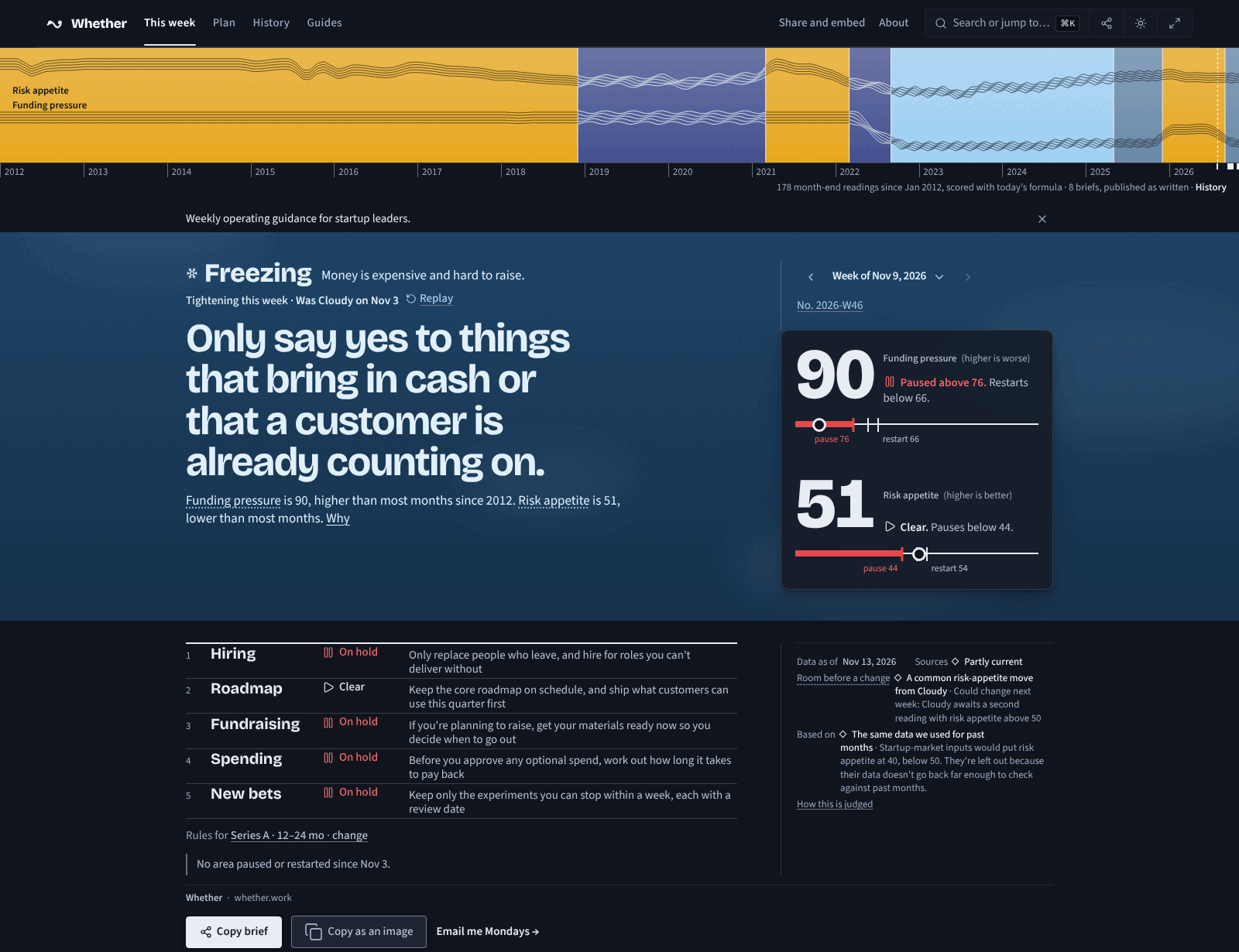
Shortened, for the week of Nov 2, 2026:
# Whether Weekly Brief — 2026-11-02

> **Conditions:** Cloudy (money is available but pricey)

## This Week's Guidance

Conditions are tightening. Protect the revenue you already have, and hold off on new bets until money gets cheaper.

**Pause if:** Funding pressure is above 76 or risk appetite falls below 44. Funding pressure is 90 now.

**Restart when:** Funding pressure falls below 66 and risk appetite is above 54
To ask from an agent instead, add the MCP server. In Claude Code:
claude mcp add --transport http whether https://whether.work/api/mcp
Cursor, VS Code, claude.ai and other clients use the same URL. For scripts, the same reading comes as about 3KB of JSON, with each score against its lines:
curl "https://whether.work/api/agent?view=state"

How it works
Whether scores two things from public U.S. market data every Monday:
- Funding pressure (0–100): how hard it is for U.S. companies to raise and borrow money. Higher is worse.
- Risk appetite (0–100): how willing investors and buyers are to back new products, hires and growth. Higher is better.
Together the two scores place the week in one of four conditions: Sunny, Cloudy, Stormy or Freezing. Interest rates, the yield curve, the pace of rate rises, stock-market volatility and the Chicago Fed financial conditions index move the scores, because the record holds each of them at every month-end since 2012. Inflation, labor, the high-yield credit spread and startup-market inputs are shown beside them and move nothing.
Each decision area gets an action for this week, a pause line that holds it back and a restart line, set apart from the pause line so one noisy week cannot undo the decision. Three rows from the brief for the week of Nov 9, 2026, in Freezing conditions:
| Area | This week | Pause line | Restart line |
|---|---|---|---|
| Hiring | Only replace people who leave, and hire for roles you can't deliver without | Funding pressure > 76 or risk appetite < 44 | Funding pressure < 66 and risk appetite > 54 |
| Spending | Before you approve any optional spend, work out how long it takes to pay back | Funding pressure > 76 | Funding pressure < 66 and the payback figures still hold |
| Fundraising | If you're planning to raise, get your materials ready now so you decide when to go out | Funding pressure > 76 or risk appetite < 44 | Funding pressure < 66 and risk appetite > 54 |
The live brief at / fits the actions to a company's stage and cash runway. Every number traces to its formula and source on /trust.
How the record holds up
The engine behind the live brief has scored every month-end since 2012. Weekly briefs began in 2026, so the earlier months are a reconstruction, not guidance anyone read at the time. Through Sep 2026:
| Measure | Result |
|---|---|
| Conditions the same a month later | 169 of 176 comparisons (96%) |
| Changes in conditions, last 60 months | 5 |
| Of those, warned a month ahead | 2 of 5 |
| Of those, changed back within a month | 0 |
Predicting "no change" every month would also score 96%, so that figure shows how rarely conditions move, not foresight. The record grades conditions, not companies: it cannot show that following the lines improved any company's results. /history lists each change, and the calibration study has the study behind the 96%.
The product
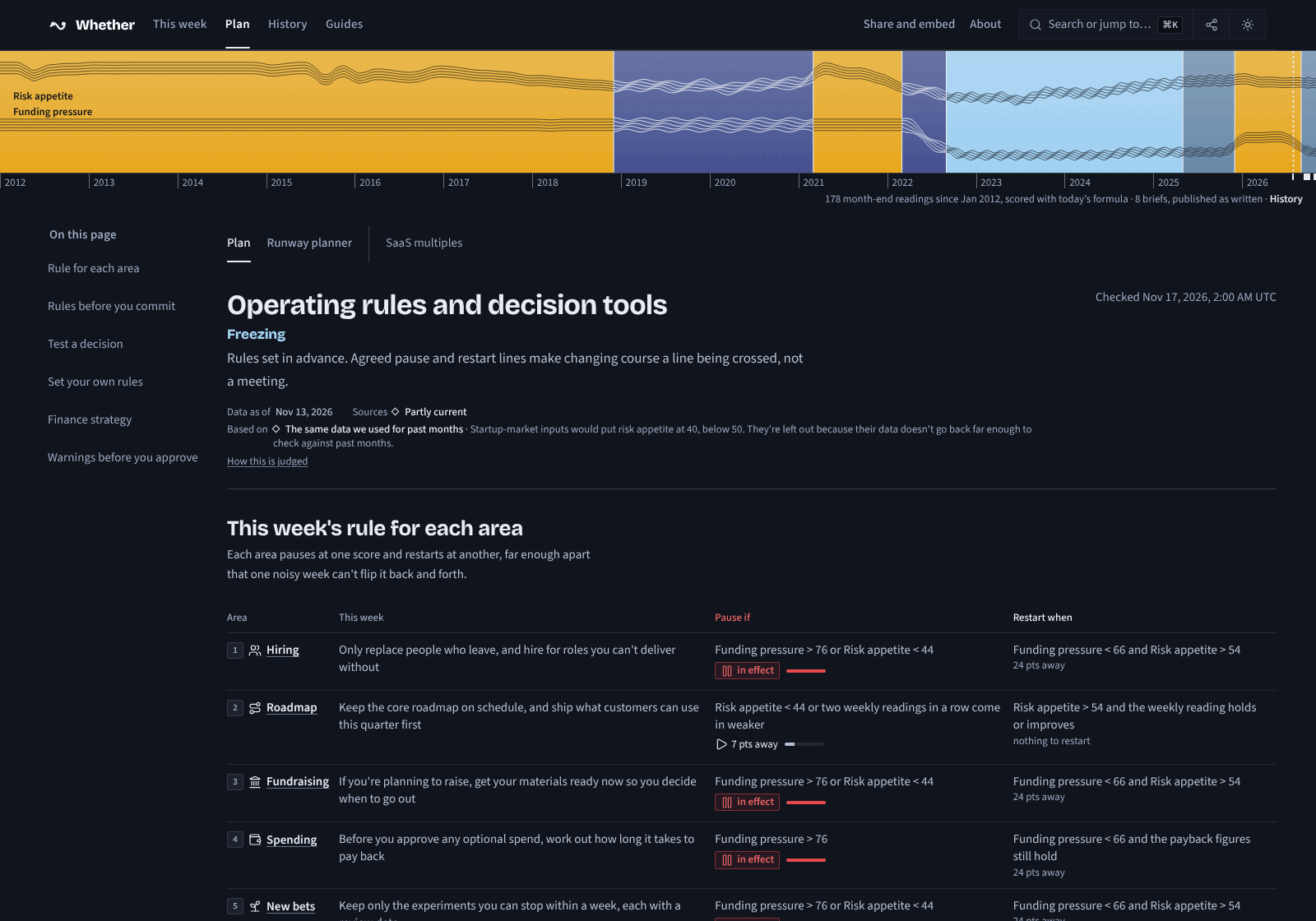 | 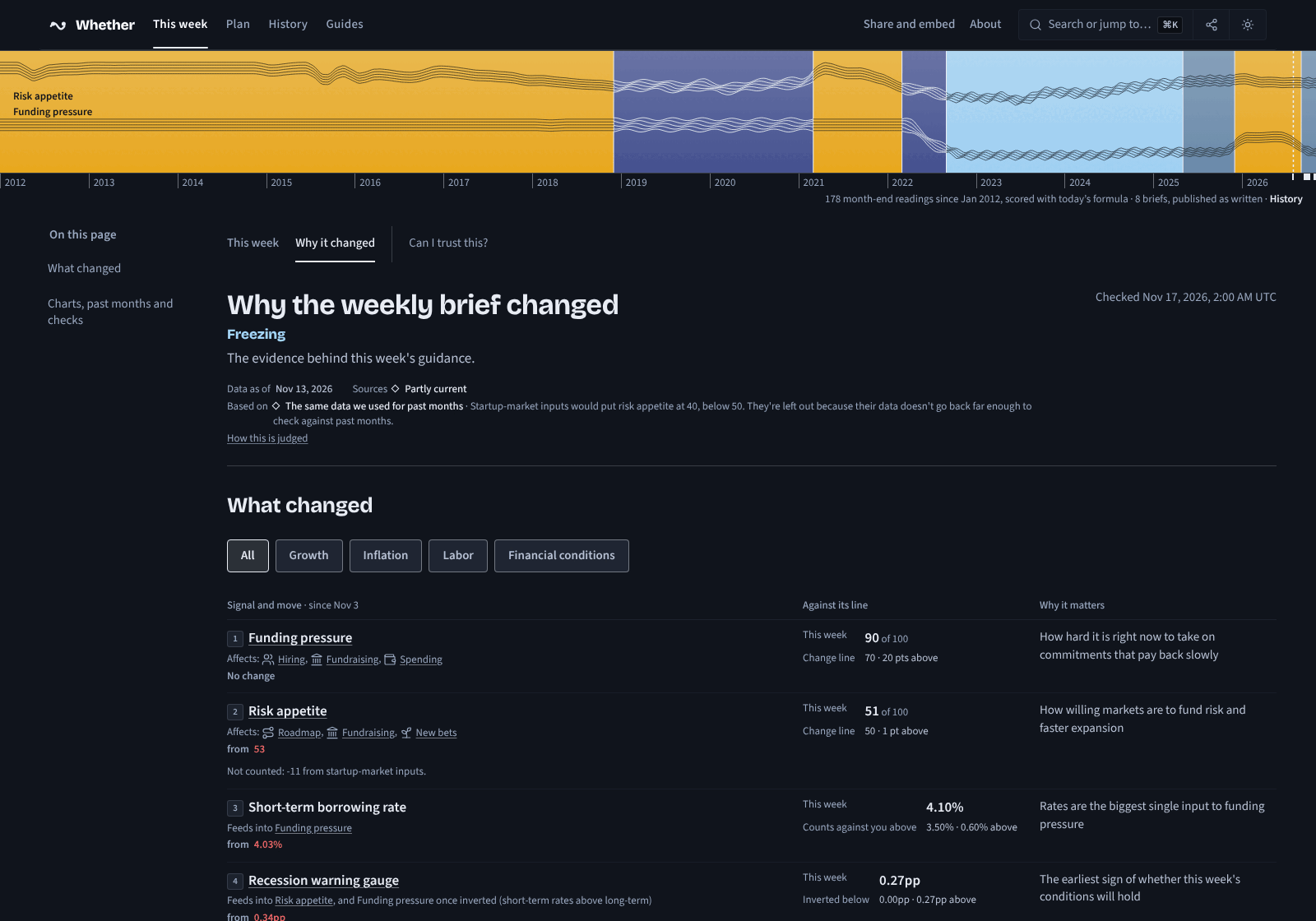 |
Plan (/operate): this week's rule for each area, the work to stop and start, and a runway planner. | Why it changed (/signals): each reading since the last brief, measured against the lines it governs. |
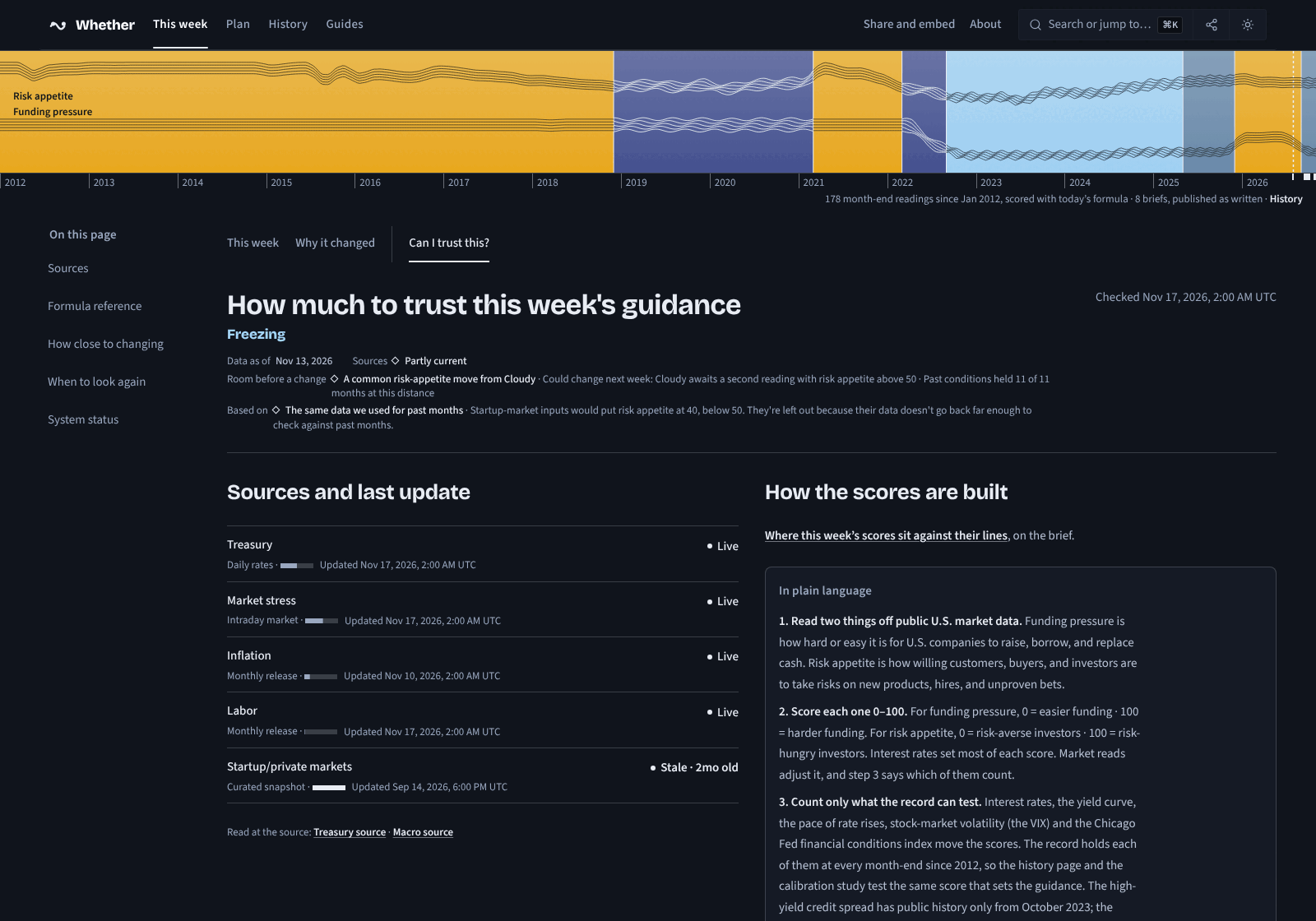 | 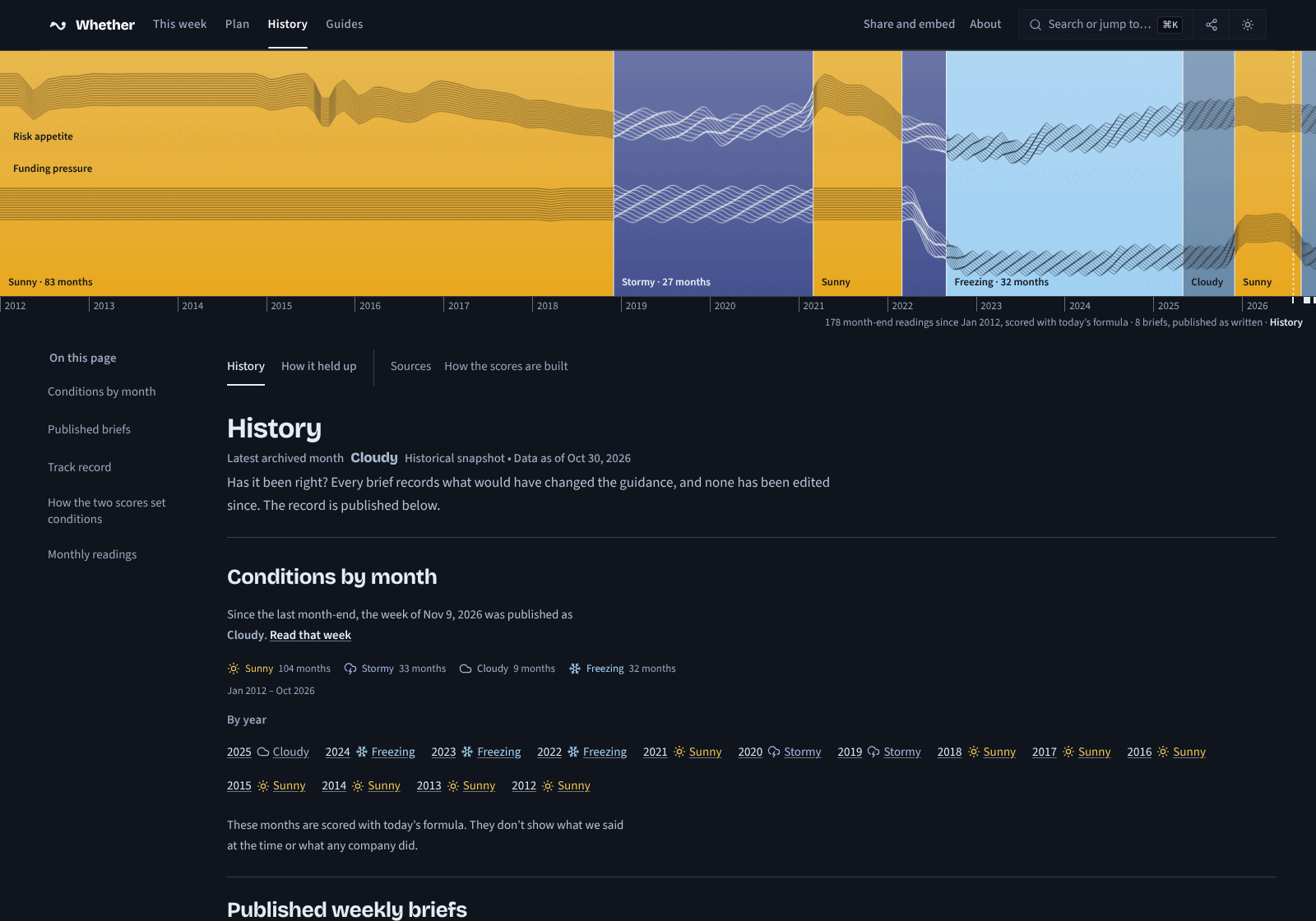 |
Trust (/trust): how each score is built, where each feed comes from and when it last updated. | History (/history): conditions by month since 2012, every published brief, and how past readings held up. |
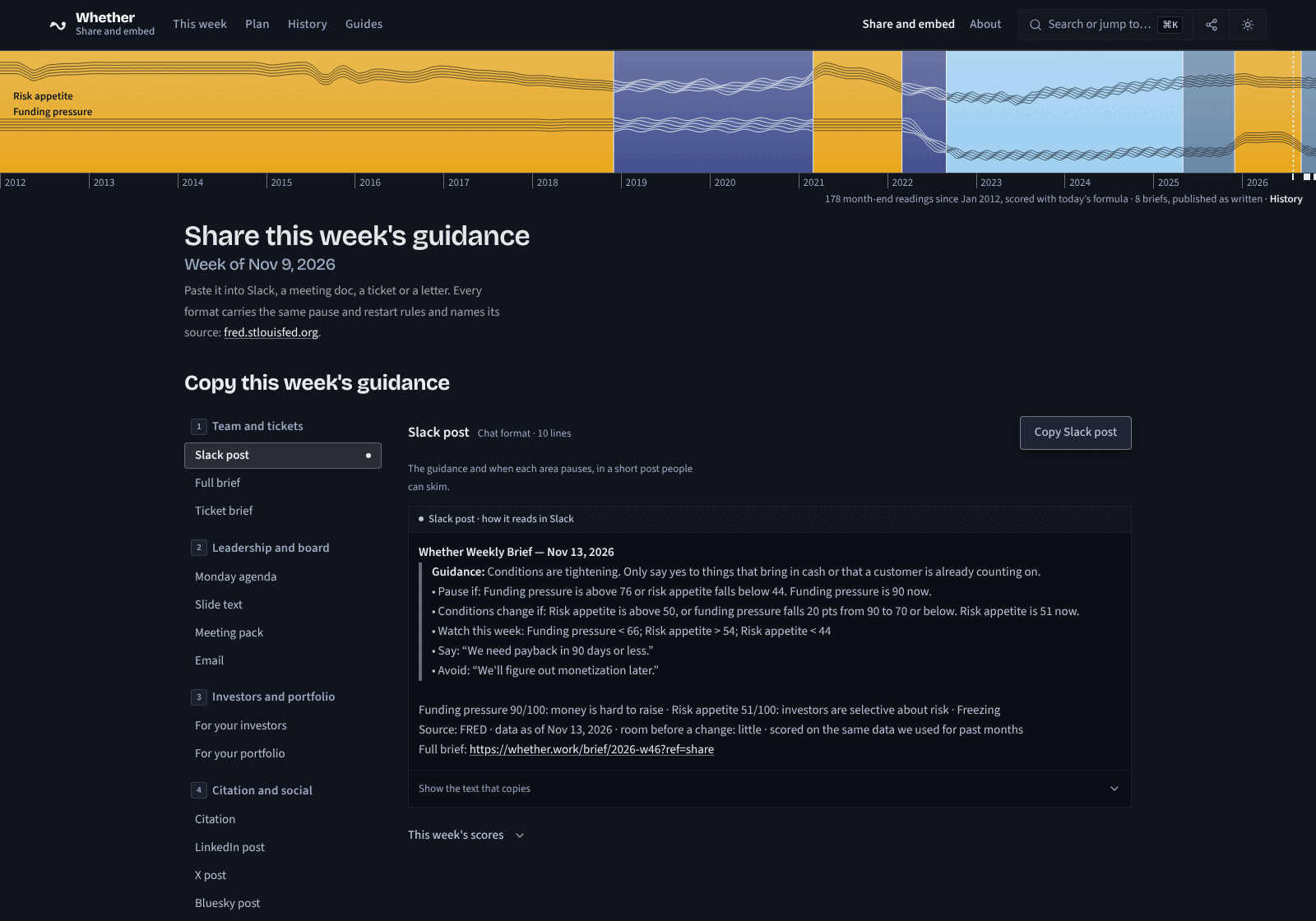 |  |
Share (/share): the week's guidance as a Slack post, email, meeting slide, ticket or investor update. | On a phone: the same brief at 430px. |
Captured from whether.work on Nov 17, 2026. docs/assets/README.md says how to recapture them.
Other ways to use it
Connect an agent
In Claude Code, the plugin adds the connector and a skill that tells Claude when this week's guidance applies (hiring, raising, burn, runway, a board update):
claude plugin install whether --marketplace zz-plant/whether
The connector alone:
claude mcp add --transport http whether https://whether.work/api/mcp
In claude.ai, add https://whether.work/api/mcp as a custom connector (Settings → Connectors).
In Cursor or VS Code, one click: Add to Cursor · Add to VS Code
Any other MCP client takes the same URL:
{
  "mcpServers": {
    "whether": {
      "url": "https://whether.work/api/mcp"
    }
  }
}
Or run the server locally over stdio with bun run mcp:whether. Agents should call get_state first. The tools, the manifest at /.well-known/whether-agent.json and /llms.txt are all generated from lib/agent/tools.ts; docs/agents/agent-interface.md covers the rest.
The REST endpoints, their parameters and the ones that need a header are in docs/developer/api-reference.md; whether.work/api-docs is the public version.
Use the CLI
From a clone, after bun install:
bun run cli:whether -- status --api-base-url https://whether.work
bun run cli:whether -- brief slack --api-base-url https://whether.work
bun run cli:whether -- watch --changes-only --api-base-url https://whether.work
status prints this week's conditions and guidance, brief slack prints the Slack post, and watch refreshes until a score moves. Leave out --api-base-url to read a local dev server. docs/cli-command-reference.md lists every command.
Embed in Notion / Coda
Paste this address into a Notion /embed block, a Coda embed, or any page that takes an iframe:
https://whether.work/embed/call-strip
The frame shows the conditions, the guidance, each area's action with the line that would change it, the line where conditions change, and the reading's date, with a link out to the weekly brief. It reads the brief each time the doc opens, so a recurring agenda never carries last Monday's screenshot. Add ?theme=light or ?theme=dark to match the doc; without it the frame follows the reader's device setting.
Pasting https://whether.work/ itself also works in editors that read oEmbed (Notion through Iframely, among others): /api/oembed answers for /, /share and the embed with the same frame. Elsewhere, an iframe works:
<iframe src="https://whether.work/embed/call-strip" width="640" height="720" style="border:0;max-width:100%" title="Whether: this week's guidance"></iframe>
Run locally
git clone https://github.com/zz-plant/whether.git
cd whether
bun install
bun run dev
Open http://localhost:3000. Without network access the brief falls back to the snapshots in data/ and says so.
Under the hood
- One registry, every agent surface. Each tool is defined once in
lib/agent/tools.ts. The HTTP and stdio MCP servers, the plain-GET shim, the manifest and/llms.txtall read from it, andtests/agentDiscoveryParity.test.tsfails if any of them drifts. - An engine that reads no data and writes no words.
lib/regimeEngineScoring.tsturns inputs into codes. Every sentence a reader sees comes fromlib/report/, and an architecture test rejects any engine import of copy, React or data files. A change to scoring bumpsENGINE_VERSION. - Fallback that says so. If a feed fails or goes stale, the brief draws from the snapshots in
data/and labels the reading with its date and the reason. - A record you can audit. Conditions are scored at every month-end since 2012 by the same engine the live brief runs, so a past reading can be checked against what followed.
- Fast, strict gates. The 4,300+ tests run in about 35 seconds on Bun. The pre-push gate rejects new
ascasts, new lint suppressions and exports with no caller.
Development
| Command | What it runs | Time |
|---|---|---|
bun run dev | Dev server with hot reload (Vinext on Cloudflare Workers) | — |
bun run test <path> | One test file | ~0.2s |
bun run test | The full suite, 4,300+ tests | ~35s |
bun run typecheck | TypeScript 7 (native) | ~5s |
bun run lint | oxlint, warnings denied | ~1s |
bun run build | The production Worker bundle | — |
bun run check | Lint, types, tests, assets, audit and landmark checks, concurrently | ~50s |
check also runs on git push through .husky/pre-push, and that hook is the gate: the GitHub workflows run only by hand. docs/agents/toolchain.md lists every command and what each costs; AGENTS.md holds the rules a change has to meet.
Codebase map
whether/
├── app/                  # Routes and UI
│   ├── page.tsx          # The weekly brief
│   ├── operate/          # Plan: rules per area, runway planner, scenarios
│   ├── signals/          # Why it changed: the evidence behind the scores
│   ├── trust/            # Sources, freshness and formulas
│   ├── history/          # The record: conditions by month, published briefs
│   ├── share/            # Every copy, file and image format of the brief
│   └── api/              # JSON API, MCP server, images and cron handlers
├── lib/
│   ├── regimeEngine.ts   # Scores the week and names its condition
│   ├── macroSnapshot.ts  # Treasury and FRED ingestion, with fallback
│   ├── report/           # Brief assembly and every reader-facing sentence
│   ├── export/           # Slack, email, slide, deck and investor-update builders
│   ├── alert/            # Alerts between Mondays, by email and Slack
│   └── agent/            # The tools every agent surface reads
├── data/                 # Fallback snapshots
├── docs/                 # Product specs, editorial rules and agent guides
└── tests/                # The suite
Documentation
- docs/README.md: the documentation hub, routed by task
- docs/use-cases/operator-playbooks.md: workflows by role
- docs/editorial-guardrails.md: vocabulary, decision contracts and tone
- docs/one-screen-weekly-brief-spec.md: the weekly brief's specification
- docs/developer/quickstart.md: integrating with the API
- docs/agents/agent-interface.md: the MCP and HTTP interface, and how saved decisions export as records
- ROADMAP.md: what has shipped and what is next
- CONTRIBUTING.md and AGENTS.md: how changes are made here