Listed from the MCP registry; nobody on Odel publishes it.

SetuHQ transit search
Search, vet and explain TESS transit candidates with provenance. Candidates, never confirmations.
Runs on your machine from its package; the steps are below.
What it does
- Reads
- Writes
- High impact
At most: creates or changes data: records, files, settings.
What it costs
FreeOdel charges nothing per call. The publisher may charge for its own service.
Runs locally over stdio
This server isn't hosted — your MCP client launches it from a package registry. Use one of the commands below, or drop the config into your client (e.g. Claude Desktop).
Run
uvx setuhq
MCP client config
{
  "mcpServers": {
    "setuhq-transit-search": {
      "command": "uvx",
      "args": [
        "setuhq"
      ]
    }
  }
}

SetuHQ · सेतु · the bridge
The open exoplanet observatory: from public sky data to reviewed, explained candidates.








setuhq.com · The app · How it works · Evidence · Quick start · Editions · Cite · Licence

Every dip in the sky, reviewed and explained
TESS has watched about 98% of the sky. Almost all of that light is public, and almost none of it has been looked at dip by dip. SetuHQ searches any TESS star: give it a TIC id and a sector or two, and it does the looking: a reviewer panel of AI Sentinels and deterministic Probes marks every dip in blind-coded light curves, the way Planet Hunters volunteers do. Each verdict keeps its marks, its weights and, for the Sentinels, their reasons in words. Then the pipeline does the physics: limb-darkened transit fits, bounded false-alarm probabilities, odd/even and secondary checks, and an honest label on everything.
Sentinels run on Claude (Anthropic) by default; other providers are supported and labelled. Probes are deterministic matched-filter detectors.
What SetuHQ is built to be:
- A search you can audit. Every candidate carries its provenance: data hash, config hash, code fingerprint, every reviewer's marks.
- A benchmark that keeps everyone honest, including SetuHQ. A frozen, blind test on 662 real TESS candidates, with controls, a public leaderboard and its negative results printed first.
- An observatory you can explore. Every known exoplanet in 3D, a full catalogue, and fifteen animated chapters on how planets are found, all in one app.
Worked examples
Five stored runs on public TESS light curves from MAST, chosen to show different kinds of star and signal. Each keeps its data hash, configuration hash and code fingerprint; every dip is counted by its vetting outcome (a candidate stays unconfirmed; a rejected dip is not a candidate). Known planets are named with their reference: finding one again checks the pipeline, it is not a discovery. Every run but pi Men is Probes only; Sentinels not run on this example.
| Star | Kind | TESS sector | Dips | Against the literature |
|---|---|---|---|---|
| WASP-126 | Hot Jupiter | 1 | 8 dips (8 candidates) | WASP-126 b: 8 of 8 transits (8 candidates). |
| TOI-270 | Multi-planet system | 5 | 7 dips (5 candidates, 2 flagged) | TOI-270 b: none of 6 transits; TOI-270 c: 5 of 5 transits (5 candidates); TOI-270 d: 2 of 2 transits (2 flagged; no period). |
| HD 15337 | Small planets near the limit | 4 | 3 dips (2 candidates, 1 flagged) | HD 15337 b: 1 of 5 transits (1 candidate; BLS period not the planet's); HD 15337 c: 2 of 2 transits (1 candidate, 1 flagged; BLS period not the planet's). |
| TOI-236 | Known false positive | 2 | 6 dips (6 rejected) | Caught: all 6 dips on the TOI ephemeris were rejected by vetting (secondary_any_phase, secondary_eclipse), so none is a candidate. |
| pi Men | Reference check | 1 | 7 dips (5 candidates, 1 flagged, 1 rejected) | Rp/R★ and T14 within 5% of Huang et al. 2018 (docs/results/pi_men_validation.md). |
Why each was chosen, its full comparison with the literature and the one command that reproduces it: docs/SHOWCASE.md. On the site, each has its dips, case file, plates and run report.
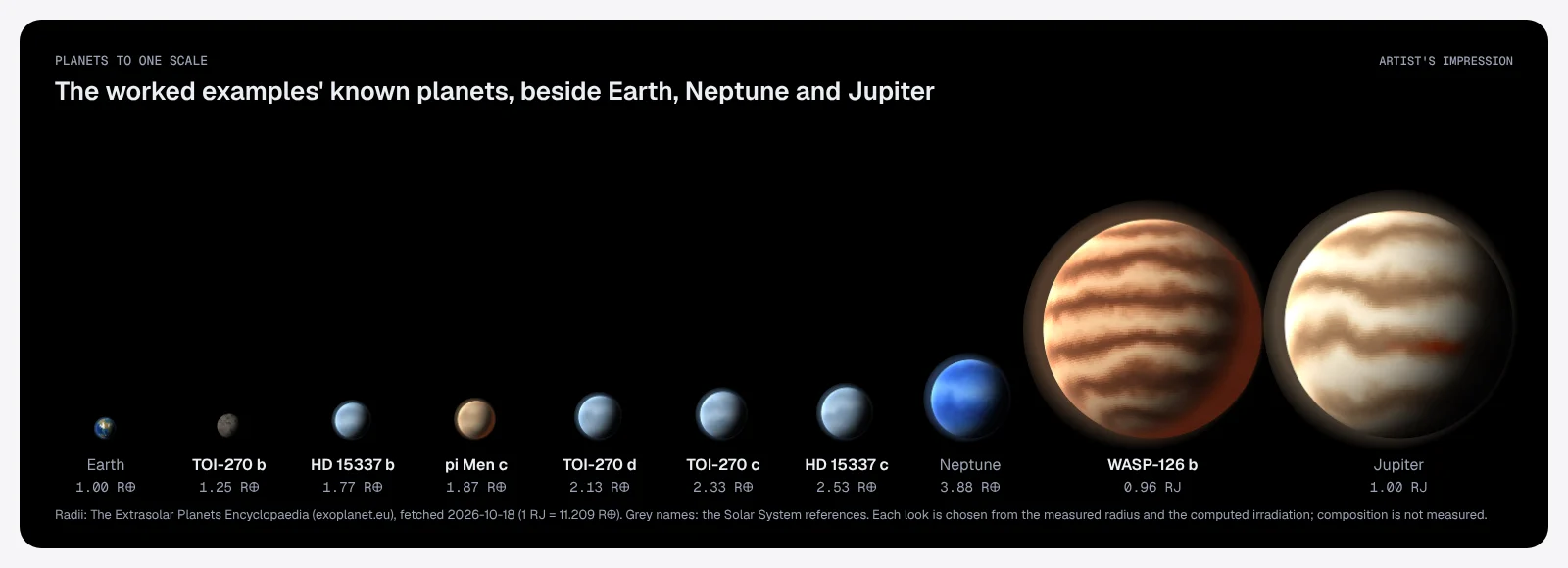
Their known planets to one scale, beside Earth, Neptune and Jupiter: artist's impressions chosen from each planet's measured radius and computed irradiation, drawn by the site's own renderer; every radius is exoplanet.eu's.


What's new in 0.1.0
The first public release (CHANGELOG). Nothing on this page is a discovery claim: SetuHQ finds and vets candidates.
- The name. The project developed as exoplan is now SetuHQ, setu being Sanskrit for
bridge: from public sky data to reviewed candidates. The package and the command are
setuhq, the MCP serversetuhq-mcp; the oldexoplancommands still run, with a deprecation notice. The logo's Q is a star with a planet crossing its face (brand kit). - Open licence. AGPL-3.0-only, or a commercial licence from Ashforde OÜ; data, benchmark, leaderboard data and paper under CC BY 4.0 (Licence).
- The feed's pre-registered rule. The search feed now needs a signal in both reviewed sectors and a FAP below 0.001. On held-out data, measured on the current code, it cuts noise about 4.5-fold but still admits about 6 false signals per 100 targets, so its admissions are leads for review (see Evidence).
- In this release: pixel-level and Data-Validation-style vetting, a reduced false-positive probability with a stability gate, ExoFOP-style export and the deep-dip clipping fix; a methods paper and the real-TOI leaderboard with a catalogue-metadata floor that SetuHQ does not yet beat; the “everything that dims” catalogue, an all-sky sweep and contributor bundles; Sentinels on any provider, an MCP server and a Claude Code plugin; this README, its generated figures and the brand kit. Each part was reviewed independently before it was merged.
The app
Every screenshot below is one frame rule: a 1440 × 900 window at twice the pixel density, motion reduced so every drawing is at rest, cropped to the app's 1360 × 850 content frame (16:10) starting just above the section shown. Light and dark follow your GitHub theme. The site's sections, addresses and end-to-end tests are described in docs/SITE.md.

Mission Control. Six linked panes: the live Galaxy, the sky position, the light curve, a catalogue slice with a star finder, the animated system view and the Sentinel feed. Selecting a star in one pane selects it in every pane and in popped-out windows. Every number on the telemetry strip is computed from the app's own data.

Overview. The landing page: SetuHQ searches any TESS star, what the panel is, and that nothing is called a planet until it is one. Below it, the worked examples. |

Galaxy. 8,049 of exoplanet.eu's 8,376 planets placed in 3D around the Sun. The Milky Way is an artist's impression drawn by the page; every planet position is data. |

Catalogue. All 8,376 exoplanet.eu records, 5,684 stars, a page for every one, and search from anywhere (⌘K). |

Planet pages. An artist's impression chosen from the planet's measured radius and irradiation, labelled as one, beside its star in its blackbody colour; then the stored parameters with their bounds. |

Transit cases. SetuHQ's own dips, with the stored points, the limb-darkened fit and each reviewer's marks. |

Methods: 15 chapters. How a survey works, Transit, Toward and away, Radial velocity, Astrometry, Microlensing, Blocking starlight, Timing and phase, Radio, False positives, Reading atmospheres, Molecules and life, Population, Equations of life, History and papers. Physics checked by tests against closed forms and published values. |

Real data, labelled. The real JWST spectrum of WASP-39 b (CO₂ at 4.37 µm), and an Atmosphere Lab. Every visual says whether it is real data, a model or an illustration. |

Coronagraphs, computed. Lyot, apodised pupil, vortex and adaptive optics with angular differential imaging, from real Fraunhofer numerics. |
More in the Methods chapters
- Physics checked by tests against closed forms and published values; the four below are drawn with the same functions.
- Coronagraphs: closing the Lyot stop from 150% to 80% cuts the starlight at 8 λ/D from 6.7×10⁻⁵ to 1.8×10⁻⁷ of the peak.
- Molecules, mode by mode. Ten molecules, each vibration linked to its infrared band, infrared-silent modes marked, the amplitude exaggeration stated per mode.
- Radial velocity: a star and planet orbiting their barycentre, solved with Kepler's equation; the star's motion is drawn exaggerated by a stated factor.
Capabilities
The reference check: a known planet, found blind and fitted
One of the worked examples, and the one checked in most depth: the stored run on pi Men (TESS sector 1), with the Sentinels as well as the Probes. The panel's marks, the seven consensus dips and the limb-darkened fit, against Huang et al. 2018.

Where the sky has been watched
The survey footprints the Sky page draws, and how many planet hosts fall in each.

How planets are found, computed
Four of the fifteen Methods chapters, drawn by the same functions the app uses and the tests check.

How a run works

Step by step
- Ingests TESS SPOC light curves from MAST, CHEOPS light-curve FITS files, or CSV.
- Cleans and detrends: spike clipping, a masked local-quadratic baseline, and binning.
- Cuts blind-coded subjects: fixed 13-day segments with opaque IDs. The target name never reaches a reviewer.
- Runs the panel: every reviewer marks and labels every subject independently. The task is the Planet Hunters task: mark the start and end of each dip, then label
potential_planetornoise. - Aggregates marks by single-linkage clustering, scores each dip by the share of skill-weighted reviewers who marked it, and requires the panel to call the subject a potential planet.
- Vets each consensus event: SNR, duration, edge effects, odd/even depth, secondary eclipse, and fit to the periodic ephemeris.
Extended tests after the Kepler/SPOC Data Validation suite add flags beside them (
dvtests.py,pixel.py): SPOC crowding (CROWDSAP below 0.8 iscrowded), a weak-secondary search at every phase with the fitted duration (threshold from a white-noise simulation,scripts/calibrate_secondary.py), odd/even depths from per-epoch fits, per-epoch transit times (linear-ephemeris and odd/even timing tests), all on the light curve re-detrended in two passes with the fitted transits masked, as DV masks transits (the second pass also masks phase 0.5, and the first pass's strongest other dip only when that pass already finds it significant), and, from the SPOC target pixel file, a difference-image centroid in pixels and arcseconds with its significance, the centroid motion test, a core/halo ghost check, momentum-dump coincidence, and a table of catalogued neighbours with the eclipse depth each would need. By default these only add flags: pass/fail is decided as before, so runs and benchmarks stay comparable with earlier ones.[vetting] decide = truemakessecondary_any_phase,odd_even_depth,odd_even_timingandcentroid_offsetdisqualifying, and lets the all-phase secondary search replace the phase-0.5 check. The pixel tests download TPFs and are off unless[vetting] pixel = true. - Weighs false-positive scenarios for every periodic candidate (
validate.py): SetuHQ's own reduced FPP (planet, eclipsing binary at P or 2P, eclipse on a resolved neighbour), built from the S2 measurements with stated priors. It is not TRICERATOPS and never says "validated". "Validated (statistically)" is reserved for TRICERATOPS with FPP < 0.015 and NFPP < 10⁻³ and a high-resolution imaging contrast curve; without a curve every candidate is "not validated: no contrast curve". SetuHQ never calls its results confirmed. - Writes a candidate catalogue (CSV and JSON), a Zooniverse-shaped classification export, a SQLite store, a provenance manifest, and a static report site.
- Exports for follow-up (
setuhq export RUN --out DIR,exofop.py): an ExoFOP CTOI-style table (CSV and JSON) of vetted candidates that pass the S2 and S3 gates and duplicate no TOI on the same TIC, plus predicted transit windows for the next 12 months with the ephemeris uncertainty cone, σ(Tₙ)² = σ_T0² + n²σ_P² (+ 2n cov), the same propagationmatch_toiuses (ephemeris.py). The CTOI field list is unverified against ExoFOP's current form (ExoFOP was unreachable); it lives in one place,exofop.CTOI_FIELDS. A person submits CTOIs under their own ExoFOP account; SetuHQ does not. Without the archive's TOI table the export refuses unless--allow-unchecked, and then every row says the check was not done. - Scales with
setuhq batch CONFIG --targets FILE(batch.py): thediscoverflow over any target list, with light curves cached incache/lightkurveand a state file that makes a killed or time-limited session resumable (done targets are skipped, failures retried, a changed config starts afresh).
The reviewer panel: Sentinels and Probes
| Reviewer kind | Shown as | What it is | Needs |
|---|---|---|---|
simulated | Probe | Deterministic matched-filter detector with human-like limits (threshold, miss rate, boundary jitter). A baseline and a calibration reference. | Nothing |
claude_code | Sentinel | Claude reviewing the rendered plot through the Claude Code CLI, which signs in with a Claude team or individual subscription. | claude on PATH, signed in |
claude | Sentinel | Claude through the Anthropic API (vision). | ANTHROPIC_API_KEY |
The pages show display names; reviewer ids stay unchanged in every data file, CSV, JSON
and URL. The default panel is 2 Sentinels and 3 Probes: Sentinel · Volunteer
(claude-volunteer), Sentinel · Skeptic (claude-skeptic), and Probe · Sensitive,
Probe · Typical and Probe · Cautious (volunteer-sensitive, volunteer-typical,
volunteer-cautious).
Sentinels receive the same task as volunteers, the blind-coded plot, and no target name. They return strict JSON, which is validated and clipped to the subject's time range. A reviewer that is not available is skipped and listed in the manifest. Responses are cached by a hash of model, prompt and image, so re-runs are free and reproducible.
The two Sentinels use two personas: volunteer (careful, marks dips) and skeptic
(rejects binary and systematic signatures unless they are clear). Sentinels can also run on
OpenAI, Gemini or any OpenAI-compatible endpoint, labelled as such (see AI providers).
Evidence
SetuHQ reports what it measured, including where it falls short.
| Measure | Result | Source |
|---|---|---|
| pi Men c, Rp/R★ against Huang et al. 2018 | 1.05 (0.0179 ± 0.0017) | validation |
| pi Men c, transit duration T14 | 1.04 (3.07 ± 0.17 h) | validation |
| Worked examples, Probes only: WASP-126 b, Rp/R★ against Pearson 2019 and T14 against Maxted et al. 2016 | 1.00 and 1.02 (8 of 8 transits) | showcase |
| … TOI-270 (Günther et al. 2019) and HD 15337 (Gandolfi et al. 2019) | TOI-270: c 5 of 5 transits, d 2 of 2 (no period), b none of 6; HD 15337: b 1 of 5, c 2 of 2, neither published period recovered | showcase |
| … TOI-236.01, a false positive in the TOI table | rejected: all 6 dips, secondary eclipse | showcase |
| Real-TOI benchmark, held-out completeness | 60% (90/150; 52–67%), re-run on the current code; 57% (86/150) in the first run, on the pre-fix code | benchmark |
| … planets below 2 R⊕ | 10% | benchmark |
| Live feed’s “new” signals | consistent with noise under the old rule (≈12 per 100 targets from controls vs 15.8 observed). On the current code the pre-registered two-sector rule cuts held-out noise about 4.5-fold, from 27.8 (23.1–33.1) to 6.1 (4.0–9.4) per 100 targets, still above the 1.6 real new signals per 100, and more than halves completeness; the live feed re-run under it admits 0 new signals | validation |
| Real-TOI leaderboard: the Probes against a floor that reads no light curve | not shown to beat it (paired ΔJ interval includes zero) | leaderboard |


Results in full
Real data, TESS SPOC sector 1 of pi Men (TIC 261136679), the three Probes plus the two Sentinels (Skeptic and Volunteer, on Claude via the CLI), as stored in runs/tess-pi-men-s1, run on the current code (the Sentinels' stored answers reused: the subject images and prompts are byte-identical):
- 7 consensus dips: 6 passed vetting, 1 of them flagged
off_ephemeris, and 1 failed it (low_snr,off_ephemeris). - 5 of them lie on the published pi Men c ephemeris. 5 of the 5 predicted epochs in the 26-day window are recovered, with a mean timing offset of −8 minutes against the NASA Exoplanet Archive value (docs/results/pi_men_crossmatch.json).
- Transit shape, limb-darkened fit (see docs/results/pi_men_validation.md). A joint fit of the 5 epochs, with the period free near the BLS period (6.2680 ± 0.0005 d; Huang: 6.26790 d), gives the like-for-like quantities first: Rp/R★ = 0.0179 ± 0.0017 (1.05 against Huang et al. 2018) and T14 = 3.07 ± 0.17 h (1.04). The mid-transit depth of the limb-darkened model is 292 ± 8 ppm (0.97 against Huang's published 300 ppm, which is defined by that paper, not by this model). The box measure it replaces gave 0.81 in depth and 0.64 in duration. Errors are conservative: the covariance plus the spread along the impact-parameter profile.
- The impact parameter needs the star. Free, 5 TESS transits give only b < 0.87 (1σ), so a/R★ and ρ★ are ranges (ρ★ 0.28 to 2.2 g/cm³ at 1σ, consistent with the TIC's 1.02). With the TIC density as a Gaussian prior (1.02 ± 0.20 g/cm³), the fit gives b = 0.64 ± 0.12, a/R★ = 12.85 (1σ 11.5 to 13.6) and T23/T14 = 0.95, against Huang's 0.59, 13.38 and 0.95. The fit is U-shaped, not V-shaped.
- The periodic signal's false-alarm probability is below 10⁻⁴ in both subjects. No one of 10,000 block-bootstrap trials reached the observed SNR, so 10⁻⁴ is a bound, not a value. The null maxima are committed in
runs/tess-pi-men-s1/fap_null/; a Gumbel fit to them, stored asfap_tail, puts the tail below 10⁻⁶ (indicative only, see below). - The passed dip at BTJD 1348.9 (0.87 h, SNR 9.5) does not fit the ephemeris and is a likely false positive. It is kept and flagged, not hidden.
- The dip at BTJD 1348.4 (SNR 6.7) failed vetting and stays in the stored candidates with its flags.
The stored run was re-run from the start on the current code on 2026-10-21 (scripts/rerun_pi_men.py). Every dip,
vetting result, fit and FAP is the same as in the first run, made with pre-fix code (the run's manifest records the
field-by-field comparison); the Sentinels were not asked again: their stored answers were reused because each
subject image and prompt is byte-identical. Extended vetting, the reduced FPP and the export on the same run:
- Extended and pixel-level vetting (
scripts/vet_pi_men_s2.py, real SPOC sector-1 files; see docs/results/pi_men_s2_vetting.md). On the joint fit of all five epochs (P = 6.26795 ± 0.00049 d, T14 = 3.09 ± 0.16 h), on the light curve re-detrended in two passes with the transits and phase 0.5 masked (window 1.55 d, 12 T14; the first pass's strongest dip is not significant, so it is not masked): CROWDSAP 0.9997, FLFRCSAP 0.980 (not crowded); the strongest dip at any phase away from the transit is 42 ± 7 ppm at phase 0.622 (5.6σ nominal), against a calibrated threshold of 6.9σ (5.16 times the scan's robust spread of 1.33), with 86% of it from one epoch; at phase 0.5, −12 ± 7 ppm. Odd/even depths from per-epoch fits agree (301 ± 14 against 311 ± 12 ppm, 0.5σ); the five mid-times fit a linear ephemeris (χ² = 1.9 for 3 dof, p = 0.59, O−C within 1.8 min) with no odd/even timing offset (0.5σ). No flag at the run's own setting, but the secondary is at the threshold and its flag depends on the setting: of 12 nearby run settings (detrend window 1 or 2 d × bins of 2, 6, 10, 15, 20 and 30 minutes, each through the full two-pass preparation) 3 flagsecondary_any_phase: 15- and 30-minute bins with the 1.55 d vetting window, and 30-minute bins with 2 d; there the dip, at phase 0.64, reaches 1.05–1.2 times the threshold, and in the first two the first pass already finds it significant. The other 9 do not flag it: 0.68–0.93 of the threshold, or not periodic (with 20-minute bins and the 1.55 d window a dip at phase 0.74 reaches 1.05 times the threshold, 90% of it from one epoch). The previous code, which masked the strongest first-pass dip whether or not it was significant, raised the default setting's dip from 5.6σ to 7.0σ and flagged 8 of 15 settings, including every 6- and 15-minute bin with a window up to 1.5 d (the reviewer's measurement). These are not independent trials: every run window up to 12 T14 collapses to the same 1.55 d vetting window, so the 12 settings are 2 distinct vetting windows (1.55 and 2 d) × 6 bin sizes, all on the same data (the reviewer's 15-setting grid, windows 0.75–2 d × 3 bin sizes, is 6 distinct settings for the same reason). - The reduced FPP of pi Men c, from the stored run (
metrics.validationincandidates.json; the scheme's priors are a stated choice, see Honest limits). Per 13-day subject: 0.019 on the first (0.0186) and 0.015 on the second (0.0148). Over the pipeline's five detrending settings (the default, and windows ×0.75 and ×1.5 with masks of 1.0 and 2.0 T14) under two noise models the range is 0.0111–0.0216 (second subject 0.0123–0.0190), a log-odds spread of 0.29 dex (0.19), so the stability gate passes. The class is "undetermined": the range straddles the 0.015 threshold. NFPP is unknown, because the run has no neighbour table, and the label is "not validated: no contrast curve". pi Men c is a published planet with a measured mass; this shows the scheme's limits on real data. History: on 2026-10-20 the joint fit of all five epochs over the whole sector (scripts/vet_pi_men_s2.py, docs/results/pi_men_s2_vetting.json) gave 0.0079–0.093 across the same settings and was refused as unstable (odds spread 12.9×; 10× allowed); on a wider grid its secondary scan was white on 6 of 15 settings, and its largest brightening ranged from 2.6 to 6.2σ. - Ephemeris cone. Exporting the stored run (
setuhq export runs/tess-pi-men-s1 --allow-unchecked; the archive's TOI table timed out, HTTP 504) gives one signal, P = 6.2681 ± 0.0012 d from the first subject's joint fit, and its predicted transit in October 2026 (epoch 479) carries σ = 13.8 h, a 3σ window of 86 h. A one-subject ephemeris is stale within a few years, as ATLAS G5 warns. With the TOI table, this signal is TOI 144.01 and is excluded as a duplicate (tested with the published ephemeris). - The difference-image centroid of pi Men is not usable, and SetuHQ says so. The PSF fit puts the difference
image 2.05 px (40.1″) from the catalogue position, mostly in the row coordinate (row −1.91 px, column −0.74 px),
which is the direction charge bleeds along a CCD column. SPOC's own DV report for TOI 144.01 finds the same size and
direction: 40.5″, row −2.07 px, column 0.02 px, with a DV quality metric of 0.58, below DV's 0.7 reliability cut.
pi Men (Tmag 5.1) is saturated: five pixels of one column sit on a plateau within 5% of the
peak, a bleed trail. A transit shortens the trail instead of dimming a PSF, so the "offset" is the trail's end.
The fit says so too: the difference-image PSF collapses to its 0.3 px width bound, 3.4 times narrower than the
out-of-transit one. SetuHQ flags
saturatedandcentroid_unreliableand raises nocentroid_offset. The per-cadence centroid motion test sees no shift (0.1σ), but on a saturated star that carries no information either: the flux-weighted centroid of a clipped bleed trail need not move when the star dims. Of 56 TIC stars within 150″, all but the target would need an eclipse deeper than 100%; the nearest, TIC 261139071 (Tmag 14.0 ± 0.75, 27″), needs 111%, which is marginal: within 3σ of its Tmag uncertainty.
What the Sentinels did in this run, read from the stored classifications:
- On the first subject (BTJD 1325.3 to 1338.3), Sentinel · Volunteer marked the dips at 1325.50, 1331.77 and 1338.05 and labelled the subject
potential_planet(confidence 0.8); Sentinel · Skeptic marked the dips at 1325.50, 1331.77 and 1338.05 and labelled the subjectpotential_planet(confidence 0.7). - On the second subject (BTJD 1338.3 to 1351.3), Sentinel · Volunteer marked the dips at 1344.27 and 1350.57 and labelled the subject
potential_planet(confidence 0.4); Sentinel · Skeptic marked the dips at 1344.27 and 1350.57 and labelled the subjectpotential_planet(confidence 0.7). Neither marked the dip at 1348.38 (rejected by vetting) or the dip at 1348.94 (passed but off the ephemeris). - In the consensus each Sentinel carries weight 0.5, against 0.4 to 0.6 for the Probes: the Sentinels are voices in a calibrated panel, not the whole panel.
Blind benchmark on real TOIs (re-run on the current code on 2026-10-21; measured on a stated benchmark, not discoveries; see docs/results/benchmark_real_tois_clipfix.md, and for the first run, on the pre-fix code, docs/results/benchmark_real_tois.md). 662 TOIs from the NASA Exoplanet Archive TOI table (fetched 2026-10-19, seed 20261019): 300 CP/KP, 300 FP and 62 FA, one per star, split into halves by star. Each star's first SPOC 2-minute sector goes through the Probes panel, along with a flux-inverted and a block-scrambled copy as false-alarm controls. Held-out half, with Wilson 95% intervals:
- Completeness: 60% (90 of 150 CP/KP on searchable stars; 52 to 67%). It is 84% above 8 R⊕, 45% at 4 to 8 R⊕, 23% at 2 to 4 R⊕ and 10% below 2 R⊕. In the bins the published references use: all radii: 60% (90/150; 52 to 67%) against Kepler Robovetter DR25's > 85% (vetting only, on detected TCEs, P < 100 d); 3 to 4 R⊕: 44% (4/9; 19 to 73%) against Planet Hunters TESS's 51% (a citizen-science search); above 4 R⊕: 79% (81/102; 71 to 86%) against Planet Hunters TESS's 85% (a citizen-science search). SetuHQ is below the Kepler Robovetter's completeness (the interval excludes it); not distinguishable from Planet Hunters TESS's 51% at 3 to 4 R⊕ (44%, 19%–73% over 9 stars; a 7-point lower estimate the interval cannot resolve); not distinguishable from Planet Hunters TESS's 85% above 4 R⊕ (79%, 71%–86% over 102 stars; a 6-point lower estimate the interval cannot resolve). Planet Hunters TESS's rates carry their own uncertainty and come from sectors 1 to 26.
-
FP TOIs: the panel found the dip of 77% and rejected or flagged 68% of those as binary-like. This applies to FP stars with 2-minute data only (124 of 158). FP TOIs are far more often FFI-only, so this is not reliability on the whole FP list.
-
The live feed's "new" signals are consistent with noise. On the controls, the feed's own admission rule passes 58 (inverted) and 61 (scrambled) false signals per 1,000 star-sectors. That is about 12 per 100 targets reviewed, against 15.8 per 100 on the live feed under that rule (3 over 19 targets).
-
The fix, pre-registered and measured on the held-out half. The feed now requires the signal in both reviewed sectors (periods within 0.5%) and a FAP below 0.001 over 2,000 trials. The rule was chosen on the tuning half and committed (8909cda) before its held-out evaluation; that evaluation was re-run unchanged on the current code (docs/results/feed_rule_validation_clipfix.json). Held-out results, measured with the discovery config, old rule to new rule:
- noise from the controls: 27.8 (95% CI 23.1–33.1) to 6.1 (4.0–9.4) false signals per 100 targets (first evaluation, on the pre-fix code: 23.0 to 6.1);
- feed-level completeness: 39% to 17% (the same as before);
- FP TOIs kept out: 70% to 94%.
Noise drops about 4.5-fold, but 6 per 100 targets is still above the 1.6 new signals per 100 that real light curves now give (0.3 on the pre-fix code). The feed is still dominated by false alarms, and an admission is a lead for human or follow-up review, not a candidate of any confirmed status. The live feed's 19 targets, re-run on the current code on their previous sectors, admit 0 new signals and 2 known TOIs (24 entries), as on the pre-fix code.
-
The Sentinels on the stated subsample of 40 held-out stars were not asked again for the re-run. Their stored answers carry over to the 37 stars whose subject images and prompts are byte-identical on the current code; the other 3 (deep transits the fix now keeps) are left out. On those 37, each persona marked 47% (9/19) of the CP/KP dips and 22% (4/18) of the FP dips as potential planets. They agree on 35 of 37 stars (φ = 0.88): one model, so one correlated voter.
Injection-recovery benchmark for the Probes (re-run on the current code): docs/results/injection_recovery_simulated_panel.md. It and the threshold sweep were first made on the code of 2026-10-16, before the injected transits became limb-darkened (2026-10-19), so their changes on the re-run are not the two fixes' alone. The sweep's held-out score fell from 0.875 to 0.833 because 2 of its 48 injections at 1000 ppm are no longer recovered (6 to 5 of 12 at 2 h, 12 to 11 at 4 h); that change appears with the limb-darkened injections and is already there on the pre-fix code of 5a03087. The Sentinels are not in the benchmark. Each injected subject would need its own CLI call, so the Sentinels are calibrated separately on a small sample (10 injected and 10 empty subjects: weight 0.5 each, against 0.4 to 0.6 for the Probes).
Continuous search and what it can claim
The search, setuhq discover, runs one batch of TESS targets. It rotates through the TOI host list
so coverage advances each day, reviews the two latest sectors of each target, and keeps
every new dip in a deduplicated catalogue. A dip is known_toi when it matches a
published TOI period, and new_candidate otherwise.
.github/workflows/discover.ymlruns one batch every six hours (and on request), commits the catalogue as ashfordeOU, and deploys the site. Claude's API reviewer runs when theANTHROPIC_API_KEYsecret is set; without it the batch runs on the Probes only.scripts/improve.pysweeps panel thresholds on injection benchmarks. It promotes a setting only if it wins on a held-out seed. Every trial is in the threshold sweep, docs/threshold_sweep.md, including losers. This synthetic sweep is not the real-TOI leaderboard (see Leaderboard and methods paper).
Measured false-alarm rate. Under the earlier rule (FAP < 0.01 over 200 trials, one sector),
light curves with every signal destroyed passed about 12 noise signals per 100 targets. The live
feed showed 15.8 new_candidate signals per 100 targets, so its "new" signals were consistent
with noise (see the benchmark).
The feed now requires the signal in both reviewed sectors and a FAP below 0.001 over 2,000 trials. That rule was chosen on the tuning half, pre-registered, and evaluated on the held-out half, first on the pre-fix code and again, unchanged, on the current code (validation). It lowers noise about 4.5-fold, from 27.8 (95% CI 23.1–33.1) to 6.1 (4.0–9.4) per 100 targets, and more than halves completeness (feed level, 39% to 17%). Noise still outweighs the real new signals (about 6 per 100 targets against 1.6), so the feed's admissions are leads for human or follow-up review.
Re-run under the new rule on the current code (on the sectors of its previous run, with the TOI table cached on 2026-10-19), the 19 live targets admit 0 new signals and the same 24 entries on 2 known TOIs. The catalogue built under the old rule is kept in docs/discoveries/catalog_v1_fap200.json.
What this can and cannot claim. Every entry is a candidate. A detection here means the pipeline saw a vetted dip that matches no published ephemeris. It does not mean a planet has been found. Confirmation needs radial velocities, ground-based photometry, or the community's TESS follow-up. The pixel-level centroid test is new, off by default and unusable on saturated stars, so blended eclipsing binaries can still survive vetting. The claim this project can defend is a reproducible, calibrated search with open provenance. It is not a claim of new planets or of beating published pipelines.
Leaderboard and methods paper
- The real-TOI leaderboard (docs/leaderboard/, and /evidence/leaderboard/ on the site)
takes a method's detected events per star of the held-out half of the frozen 662-TOI benchmark, and scores them
itself: completeness, FP rejection, control false alarms and reliability, with Wilson intervals. It ranks by
Youden's J on the benchmark's searchable set with one predicate (a clean candidate) on both sides, so calling every
TOI a planet scores zero, flagged or not, and ranks only entries measured on both controls; the Sentinel subsample
(37 of the stated 40 stars, those the re-run left byte-identical) is listed, never ranked. A metadata-only floor that never reads a light curve is ranked too, and the
benchmark cannot show that the Probes beat it: a paired comparison over the same stars puts the floor ahead by a
ΔJ whose interval includes zero (on the re-run, J = 0.35 for the Probes against 0.39 for the floor, paired ΔJ
+0.04 with a 95% interval of −0.10 to +0.17; docs/leaderboard/leaderboard.md).
setuhq leaderboard my.jsonscores a submission and refuses one that states anything but the hash of the tuning-half-only inputs or carries a field outside the whitelist. It is seeded with SetuHQ's own configurations, built from the benchmark's stored outputs (scripts/leaderboard_seed.py). - The methods paper draft (docs/paper/paper.md, AAS/AJ style, Markdown) reports the
benchmark with its negative results. Every number in it comes from the committed JSON through
scripts/paper_numbers.py; results that later work will change are marked pending.
Everything that dims: the sweep and its catalogue
The planet search used to throw away every dip that was not a planet candidate. The sweep keeps them.
setuhq sweep works through a TESS sector's SPOC 2-minute targets and, for each star-sector, keeps every
consensus dip of the panel (whatever the panel's label), every brightening and the star's variability, and
classifies each by first-match rules in src/setuhq/variables.py:
| Class | Rule (summary) |
|---|---|
| Systematic | a subject edge, a momentum dump, a scattered-light or pointing flag, or a data gap within 0.1 d; or the panel says instrumental |
| Eclipsing binary | odd/even mismatch or secondary eclipse; 30,000 ppm or deeper; V-shaped and 5,000 ppm or deeper; a stellar-density mismatch at P < 1 d; or the panel says binary |
| Pulsator or rotational variable | a Lomb-Scargle peak (Baluev FAP < 10⁻³ and a semi-amplitude ≥ 2× the binned scatter); a dip lasting ≥ ¼ of that period |
| Flare | ≥ 3 consecutive points ≥ 3σ above a running median, peaking ≥ 5σ (globally and locally), not on an instrumental cue |
| Planet candidate | passed vetting, potential planet by half the panel's weight, not off its star's own signal, and no rule above |
| Unclassified | everything else, with the reason |
Every entry keeps its confidence and the cues that decided it, its marks, its weights and the Sentinels' own words, the light curve's sha256, the code fingerprint and config hash, and the name of whoever searched it. Nothing is ever called confirmed. Every class is set against its own null on the same stars: the dip classes against the flux-inverted copy (a real dip becomes a bump, though a real flare or pulsation maximum becomes a dip, so this null is not empty of real signals), flares against downward events with the real dips masked, and variability against a red-noise copy of the same star, an AR(1) process fitted to its own bins (a periodogram is unchanged by flipping the flux, so the inverted copy is no null for it, and shuffling removes the red noise that makes false peaks). The variability rule itself asks for a coherent period: the same best peak, within 10%, in each half of the light curve. Each kind is compared with the same kind, and the star-sector is the unit: dips cluster on a few stars, so the excess's 95% interval comes from a paired bootstrap over star-sectors, beside McNemar's exact test on the star-sectors with events on one side only. A class exceeds its null only when both agree; otherwise the site calls it "not distinguishable from noise in this slice".
setuhq sweep configs/sweep.toml --sector 1 --limit 200 --workers 3   # resumable; cached; polite to MAST
setuhq bundle my-sweep/sector_0005.json.gz --contributor "Your Name" --out bundle/
setuhq ingest bundle/ --attested-by <pr-author>   # sealed, not signed: re-searches every finding + max(3, 5%) by a nonce
The site reads docs/sweep/catalogue.json: the home page's counter, /catalogue/everything-that-dims/ (Explore ›
Everything that dims, with filters, per-TIC pages and CSV/JSON export), the sweep layer on the Sky map, Mission Control's
telemetry and the search. Anyone can add a sector with their own Claude subscription or API key (kept in
their environment, never in a file) and be credited: see CONTRIBUTING.md.
First real slice (measured, Probes only). TESS sector 1: the first 200 of its 15,898 SPOC 2-minute
targets in sweep order, all 200 searched (no download failures) by the search code of 0e87409 and classified
by the rules of this commit (each record's search_code and classify_code). The panel reviewed 936 consensus
dips (2,662 marks; 60 mark clusters fell below consensus), and the catalogue holds 1,011 entries. Each
comparison against its null on the same 200 star-sectors, kind for kind; the interval is the paired bootstrap
over star-sectors, and "real / null" star-sectors count those with at least one event:
| Comparison | Real | Null | Excess (95%) | Star-sectors real / null | McNemar p | In this slice |
|---|---|---|---|---|---|---|
| Pulsator or rotational variable (coherent periodogram peak) | 8 | 2 | +6 (0 to +12) | 8 / 2 | 0.11 | not distinguishable from noise |
| Eclipsing binary (dips) | 110 | 77 | +33 (−11 to +89) | 26 / 20 | 0.24 | not distinguishable from noise |
| Planet-candidate rule (dips) | 3 | 2 | +1 (−3 to +5) | 3 / 2 | 1.0 | not distinguishable from noise |
| Flare (brightenings) | 11 | 5 | +6 (−6 to +19) | 5 / 3 | 0.73 | not distinguishable from noise |
| Variable-star troughs (dips) | 10 | 17 | −7 (−18 to +1) | 3 / 4 | 1.0 | not distinguishable from noise |
| Systematic (dips) | 720 | 728 | −8 (−103 to +88) | 97 / 99 | 0.87 | not distinguishable from noise |
| Systematic (brightenings) | 22 | 25 | −3 (−42 to +27) | 11 / 6 | 0.23 | not distinguishable from noise |
No class exceeds its null in this slice. Two earlier versions of this table claimed one did, and both claims were wrong:
- The eclipsing-binary claim counted dips as independent events. Two stars supply about a third of them, and star by star the excess is not distinguishable from zero.
- The variable-star claim used a periodogram rule that red noise also passes, against a shuffled null that had lost the red noise. Of the 36 peaks that pass the FAP and amplitude rule, 8 have a coherent period, the same best peak in each half of the light curve (1.0 to 2.7 d). 20 are longer than a half can test, 5 sit at the edge of the period grid, and 3 wander between halves; those 28 are now unclassified, with the reason. The null is now a red-noise copy of each star, through the same rule.
Six eclipsing-binary entries of the variability kind have no null of their kind and are not compared. The 3 entries that pass the planet-candidate rule (none matching a known TOI) are about what noise alone gives, so the site does not present them as candidates. Of the 11 flares, 8 rise faster than they decay and 2 the other way (1 equal). The slice finds no planet, and every class needs many more stars before an excess could show. FAP trials are off in the sweep (50 trials cost about two minutes a star), and the stellar parameters come from each file's header. Records: docs/sweep/sector_0001.json.gz and docs/sweep/catalogue.json.
Provenance of this slice. The records were searched again at 0e87409, then reclassified once on this
commit, from the cached files and stored runs, for the coherence rule and the red-noise null. Each record's
reclassifications lists that step and its rule changes. Th