gen-system Understand
Parser facts about a codebase: architecture, call graphs, control flow, effects, beliefs
Runs on your machine from its package; the steps are below.
What it does
- Reads
- Writes
- High impact
Not assessed yet.
What it costs
FreeOdel charges nothing per call. The publisher may charge for its own service.
Runs locally over stdio
This server isn't hosted — your MCP client launches it from a package registry. Use one of the commands below, or drop the config into your client (e.g. Claude Desktop).
Run
npx -y gen-understand
MCP client config
{
  "mcpServers": {
    "gen-system-understand": {
      "command": "npx",
      "args": [
        "-y",
        "gen-understand"
      ]
    }
  }
}gen-system
Parser facts about a codebase, and Go services from local models that must compile before they ship.
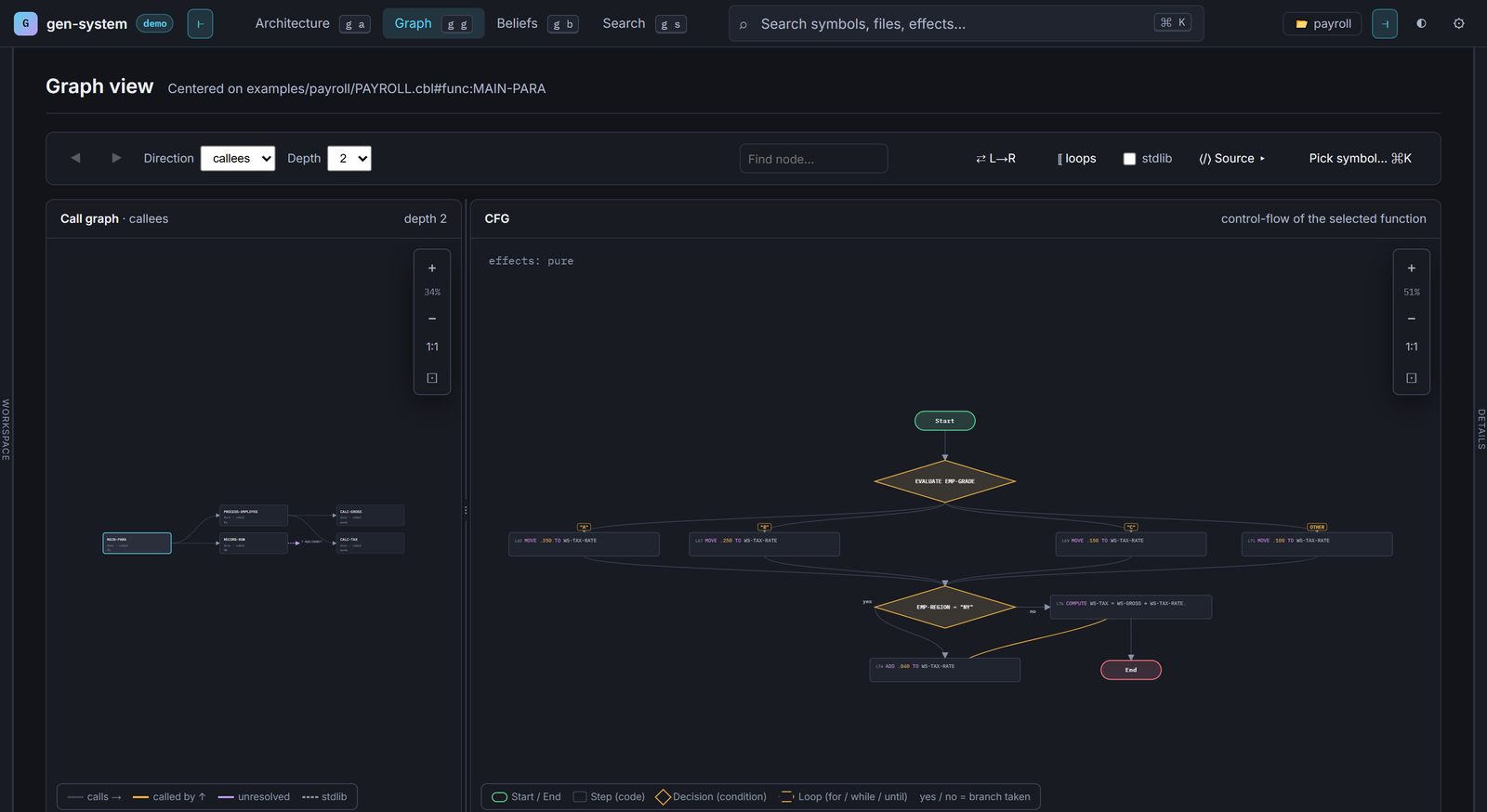
The Studio on examples/payroll. Left: what MAIN-PARA calls, two levels
deep. Right: the control flow graph of CALC-TAX. The EVALUATE on the pay grade fans out into
four arms, then the region check adds a branch.
A model that writes code for an existing system has to guess about it. What does this routine call? Which data does it write? What does a COBOL paragraph pull in from a copybook? gen-system answers those questions with parsers, one hand written parser each for Go, COBOL with copybooks, CA Gen, Java, TypeScript and Python. They build the syntax tree, the symbol index, the call graph and the control flow graph of each routine. No model takes part in that step, so the same code always gives the same graph.
For each routine, gen-system then lists the inputs, the calls, the data it writes and the action its name suggests. It calls each line a belief. A local model may add claims, and gen-system marks any claim the parser contradicts and never uses it. You can correct any belief. Only beliefs a person verified steer generation.
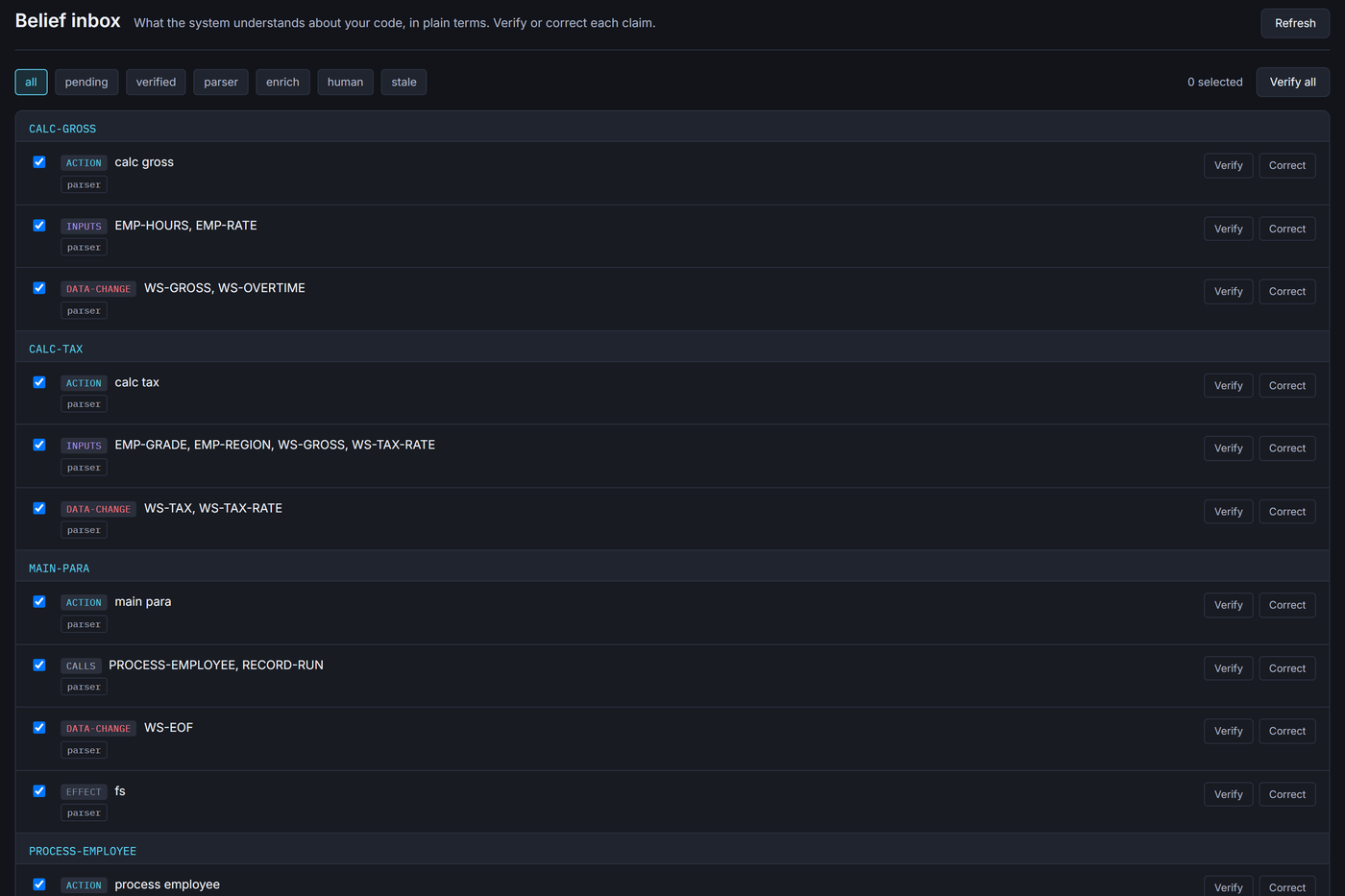
The Beliefs page for examples/payroll. A COBOL paragraph has no parameters, so gen-system reads
its inputs and the data it writes from its statements: CALC-TAX reads the grade, the region, the
gross pay and the rate, and writes the tax and the rate. Each line has Verify and Correct.
The generation half plans a Go service with qwen3:14b and writes each operation with
qwen2.5-coder:14b. Each operation must compile on its own before it enters the service file. A
body that still fails after two repairs becomes a not implemented stub, and the run counts it.
Then go vet, go build and go test run on the whole service, and the parsers read the result
again.
I measured the parsers on 2026-09-09, on four public repositories pinned to a commit: 405 files,
268 of them COBOL. They hit 0 parse errors and resolved 100% of the calls between each project's
own symbols. They built 1,302 control flow graphs, and none had an issue. On 60 SWE-bench Verified
tasks, gen-system took the names in each issue and walked two hops through the call graph. The
walk reached 0.674 of the files the real fix touched, and a median of 422 files per task. That
is localization recall, not a solve rate: gen-system writes no fix. The raw files are in
results/2026-09-09/.
What you get
| Program | What it does |
|---|---|
understand-server | the Studio in your browser: architecture, symbol search, call graph, control flow graphs, source and beliefs. Correct a belief in place. Read only, no model |
understand-mcp | the same facts for Claude Code, Codex, Cursor or any MCP client |
gen-enrich | asks the local model to describe each routine and stores the answers as model claims |
gen | idea plans and generates a service; continue and evolve change one; style measures and checks a team style profile; migrate applies the database changes |
gen-server | the Studio plus the generation half |
genbench | the measurements: parse speed, call resolution, model speed, generation |
The read only half (understand-server, understand-mcp) links no generation code and no model
client. An architecture test (internal/archtest) fails the build if that changes.
Install
You need Go 1.25 or newer. The generation half also needs Ollama and one GPU with 16 GB. I run it on an RTX 4060 Ti with 16 GB, on Linux and on Windows.
git clone https://github.com/hpdkhoa/gen-system.git
cd gen-system
./install.sh                # Go, Ollama, the two models, optional Postgres and Node
./install.sh --understand   # only the read only half, for an air gapped review
The installer pulls the two default models:
ollama pull qwen3:14b           # plans
ollama pull qwen2.5-coder:14b   # writes code
genbench model shows whether Ollama is up, whether the model loaded and whether it stays
resident. Run it before you measure anything.
Read a codebase
understand-server --root ./your-repo
Open http://localhost:28080/. gen-system writes the beliefs to ./your-repo/.gen/beliefs.json.
Correct one in the Studio, or POST to /api/present/beliefs/correct. Your correction wins from
then on. If the source changes under it later, gen-system marks the belief out of date and shows
your value next to the new one.
Python files need python3 3.9 or newer on the host. The other five parsers are pure Go. A
construct a parser cannot model becomes an unknown node that carries the reason.
To try it before you point it at your own code, open one of the two examples:
understand-server --root examples/payroll --copybooks examples/payroll/copybooks
understand-server --root examples/shop
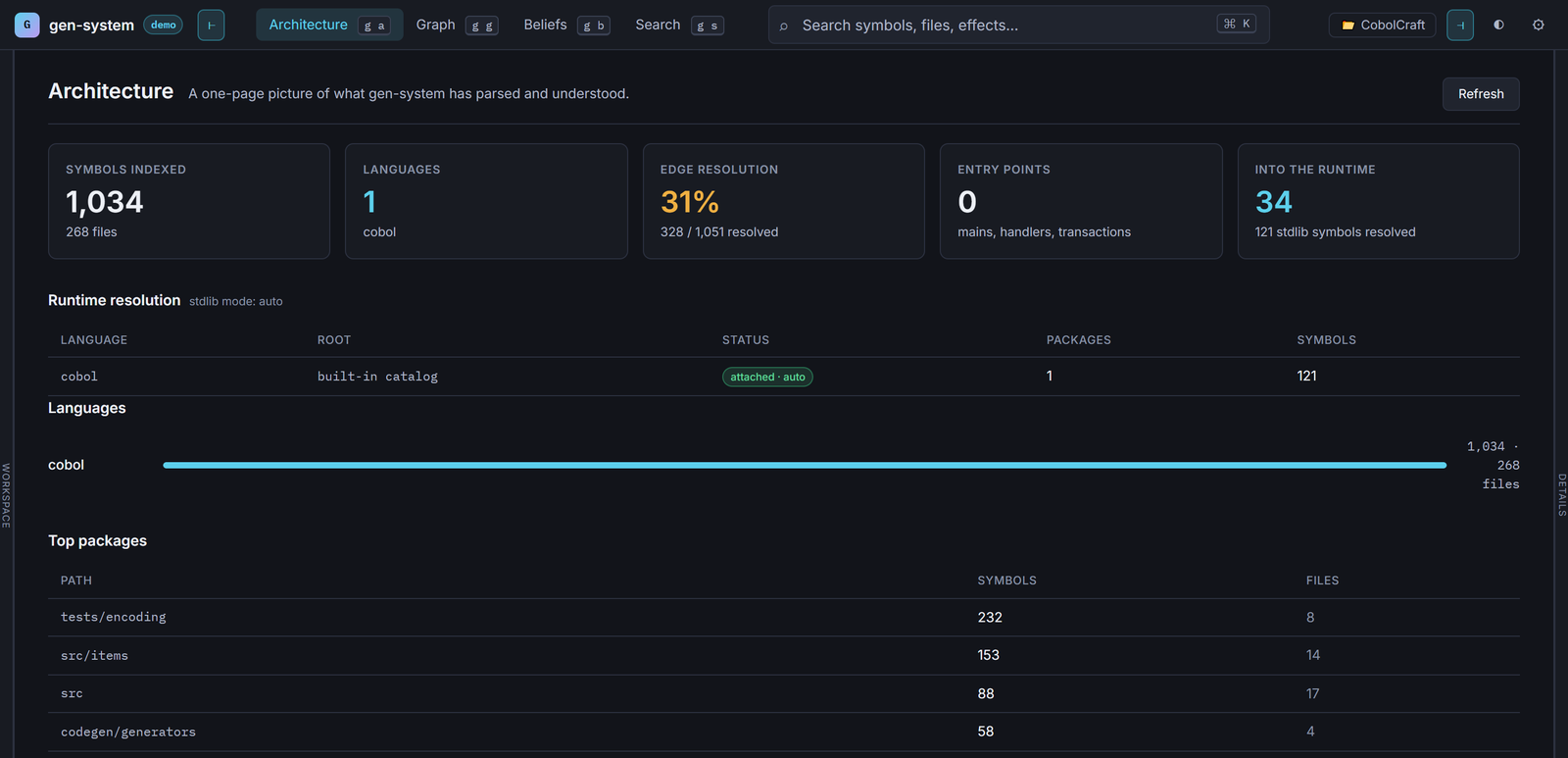
The Architecture page for CobolCraft, a Minecraft server
written in COBOL. "Edge resolution 31%" counts every call edge, including calls into the GnuCOBOL
runtime and C helpers that have no COBOL definition to resolve to. Every call between CobolCraft's
own programs resolves; the baseline in generator/internal/bench/baselines/ explains the split.
Give your agent the facts (MCP)
claude mcp add gen-understand -- npx -y gen-understand --root ./your-repo
or, with Go and no npm:
go install github.com/hpdkhoa/gen-system/generator/cmd/understand-mcp@latest
claude mcp add gen-understand -- understand-mcp --root ./your-repo
| Tool | Answers |
|---|---|
architecture | the languages, top packages, entry points, call resolution, and what the parsers could not model |
search_symbols | symbols by name, ranked, with the ids the other tools take |
call_graph | a walk over the call edges from one symbol; a callee it cannot resolve shows as an external node |
control_flow | a function's basic blocks, their edges and the source lines in each block |
source, file_symbols | the code of one symbol; every symbol in one file |
effects | functions grouped by what they touch: database, files, network, pure or unknown |
beliefs | the belief records with their source (parser, model or person), filtered by routine, kind or verified state |
Ask your agent "who calls CALC-TAX, and which paragraphs touch the database?" on
examples/payroll, and it calls two tools. These are the real answers, shortened:
// call_graph {"symbol": "…PAYROLL.cbl#func:CALC-TAX", "direction": "callers", "depth": 3}
"edges": [
  { "from": "…#func:PROCESS-EMPLOYEE", "to_name": "CALC-TAX",         "unresolved": false },
  { "from": "…#func:MAIN-PARA",        "to_name": "PROCESS-EMPLOYEE", "unresolved": false }
]

// effects {}
"by_effect": {
  "db":   [ { "name": "RECORD-RUN", "line": 78 } ],
  "pure": [ { "name": "CALC-GROSS", "line": 53 }, { "name": "CALC-TAX", "line": 62 } ]
}
RECORD-RUN is the only paragraph with an EXEC SQL block, and the parser found it without a
model.
correct_belief exists only when you start the server with --allow-corrections. The server
runs locally and sends nothing anywhere. docs/mcp.md covers Codex, Cursor, the
flags and the protocol.
Generate a service
gen idea --out ./generated-app "a library lending service with members, books and loans"
Every model call uses temperature 0 and seed 42. gen-system attaches the standard library of each
language in the project, so the final check knows net/http and encoding/json when it reads the
output. --stdlib none turns that off, and --stdlib go,java=/opt/jdk/java.base names the roots.
A team style profile puts your conventions into every prompt. The parsers then check the same rules on the output:
gen style derive ~/code/team-repo --out gen-style.json   # measure a repo, with evidence per rule
gen idea --style gen-style.json --style-mode gate "a support ticket tracker"
gen style check ./generated-app/backend --profile gen-style.json
An operation that compiles but breaks a rule goes back to the model with the rule named. Only the compile gate can turn an operation into a stub. docs/style-gate.md lists what a profile can say.
Settings
Copy gen-system.env.example to .env. A variable in your shell wins over the file.
| Variable | Meaning |
|---|---|
OLLAMA_HOST | the Ollama address; default http://127.0.0.1:11434 |
OLLAMA_MODEL_PLAN, OLLAMA_MODEL_CODE | the planning model and the code model |
OLLAMA_KEEP_ALIVE | how long Ollama keeps a model loaded between calls |
OLLAMA_TIMEOUT | seconds per model call |
GEN_STDLIB | the standard library roots, in the --stdlib form |
GEN_COBOL_COPYBOOK_PATH | where the COBOL parser looks for copybooks |
How it works
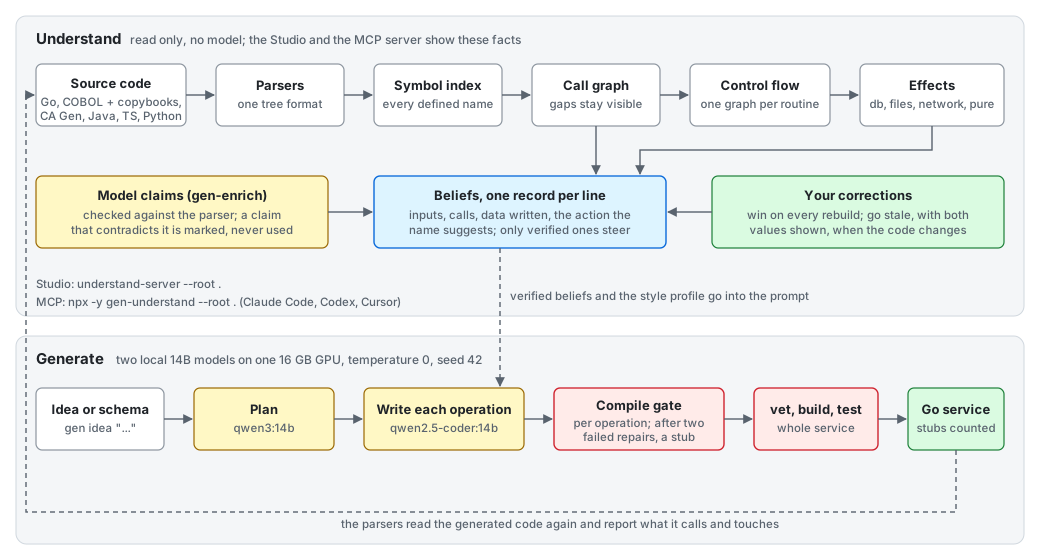
generator/internal/ast: one parser per language, all into one tree format.generator/internal/symbols,flow: the symbol index, call resolution and control flow graphs.generator/internal/belief: the belief records, model claims, corrections and staleness.generator/internal/presentation: the API the Studio and the MCP server share.generator/internal/engine,agent,planner_v2: planning, generation and the gates.generator/internal/ai: the single path to the model.
The two models run one after the other. Ollama keeps a model loaded between calls, and swapping between them took about 2 seconds in the 2026-09-09 run.
Test
make test
It runs go test ./... in generator/. Several tests write .gen/ast_cache folders next to the
code they parse; run them on a copy if you want a clean tree.
Benchmarks
bench/ holds the harness, the task set and the drivers. I commit the task set before any run.
./bench/freeze-env.sh    # record the commit, GPU, driver and model list
./bench/run-all.sh       # the full campaign
python3 bench/attest.py --results results/<date>
Each campaign ends with results/<date>/ATTESTATION.md. It records what ran, on which commit and
machine, and which runs the harness dropped and why. MANIFEST.sha256 lists every raw file with
its SHA-256. bench/README.md explains each driver.
A service that compiles is a weak signal here. A body that fails the compile gate twice becomes a stub, and stubs compile. Read the stub rate and the repair counts.
Limitations
- One GPU. No multi GPU or multi node support.
- Six languages. Other files parse as unknown nodes, with no symbol resolution.
- Body rewriting works for Go and Python only. Other languages return a
not implementederror. - The model's security review warns and never blocks.
- The CLI summarizes beliefs per service only. The code for module and project summaries exists but does not run yet.
Documentation
- docs/understand-pipeline.md: from a source file to a control flow graph.
- docs/beliefs.md: the belief record, a worked example, and how staleness spreads.
- docs/model-contact.md: the single path to the model and its settings.
- docs/style-gate.md: style profiles and the style gate.
- docs/mcp.md: the MCP server.
- docs/adding-a-language.md: how to add a parser.
Contributing
Open an issue and attach the belief file (.gen/beliefs.json). It shows where gen-system read the
code wrong.
License
Apache-2.0. See LICENSE and NOTICE. The only external Go dependency is
github.com/lib/pq (MIT). The COBOL baseline fetches CobolCraft (MIT) at a pinned commit when it
runs.