Listed from the MCP registry; nobody on Odel publishes it.

Batfish Q
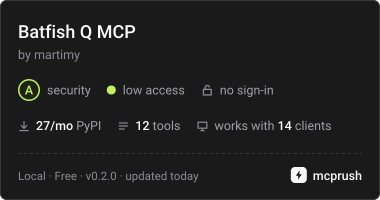
An MCP server exposing Batfish tools so AI assistants can query network configs in plain language.
Runs on your machine from its package; the steps are below.
What it does
- Reads
- Writes
- High impact
At most: moves money, runs code or commands, deletes data, or sends messages for you.
What it costs
FreeOdel charges nothing per call. The publisher may charge for its own service.
Runs locally over stdio
This server isn't hosted — your MCP client launches it from a package registry. Use one of the commands below, or drop the config into your client (e.g. Claude Desktop).
Run
uvx batfish-q-mcp
MCP client config
{
  "mcpServers": {
    "batfish-q": {
      "command": "uvx",
      "args": [
        "batfish-q-mcp"
      ]
    }
  }
}batfish-q-mcp



An MCP (Model Context Protocol) server that exposes Batfish as tools for AI assistants. Point it at a snapshot of your network configs and ask questions in plain language, without writing Batfish queries yourself.
With it, an assistant can:
- run any of 60 curated Batfish questions (node properties, routing, ACLs, reachability, parse issues, and more)
- run assertions, such as "no forwarding loops", singly or as a YAML suite
- fork a snapshot with failed nodes or interfaces and diff the result against the original
- return layer 3 and routing topology as nodes and edges
batfish-q-mcp is an offshoot of Bat-Q, a Streamlit GUI over Batfish (see Acknowledgements). The pybatfish project also includes its own MCP server; batfish-q-mcp is a separate community project, not affiliated with the Batfish maintainers, and uses a different command name (
batfish-q-mcp) so the two can be installed side by side.
Example prompts
Once the server is connected to your MCP client and a snapshot is loaded, try:
- "List the snapshots and tell me whether the configs parsed cleanly."
- "Are there any forwarding loops in this snapshot?"
- "Show me the layer 3 topology."
- "What happens to reachability from r2 to r3 if r1 fails?"
- "Which nodes have BGP configured, and what are their peers?"
Behind the scenes the assistant calls the tools listed below.
Quick start
1. Start Batfish
The server needs a running Batfish instance. The quickest way is Docker:
docker run --rm -p 9996:9996 -p 9997:9997 batfish/allinone
The server connects to 127.0.0.1 by default. If Batfish runs elsewhere, set
BATFISH_SERVER (for example BATFISH_SERVER=<batfish-host>).
2. Connect your MCP client
The package is on PyPI, so the simplest setup runs it with
uv (uvx), with nothing to clone or install first.
Claude Desktop, Cursor, and other stdio clients
{
  "mcpServers": {
    "batfish-q-mcp": {
      "command": "uvx",
      "args": ["batfish-q-mcp"],
      "env": { "BATFISH_SERVER": "127.0.0.1" }
    }
  }
}
Restart the client so it picks up the new server. To pin a version, use
"batfish-q-mcp@X.Y.Z" in args.
Prefer pip? Install it with pip install batfish-q-mcp (ideally in a virtual
environment) and use the full path to the batfish-q-mcp command, or just
batfish-q-mcp if it is on your PATH, as the command instead of uvx.
Claude Desktop on Windows with the server in WSL
Claude Desktop runs on Windows, so launch the server through wsl.exe. Edit
%APPDATA%\Claude\claude_desktop_config.json:
{
  "mcpServers": {
    "batfish-q-mcp": {
      "command": "wsl.exe",
      "args": [
        "-d", "<distro>",
        "--",
        "env", "BATFISH_SERVER=127.0.0.1",
        "/home/<you>/.local/bin/uvx", "batfish-q-mcp"
      ]
    }
  }
}
- Find
<distro>withwsl -l -vin PowerShell. - Use the absolute path to
uvx(which uvxin WSL). Non-interactive WSL shells often do not have~/.local/binonPATH. - Adjust
BATFISH_SERVERif Batfish runs somewhere other than the WSL machine. - Fully quit and reopen Claude Desktop after editing the file.
OpenCode
OpenCode uses opencode.json (schema https://opencode.ai/config.json) with
mcp.servers, type: "local", and command given as an array:
{
  "$schema": "https://opencode.ai/config.json",
  "mcp": {
    "servers": {
      "batfish-q-mcp": {
        "type": "local",
        "command": ["uvx", "batfish-q-mcp"],
        "environment": {
          "BATFISH_SERVER": "127.0.0.1"
        }
      }
    }
  }
}
Put the file in your project root (or ~/.config/opencode/), then start or
restart OpenCode from that directory so it reloads MCP servers.
Note: OpenCode Code Mode isolates tools. There are no direct
batfish_*tools; call them through theexecutetool, for example:jsawait tools["batfish-q-mcp"].batfish_list_questions({});
3. Load a snapshot and ask
Package your configs as a snapshot zip (see Providing a snapshot), put it in your workspace, and tell the assistant the filename. The assistant uploads it and runs the questions you ask.
A fresh server process has no Batfish network set yet. Pass
network(for example"NETWORK") on the first call that needs snapshots; it then stays set for the life of the process. Callingbatfish_list_snapshotswithoutnetworkfails withNetwork must be set.
Compatibility
- Python
>=3.10. - Tested with Claude Desktop on Windows, with the server running in WSL. Other MCP clients that launch stdio servers (Cursor, OpenCode, and similar) should work, but have not all been tested.
Data handling
Batfish runs where you start it, but what the assistant retrieves is not local: tool results, including parts of your configurations (addresses, interface descriptions, routing details), pass through your MCP client to the LLM provider behind it. Before loading real configs:
- remove or replace secrets such as passwords, SNMP communities, and keys, or use lab or sanitized configs;
- check your LLM provider's data-retention and privacy terms and your organization's policy.
Known limitations
- Snapshot upload goes through the assistant as base64. This is fine for small lab snapshots and impractical for large ones. For large snapshots, load the snapshot into Batfish yourself (see below) and refer to it by
snapshotandnetworkname. - A network must be set on the first call that needs one (see the note above).
- One shared Batfish session per server process; tool calls are serialized.
Providing a snapshot
-
Format: one Batfish zip containing configs, plus optional
batfish/andhosts/folders. For example,abc_net.zipcontainsabc_net/configs/R1.cfg,R2.cfg,R3.cfg,FW.cfgandhosts/server_*.json. -
Where: drop the zip in your workspace and tell the assistant the filename.
-
Upload: the assistant base64-encodes the zip and calls
batfish_upload_snapshot(name, zip_base64, network?, overwrite?).nameis sanitized (safe_snapshot_name). Collisions are made unique (name_1, ...) unlessoverwrite=true.zip_base64must be valid base64 with correct padding (=or==). Validation is enforced server-side.
-
Already on the Batfish server: give the assistant the
snapshotandnetworknames; no upload is needed. -
Shell access: you can also upload directly with pybatfish:
bashpip install pybatfish python3 - <<'PY' import os from pybatfish.client.session import Session bf = Session(host=os.getenv("BATFISH_SERVER", "127.0.0.1")) bf.set_network("NETWORK") bf.init_snapshot("abc_net.zip", name="abc_net", overwrite=True) print(bf.list_snapshots()) PY
Tools
The server provides 12 tools. batfish_run_question gives access to the full
60-question catalog.
| Tool | Description |
|---|---|
batfish_list_questions(category?) | The 60-question curated catalog. Each entry includes a one-line description, tags, synonyms, output column names, category_description, input required flags, TYPE_HINTS details (hint, fields, placeholder, example), and supports_differential/differential_only. No Batfish server needed. |
batfish_find_questions(query, limit?) | Plain-language search over names, descriptions, categories, tags, synonyms, inputs, allowed values, and output columns. Returns ranked matches with score and matched_on. No Batfish server needed. |
batfish_get_question(fun) | Full metadata for one question: long description, typed output_columns ({name, type, description}), input descriptions/defaults/allowed values/field_specs, tags, and synonyms. No Batfish server needed. |
batfish_list_snapshots(network?) | Snapshots of a network. |
batfish_delete_snapshot(name, network?) | Delete a snapshot; verifies it exists first. |
batfish_upload_snapshot(name, zip_base64, network?, overwrite?) | Upload a snapshot zip (base64). The name is sanitized (safe_snapshot_name); collisions are made unique (name_1, ...). |
batfish_run_question(fun, options?, snapshot?, reference_snapshot?, network?, debug?, trace_detail?, max_rows?) | Run any catalog question. Giving reference_snapshot and snapshot runs a differential question. trace_detail is "summary" (default), "none", or "full"; max_rows caps returned rows (default 50, 0 for no limit). Returns JSON-safe {fun, snapshot, reference_snapshot, status, rows, removed_columns, total_rows, returned_rows, truncated}; Batfish failures return {status: "error", code, message} (set debug=true for the raw log). |
batfish_list_assertions() | Live pybatfish assertion names plus the 16-entry registry (specs) with parameter descriptions. |
batfish_run_assertion(name, params?, question?, snapshot?, network?, debug?) | Validate and run one assertion (answer-based ones fetch the answer first). Returns {type, status, message, snapshot, ran_at, runtime, fun?, answer_rows?, details?, code?}; message is a one-line summary and failing rows are structured where possible. |
batfish_run_assertion_suite(suite_yaml, snapshot?, network?, debug?) | Validate (all-or-nothing) and run a YAML suite; examples/assertions.yaml shows the schema. Returns results[], errors[], summary; each result uses the same short-message/structured-row shape. |
batfish_fork_snapshot(base_name, name?, failed_nodes?, failed_interfaces?, overwrite?, network?) | Fork a snapshot, optionally failing nodes or interfaces, then diff the fork against the base with a differential question. failed_interfaces accepts node[interface] strings such as "r1[Gi0/0]" or {hostname, interface} mappings. |
batfish_get_topology(kind, snapshot?, network?) | kind="layer3" (from layer3Edges, with interface titles) or "routing" (from bgpEdges). Returns {kind, snapshot, node_count, edge_count, nodes, edges}. |
All tools share one Batfish session (batfish_mcp.session, using
BATFISH_SERVER, default 127.0.0.1), serialized with a lock.
Catalog entries are self-describing: inputs are optional unless marked
required: true, and complex values include their fields, placeholder,
and example. Any question with supports_differential: true can be run
with both snapshot and reference_snapshot; the two differential_only
questions (compareFilters and differentialReachability) require it.
In a differential answer, Snapshot_* columns come from snapshot (the
snapshot under test) and Reference_* columns come from
reference_snapshot (the baseline being compared against). For
differentialReachability, the response also includes a trace_columns
mapping so these labels cannot be read backwards.
Reachability answers compress trace columns by default. trace_detail="summary"
returns each trace's disposition, node path, and hop count; "none" drops the
trace columns but keeps the trace counts; "full" returns the original
hop-by-hop traces. max_rows caps large answers (default 50, 0 for no limit)
and total_rows, returned_rows, and truncated report any truncation.
Per-question descriptions, tags, synonyms, output columns, defaults, and
allowed values live in the checked-in question_metadata.json. It is generated
from live Batfish question templates, the questions/Parameters.md specifier
documentation, and the official docs notebooks by
scripts/generate_question_metadata.py; scripts/extract_output_columns.py
refreshes the docs-derived columns. The server loads this file once, so
batfish_list_questions, batfish_find_questions, and batfish_get_question
work without a Batfish server.
The server's MCP instructions include a decision tree for discovery. For
ambiguous requests, use batfish_find_questions first (for example
"standby gateway", "traffic going in circles", or "which firewall rule is blocking"), then batfish_get_question to inspect the candidates.
Tools that read a snapshot verify it exists before calling Batfish, so a typo
fails immediately with a message such as
snapshot 'abc_net' not found in network 'LAN'; available: [] instead of an
opaque Batfish work-queue error.
Failures raised by Batfish are mapped to concise structured errors, for example
{"status": "error", "code": "SNAPSHOT_INCOMPATIBLE", "message": "Snapshot was built with an incompatible Batfish version; re-upload it with the current Batfish server."}. Pass debug: true to include the raw Java log.
Other codes include INVALID_ARGUMENT, INVALID_PORT_SPEC, and
BIDIRECTIONAL_REQUIRES_DST.
Header values use Batfish specifiers:
srcIps/dstIpsaccept literal IPs, prefixes, node names, interfaces, or named IP spaces. For example{"srcIps": "server_1", "dstIps": "server_2"}.srcPorts/dstPortsmust be string specs such as"443"or"80,443"; numeric JSON values are rejected.maxTracesis an integer.- If
ipProtocolsis omitted, Batfish tests ICMP. For service-level checks set it explicitly, e.g.{"dstIps": "8.8.8.8", "ipProtocols": ["TCP"], "dstPorts": "443"}. bidirectionalReachabilityrequiresheaders.dstIps; without a destination Batfish fails during reverse-flow transformation setup.
Batfish returns representative flows for broad headers: a prefix such as
{"srcIps": "192.168.1.0/24"} may produce a flow sourced from a network or
broadcast address. Prefer node names, interface locations, or explicit host
IPs when you need a realistic example.
reachability returns example flows that satisfy the constraints, not an
exhaustive source-to-destination matrix. Use traceroute for one specific
destination, or run per-pair queries to build a matrix.
Tool call examples
For reference, this is roughly what the assistant calls when you ask the
example prompts. Upload abc_net.zip, then:
batfish_list_questions(category="Packet Forwarding")
batfish_find_questions(query="standby gateway")
batfish_get_question(fun="traceroute")
batfish_upload_snapshot(name="abc_net.zip", zip_base64="UEsDBB==", network="NETWORK")
batfish_run_question(fun="nodeProperties", snapshot="abc_net")
batfish_run_assertion(name="assert_no_forwarding_loops", snapshot="abc_net")
batfish_fork_snapshot(base_name="abc_net", failed_nodes=["r1"])
batfish_run_question(fun="differentialReachability",
    options={"pathConstraints": {"startLocation": "r2", "endLocation": "r3"},
             "headers": {"dstIps": "192.168.3.1"}},
    snapshot="abc_net_Fail", reference_snapshot="abc_net")
Topology:
batfish_get_topology(kind="layer3", snapshot="abc_net", network="NETWORK")
batfish_get_topology(kind="routing", snapshot="abc_net", network="NETWORK")
In OpenCode, wrap these in execute, for example:
await tools["batfish-q-mcp"].batfish_run_question({
  fun: "initIssues", snapshot: "abc_net", network: "NETWORK"
});
See HOW-TO.md for a longer walkthrough.
Troubleshooting
- The server does not show up or fails to start in Claude Desktop: check the log (on Windows,
%APPDATA%\Claude\logs\mcp-server-batfish-q-mcp.log) and run the same command by hand in a terminal. A working server starts and waits silently for input. Check that the JSON is valid and that<distro>and<you>are replaced. uvx: command not found(for example inside the WSL launch above): use the absolute path fromwhich uvx.- The server starts but tools report connection errors: Batfish is not running or not reachable on ports 9996 and 9997. Start it and check
BATFISH_SERVER. Network must be set: passnetwork="NETWORK"on the first call.zip_base64 is not valid base64: Incorrect padding: re-encode withbase64 -w 0 abc_net.zip(no newlines) and keep the trailing=or==. Do not trim by hand.- Snapshot already exists: pass
overwrite: true, or accept thename_1suffix. - No parse issues but wrong IPs? Run
batfish_run_question(fun="initIssues")andfileParseStatusfirst. - Reachability to
240.254.254.1fails but8.8.8.8works:240.0.0.0/4is reserved, and an ISP egress filter such asBlock outgoing traffic using reserved addressesdrops it. Use a public IP to test internet egress.
Development
Developer documentation
See docs/ for architecture, module reference, tool
contracts, the metadata pipeline, assertion internals, and change recipes. Start
with the high-level overview.
Install from source
git clone https://github.com/martimy/batfish-q-mcp.git
cd batfish-q-mcp

python3 -m venv .batmcp
source .batmcp/bin/activate
pip install -e ".[dev]"      # includes test dependencies
This installs the batfish-q-mcp command, which starts the MCP server over
stdio. To use your local copy from a client, point command at the script in
your virtual environment (find it with which batfish-q-mcp while the
environment is active):
{
  "mcpServers": {
    "batfish-q-mcp": {
      "command": "/path/to/batfish-q-mcp/.batmcp/bin/batfish-q-mcp",
      "env": { "BATFISH_SERVER": "127.0.0.1" }
    }
  }
}
To check that the server starts outside a client:
export BATFISH_SERVER=127.0.0.1
batfish-q-mcp
# or
python -m batfish_mcp.server
It speaks stdio JSON-RPC (FastMCP) and does not print logs to stdout.
Regenerating question metadata
question_metadata.json is checked in. To refresh it against a running
Batfish and the published docs notebooks:
python3 scripts/extract_output_columns.py
python3 scripts/generate_question_metadata.py --host 127.0.0.1
The generator records the coordinator host, pybatfish version, and coverage gaps (missing output columns or catalog/template mismatches) in the file.
Tests
pytest # no Batfish server required (fakes + one in-memory MCP round-trip)
tests/test_assertions.py also checks that assertion_specs.py stays in sync
with the installed pybatfish (scripted-assertion signatures).
Layout
src/batfish_mcp/
  server.py           # FastMCP tools over the headless core
  session.py          # thread-safe singleton Session
  catalog.py          # curated question catalog (60 questions)
  question_metadata.json  # generated descriptions/output columns/inputs
  assertion_specs.py  # assertion registry (params as {name, type, optional})
  assertion_io.py     # assertion YAML load/validate/dump
  assertions.py       # assertion runner (session- vs answer-based, PASS/FAIL/ERROR)
  queries.py          # question runner (incl. differential snapshots)
  utils.py            # snapshot-name sanitizing, template helpers
  presenter.py        # pure DataFrame/trace serialization helpers
  hints.py            # TYPE_HINTS: tool-parameter descriptions
  topology.py         # L3 + routing graph construction from answers
tests/
  fakes.py            # FakeBatfish + assertion fake (no server needed)
  test_queries.py
  test_assertions.py
  test_server.py      # MCP tools + wire round-trip
examples/assertions.yaml
scripts/
  generate_question_metadata.py  # live templates + docs -> question_metadata.json
  extract_output_columns.py      # docs notebooks -> output_columns.json
HOW-TO.md             # mini tutorial
docs/                 # developer documentation (start at docs/README.md)
Feedback and contributions
Bug reports, questions, and pull requests are welcome through
GitHub Issues. Reports that
include the client you use, your operating system, and the output of
batfish-q-mcp run by hand are the easiest to act on.
Acknowledgements
batfish-q-mcp started as an offshoot of Bat-Q, a Streamlit GUI over Batfish. The reusable headless core (question catalog, assertion registry and runner, answer serialization, snapshot tooling) came from there; the GUI layer was dropped and replaced with the MCP transport. Both projects are Apache-2.0.
License
Apache-2.0 (see LICENSE).