Listed from the MCP registry; nobody on Odel publishes it.
Is this yours? Claim it
Cherry Blossom
Design PCBs: find parts, draw the schematic, lay out, route and check the board, export Gerbers.
One address for any MCP client. You sign in at spotless-frog-64.authkit.app once, after adding it.
What it does
- Reads
- Writes
- High impact
At most: creates or changes data: records, files, settings.
What it costs
FreeOdel charges nothing per call. The publisher may charge for its own service.
Tools
None listed · checked 23 Nov 2026Odel could not list its tools without signing in.

Cherry Blossom
Build PCBs with AI, in an open-source editor that runs in your browser.
Describe a board to Claude, ChatGPT, Cursor, Codex or Sakura, our copilot: it picks real parts,
draws the schematic, lays out and routes the board, and checks its own work.
Then take it from there by hand, and export Gerbers, KiCad, Altium and STEP.






Open the hosted app · Connect your AI · trycherryblossom.com · Report a bug
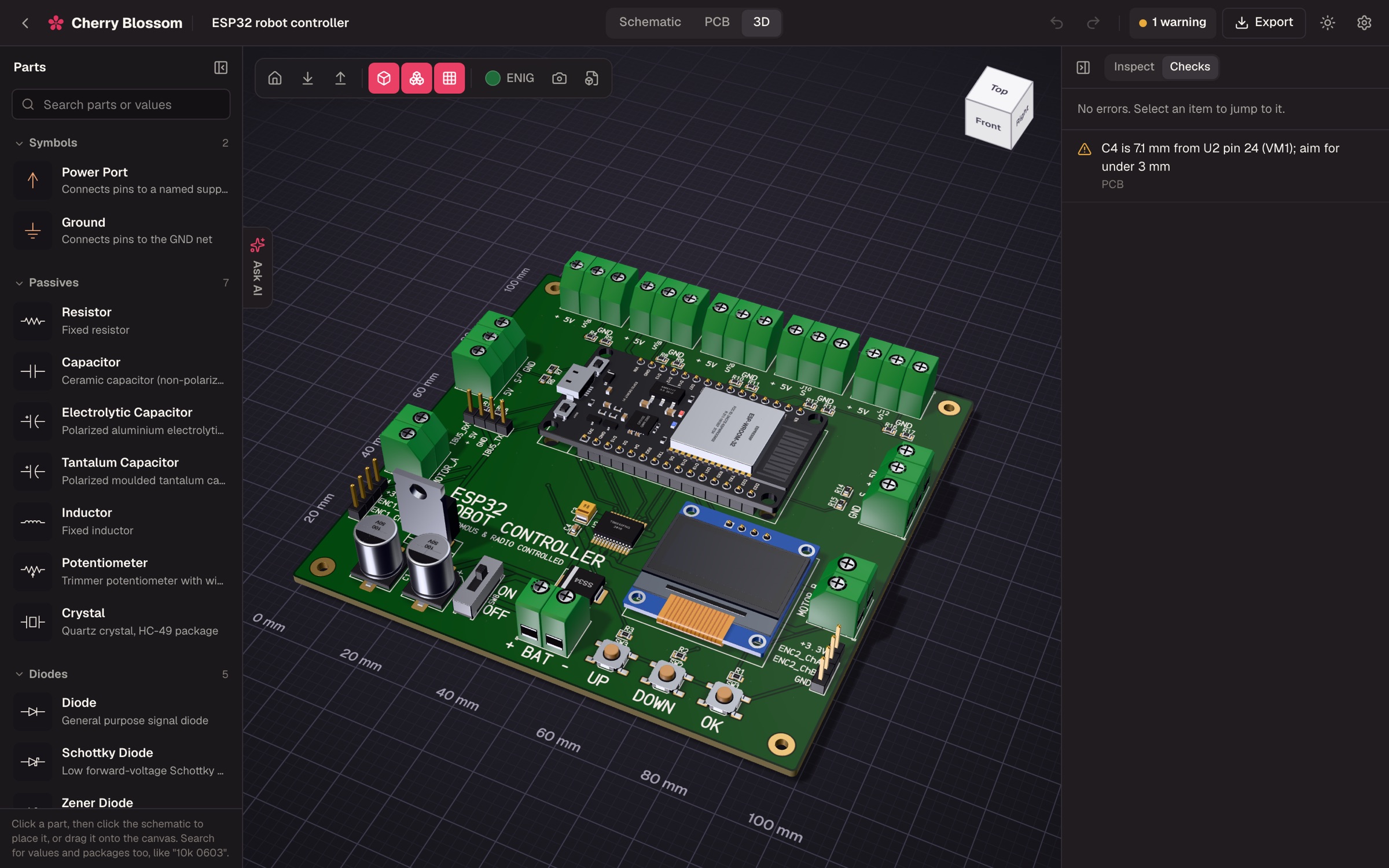
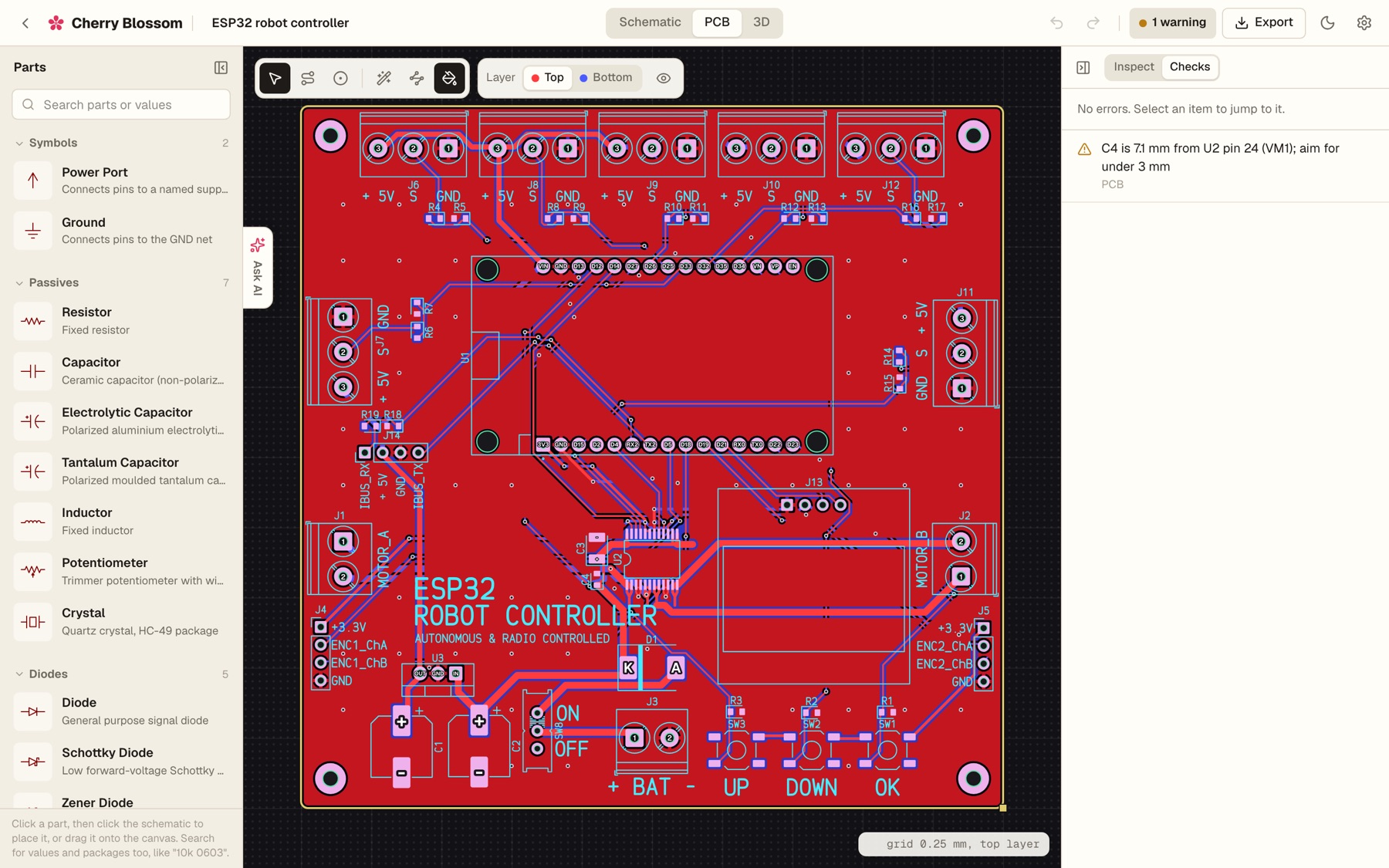
The ESP32 robot controller example in the 3D view: 45 parts, routed and poured, with one decoupling warning in Checks.
Note
This is the editor behind trycherryblossom.com, and the tools AI designs with in it.
Every action an AI takes on a board, from finding a part to routing the PCB,
is a tool in this repository (src/ai), run on the same document
model and held to the same rules as your own edits. The hosted app connects
the AI (your own assistant over MCP, or Sakura) and adds accounts, projects in
the cloud that you share and edit together, version history, supplier part
data and KiCad's 3D models. Everything in this repository, the whole editor
by hand, runs locally with no backend.
Build PCBs with AI · Features · Everything in the box · Under the hood · Get started · Contributing · License
Build PCBs with AI
Cherry Blossom is an editor made for AI to design in, not a chat box bolted onto one. The schematic, the board and the checks are one typed model, and every action an AI can take is a tool with rules it can't break: it can't short two nets, cut a pin loose or guess a pinout without saying so. When it tries, the tool refuses with a sentence saying why, and the AI tries again. What you get back is an ordinary project: a schematic you can read, a board you can edit, and files a fab will take.
There are two ways to bring the AI:
🔌 Your own AI, over MCPClaude, ChatGPT, Claude Code, Codex, Cursor or any MCP client gets Sakura's tools on your projects, through the hosted app's MCP server. It runs on the AI subscription you already pay for, so it's free on every plan, Free included.Its edits land live in any editor tab that has the project open, like a collaborator's, so you can watch the board come together. Setup guide → |
🌸 Sakura, the copilot in the editorNothing to install or connect: open a project and ask. Sakura searches the web and reads datasheets, builds the parts the library doesn't have from supplier data, wires and tidies the sheet, places and routes the board, runs the checks and looks at its own work before it reports.Every change it makes can be undone like your own, and your chats are kept with each project. Included from the Pro plan. Open the app → |
Connect your AI in a minute
Claude Code, Codex and Cursor: the Cherry Blossom plugin adds the MCP server and skills that teach your agent how to work in Cherry Blossom.
# Claude Code: then run /mcp in Claude Code to sign in
claude plugin marketplace add cherryblossomhq/skills
claude plugin install cherryblossom@cherryblossom

# Codex: it opens the sign-in in your browser
codex plugin marketplace add cherryblossomhq/skills
codex plugin add cherryblossom@cherryblossom

# Cursor: then Developer: Reload Window, and sign in from Cursor's MCP settings
git clone https://github.com/cherryblossomhq/skills ~/.cursor/plugins/local/cherryblossom
Claude, ChatGPT and any other MCP client: add this URL as a custom connector (a remote MCP server, Streamable HTTP, with OAuth sign-in). Your assistant opens Cherry Blossom's sign-in; sign in and allow it. There is no API key to make or paste.
https://www.trycherryblossom.com/api/mcp
The setup guide has every client's steps. Then ask:
Make a new Cherry Blossom project for a 555 LED blinker, lay out and route the board, and check it.
Export the Gerbers for my LED blinker.
What the AI can do
- Start from a sentence. Create a project, find real parts by value, package
or part number, read their datasheets, and build any part the library doesn't
have from supplier data, its pins and land pattern checked against the
supplier's (
find_part,search_parts,read_datasheet,create_part). - Draw the schematic. Place parts, connect pins and name nets, group a
circuit into blocks, and tidy the sheet into a drawing an engineer can read,
across hierarchical sheets (
add_component,connect,group_parts,tidy_schematic). - Lay out and route the board. Set the outline and the stackup, place parts
by what they do (each decoupling capacitor at the pin it serves), size traces
for their current, autoroute, pour ground, and draw a trace by hand where it
matters (
set_board,layout_pcb,set_net_width,route_pcb,set_pour,draw_trace). - Check its own work. Run the design rule and electrical checks, and
lookat the schematic or the board: a picture with the numbers behind it (overlaps, wires through symbols, unconnected pins, parts off the board, unrouted connections), so it fixes what it sees before it reports. - Save and go back. Name a version before a big change and restore it if
the change goes wrong (
save_version,restore_version). - Hand you the files. Fabrication files, the BOM and pick-and-place, a KiCad
or Altium project with its 3D models, a STEP model or the project file, as a
download link (
export_files, over MCP).
Why the boards come out right
- Nets are sacred. Every tool call is checked against the netlist. An edit
that would join two nets nobody asked to join, or leave a pin loose, is
refused with the pins and nets named, and changes nothing
(
src/model/merges.ts). - Real parts, not remembered ones. Parts come from supplier data when a supplier has them; a part made from memory is marked unverified, and the checks say so.
- It sees what it made.
lookdraws the sheet or the board as you see it, and the checks point at each problem by part, pin and place. - One design guide for every AI. Sakura's prompt and the MCP server's
instructions are built from the same guide
(
src/ai/designGuide.ts): how to group a circuit, decouple a chip, wire a block a reader can follow, and route a board, so your own assistant designs by the same rules as Sakura. - Its edits are your edits. The same document model and the same rules as your own. Sakura's steps are on your undo stack; your own assistant's land live like a collaborator's, and it saves a version before a big change that you can go back to. Nothing the AI makes is a black box you have to accept or throw away.
Sakura's tools, agent loop and design guide are in this repository
(src/ai) and run in the browser; the models, the MCP server and the
supplier data they call are the hosted app's. A local build has no session, so
its Sakura panel offers to sign in at the hosted app instead of calling
anything.
Features
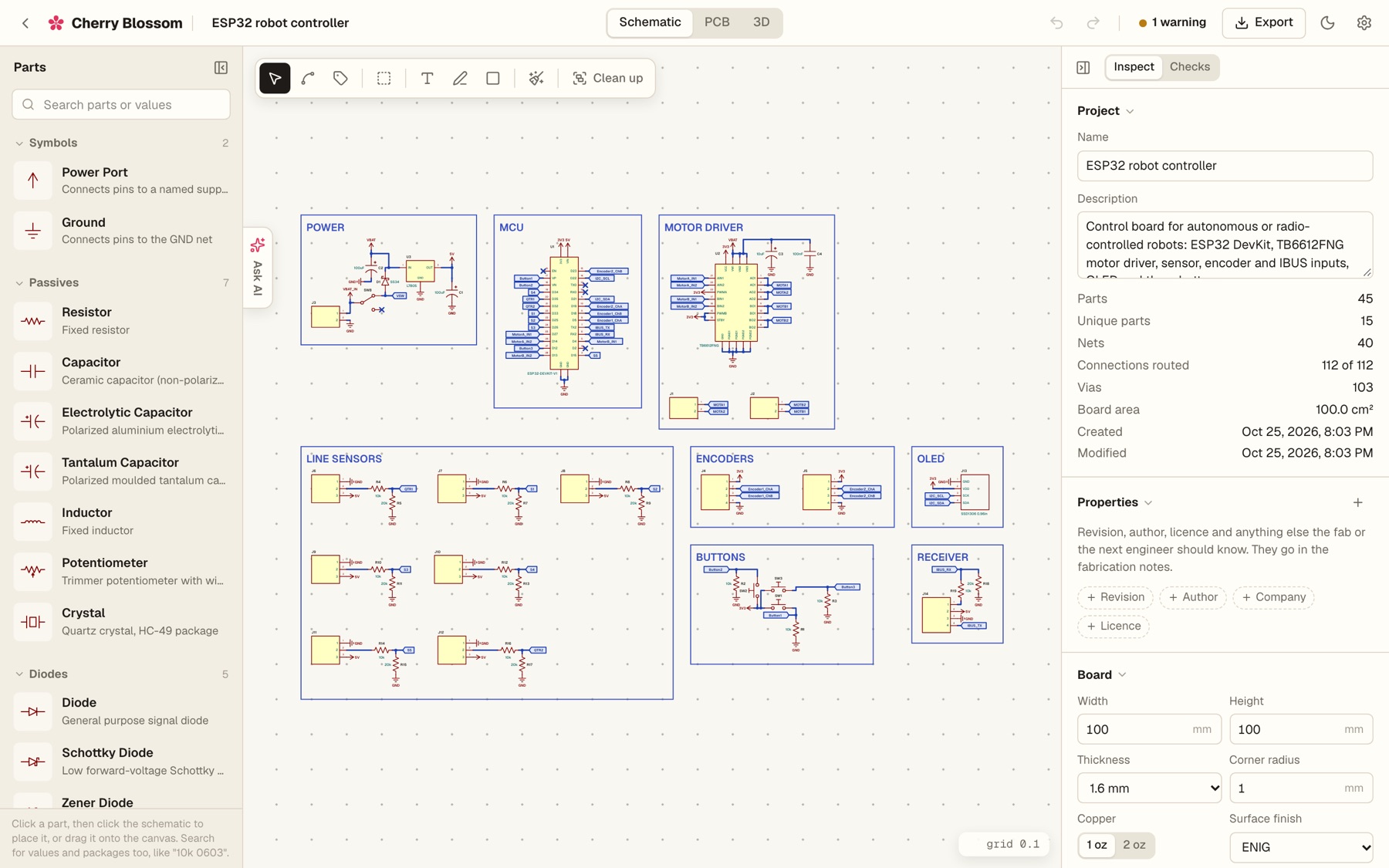
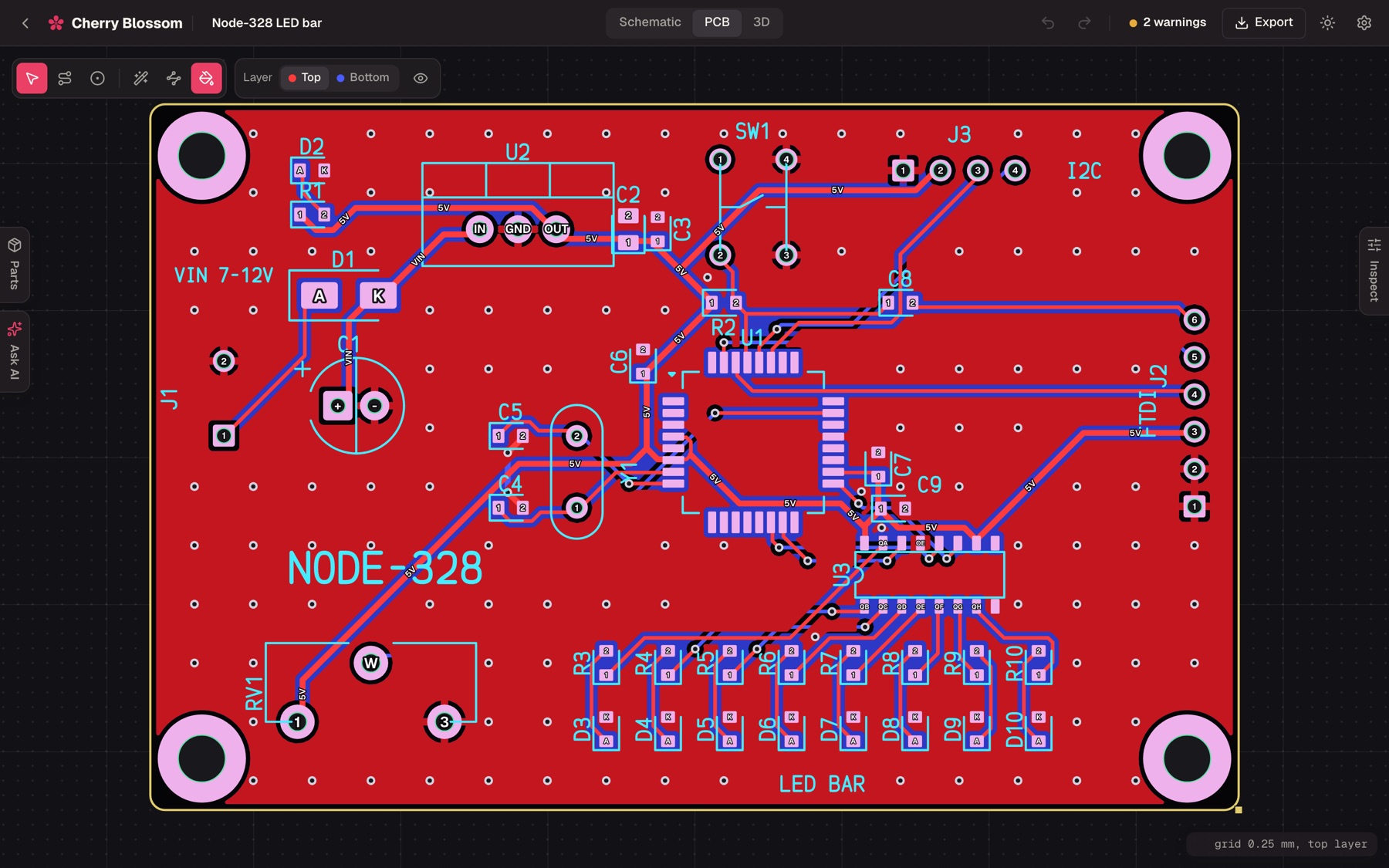
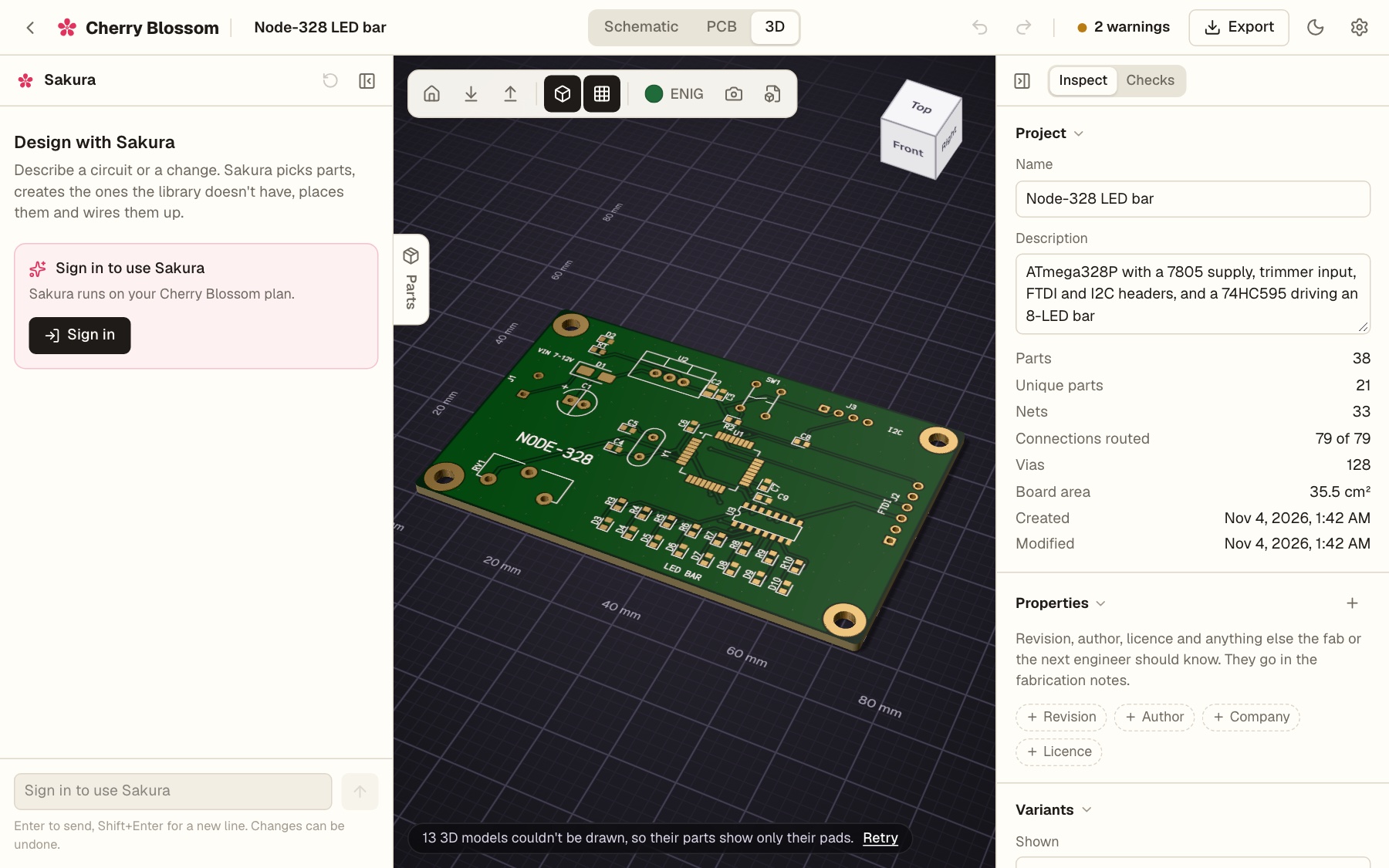
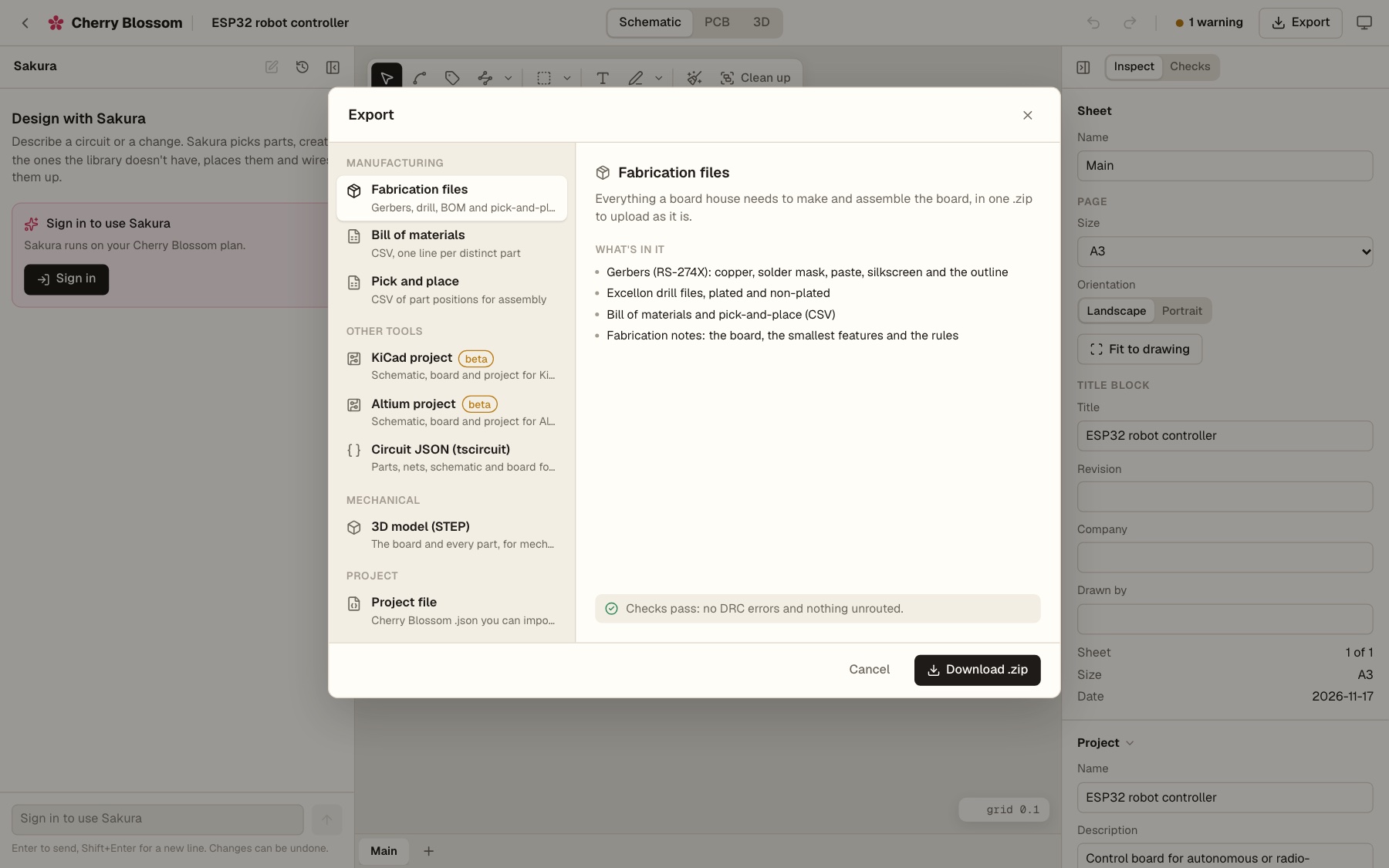
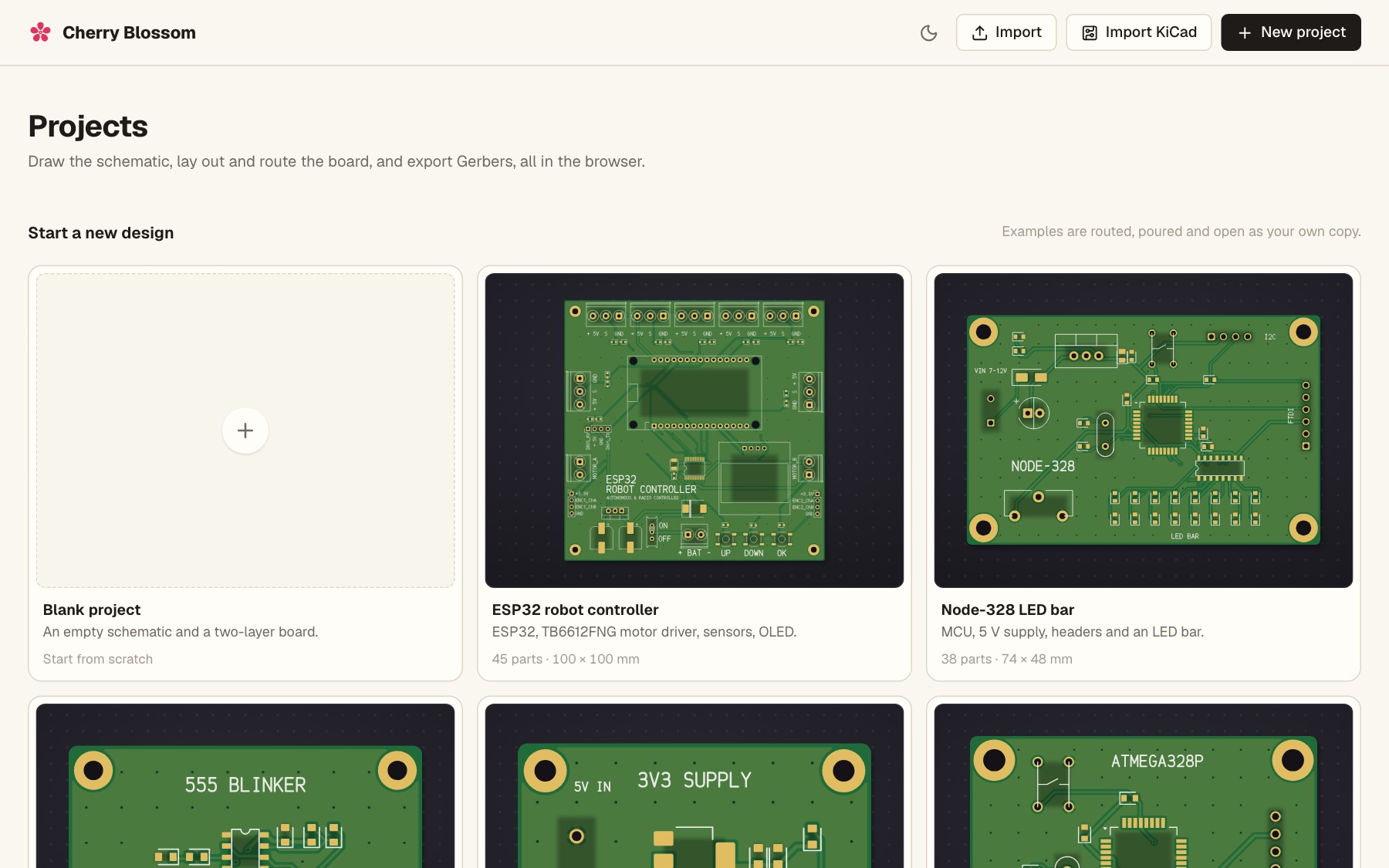
Every screenshot here is the editor as it runs from this repository, on its shipped examples.
Everything in the box
🧰 PartsBasic parts built in: resistors, capacitors (ceramic, electrolytic, tantalum), inductors, potentiometers, crystals, diodes, LEDs, BJTs and MOSFETs, power and ground ports, a battery and coin-cell holder, switches, a relay and a buzzer.Everything else is a part of the project: imported from a KiCad symbol, footprint and 3D model, or drawn in the part editor. Search understands values and packages: 10k 0603 places a 10k 0603 resistor.
|
✏️ SchematicWires · net labels · global labels and ports · power and ground ports · junctions · no-connect flags · blocks · hierarchical sheets with entries drawn by hand · pages with a border, zones and a title block that fills itself in · buses · variants · text, lines, arrows, polygons and rectangles for titles and notes · copy, paste and duplicate · Tidy · Clean up · rotate, flip and drag with nets kept intact.🟥 PCBAuto-place · re-pack · autoroute on every layer · interactive routing · trace reshaping · arcs · vias · up to 32 copper layers · net classes · per-net widths · copper pours and zones · keepouts · thermal spokes · stitching vias · locked parts and copper · any board outline, cutouts, mounting holes · dimensions · reference images · other layers shown, dimmed or hidden · a pick list where things overlap · designators moved, hidden or reset · stackup, copper weight, finish, mask and silkscreen colours design rules in mm or mil. |
📤 ExportsGerber RS-274X · Excellon drill · BOM CSV · pick-and-place CSV · fabrication notes · KiCad 9 project with 3D models · Altium Designer project with 3D models (beta) · Circuit JSON · STEP AP214 assembly · PNG from the 3D view · the project file.⌨️ ShortcutsSchematic:W wire · L label · B block · R rotate · T tidy · ⌘G group.PCB: W route · V via · L layer · F flip · ⇧S other layers.Both: ⌘Z undo · [ ] panels. The full list is in AGENTS.md.
|
Under the hood
- Its own document model. A typed ECAD project edited by pure functions, with no compile step between what you draw and what's on screen. Connectivity, checks and exports all read the same model.
- Nets are sacred. Every move, turn, paste, drag and Tidy is checked against the netlist; an edit that would short two nets or cut a pin loose is refused, with a sentence saying why, and changes nothing.
- Fast where it matters. Spatial indexes, memoised analysis, Tidy and STEP reading in Web Workers, and the 3D view and KiCad converter loaded only when you ask for them.
- A real file format. Versioned, migrated on read, and tolerant of fields it doesn't know, which survive a save.
- Edits travel as changes. Every edit is written as a list of changes to the
project's items (
host/project-changes.ts), applied the same way by every open copy, so two people, or two tabs, edit one project without overwriting each other. - Tested hard. More than 5,000 unit tests, including fuzzers that throw random
edits at random sheets, round trips through Circuit JSON and KiCad, STEP and
KiCad exports read back and checked, and corpus tests that import some 1,500
open-source KiCad boards when you point them at a copy (
npm run test:corpus); plus a Playwright suite that drives the editor in a real browser.
Get started
Requires Node 24 (see .nvmrc).
git clone https://github.com/cherryblossomhq/pcb-editor
cd pcb-editor
npm install
npm run dev          # http://localhost:5173
No environment variables, no API keys, no services to provision.
npm run check        # typecheck, unit tests and a production build
npm run test:e2e     # the browser suite (run npm run test:e2e:install once first)
npm run build        # a static site in dist/
The build is a static single-page app: host dist/ anywhere, with every path
falling back to index.html so a link to a project (/p/<id>) opens it.
New contributors and AI agents: start with AGENTS.md. It covers the
architecture, the file format, how Tidy and the router work, and the sharp edges.
Important
Early stage. The schematic and PCB editors work end to end and the examples go all the way to Gerbers, but expect rough edges and breaking changes. The autorouter can leave a dense board's last connections to you, and there is no simulation yet. Please file issues with the steps, your browser, and a project file if you can share one.
Contributing
We're not looking for pull requests right now. The project is early enough that the architecture is still moving under our feet, and a PR you spend real time on may sit unreviewed or get closed because it collides with something we're already rewriting. We'd rather say that up front than waste your evening.
Bug reports are genuinely useful: open an issue. Found a security problem? Please don't file it publicly; contact a maintainer directly.
License and credits
AGPL-3.0-or-later. Use it commercially, modify it, redistribute it, build a business on it. The one obligation: if you distribute a modified version, or run one as a network service others use, those users get the complete source of your version under this same license.
Designing boards with the editor — including boards you sell — carries no obligation at all. This governs the editor's source, not your circuits.
Third-party components keep their own licenses; see THIRD-PARTY-NOTICES.md. "Cherry Blossom" and the cherry blossom logo are trademarks and are not licensed — please rename and re-brand forks.
KiCad, Altium and other product names are trademarks of their respective owners. Cherry Blossom is an independent project, not affiliated with or endorsed by them; the names are used only to describe compatible workflows and file formats.
Made with 🌸 for the hardware community.